
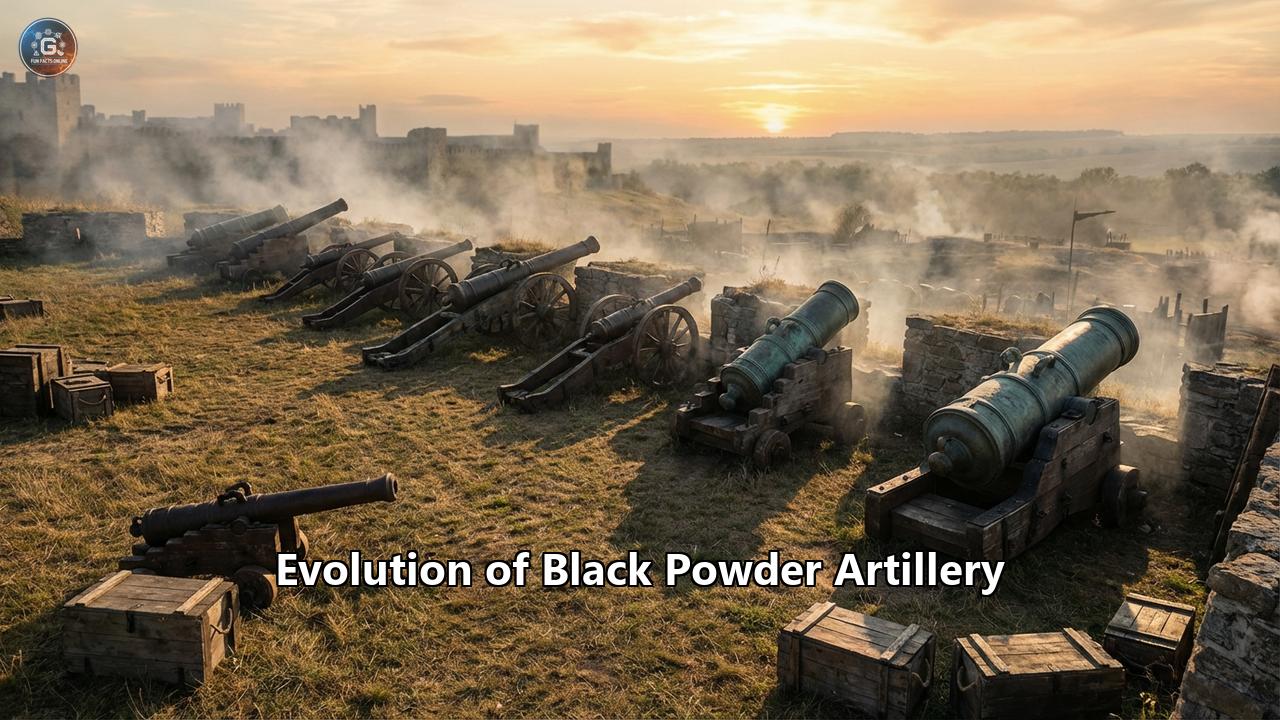
The air on a pre-modern battlefield was not just filled with the screams of men and the clash of steel; it was heavy with a distinct, acrid taste—the taste of sulfur. For nearly six hundred years, the "black art" of gunnery defined the rise and fall of empires. From the crude, vase-like pots of the Middle Ages to the precision-rifled cannons of the American Civil War, black powder artillery was the hammer that forged the modern world. It shattered the impregnable walls of feudalism, dictated the boundaries of nations, and turned the open ocean into a deadly chessboard.
This is the story of the thunder that shook the world—the evolution of black powder artillery.
Chapter 1: The Alchemist’s Accidental Demon
The story of artillery begins not with a weapon, but with a quest for eternal life. In 9th-century China, Taoist alchemists were experimenting with mixtures of sulfur, realgar, and saltpeter, hoping to synthesize an elixir of immortality. Instead, they found a mixture that burned with a furious, expanding energy. They called it huo yao—the "fire drug."
For centuries, this volatile powder was used for pyrotechnics and simple incendiaries attached to arrows. But by the Song Dynasty (960–1279), the Chinese had realized that if you confined the explosion, the energy had nowhere to go but out.
The First CannonsThe earliest ancestors of the cannon were the "fire lances"—bamboo tubes filled with powder and shrapnel attached to spears. But bamboo bursts easily. The leap to true artillery required metal.
The Heilongjiang hand cannon (c. 1288) is one of our earliest surviving examples of this transition. A small bronze tube, barely a foot long, it was a crude device. Yet, the physics were undeniably in place: a chamber for the powder, a touchhole for ignition, and a muzzle to direct the projectile.
When the Mongols swept across Asia, they didn't just conquer; they absorbed technology. They recognized the terrifying potential of the Chinese "eruptors" and carried the secret of black powder westwards. It traveled along the Silk Road, through the Middle East—where it was refined by Arab engineers who developed the madfaa (a wooden bowl-shaped device)—and finally, into the chaotic, warring patchwork of Europe.
Chapter 2: The Pot-de-Fer and the Death of Chivalry
Black powder arrived in Europe in the 13th century, referenced by the philosopher Roger Bacon, who encrypted the formula in an anagram, fearing its destructive power. He was right to be afraid.
By the 1320s, illuminated manuscripts depict the pot-de-fer ("iron pot"). It looked less like a weapon and more like a vase lying on its side. It fired a heavy arrow-like bolt wrapped in leather to create a seal. These early guns were terrifyingly inefficient. They were slow to load, prone to bursting, and inaccurate.
However, at the Battle of Crécy in 1346, the English deployed primitive cannons against the French. They killed few men, but the thunderous roar and the flash of fire terrified the horses and demoralized the French knights. It was a psychological turning point. The knight, safe in his plate armor, suddenly faced a force that could not be blocked by a shield or parried by a sword.
The Construction of the Early BombardsAs the 14th century progressed, the "vase" shape was abandoned for tubes. But casting large metal tubes was beyond European metallurgy at the time. Instead, smiths built cannons the way coopers built wine barrels.
- Staves and Hoops: Long strips of wrought iron (staves) were hammered together around a cylindrical mandrel.
- Reinforcement: Red-hot iron hoops were driven over the staves. As the hoops cooled, they shrank, binding the staves tightly together.
This method created the "bombard." These were siege weapons, pure and simple. They were dragged on sledges, laid on the ground, and aimed by piling dirt under the muzzle. They fired massive stone balls, cut by masons to fit the bore.
Chapter 3: The Walls of Babylon – The Fall of Constantinople
The apex of the bombard era came in 1453, outside the walls of Constantinople. The Theodosian Walls had stood for a thousand years, repelling Goths, Huns, and Crusaders. They were considered indestructible.
Sultan Mehmed II, the Ottoman ruler, hired a Hungarian engineer named Urban (or Orban). Urban claimed he could build a gun that could "blast the walls of Babylon itself."
The Basilica GunUrban’s masterpiece was a monster.
- Length: 27 feet.
- Weight: Nearly 40,000 pounds.
- Projectile: A 1,200-pound marble sphere.
- Transport: It required 60 oxen and 400 men just to move it.
The gun, dubbed the "Basilica," could only fire seven times a day because the barrel got so hot it had to be cooled with olive oil. But when it fired, the ground shook for miles. The stone shot pulverized the ancient masonry of Constantinople. On May 29, 1453, the walls were breached, the city fell, and the Middle Ages effectively ended. The castle was no longer a sanctuary; it was a trap.
Chapter 4: The Renaissance of Gunnery – Bronze, Iron, and Trunnions
Following the fall of Constantinople, a quiet revolution took place in the foundries of Europe. The cumbersome bombards were too slow. Kings wanted guns that could move with their armies.
1. The Shift to Cast BronzeWhile iron was cheaper, early cast iron was brittle and prone to exploding. Bronze (an alloy of copper and tin) was expensive but superior. It was tough, slightly elastic (resisting the explosive shock), and could be cast into complex shapes.
- The Bell-Makers: The same craftsmen who cast church bells began casting cannons. The technology was identical: creating a clay mold and pouring molten metal into the void.
Around 1450, a simple innovation changed everything: trunnions. These were two cylindrical knobs cast on the side of the barrel at its center of gravity.
- Before trunnions, guns were lashed to immobile blocks of wood.
- With trunnions, the barrel could be dropped into a wheeled carriage.
- Elevation: The gun could now pivot up and down easily for aiming.
- Recoil: The recoil was transferred into the carriage and wheels, allowing the gun to roll back and be pushed forward again.
In 1494, King Charles VIII of France invaded Italy. He brought with him the first true "field artillery" train. His bronze guns were mounted on wheeled carriages pulled by horses, not oxen. They could keep pace with the infantry. When he reached Italian fortresses, he didn't besiege them for months; he battered them into submission in hours. The Italians were horrified. The era of mobile warfare had begun.
4. Corned PowderEarly gunpowder (serpentine) was a loose mixture of sulfur, charcoal, and saltpeter. It often separated during transport (the heavy sulfur sank to the bottom), making it unreliable.
In the 15th century, "corning" was invented. The powder was wetted, pressed into cakes, and then crushed into kernels.
- Air Gaps: The kernels allowed flame to travel through the charge instantly, creating a much faster, more powerful explosion.
- Iron Shot: This stronger explosion allowed gunners to switch from stone balls to cast iron shot. Iron was denser, meaning a smaller ball could have the same weight, allowing for smaller, lighter gun barrels with the same hitting power.
Chapter 5: Thunder at Sea – The Naval Revolution
As armies refined artillery on land, navies were solving a harder physics problem: how to fire a cannon from a rolling wooden platform.
In the early 1500s, ships like the Mary Rose (English) and the Great Michael (Scottish) were transition vessels. They carried a mix of old breech-loading anti-personnel guns and the new heavy muzzle-loaders.
The GunportThe breakthrough was the invention of the gunport—a hinged door cut into the hull of the ship. This allowed heavy guns to be mounted on the lower decks, closer to the waterline, lowering the ship's center of gravity.
This seemingly minor carpenter's innovation allowed ships to carry significantly more and heavier guns, leading to the Ship of the Line.
The BroadsideNaval tactics shifted from "grapple and board" to the "line of battle." Ships sailed in a single file, unleashing a "broadside"—a simultaneous volley from all guns on one side.
- The Truck Carriage: Unlike the large-wheeled land carriages, naval guns were mounted on small, four-wheeled wooden trucks. This saved space and allowed the gun to be run out the port, fired, and rolled back in by the recoil for reloading.
Chapter 6: The Lion of the North – 17th Century Reform
By the 1600s, artillery was powerful but chaotic. Armies dragged dozens of different calibers (barrel sizes) into battle, creating a logistical nightmare. If your cannonballs were 4 pounds and your neighbor's were 5, you couldn't share ammunition.
Enter Gustavus Adolphus of Sweden, the "Father of Modern Warfare."
During the Thirty Years' War (1618–1648), Adolphus revolutionized artillery with three concepts: Standardization, Mobility, and Rate of Fire.
- Standardization: He reduced the confused mess of calibers to a few standard sizes (24-pounders for sieges, 12-pounders, and 6-pounders for the field).
- The Leather Cannon: In his quest for lightness, he experimented with a thin copper tube wrapped in layers of rope and boiled leather. It was light enough for two men to carry. It proved too fragile, but it led to the development of the light 3-pounder regiment gun.
- The Regimental Gun: Adolphus attached two light cannons to every infantry regiment. These weren't parked in a distant battery; they advanced with the troops, blasting canister shot (tins filled with musket balls) into enemy pikes.
- The Paper Cartridge: Before Adolphus, gunners used a ladle to scoop loose powder into the barrel—a slow and dangerous process. The Swedes introduced pre-measured powder charges wrapped in paper or cloth. A gunner simply shoved the bag in, followed by the ball. This doubled the rate of fire.
Chapter 7: The Science of Gunnery – The 18th Century
Warfare in the 1700s became a contest of mathematics.
The English mathematician Benjamin Robins published New Principles of Gunnery in 1742. He used a "ballistic pendulum" to measure the velocity of cannonballs. He discovered that air resistance was a massive factor. His work turned gunnery from an art into a science.
The Gribeauval SystemThe greatest leap in the 18th century came from France. Jean-Baptiste de Gribeauval, an artillery officer, rebuilt the French artillery from the ground up in 1765.
- Interchangeable Parts: Gribeauval insisted that the wheel from one cannon should fit any other cannon of the same class. This was the birth of industrial standardization.
- Precision Boring: Instead of casting a barrel around a clay core (which often resulted in off-center bores), the French began casting solid logs of bronze and drilling the bore out with a machine (the Maritz method). This created perfectly straight, centered barrels.
- Windage Reduction: Because the barrels were more precise, the gap between the ball and the barrel (windage) could be tighter. Less gas escaped, meaning the gun used less powder to shoot harder and further.
This was the artillery system that a young Corsican officer named Napoleon Bonaparte would inherit.
Chapter 8: The Emperor’s Daughters – The Napoleonic Era
"God fights on the side with the best artillery," Napoleon famously said. He was an artilleryman by training, and he used cannons not just to support troops, but as the decisive arm of battle.
Grand Battery TacticsPre-Napoleonic generals spread their guns out along the line. Napoleon concentrated them. He formed "Grand Batteries"—massing 50, 100, or more guns in a single sector.
At the Battle of Friedland and Wagram, these massive batteries tore holes in the enemy lines that were miles wide. He treated cannons like a shotgun, blasting the enemy center until it collapsed, then sending in the infantry to occupy the ruin.
Horse ArtilleryFrederick the Great of Prussia had introduced it, but Napoleon perfected it. In Horse Artillery, every gunner rode a horse. The battery could gallop across the battlefield, unlimber (detach the gun), fire a volley, limber up, and gallop away before the enemy could react.
Ammunition of the Era- Round Shot: Solid iron balls. Used against fortifications or to bounce (ricochet) through ranks of infantry. A single bouncing ball could take off the legs of 20 men.
- Shell: Hollow iron spheres filled with gunpowder and fitted with a fuse. They exploded into fragments.
- Canister/Grapeshot: A tin can or canvas bag filled with iron balls. When fired, the can disintegrated, turning the cannon into a giant shotgun. Deadly at close range (under 400 yards).
- Spherical Case (Shrapnel): Invented by Henry Shrapnel in 1784. A hollow shell filled with musket balls and a small bursting charge. It was designed to explode in the air above enemy troops, raining bullets down on them.
Chapter 9: The Industrial Forge – The 19th Century Transition
As the Industrial Revolution took hold, the pace of evolution accelerated. The mid-19th century saw the "Rifled Revolution."
The Problem with SmoothboresFor 500 years, cannons were smooth tubes. The ball rattled down the barrel, bouncing off the sides. This made them inaccurate beyond a mile.
RiflingRifling involves cutting spiral grooves inside the barrel to spin the projectile. A spinning projectile is gyroscopically stable (like a football spiraling).
- The Challenge: How do you load a tight-fitting projectile down the muzzle?
- The Solution (Minié and Expansion): Inventors created projectiles that were smaller than the bore but had a soft metal ring or cup at the base. When the powder exploded, the gas pressure expanded the base, forcing it into the rifling grooves.
This war was the great laboratory of artillery. It saw the clash of the old and the new.
- The Napoleon (M1857): The workhorse of the war. A bronze, smoothbore 12-pounder. It was rugged, reliable, and deadly with canister shot at close range, but lacked long-range accuracy.
- The Parrott Rifle: A cast-iron gun with a thick band of wrought iron shrunk around the breech (the back) to prevent it from exploding. It fired elongated, cylindrical shells with terrifying accuracy over 2 miles.
- The 3-inch Ordnance Rifle: Made of wrought iron, it was light, incredibly strong, and accurate.
Civil War artillery changed the landscape. Rifled guns could smash masonry forts from distances where the defenders couldn't reply (as seen at the Siege of Fort Pulaski). The stone fortress, obsolete since 1453 but revived in the star-fort era, was finally rendered dead. Earthworks and trenches became the only safety.
Chapter 10: The End of the Smoke
By the 1880s, the era of black powder was drawing to a close. Two inventions killed it:
- Breech-Loading: Loading from the rear allowed for a tighter seal and faster rate of fire. The Armstrong gun paved the way.
- Smokeless Powder (Poudre B): Invented in 1884. Old black powder created thick white smoke that obscured the battlefield after a few volleys. It also fouled the barrel with soot. The new nitrocellulose-based powders were three times more powerful and burned clean.
Combined with new high explosives (like Lyddite or TNT) replacing simple gunpowder in the shells, artillery transformed into the modern "Indirect Fire" weapon. Gunners no longer looked over the barrel at their target; they fired at unseen enemies miles away using mathematics and telephone communications.
Anatomy of a Black Powder Shot
To understand the skill of the black powder era, one must visualize the drill. It was a dance of death performed by a crew of 6 to 10 men.
- Sponge: The sponge man dips a sheepskin swab in water and rams it down the barrel. This extinguishes any sparks from the previous shot. (Failure to do this meant the new powder bag would explode in the loader's hands).
- Load: The loader places the powder cartridge and the projectile into the muzzle.
- Ram: The rammer pushes the charge down to the breech. He must stand to the side—if the gun fires prematurely, the ramrod becomes a spear.
- Prick and Prime: The gunner thrusts a metal pick down the touchhole to pierce the powder bag. He inserts a friction primer or pours loose priming powder.
- Aim: The Gunner Corporal adjusts the elevation screw and directs the crew to leverage the trail left or right.
- Fire: The lanyard is pulled. The hammer strikes the primer. Fire shoots down the vent. The main charge ignites.
The gun leaps back six feet (recoil). The crew rushes forward to roll it back into position. The air fills with the rotten-egg smell of sulfur.
Conclusion
The evolution of black powder artillery is the history of technology itself. It moved from the mystical experiments of alchemists to the brute force of iron-hooped bombards, and finally to the precision engineering of the Industrial Revolution.
For five centuries, these sulfur-breathing beasts dictated the fate of nations. They forced kings to centralize power (only a king could afford a siege train), they ended the dominance of the mounted knight, and they drew the borders of the modern world in iron and fire. The black powder era may be over, but its echoes still thunder through history.
Reference:
- https://opentextbooks.clemson.edu/sciencetechnologyandsociety/chapter/gunpowder-in-medieval-china/
- https://en.wikipedia.org/wiki/History_of_cannons
- https://en.wikipedia.org/wiki/Gunpowder_artillery_in_the_Middle_Ages
- https://www.reddit.com/r/AskHistorians/comments/bpdaty/at_what_point_in_european_history_were_black/
- https://en.wikipedia.org/wiki/Basilic_(cannon))
- https://en.wikipedia.org/wiki/Fall_of_Constantinople
- https://www.youtube.com/watch?v=28nJgSyESWs
- https://www.tandfonline.com/doi/abs/10.1080/17416124.2016.1191750
- https://www.youtube.com/watch?v=HkocvqzBPGw
- https://www.battlefields.org/learn/articles/10-facts-civil-war-artillery
- https://en.wikipedia.org/wiki/Gribeauval_system
- https://medium.com/@aliosg458/the-sultans-shadow-urban-and-the-fall-of-constantinople-b8d6d7bdf748
- https://www.gibmuseum.gi/our-history/military-history/development-of-artillery
- https://en.wikipedia.org/wiki/Broadside_(naval))
- https://en.wikipedia.org/wiki/Naval_artillery
- http://passioncompassion1418.com/decouvertes/english_fusees_munitions.html
- https://www.thecollector.com/french-artillery-napoleonic-wars/
- https://www.britannica.com/technology/military-technology/The-gunpowder-revolution-c-1300-1650
- https://en.wikipedia.org/wiki/Gustavus_Adolphus
- https://www.nps.gov/fosc/learn/education/artshot.htm
- https://www.britannica.com/technology/artillery/Ammunition
- https://www.quora.com/How-did-the-introduction-of-rifled-cannons-change-the-use-of-explosive-shells-in-the-American-Civil-War