
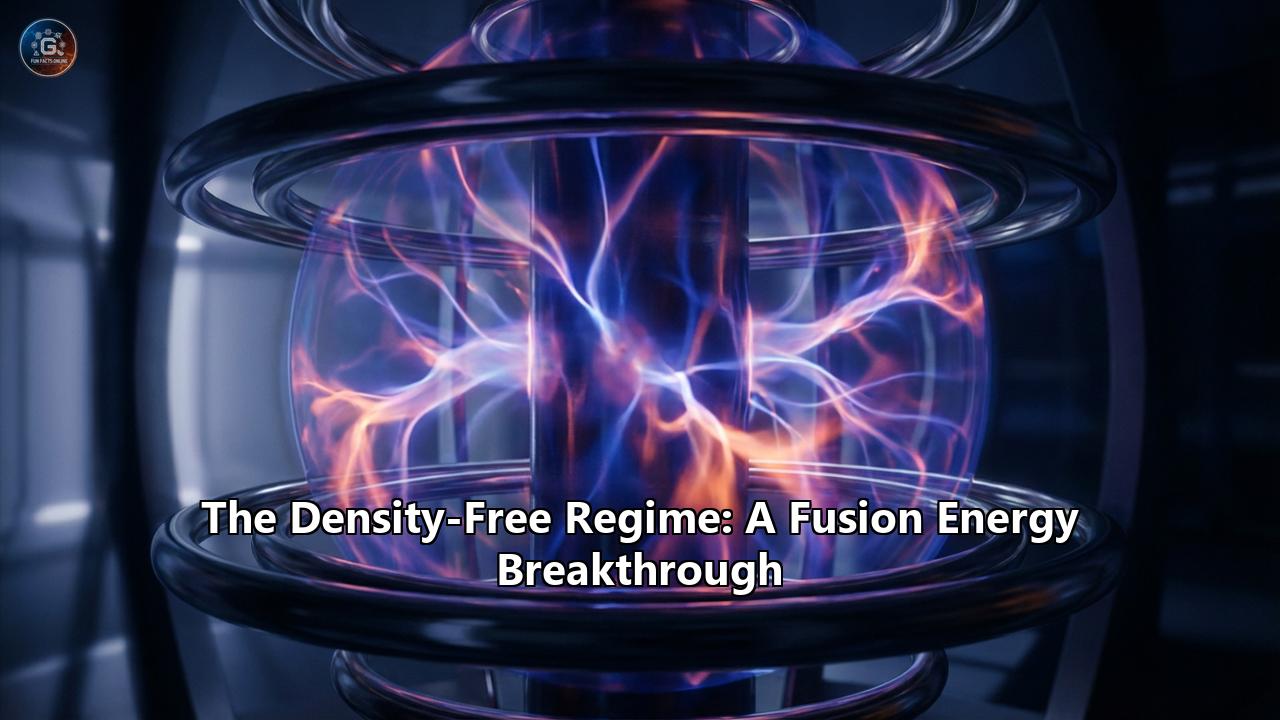
The "iron law" of tokamak fusion has effectively been repealed. For decades, physicists have operated under the strict authoritarian rule of the Greenwald Limit—an empirical ceiling on plasma density that, if crossed, sentenced a fusion reaction to immediate, violent death.
But recent experiments, most notably at China’s EAST (Experimental Advanced Superconducting Tokamak) and the DIII-D National Fusion Facility in the United States, have not just broken this law; they have discovered a completely new mode of existence beyond it. They call it the Density-Free Regime.
In this new domain, the chaotic instabilities that once destroyed plasmas are tamed. They are transformed into beneficial structures—"filaments" or "prominences"—that act as natural exhaust valves, solving one of the most critical engineering nightmares of fusion energy: how to keep the core hot without melting the walls.
This is the story of how fusion science turned its greatest enemy into its most valuable ally.
The Tyranny of the Greenwald Limit
To understand the magnitude of this breakthrough, one must appreciate the constraint that has bound fusion research since 1988. That year, MIT physicist Martin Greenwald observed a frustrating pattern across all tokamak devices: there was a maximum plasma density they could not exceed.
This was a major problem because fusion power is purely a numbers game. The power output of a fusion reactor scales with the square of the plasma density. If you double the density, you get four times the energy. Operating at high density is the difference between a science experiment that consumes power and a commercial power plant that lights up a city.
However, whenever researchers tried to push the density past the Greenwald Limit, the plasma would become turbulent. The magnetic bottle would lose its grip, leading to a "disruption"—a sudden loss of confinement where the plasma creates a flash of light and slams into the reactor walls with the force of a small explosion.
For years, the limit was treated as a hard wall. Reactor designs like ITER (the massive international project in France) were conservatively sized to stay safely below this ceiling, which meant they had to be enormous (and enormously expensive) to generate sufficient power.
Entering the Density-Free Regime
The breakthrough came when researchers began to look at the relationship between the plasma and the reactor wall not as a conflict, but as a partnership. This is the core of the Plasma-Wall Self-Organization (PWSO) theory.
In recent campaigns at EAST and DIII-D, scientists utilized specific startup techniques—using Electron Cyclotron Resonance Heating (ECRH) and precise gas fueling—to gently guide the plasma into a state of equilibrium that the textbooks said shouldn't exist. They pushed the density to 1.5 times the Greenwald Limit and beyond.
Instead of disrupting, the plasma stabilized. It entered the Density-Free Regime.
The secret to this stability lies in how the plasma handles pressure. In a standard "H-mode" (High-Confinement mode) plasma, pressure builds up at the edge of the plasma ring like steam in a pressure cooker. Eventually, the pressure becomes too great for the magnetic field to hold, and it releases in a violent burst known as an Edge Localized Mode (ELM).
ELMs are the bane of fusion engineering. They act like solar flares, blasting the reactor's divertor plates with pulses of heat intense enough to crack tungsten and melt carbon. A commercial reactor simply cannot survive years of constant ELM bombardment.
In the Density-Free Regime, however, the "pressure cooker" lid is removed. The violent ELMs disappear. In their place, something remarkable appears: filaments.
The "Prominence" Solution: A Natural Exhaust Pipe
This is where the ballooning mode instability comes into play.
In traditional plasma physics, the ballooning mode is a villain. It is an instability where the high-pressure plasma bulges out between the magnetic field lines, much like an inner tube bulging out of a weak spot in a tire. If unchecked, this bulge bursts, causing a disruption.
But in the high-density, high-poloidal-beta conditions of the Density-Free Regime, the physics flips. The magnetic shear (the twisting of the magnetic field) is manipulated to suppress the explosive growth of these modes. Instead of bursting, the ballooning modes saturate. They form stable, string-like structures of plasma that peel off from the main core and spiral gently outward.
These structures are the "filaments" or "prominences" you asked about.
Imagine the surface of the sun. You often see loops of plasma, known as solar prominences, arching out from the surface. In the Density-Free Regime, the tokamak plasma creates its own miniature versions of these prominences.
These filaments act as conveyor belts or continuous exhaust valves. They carry excess particles and heat from the hot core to the cool edge, but they do so in a smooth, continuous stream rather than a violent, pulsed explosion.
- Standard Regime (ELMs): Think of a dam that holds back water until it breaks, causing a catastrophic flood (Disruption/ELM).
- Density-Free Regime (Filaments): Think of a dam with thousands of small spillways (Filaments). The water level (pressure) stays high and useful, but the excess flows out smoothly without ever breaking the dam.
This "filamentary transport" is the holy grail of exhaust management. It allows the reactor to run at incredibly high pressure (generating massive power) while simultaneously protecting the reactor walls from heat damage. The filaments spread the heat load out over a larger area and deliver it continuously, rather than in shockwaves.
Why This Changes Everything
The implications of the Density-Free Regime are nothing short of revolutionary for the economics of fusion energy.
1. Smaller, Cheaper Reactors:Because power scales with density squared, a reactor operating in the Density-Free Regime can be much smaller than previously thought while producing the same amount of electricity. We no longer need cathedral-sized tokamaks to achieve ignition. This opens the door for "Compact Tokamaks"—reactors that can be factory-built and shipped to sites, drastically reducing capital costs.
2. Indestructible Walls:The elimination of ELMs solves the materials challenge. By using the filaments to softly exhaust heat, the wear and tear on the reactor's divertor plates are minimized. This means reactors can run for months or years without needing expensive maintenance shutdowns to replace fried components.
3. Higher Efficiency:The "high-confinement" aspect of this regime means the insulation of the plasma remains excellent even at high densities. In the DIII-D experiments, the energy confinement quality was 50% better than the standard high-confinement mode. This means we get more fusion bang for our heating buck.
The Path Forward
The discovery of the Density-Free Regime has sent a ripple of optimism through the global fusion community. It validates the "high-poloidal-beta" approach planned for future pilot plants.
The next steps involve scaling this regime up. The ITER project, currently under construction, will likely look to exploit these findings to run at higher performance levels than originally designed. Furthermore, private fusion companies are now racing to incorporate these "filamentary exhaust" concepts into their designs to speed up the timeline to commercial power.
We have moved from an era of fighting plasma physics to an era of collaborating with it. By allowing the plasma to form its own "prominences" and "filaments," we have found a way to let the star in the jar breathe. And in doing so, we have brought the dream of limitless, clean energy within striking distance.
Reference:
- https://www.researchgate.net/publication/229125829_Improvement_of_divertor_triple_probe_system_and_its_measurements_under_full_graphite_wall_on_EAST
- https://www.researchgate.net/publication/376384403_First_results_of_high_density_H-mode_operation_in_metal-wall_EAST_tokamak
- https://www.researchgate.net/figure/The-approximate-profile-of-the-rotational-transform-i-of-W7-X-solid-blue-line-is_fig1_335150442
- https://www.researchgate.net/figure/A-divertor-module-The-target-plates-are-made-of-ITER-like-monoblock-PFUs-The-dome-and_fig5_356553996
- https://www.researchgate.net/scientific-contributions/Xin-Lin-2142729539
- https://www.researchgate.net/publication/306070821_Upgrade_of_Langmuir_probe_diagnostic_in_ITER-like_tungsten_mono-block_divertor_on_experimental_advanced_superconducting_tokamak
- https://tr-236-3142.teamresa.net/shared/tr_236_3142/medias/Files/Friday_PosterSessionIV_BookAbstracts.pdf
- https://scientific-publications.ukaea.uk/wp-content/uploads/CCFE-PR1766.pdf
- https://www.jspf.or.jp/PFR/PDF2023/pfr2023_18-1401037.pdf
- https://www.researchgate.net/publication/380071181_A_high-density_and_high-confinement_tokamak_plasma_regime_for_fusion_energy