
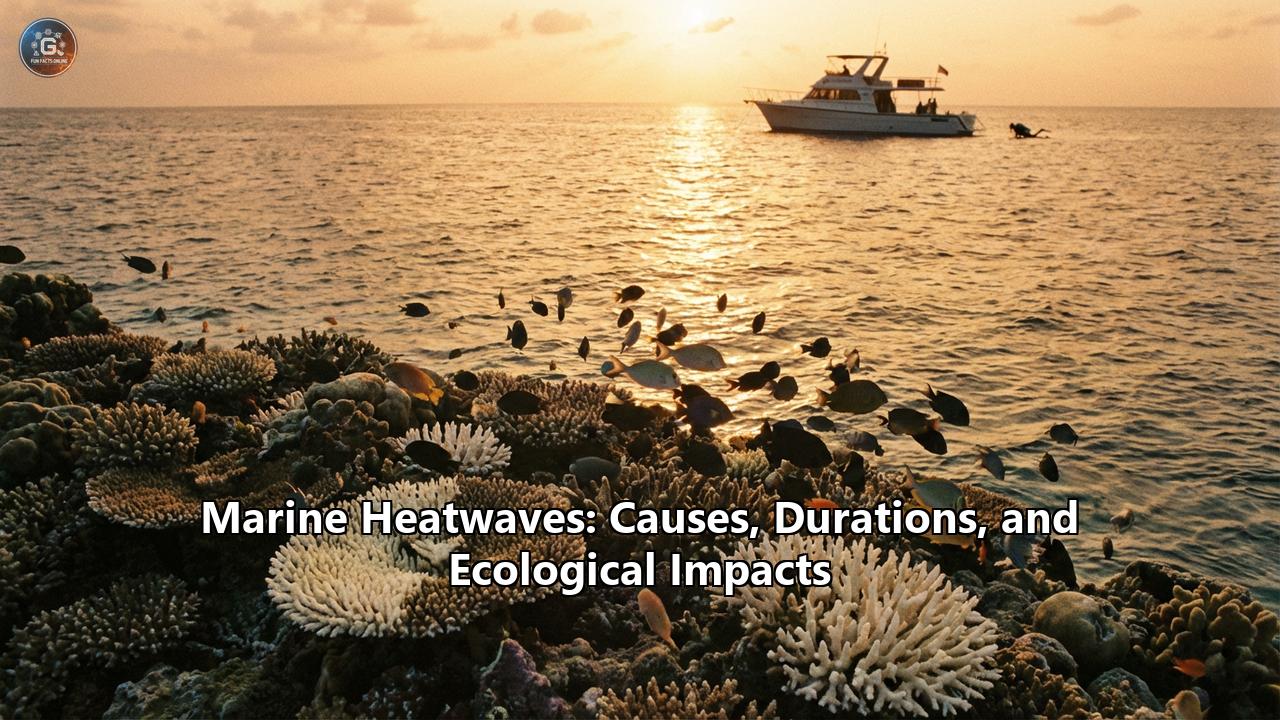
The ocean, once thought to be a buffer against the extremes of climate change, is now experiencing its own version of wildfires: Marine Heatwaves (MHWs). These discrete, prolonged periods of anomalously warm seawater are rewriting the rules of marine ecology, causing mass die-offs, collapsing fisheries, and fundamentally altering the biological fabric of our planet.
This comprehensive article explores the science, history, and future of marine heatwaves, detailing their physical drivers, the devastation they wreak on ecosystems, and the urgent strategies humanity is devising to adapt to a warming ocean.
I. Defining the Invisible Fire: What is a Marine Heatwave?
While atmospheric heatwaves are visceral—felt on our skin and seen in the shimmering pavement—marine heatwaves occur beneath the surface, often invisible to the naked eye until dead fish wash ashore or coral reefs turn ghostly white.
1. The Scientific Definition
In 2016, a landmark paper by Hobday et al. standardized the definition of a marine heatwave to facilitate global comparison. A marine heatwave is defined as a period of at least five consecutive days where ocean temperatures exceed the 90th percentile of the seasonally varying historical baseline (typically a 30-year climatology, e.g., 1983–2012).
This definition is crucial because it accounts for season and location. A heatwave can occur in winter if temperatures are significantly warmer than what is "normal" for that winter. It allows scientists to track these events in the freezing waters of the Arctic just as effectively as in the tropical Pacific.
2. The Categorization Scale
Much like hurricanes are rated from Category 1 to 5, marine heatwaves are classified by their intensity—how far the temperature anomaly exceeds the local threshold.
- Category I (Moderate): Temperatures exceed the threshold by 1–2 times the local difference between the mean and the 90th percentile.
- Category II (Strong): 2–3 times the threshold.
- Category III (Severe): 3–4 times the threshold.
- Category IV (Extreme): More than 4 times the threshold.
This hierarchy helps policymakers and managers understand the potential severity of biological impacts. For instance, the "Blob" in the Northeast Pacific reached Category IV status, signaling catastrophic potential.
3. Key Metrics
To fully understand an MHW, scientists measure:
- Intensity: The maximum temperature anomaly (e.g., +4°C above normal).
- Duration: How many days the event lasts (weeks, months, or even years).
- Spatial Extent: The geographic area covered (often millions of square kilometers).
- Rate of Evolution: How quickly the heat ramps up, which determines if species have time to migrate or acclimatize.
II. Physical Drivers: The Anatomy of an Ocean Heatwave
Marine heatwaves are not random; they are the result of specific physical processes in the atmosphere and ocean. Often, a "perfect storm" of multiple drivers converges to create the most extreme events.
1. Atmospheric Blocking: The Heat Dome
The most common trigger for MHWs, particularly in mid-latitudes, is a persistent high-pressure system in the atmosphere, often called a "blocking high."
- Mechanism: A high-pressure ridge parks itself over a patch of ocean, clearing the skies. This allows intense solar radiation to heat the water surface directly.
- Suppression of Wind: The high pressure suppresses surface winds. Wind is the ocean's primary way of cooling itself (through evaporation and mixing warm surface water with cool deep water). Without wind, heat accumulates in a stagnant, shallow layer at the top.
- The "Ridiculously Resilient Ridge": This was the primary driver of "The Blob" (2013–2016). A massive ridge of high pressure over the Northeast Pacific deflected the jet stream, shielding the ocean from storms that would normally cool it down.
2. Ocean Currents: Advection of Heat
Ocean currents act as conveyor belts, moving massive amounts of heat around the planet.
- Western Boundary Currents: Currents like the Gulf Stream (Atlantic) and the Kuroshio (Pacific) carry warm tropical water toward the poles. If these currents meander or intensify, they can flood a temperate region with unexpectedly warm water, triggering an MHW.
- The Ningaloo Niño: Off Western Australia, the Leeuwin Current flows southward. In 2011, a massive surge of this current, driven by La Niña winds, transported record-breaking warm water south, causing a Category IV heatwave that destroyed kelp forests along hundreds of kilometers of coastline.
3. Teleconnections: The Global Web
Climate patterns in one part of the world can trigger heatwaves thousands of miles away.
- El Niño-Southern Oscillation (ENSO): During an El Niño phase, the trade winds weaken, allowing a massive pool of warm water to spread across the eastern and central Pacific. This is the "engine room" for global marine heatwaves, often triggering synchronous events worldwide.
- North Atlantic Oscillation (NAO): Phases of the NAO influence wind strength and heat exchange in the Atlantic, modulating the likelihood of heatwaves in the Mediterranean and Northwest Atlantic.
4. Climate Change: The "Base Load"
Anthropogenic global warming acts as a "threat multiplier." As the baseline ocean temperature rises due to greenhouse gas emissions, it becomes much easier for natural variability (like a high-pressure system) to push temperatures past the extreme heatwave threshold. A weather event that might have been a mild warm spell 50 years ago now manifests as a severe marine heatwave because the starting point is already elevated.
III. Case Studies: Historic Inferno Events
To understand the scale of the threat, we must look at the major events that have defined this field of study.
1. The Mediterranean Burn (2003 & 2015-2019)
The Mediterranean Sea is a climate change hotspot, warming 20% faster than the global average.
- 2003 Event: Coinciding with the deadly European terrestrial heatwave, the Mediterranean Sea surface temperatures soared 3°C above average. This led to the first massive observation of rocky reef mortality.
- Recurrent MMEs (2015–2019): A study led by the Institut de Ciències del Mar found that between 2015 and 2019, the Mediterranean experienced five consecutive years of widespread mass mortality events (MMEs). These events affected 50 distinct taxa (groups of species) across thousands of kilometers of coastline, penetrating depths of up to 45 meters. Iconic species like the red gorgonian (Paramuricea clavata) suffered tissue necrosis and death, stripping the seascape of its complexity.
2. Western Australia (2011)
In the summer of 2011, sea surface temperatures off Western Australia rose to unprecedented levels, reaching >5°C above average in some areas.
- The Driver: A "Ningaloo Niño" caused by an unseasonably strong surge of the Leeuwin Current.
- The Impact: This event is infamous for causing a "regime shift." 100 kilometers of temperate kelp forests collapsed and were replaced by tropical turf algae. Tropical fish species moved in, preventing the kelp from recovering by grazing on new recruits. More than a decade later, the kelp forests have not returned; the ecosystem has fundamentally changed from a temperate reef to a tropicalized system.
3. "The Blob" (Northeast Pacific, 2013–2016)
The largest and longest-lasting marine heatwave on record.
- Evolution: It began in the Gulf of Alaska in late 2013 due to the "Ridiculously Resilient Ridge" and later merged with warm waters from the 2015/2016 El Niño, stretching from Mexico to Alaska.
- Biological Catastrophe:
Seabirds: Hundreds of thousands of Common Murres starved to death because their prey (forage fish) moved to deeper, cooler waters or died.
Whales: Record numbers of humpback whales became entangled in fishing gear. The heatwave pushed krill closer to shore, bringing whales into direct conflict with crab fisheries.
Toxic Algae: The heat triggered a massive bloom of Pseudo-nitzschia, producing domoic acid (a neurotoxin). This shut down the Dungeness crab fishery, causing millions of dollars in losses.
4. The Great Barrier Reef (2016, 2017, 2020, 2022, 2024)
The world's largest living structure has become the poster child for marine heatwaves.
- Sequential Bleaching: Historically, bleaching events were rare (decades apart), allowing reefs time to recover (which takes 10–15 years). However, the GBR suffered back-to-back bleaching in 2016 and 2017.
- 2024 Event: In early 2024, aerial surveys confirmed yet another mass bleaching event, with heat stress reaching record levels in the southern section of the reef. The frequency of these waves means that many corals are killed before they reach sexual maturity, limiting the reef's ability to self-seed and recover.
IV. Ecological Impacts: A Cascading Collapse
Heatwaves do not just make water warm; they disrupt the physiology, behavior, and survival of marine life, leading to cascading effects throughout the food web.
1. Foundation Species Collapse
The most severe impact is the loss of "habitat-forming" species—the trees of the ocean.
- Coral Reefs: Corals are symbiotic animals. When water is too warm, they expel the colorful algae (zooxanthellae) living in their tissues, turning white (bleaching). If the heat persists, the coral starves and dies. The skeleton is then overgrown by algae, and the complex 3D structure collapses, leaving fish homeless.
- Kelp Forests: Kelp are cool-water species. Extreme heat damages their cellular structure, causing fronds to disintegrate. The 2011 Western Australia event showed that once kelp is lost, "tropicalization" (herbivorous tropical fish moving in) can prevent it from ever growing back, locking the ecosystem into a low-biodiversity turf algae state.
- Seagrass Meadows: Seagrasses store vast amounts of carbon (Blue Carbon). Heatwaves can cause massive die-offs, releasing this stored carbon back into the atmosphere and removing a critical nursery ground for juvenile fish. In Shark Bay, Australia, a 2011 heatwave wiped out 36% of the seagrass, which subsequently caused a crash in the populations of dugongs, sea turtles, and commercial scallops.
2. Mass Mortality Events (MMEs)
Sudden spikes in temperature can exceed the thermal tolerance of stationary animals.
- Benthic Invertebrates: In the Mediterranean, sponges, bryozoans, and gorgonians effectively melted. Their tissues became necrotic, sloughing off and leaving bare skeletons. Because these animals grow slowly (some are decades old), recovery is measured in human generations.
- Fish Kills: While fish can swim, they are often trapped by geography or the speed of the event. In 2025, massive fish kills were reported in Western Australia, with thousands of fish washing up due to thermal stress and associated oxygen depletion (warm water holds less oxygen).
3. Species Range Shifts and "Tropicalization"
Mobile species flee the heat, generally moving poleward or deeper.
- Displaced Resources: As waters warm, commercially valuable species like cod, lobster, and tuna move away from their traditional grounds. This forces fishers to travel further, increasing costs and safety risks.
- Invasive Species: "Tropicalization" occurs when warm-water species invade temperate zones. In Japan, rabbitfish (a warm-water herbivore) have expanded northward, decimating seaweed beds that were traditionally harvested for food and habitat.
- The Arctic Borealization: In the Arctic, "Atlantification" is occurring. Atlantic species like cod and haddock are moving into the Barents Sea, outcompeting true Arctic species like the Polar Cod, which relies on sea ice.
4. Disrupted Food Webs
Heatwaves desynchronize the delicate timing of nature.
- Plankton Mismatch: Zooplankton (tiny animals) bloom in response to temperature. If they bloom too early due to a heatwave, the juvenile fish that rely on them for food may hatch too late, finding an empty pantry. This "trophic mismatch" can cause the collapse of an entire generation of fish.
- Starvation Events: The 2013–2016 Pacific "Blob" reduced the nutritional quality of zooplankton. This cascaded up to forage fish, and eventually to seabirds and marine mammals. Thousands of sea lion pups stranded on California beaches, emaciated because their mothers could not find enough fatty prey to produce milk.
V. Socio-Economic Impacts: The Cost of Boiling Seas
The ocean is an economic engine. When it overheats, the financial gears grind to a halt.
1. Fisheries and Aquaculture
- Dungeness Crab Disaster: During "The Blob," the toxic algal bloom forced managers to close the Dungeness crab fishery on the US West Coast. Losses were estimated at over $185 million.
- Snow Crab Collapse: In the Bering Sea, the snow crab population collapsed by billions of individuals following heatwaves that increased their metabolic rate, causing them to starve to death. In 2022, the fishery was closed for the first time in history, devastating Alaskan communities.
- Aquaculture Losses: Farmed fish cannot swim away. In 2016, a heatwave in Chile triggered an algal bloom that killed 27 million tonnes of farmed salmon, resulting in an economic loss of $800 million and social unrest in coastal communities.
- Pearl and Abalone: In Australia, heatwaves have caused abalone to detach from rocks and die. The Tasmanian abalone fishery and the famous pearl industry have both suffered multi-million dollar hits from thermal stress and associated diseases.
2. Tourism and Recreation
- Great Barrier Reef: Valued at over $6.4 billion AUD annually, the reef supports 64,000 jobs. Recurrent bleaching generates negative global headlines, reducing tourist numbers and threatening the livelihood of tour operators.
- Recreational Fishing: In Western Australia, the closure of fisheries due to stock collapse affects bait shops, boat mechanics, and local hospitality sectors that rely on visiting anglers.
3. Cultural Impacts
For Indigenous communities, the ocean is not just a resource but a relative.
- Loss of Totem Species: The decline of culturally significant species, such as sea turtles or specific salmon runs, represents a loss of heritage and spiritual connection.
- Food Security: Many coastal communities rely on subsistence fishing. Heatwaves that render shellfish toxic or drive fish away directly threaten the food security of vulnerable populations.
VI. Future Projections: A Permanent Heatwave State?
Climate models (specifically CMIP6) paint a sobering picture of the future.
1. Frequency and Intensity
According to the IPCC, marine heatwaves have already doubled in frequency since 1982. By 2100:
- Frequency: MHWs are projected to occur 50 times more often under high-emission scenarios.
- Intensity: They will become 10 times more intense.
- Duration: Events that currently last weeks could last for months or years.
2. The "Permanent Heatwave" State
Perhaps the most alarming projection is the shift in baselines. By the mid-to-late 21st century, many parts of the ocean (particularly the Indo-Pacific and Caribbean) will reach a state where the average* temperature is higher than the extreme heatwave threshold of the past.
- Implication: We will enter a "permanent heatwave state." What we consider an extreme event today will be the "cool" normal of tomorrow. This suggests that ecosystems as we know them will not be able to persist; we are looking at a future of novel, heat-adapted ecosystems.
3. The Arctic Amplification
The Arctic is warming 3-4 times faster than the rest of the planet.
- Sea Ice Feedback: As sea ice melts, it exposes dark water, which absorbs more sunlight, creating a feedback loop that intensifies heatwaves.
- Bottom Water Impacts: In the Arctic, heatwaves are not just at the surface. Warm water is now penetrating to the bottom, threatening benthic communities (clams, crabs) that have evolved in near-freezing stability for millennia.
VII. Adaptation and Mitigation: Fighting for the Future
Facing this existential threat, scientists, managers, and communities are moving from observation to action. Adaptation strategies are being developed to help marine life—and the people who depend on it—survive the heat.
1. Dynamic Ocean Management
Traditional fishery management uses static zones (e.g., "Fishing Zone A"). In a changing climate, we need Dynamic Ocean Management (DOM).
- Real-Time Data: Using satellite data to track heatwaves and species movement in real-time.
- Forecasting: Australia has deployed the ACCESS-S2 model, which provides seasonal forecasts of marine heatwaves. This allows fishery managers to warn abalone divers to harvest early before the heat hits, or to close areas to reduce stress on spawning stocks.
- Case Study: In California, the EcoCast tool predicts where target fish (swordfish) and protected species (sea turtles) are likely to be based on ocean conditions. This allows fishers to catch swordfish while avoiding bycatch, adjusting their location as the water warms.
2. "Reefs of Hope" and Assisted Evolution
If corals cannot adapt fast enough on their own, science is stepping in.
- Super Corals: In the Gulf of Aqaba (Red Sea), scientists have discovered corals that are naturally resilient to extreme heat. These corals are being studied to understand their genetic secrets.
- Assisted Gene Flow: Scientists are cross-breeding heat-tolerant corals with sensitive ones and planting the offspring on damaged reefs.
- Probiotics: Just as humans take probiotics for health, researchers are experimenting with giving corals "beneficial bacteria" cocktails that help them withstand thermal stress.
- Fiji's Strategy: The "Reefs of Hope" initiative focuses on identifying "hot pockets" where corals have survived past heatwaves. These survivors are propagated in nurseries and used to reseed other reefs, effectively spreading heat-resistant genes.
3. Nature-based Solutions (NbS) & Climate Refugia
- Marine Protected Areas (MPAs) as Refugia: Scientists are mapping areas of the ocean that are naturally cooler due to upwelling or currents (climate refugia). Protecting these areas from fishing and pollution gives species a "safe house" where they can survive and repopulate surrounding areas after a heatwave passes.
- Restoration with Resilience: When restoring kelp forests or mangroves, restoration practitioners are no longer just using local stock. They are increasingly using "future-proofed" stock—seeds or genetic strains sourced from warmer locations that are pre-adapted to the temperatures expected in 2050.
4. Fisheries Adaptation
- Diversification: Fishermen are being encouraged to hold "portfolios" of permits. Instead of relying solely on lobster, a fisher might also have permits for squid or black sea bass (warm-water species). This diversification acts as insurance; if a heatwave crashes the lobster stock, the squid fishery might boom.
- Exempted Fishing Permits (EFPs): Managers are issuing special permits that allow fishers to test new gear or target new species (like invasive rabbitfish) that are appearing due to warming waters.
VIII. Conclusion: The Urgency of Now
Marine heatwaves are no longer a theoretical risk; they are a dominant force shaping the modern ocean. From the bleaching reefs of Australia to the starving seabirds of the Pacific and the collapsing kelp forests of Europe, the signal is clear.
The physics are simple: as long as we pump greenhouse gases into the atmosphere, the ocean will continue to accumulate heat, and these invisible fires will burn hotter, longer, and deeper.
However, the future is not yet written. While mitigation (reducing emissions) is the only way to stop the warming at its source, adaptation offers a lifeline. Through dynamic management, cutting-edge genetic science, and the protection of climate refugia, we can help the ocean steer through the bottleneck of the coming decades. The resilience of the ocean is immense, but it is not infinite. It requires our urgent help.
The era of the stable ocean is over. We are now the stewards of a fevered planet, and our actions today will determine what life remains in the seas of tomorrow.
Reference:
- https://www.frontiersin.org/journals/environmental-science/articles/10.3389/fenvs.2025.1473890/full
- https://www.hi.no/en/hi/news/2021/november/ocean-economy-suffers-as-marine-heatwaves-are-ramping-up
- https://www.globalseafood.org/advocate/study-fisheries-managers-should-expect-volatility-due-to-marine-heatwaves/
- https://www.unep.org/unepmap/resources/factsheets/biological-diversity
- http://passage.phys.ocean.dal.ca/~olivere/docs/Richaud_2024_JGR_DriversMHWsArctic.pdf
- https://www.medecc.org/marine-heatwaves-drive-recurrent-mass-mortalities-in-the-mediterranean-sea/
- https://pubmed.ncbi.nlm.nih.gov/35848527/
- https://www.unsw.edu.au/newsroom/news/2021/10/marine-heatwaves-don-t-just-endanger-ecosystems---they-have-sign
- https://iucn.org/resources/issues-brief/marine-heatwaves
- https://www.marineconservation.org.au/actions/marine-heatwave-solutions/
- https://s3.ap-southeast-1.amazonaws.com/ap-st01.ext.exlibrisgroup.com/61SCU_INST/upload/1769221862635/1-s2.0-S0964569124005118-main.pdf?response-content-disposition=attachment%3B%20filename%3D%221-s2.0-S0964569124005118-main.pdf%22%3B%20filename%2A%3DUTF-8%27%271-s2.0-S0964569124005118-main.pdf&response-content-type=application%2Fpdf&X-Amz-Algorithm=AWS4-HMAC-SHA256&X-Amz-Date=20260124T023102Z&X-Amz-SignedHeaders=host&X-Amz-Credential=AKIAJN6NPMNGJALPPWAQ%2F20260124%2Fap-southeast-1%2Fs3%2Faws4_request&X-Amz-Expires=119&X-Amz-Signature=565b317cd418673179f4d28413b5efa3b34968071b6fcbdda2f9e6ed70a49a29
- https://www.sciencealert.com/the-ocean-is-still-reeling-from-a-single-massive-heat-wave-decades-ago
- https://www.mdpi.com/journal/sustainability/special_issues/N11KWFJS1Q
- https://research.csiro.au/cor/research-domains/climate-impacts-adaptation/marine-heatwaves/dynamical-forecasting-of-marine-heatwaves/
- https://www.greencitytimes.com/nature-based-solutions-for-climate-change/