
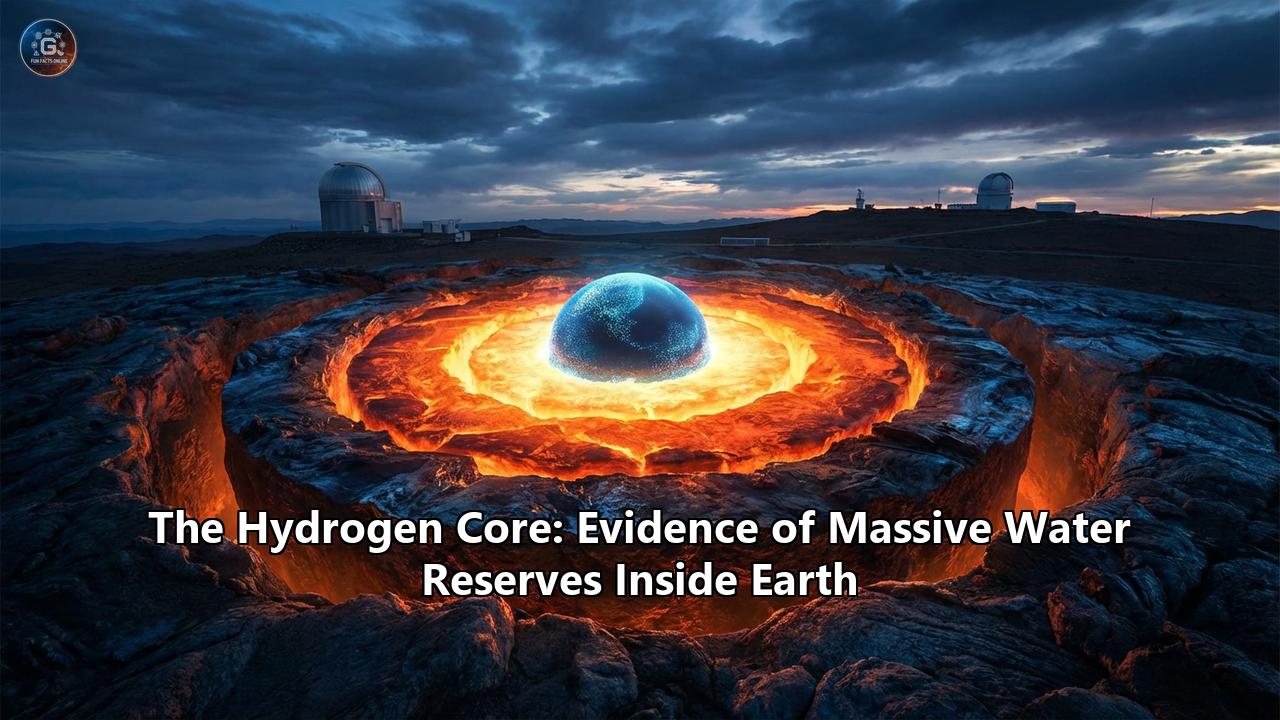
If you were to slice the Earth in half like a peach, the school textbooks of the last century would tell you exactly what to expect: a thin, rocky crust; a thick, flowing mantle of silicate rock; a liquid outer core of molten iron and nickel; and a solid inner core of crystalized metal. For decades, we were taught that the deeper you go, the drier it gets. We were told that the volatile compounds—water, gases, the delicate chemistry of life—were merely a surface veneer, a lucky "blue paint" on a dry, dead rock, delivered by icy comets long after the planet cooled.
That story is no longer true.
Over the last decade, and culminating in explosive research published this very week in February 2026, geophysics has undergone a silent revolution. We have found the missing oceans. They are not hidden in lost caverns or hollow Earth theories, but locked within the atomic lattices of crystals and dissolved into the hellish metal of the planetary heart.
We now know that the Earth is not just blue on the outside. It is soaked to the core. From the hydrated "wet zone" of the mantle to the newly confirmed "Hydrogen Core," we are standing atop a reservoir that dwarfs the Pacific, the Atlantic, and the Indian Oceans combined. The latest estimates suggest that the Earth’s core alone may hold the hydrogen equivalent of 45 global oceans.
This is the story of how we found the water inside the stone, the leak that trickles into the center of the world, and the hydrogen battery that has kept our planet alive for 4.5 billion years.
PART I: THE DIAMOND KEY
The Paradox of the Blue Marble
To understand the magnitude of the Hydrogen Core discovery, we must first understand the mystery that plagued geologists for a century: The Density Deficit.
When seismologists first began mapping the Earth's interior using the shockwaves of earthquakes, they encountered a math problem. They knew the mass of the Earth (calculated from its gravitational pull) and they knew the volume. By analyzing how fast seismic waves traveled through the core, they could determine that the core was made mostly of iron and nickel. But there was a discrepancy. The core was too light.
Pure iron-nickel at core pressures (360 gigapascals) should be denser than what we observe. The core was "missing" about 10% of its expected mass. Something else was down there—some "light element" that was diluting the iron, making the alloy frothy and buoyant. Candidates included silicon, sulfur, oxygen, and carbon. Hydrogen, the lightest element in the universe, was considered a long shot. Hydrogen is volatile; surely it would have boiled away during the violent, molten birth of the planet.
For years, the "Dry Earth" hypothesis reigned. It assumed Earth formed hot and dry, and water arrived later via a "Late Heavy Bombardment" of icy comets. But this theory had holes. The isotopic signature of Earth’s water (the ratio of heavy hydrogen, deuterium, to normal hydrogen) didn’t match the comets we measured. It matched the asteroids and the dust of the early solar system. This hinted that water wasn't an alien visitor—it was indigenous. It was baked in.
But where was it hiding?
The Message in the Bottle
The first crack in the "Dry Earth" dam didn't come from a computer model, but from a piece of trash.
In the diamond trade, "inclusions" are flaws. They are bits of foreign minerals trapped inside the diamond as it forms, dirtying the gem and lowering its value. For geochemists, however, diamonds are the only time capsules we have from the deep Earth. While the deepest hole humanity has ever drilled is a paltry 12 kilometers (the Kola Superdeep Borehole), diamonds form at depths of 150 kilometers or more, then ride volcanic "kimberlite pipes" to the surface at supersonic speeds, preserving the high-pressure minerals inside them.
In 2014, a team led by Graham Pearson from the University of Alberta was analyzing a "trash" diamond from the Juína river gravels in Mato Grosso, Brazil. It was a battered, brown, worthless stone. But inside, they found a microscopic speck of a mineral that had never been seen before in nature: Ringwoodite.
Ringwoodite is the high-pressure alter-ego of olivine, the green mineral that makes up most of the Earth's upper mantle. We had synthesized ringwoodite in labs by crushing olivine between diamond anvils, and we had seen it in shock-veins of meteorites that had crashed into other planets. But we had never seen a terrestrial sample.
The reason was simple: Ringwoodite only exists between 410 and 660 kilometers deep, in the "Mantle Transition Zone." If you bring it up slowly, the pressure drop causes it to revert back to olivine. It crumbles. But encased in the diamond's adamantine pressure vessel, this speck survived the ascent.
When Pearson’s team fired infrared light at the speck, they saw something impossible. The crystal structure wasn’t dry. It was filled with hydroxide ions (OH-). The ringwoodite was 1.5% water by weight.
One and a half percent sounds small. But the Transition Zone is 250 kilometers thick and wraps around the entire planet. If the Juína diamond was representative of the whole layer, that 1.5% translated to a volume of water equal to three times the surface oceans.
The headlines in 2014 were ecstatic: "Massive Ocean Discovered Beneath Earth's Crust." But this was not an ocean of liquid water with fish and waves. It was water trapped in the rock, like water in a damp sponge or a concrete wall. It was a "hydrous mineral reservoir."
This discovery solved one problem—where the Earth keeps its water budget—but it opened a much larger door. If water could survive in the mantle, could it go deeper? Could the "sponge" leak?
PART II: THE LEAK
The 2,900-Kilometer Drip
For a decade after the Ringwoodite discovery, the scientific consensus settled on a "wet mantle" but a dry core. The Core-Mantle Boundary (CMB), located 2,900 kilometers down, was viewed as a hard "iron wall." Rock above, metal below, and never the twain shall meet. The mantle is silicate (rock); the core is metallic (iron). They don't mix.
Or so we thought.
In late 2023, a collaboration between Arizona State University and Yonsei University shattered the "iron wall" concept. They were investigating a mysterious layer that seismologists had detected for decades. Sitting just above the liquid outer core is a thin, patchy skin called the E-prime layer (E'). In this layer, seismic waves slow down, and density drops.
The researchers, led by Dan Shim, ran high-pressure experiments to simulate the conditions at the boundary. They took iron (representing the core) and water (carried down by subducting tectonic plates) and squeezed them to 135 gigapascals while heating them to thousands of degrees with lasers.
What they saw was a chemical massacre.
At the boundary where the wet rock meets the molten iron, the water molecule breaks apart. The hydrogen, being small and iron-loving (siderophile), abandons the oxygen and dives into the iron core. It dissolves into the metal, turning the outer core into a hydrogen-rich alloy.
But what happens to the oxygen? The oxygen stays behind and reacts with the silicon in the core (which is also present in small amounts). This reaction creates crystals of silica (SiO2)—essentially, sand crystals. Because these silica crystals are lighter than the liquid metal, they float upwards, snowing up into the mantle.
This was the mechanism of the leak.
- Subduction: Tectonic plates drag wet ocean crust down.
- Descent: The slabs sink through the mantle, carrying water past the Ringwoodite zone, all the way to the bottom.
- Reaction: At the core boundary, water attacks the iron.
- Separation: Hydrogen is sucked into the core; silica crystals are spit back out into the mantle.
The E-prime layer wasn't just a "skin." It was a crystal factory and a hydrogen pump. The Earth was stripping the hydrogen from water and hoarding it in its heart, slowly growing a hydrogen-rich layer on the surface of the core.
This proved that the core was taking in hydrogen now. But it didn't explain the massive density deficit of the entire core. The "leak" was a slow trickle. To explain the missing 10% of the core's mass, we needed something bigger. We needed a deluge.
PART III: THE HYDROGEN HEART
The 2026 Breakthrough
This brings us to the present day, February 2026, and the groundbreaking study published in Nature Communications by Dongyang Huang and Motohiko Murakami.
While the 2023 studies focused on the surface of the core, Huang and Murakami went for the center. They sought to answer the question: Did Earth form wet from the very beginning?
The team utilized a new generation of "Diamond Anvil Cells"—devices capable of creating pressures not just of the mantle, but of the deep core. They placed iron samples inside these cells, surrounded them with hydrogen, and used lasers to replicate the "Magma Ocean" phase of the early Earth.
4.5 billion years ago, Earth was a ball of molten rock. There was no solid crust, no separation of core and mantle. It was a chaotic soup. As the planet cooled, the heavy iron droplets sank to the center to form the core, raining down through the silicate magma.
The researchers wanted to know: As these iron raindrops fell through the magma, how much hydrogen did they drag down with them?
The results were staggering. The partition coefficient—the preference of hydrogen to bond with iron versus rock—was much higher than previously predicted. Under the extreme pressures of the proto-Earth, iron acted like a hydrogen magnet.
The study concludes that as the core formed, it sequestered a colossal amount of hydrogen. The iron didn't just "leak" hydrogen later; it was born saturated with it.
45 Oceans
The numbers are difficult to comprehend. The study estimates that the Earth’s core contains between 0.36% and 0.7% hydrogen by weight.
In terms of planetary mass, that sounds negligible. But the core is huge. When you convert that percentage into water equivalents (since that hydrogen came from primordial water), the total volume is between 30 and 45 times the total volume of Earth’s modern oceans.
Let’s visualize that.
- Surface Water: 1.3 billion cubic kilometers (The familiar blue oceans).
- Mantle Water (Ringwoodite): ~3 to 5 billion cubic kilometers.
- Core Hydrogen: ~50 to 60 billion cubic kilometers of water equivalent.
We are not living on a rock with a bit of water. We are living on a drop of rock suspended in a ball of water-infused metal. The "dry" Earth is a myth. The planet is, by composition, a "water world" that happens to have a hard shell.
PART IV: THE IMPLICATIONS
The Hydrogen Battery
Why does this matter? Why should the average person care if there is hydrogen in the center of the Earth?
Because the Hydrogen Core is the engine of our existence.
1. The Magnetic ShieldEarth’s magnetic field shields us from the solar wind. Without it, our atmosphere would be stripped away, and we would look like Mars. The magnetic field is generated by the "geodynamo"—the churning of the liquid outer core.
For the dynamo to work, the core needs to stay hot and fluid, and it needs "convection currents." The presence of light elements like hydrogen is crucial for this. As the inner core freezes, it expels these light elements into the outer core. The lighter fluid rises, the heavier fluid sinks, and this motion generates the magnetic field.
The massive reservoir of hydrogen acts as a chemical battery, powering the dynamo for billions of years longer than a pure iron core could. If the core were dry, Earth might have lost its magnetic field—and its life—billions of years ago.
2. The Great Heat EngineHydrogen affects the melting temperature of iron. A hydrogen-rich core melts at a lower temperature than a pure one. This changes our understanding of the Earth's thermal history. It means the core stays liquid longer, keeping the mantle heated from below. This heat drives plate tectonics, which recycles carbon and stabilizes our climate. The "heartbeat" of the continents is driven by the hydrogen in the core.
3. The Origin of WaterThe 2026 study effectively kills the "Comet Delivery" theory as the primary source of Earth's water. If the core holds 45 oceans' worth of hydrogen, and the mantle holds another 3, it is mathematically impossible for comets to have delivered all of that.
Earth's water is indigenous. We formed from "wet pebbles" in the solar nebula. The water was here from day one. The oceans we see today are just the "sweat" of the planet—the tiny fraction of water that outgassed to the surface, while the vast majority sank to the center.
PART V: THE DEEP WATER CYCLE
The Vertical River
We are all taught the water cycle in elementary school: Evaporation, Condensation, Precipitation. Ocean to Cloud to River to Ocean.
We now must add a new, slower, darker cycle: The Deep Water Cycle.
It operates on a timescale of millions of years.
- Ingassing: Water-laden sediments on the ocean floor are subducted into the mantle.
- Storage: The water is trapped in the "transition zone" (Ringwoodite sponge) for millions of years.
- The Great Leak: Some water sinks further, reaching the core-mantle boundary. The hydrogen is stripped and stored in the core; the oxygen is ejected as silica.
- Upwelling: The silica crystals and heated mantle plumes rise back up.
- Outgassing: Volcanoes spew steam and gas back into the atmosphere, returning the water (or its components) to the surface.
This cycle suggests that the volume of our oceans is not constant. It is a dynamic equilibrium. In deep geological time, the sea level is determined not just by melting ice caps, but by the hunger of the core. There may have been times in Earth's past when the surface was drier because the interior was "drinking" the oceans, or times when the interior "burped" them back out, creating floodworlds.
PART VI: BEYOND EARTH
The Exoplanet Hope
The discovery of the Hydrogen Core has profound implications for the search for alien life.
When we look at exoplanets (planets orbiting other stars), we often categorize them as "Rocky" or "Gas Giants." We look for "Goldilocks" planets that are at the right distance for liquid water on the surface.
But if Earth can hide 45 oceans inside its metal heart, then "dry" looking planets might be wet on the inside. A planet that looks like a desert on the surface might have a massive hydrogen reservoir in its core, driving a magnetic field and tectonic activity that could, eventually, support life.
It suggests that "Water Worlds" are the norm in the universe, not the exception. The water just might be underground.
PART VII: THE NEW GEOLOGY
We are entering a new era of geology. The static, layered Earth model is dead. The new model is dynamic, permeable, and wet.
The boundary between the core and the mantle is not a wall; it is a membrane. The interaction between the rock and the metal is chemically violent and vital.
As you walk outside today and feel the rain, or look at the ocean, remember that you are seeing only the tiniest fraction of Earth's water. The true ocean is beneath you.
- 400 km down: The Ringwoodite Ocean, a green crystal sponge holding three times the volume of the Atlantic.
- 2,900 km down: The E-Prime Factory, ripping water apart to feed the core.
- 5,000 km down: The Hydrogen Core, a metallic sea of iron and hydrogen, holding the ghost of 45 ancient oceans, swirling and churning to generate the magnetic shield that keeps us safe from the stars.
The Earth is not a rock with a splash of water. It is a water world, shielded in iron, disguised as stone.
Key Terms & Definitions
- Ringwoodite: A high-pressure mineral form of olivine (magnesium silicate) found in the mantle transition zone (410-660km deep). It has a crystal structure that can trap up to 1.5-2% water by weight as hydroxide ions.
- Core-Mantle Boundary (CMB): The discontinuity roughly 2,900 km below the surface where the solid silicate mantle meets the liquid iron-nickel outer core.
- E-Prime Layer: A newly defined, hydrogen-rich, silica-depleted layer at the very top of the outer core, formed by the chemical reaction of subducted water with the core's iron.
- Diamond Anvil Cell: A laboratory device used to compress small samples to extreme pressures (millions of atmospheres) between two gem-quality diamonds, allowing scientists to simulate conditions inside the Earth.
- Siderophile: "Iron-loving." Elements that prefer to bond with or dissolve into iron. The recent discovery confirms hydrogen acts as a siderophile under high pressure.
- Ingassing: The process of volatile elements (like hydrogen and water) being trapped inside the planet during its formation, as opposed to being delivered later by impacts.
Further Reading (The Science Behind the Story)
- Nature Communications (Feb 2026): "Experimental quantification of hydrogen content in the Earth's core" by Huang, D., et al. (The "45 Oceans" study).
- Nature Geoscience (2023): "A hydrogen-enriched layer at the topmost outer core sourced from deep water" by Kim, T., Shim, D., et al. (The "Leaking Water" study).
- Nature (2014): "Hydrous mantle transition zone indicated by ringwoodite included in diamond" by Pearson, D.G., et al. (The discovery of the wet diamond).
- Science (2014): "Dehydration melting at the top of the lower mantle" by Schmandt, B. & Jacobsen, S.D. (Seismic evidence of deep water).
Reference:
- https://www.thebrighterside.news/post/earths-core-may-hold-45-oceans-worth-of-hydrogen-study-finds/
- https://insights.made-in-china.com/45-Oceans-Deep-The-Secret-Hydrogen-Vault-Inside-Our-Planet_bGhtEFoLVnDm.html
- https://dailygalaxy.com/2026/02/earth-hidden-hydrogen-reservoir-45x-oceans/
- https://www.404media.co/a-mystery-inside-earths-core-has-finally-been-solved-with-a-mind-boggling-discovery/
- https://en.wikipedia.org/wiki/Ringwoodite
- https://www.sciencealert.com/water-from-earths-surface-creates-a-mysterious-layer-deep-inside-the-planet
- https://www.sci.news/othersciences/geoscience/earth-e-layer-12446.html
- https://www.space.com/water-in-earth-core-forms-crystal-layer
- https://www.iflscience.com/earths-surface-is-leaking-water-down-to-its-core-71570
- https://www.youtube.com/watch?v=PBLpthJRXcg
- https://s-ink.org/deep-geologic-water-cycle
- https://www.natureasia.com/en/info/press-releases/detail/9233
- https://www.livescience.com/planet-earth/geology/the-largest-reservoir-of-hydrogen-on-earth-may-be-hiding-in-its-core
- https://www.sciencenews.org/article/earth-core-hide-oceans-hydrogen
- https://pubs.geoscienceworld.org/msa/elements/article/20/4/253/646228/The-Geological-History-of-Water-From-Earth-s
- https://www.earth.com/news/ringwoodite-mineral-confirms-vast-ocean-exists-400-miles-under-earths-crust/