
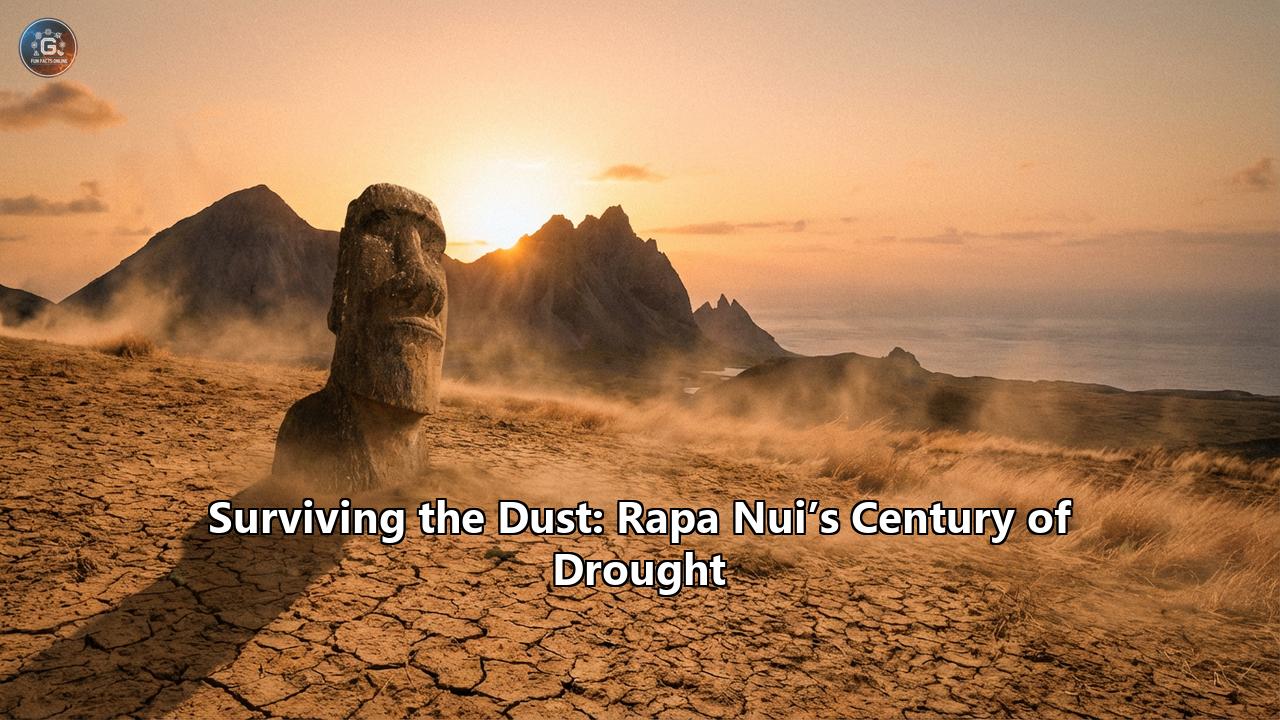
There is a silence on Rapa Nui that is louder than the crashing of the Pacific waves against its volcanic cliffs. It is a silence that emanates from the lips of the moai, the monolithic stone giants that gaze eternally inward across the island’s grassy hills. For centuries, the Western world has filled this silence with a story of its own making—a tragic fable of hubris, greed, and ecological suicide. We looked at the treeless landscape and the toppled statues and told ourselves that the Rapanui people destroyed their own paradise, cutting down every last palm to roll their ego-driven monuments, until the soil eroded, the food ran out, and they descended into cannibalism and chaos. It was the ultimate cautionary tale, a “parable of self-destruction” popularized by authors like Jared Diamond in his book Collapse.
But the stones of Rapa Nui have finally begun to speak a different truth.
Thanks to groundbreaking new research published in 2024 and 2025, specifically from teams at the Lamont-Doherty Earth Observatory and other institutions, we now know that the story of “ecocide” is largely a myth. The Rapanui did not recklessly destroy their environment. Instead, they were the victims of a massive, invisible catastrophe that no amount of foresight could have predicted: a century-long megadrought that turned their lush home into a dust bowl.
From approximately 1550 to 1720 CE, Rapa Nui was gripped by a climatic shock linked to the Little Ice Age. The rains stopped. The crater lakes dried up. The crops withered. Yet, what happened next was not a collapse, but one of the most remarkable feats of human survival in history. This is the true story of how the people of Rapa Nui engineered their way through the dust, reinvented their gods, and survived against impossible odds—until the real apocalypse arrived from across the sea.
Part I: The Thirsty Rock
To understand the magnitude of the Rapanui’s achievement, one must first understand the precarious nature of their home. Rapa Nui (Easter Island) is the most isolated inhabited landmass on Earth. It is a tiny speck of volcanic rock, a mere 63 square miles, adrift in the immense emptiness of the South Pacific. Its nearest neighbor, Pitcairn Island, is over 1,200 miles away; the coast of South America lies 2,300 miles to the east.
Unlike other Polynesian paradises like Tahiti or Hawaii, Rapa Nui is not a lush, tropical garden. It lies in the subtropics, making it cooler, windier, and drier. More critically, the island is geologically young. Its volcanic soil is incredibly porous, acting like a giant sponge. When rain falls, it doesn't form winding rivers or gather in accessible valleys; it vanishes instantly, filtering deep into the subterranean lava tubes and flowing out to sea. There are no permanent streams on Rapa Nui. The only fresh water is found in three small crater lakes—Rano Kao, Rano Raraku, and Rano Aroi—or in difficult-to-reach coastal seeps where groundwater meets the ocean.
For the first settlers, who arrived around 1200 CE (according to the latest radiocarbon dating by Hunt and Lipo), the island was a challenge, but a manageable one. They brought with them the “Polynesian package” of crops: taro, yam, banana, sugar cane, and the all-important sweet potato (kumara). They found a forest of giant palm trees (Paschalococos disperta) that provided shade, wind protection, and wood for canoes.
For three hundred years, the society thrived. They built the ahu (platforms) and carved the moai, moving millions of tons of rock in a display of cooperative labor and spiritual devotion. The population grew, likely stabilizing around 3,000 to 4,000 people—a sustainable number for the island’s carrying capacity.
Then, the sky turned against them.
Part II: The Great Drying
The first cracks in the traditional narrative appeared when scientists began looking closer at the mud. In 2025/2026, researchers led by Redmond Stein and colleagues extracted sediment cores from the Rano Raraku and Rano Aroi crater lakes. They weren't just looking for pollen; they were looking for the chemical fingerprints of rain.
By analyzing hydrogen isotopes in the waxy coatings of ancient preserved leaves buried in the mud, the team could reconstruct the island’s rainfall history with unprecedented precision. What they found was startling.
Around 1550 CE, the isotopic signature shifted dramatically. The data indicated a massive, sustained drop in precipitation. This wasn't a dry summer or a bad decade. It was a hydrologic crash that lasted for over 150 years.
This period coincides with the Little Ice Age, a time of global cooling that disrupted weather patterns worldwide. In Europe, the Thames froze over; in the Pacific, the Intertropical Convergence Zone (the rain belt that circles the Earth) likely shifted north, leaving Rapa Nui high and dry.
Imagine the horror of those first decades. The rains, once reliable, became sporadic. The crater lake of Rano Raraku—the very quarry where the moai were carved—began to shrink. This was not just a water source; it was the spiritual industrial center of the island. As the water receded, the reeds used for thatching huts and making floats died back. The soil, already fragile and exposed to the relentless Pacific winds, turned to dust. The forest, already thinning due to rat infestation (rats ate the palm nuts, preventing regrowth) and human clearing, could no longer regenerate in the arid conditions.
The "ecocide" theory blames the Rapanui for cutting down the last tree. The climate data suggests that the drought delivered the killing blow to the forest. A sapling cannot survive on a parched, wind-scoured hill. The loss of trees wasn't just a loss of wood; it was a loss of the canopy that kept the soil moist. A vicious feedback loop began: less rain led to less vegetation, which led to hotter, drier soil, which led to even less vegetation.
By 1600, Rapa Nui was a dust bowl. The traditional agricultural methods—slash and burn, simple planting—failed. A society based on surplus was suddenly facing starvation.
Part III: Engineering Resilience
In many civilizations, a climate shock of this magnitude triggers a swift collapse. Cities are abandoned, populations scatter, and warlords rise. But the Rapanui did not collapse. They didn't have the luxury of migration; there was nowhere else to go. They had to innovate or die.
Their response was a masterclass in agricultural engineering. They developed a technique known today as lithic mulching, or "rock gardening."
To the untrained eye of early European explorers, the interior of Rapa Nui looked like a wasteland covered in rubble. They assumed the "savages" were too lazy to clear the stones from their fields. They couldn't have been more wrong. Those stones were the technology that saved the people.
The Rapanui deliberately quarried and broke volcanic rocks into specific sizes and scattered them over their fields. This seems counterintuitive—how do you grow food in a rock pile? But the physics of lithic mulching are brilliant:
- Moisture Retention: The rocks shade the soil, preventing the sun from baking the earth and stopping evaporation. In a drought, every drop of dew or light rain is trapped beneath the stones.
- Windbreak: The rough surface of the rock garden creates turbulence, slowing down the wind at ground level. This stops the precious topsoil from blowing away and protects delicate plant leaves from windburn.
- Fertilizer: As the volcanic basalt weathers, it releases key nutrients like calcium, magnesium, and phosphorus directly into the soil, acting as a slow-release fertilizer for the nutrient-poor dirt.
- Temperature Regulation: The rocks absorb heat during the day and release it at night, creating a stable microclimate that protects crops from temperature swings.
Recent satellite analysis and ground surveys have revealed that these rock gardens covered up to 19% of the island. This was a massive industrial undertaking. Millions of stones were moved by hand to terraform the island. In these stone fields, they planted the resilient sweet potato, which became the caloric backbone of their survival.
They didn't stop at agriculture. They had to solve the water crisis.
With the crater lakes receding and becoming stagnant, the Rapanui turned to the ocean. They discovered that fresh groundwater, heavier than air but lighter than saltwater, flowed through the lava tubes and emerged at the coast, bubbling up into the sea at low tide. This is known as Coastal Groundwater Discharge (CGD).
To capture this fleeing water, they built puna—massive stone wells or cisterns located right at the shoreline. They dammed the flow, creating reservoirs where they could skim fresh (or slightly brackish) water off the top before it mixed with the brine. They also carved taheta, small basins in rocks, to catch every fleeting drop of rain.
The Rapanui survived by drinking water that would be considered too salty for modern standards, but their bodies adapted, and their diet of low-salt sweet potatoes helped balance their electrolyte intake. They literally wrung life out of the stone and the sea.
Part IV: The Twilight of the Moai
As the drought deepened, the social and spiritual fabric of the island began to tear. For centuries, the Rapanui had relied on the moai. These statues represented the ancestors, the conduits of mana (spiritual power) who ensured the fertility of the land. The deal was simple: the people built the statues and fed the priests; the ancestors provided rain and harvest.
But for a hundred years, the ancestors remained silent. The rain did not come.
The "collapse" theory posits that the Rapanui toppled the statues in a frenzy of civil war and revolution. While there was certainly conflict, the cessation of moai carving around 1550–1600 makes perfect rational sense in the context of the drought.
First, the resources required to carve and move them were gone. The rope (made from hau bark) and the timber (for sledges) were scarce. But more importantly, the moai had failed. Why invest the caloric energy of a starving population into carving a 40-ton statue when the god it represents has stopped listening?
The quarries at Rano Raraku fell silent not because the workers died, but because the society pivoted. They didn't lose their religion; they evolved it. They needed a new kind of god—one that was more immediate, more potent, and directly connected to the one thing they desperately needed: fertility.
Part V: The Rise of the Birdman
Out of the dust of the drought rose the cult of Makemake.
Makemake was a creator god, often depicted as a mask-like face with huge, staring eyes. He was the god of fertility—of the crops, of the sea, and of the people. As the moai cult faded, the worship of Makemake centered on a new, terrifyingly difficult ritual that would determine the leadership of the island.
This was the Tangata Manu (Birdman) ceremony.
The center of power shifted from the open plains of the moai to the dramatic cliffs of Orongo, a village of stone houses perched on the razor's edge of the Rano Kao crater. On one side, a thousand-foot drop into the dark, stagnant lake; on the other, a thousand-foot sheer drop into the churning ocean.
The ritual was a direct response to resource scarcity. Every spring, the Sooty Tern (Sterna fuscata) would arrive to nest on Motu Nui, a tiny, shark-ringed islet just off the coast. The birds brought eggs—a concentrated source of protein and a symbol of life in a dying land.
The competition was brutal. Each clan selected a champion, a hopu, to swim through the shark-infested waters to Motu Nui. There, they would wait in caves for days or weeks, watching the sky for the first terns. The first man to find an egg, strap it to his forehead, swim back through the surf, and climb the vertical sea cliffs to Orongo would win.
But he didn't win for himself. He won for his master, the head of his clan. The master was declared the Tangata Manu, the Birdman. For one year, he was the living avatar of Makemake. He was considered tapu (sacred). He would shave his head, paint it red, and live in seclusion.
Crucially, his clan gained the exclusive right to collect the bird eggs and fledglings from the islet for that year.
This wasn't just a sport; it was a political system born of drought. In a time of starvation, fighting over resources could lead to total annihilation. The Birdman ritual replaced open warfare with a ritualized competition. It ensured that power and resource rights rotated between the clans. It was a mechanism to distribute scarcity without destroying the society.
The "warriors" (matatoa) who rose during this time were not just thugs; they were the enforcers of this new, harsh order. They protected the rock gardens, guarded the puna wells, and managed the distribution of the meager harvests.
Part VI: The Real Collapse
By 1700, the drought began to ease. The Rapanui had weathered the storm. They had a functioning society, a new religion, highly adapted agriculture, and a stable population. They were bruised, but they were survivors.
Then, on Easter Sunday, 1722, three Dutch ships commanded by Jacob Roggeveen appeared on the horizon.
This was the beginning of the end. The Rapanui, isolated for 500 years, had no immunity to the invisible cargo the Europeans brought: smallpox, syphilis, tuberculosis, and influenza.
The impact was catastrophic. While the drought had stressed the population, disease decimated it. But the final blow came in the 19th century. In 1862, Peruvian slave raiders arrived. They didn't come to trade; they came to steal human beings. They captured over 1,500 Rapanui—including the King (Ariki Mau), the royal family, and the wise men (maori) who knew how to read the rongo-rongo script. They were hauled off to work in the guano mines of Peru.
Almost all of them died. When international pressure forced Peru to repatriate the survivors, only 15 made it back alive. And they brought smallpox with them.
The resulting epidemic killed almost everyone who remained. By 1877, the population of Rapa Nui, which had survived a century of dust and hunger, was reduced to 111 people.
This—this—was the collapse. It was not caused by cutting down trees. It was not caused by overpopulation. It was caused by the collision with the outside world.
Part VII: The Unbroken Thread
Despite the near-extinction event of the late 19th century, the Rapanui culture was not extinguished. The 111 survivors carried the weight of their ancestors.
We see glimpses of their incredible resilience in figures like Angata (c. 1853–1914). A Catholic catechist and prophetess, she led a rebellion in 1914 against the foreign company that had turned the entire island into a sheep ranch, confining the Rapanui to a small ghetto in Hanga Roa. Angata received visions from God—a syncretic mix of the Christian deity and the old Rapanui spirits. She urged her people to reclaim their land and their cattle. She was a modern echo of the Birdman champions, fighting for the resources and dignity of her people.
Today, the Rapanui people have reclaimed much of their heritage. They manage the National Park. They are reviving the language. And they are finally correcting the history books.
The rock gardens are still there, hidden in the grass, a testament to the genius of their ancestors. The puna still bubble with fresh water at the ocean's edge. And the moai, many of them restored, stand watch again.
The lesson of Rapa Nui is not one of failure. It is one of the greatest survival stories in human history. When the sky turned to dust, they didn't give up. They moved the rocks, they caught the rain, they swam with sharks, and they endured.
In a world facing its own climate crisis, Rapa Nui is no longer a warning of what happens when we are foolish. It is a beacon of what is possible when we are determined to survive.
Reference:
- https://www.researchgate.net/figure/The-ceremonial-village-of-Orongo-at-the-SW-rim-of-the-Kao-crater-See-Figure-7-for-the_fig4_323847528
- https://scitechdaily.com/what-really-happened-on-easter-island-new-evidence-challenges-long-held-myths/
- https://www.sciencedaily.com/releases/2026/02/260210040611.htm
- https://www.savacations.com/mythological-figures-easter-island/
- https://kids.kiddle.co/Makemake_(deity))
- https://en.wikipedia.org/wiki/Tangata_manu
- https://www.bradshawfoundation.com/easter/birdman_motif_easter_island.php
- https://moevarua.com/en/tangata-manu-the-bird-man-and-its-origins/
- https://en.wikipedia.org/wiki/Makemake_(deity))
- https://en.wikipedia.org/wiki/Orongo
- https://en.wikipedia.org/wiki/Angata
- https://socialsci.libretexts.org/Bookshelves/Anthropology/Archaeology/Archaeology_(Ruth)/01%3A_Chapters/1.07%3A_Rapa_Nui/01%3A_Chapters/1.07%3A_Rapa_Nui)