
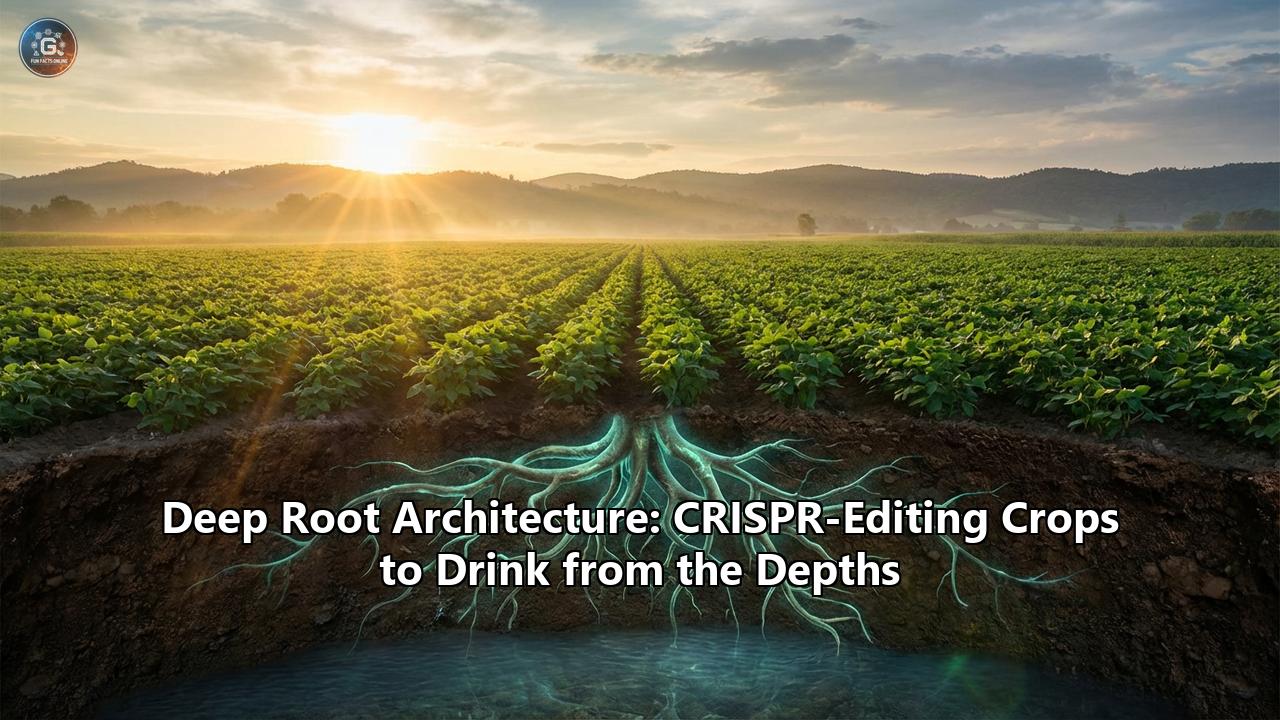
The wind rustles the cornstalks of a typical Midwestern farm, a sound that has defined American agriculture for centuries. But if you were to slice the earth vertically, peeling back the soil like the pages of a book, you would see that the story of modern farming is being rewritten—not in the golden tassels waving above, but in the dark, tangled silence below.
For ten thousand years, humans have looked up. We selected crops for bigger seeds, sweeter fruits, and shorter stalks that wouldn't topple in the wind. We engineered the "Green Revolution" of the 1960s by focusing on what we could see, taste, and harvest. But in doing so, we largely ignored the engine room of the plant: the root system.
Now, a second revolution is underway. It is a quiet, subterranean shift driven by the precise molecular scissors of CRISPR gene editing. This is the era of Deep Root Architecture (DRA). Scientists are no longer just asking plants to yield more; they are asking them to drink from the depths, to mine ancient water reserves, and to become the world’s most efficient carbon pumps.
This article explores the cutting-edge science, the high-stakes commercial race, and the profound environmental promise of engineering crops that grow down, deep, and resilient.
Part I: The Hidden Half – Redefining Root Architecture
To understand why scientists are obsessed with deep roots, we must first understand the "shallow trap" of modern agriculture.
The Shallow Trap
Most modern crop varieties—corn, wheat, soy, rice—have been bred for high inputs. We provide them with fertilizers and irrigation right at the surface. Over generations, these plants became "lazy" foragers. Why grow a deep, expensive root system when water and nitrogen are spoon-fed to the top six inches of topsoil?
The result is a root system architecture (RSA) that is often shallow and lateral. While efficient in good years, this architecture is catastrophic in bad ones. When a drought hits, the topsoil dries out first. Shallow roots are left stranded in dust, while moisture remains tantalizingly out of reach, just a meter or two below. Furthermore, shallow roots fail to capture excess nitrogen fertilizer, allowing it to leach into groundwater and causing massive "dead zones" in oceans and lakes.
The CRISPR Solution
Enter CRISPR-Cas9. Unlike traditional breeding, which can take decades to isolate a trait, or older GMO methods that involve blasting foreign DNA into a genome, CRISPR allows for precise "editing" of the plant's own genetic code. It is akin to fixing a typo in a manuscript rather than pasting in a page from a different book.
This precision is vital for root architecture because roots are not controlled by a single "grow deep" button. They are governed by a complex symphony of genes that regulate gravity sensing (gravitropism), branching, and cell elongation.
Part II: The Genetic Architects – Key Genes Driving the Revolution
Recent breakthroughs have identified specific genetic "control knobs" that determine whether a root spreads wide or dives deep.
1. DRO1: The Gravity Guide
The superstar of deep root genetics is DRO1 (DEEPER ROOTING 1). First identified in rice by researchers at the National Institute of Agrobiological Sciences in Japan, DRO1 controls the "root growth angle."
In typical high-yield rice (like the IR64 variety), roots grow outward at a shallow angle. The researchers found that by upregulating DRO1, the roots grew steeper, plunging downward. The results were startling: rice plants with high DRO1 expression yielded double the grain under moderate drought conditions compared to their shallow-rooted cousins. Under severe drought, where normal rice failed completely, DRO1 rice still produced grain.
This discovery was the "proof of concept" that changing a single gene could radically alter the physical architecture of the plant underground without sacrificing yield above ground.
2. EXOCYST70A3: The Auxin Traffic Controller
While DRO1 manages the angle, other genes manage the flow of growth hormones. At the Salk Institute for Biological Studies, researchers identified EXOCYST70A3 in the model plant Arabidopsis thaliana.
Root growth is driven by auxin, a powerful plant hormone. The EXOCYST70A3 gene acts like a traffic cop, determining how much auxin gets to the root tip. By using CRISPR to dampen this gene's activity, researchers found the roots grew significantly deeper. This gene is conserved across many species, meaning the trick learned in a tiny mustard weed can be translated to massive crops like soybean and corn.
3. ZmCIPK15: The Corn Angle
In 2021, a team led by Penn State identified ZmCIPK15 in maize (corn). This gene was missing in a mutant line of corn that naturally grew roots at a steep, vertical angle. By using CRISPR to replicate this "loss of function" in standard corn varieties, scientists can essentially force the plant to adopt a steep-rooting strategy. This is a game-changer for the U.S. Corn Belt, where nitrogen runoff and increasingly erratic summer rains are dual crises.
Part III: The Salk Vision – Cork, Carbon, and Climate
Perhaps the most ambitious project in this space is the Harnessing Plants Initiative (HPI) at the Salk Institute. Their goal is not just agricultural resilience; it is planetary engineering.
The Carbon Injection Problem
Plants are excellent at sucking CO2 out of the air (photosynthesis). The problem is that they are terrible at keeping it there. When a crop dies and decomposes, most of that carbon returns to the atmosphere.
The Salk team, led by luminaries like Wolfgang Busch and Joanne Chory, proposed a radical idea: Salk Ideal Plants™. These plants are engineered with two specific traits:
- Massive Root Systems: To act as a larger repository for carbon.
- High Suberin Content: To lock that carbon away.
The Magic of Suberin
Suberin is the waxy substance that makes up cork. It is complex, tough, and critically, hard for soil microbes to digest.
Typical roots decompose quickly. Roots rich in suberin can persist in the soil for years or decades. By using CRISPR to boost the metabolic pathways that produce suberin, Salk scientists are creating roots that act like carbon vaults.
When you combine Deep Root Architecture with High Suberin, you get a biological pump that pushes carbon deep into the soil profile (below the active plow layer) and locks it in a chemical form that doesn't rot. Salk estimates that if just the world's top crops (corn, soy, wheat, rice, cotton, canola) were converted to "Ideal Plants," we could sequester 4 to 8 gigatons of CO2 per year—a massive chunk of human emissions.
Part IV: The Commercial Race – From Lab Bench to IPO
This isn't just academic theory. The race to monetize deep roots is on. Venture capital is flowing into ag-tech startups that promise to deliver these seeds to farmers by the mid-to-late 2020s.
Cquesta: The Salk Spinoff
To move fast, Salk spun out a company called Cquesta. Launched with patents from the institute, Cquesta is the commercial vehicle for the "Ideal Plant" technology. As of 2024 and 2025, they are conducting field trials to prove that these high-suberin, deep-rooted crops don't suffer a "yield drag." (A common fear is that if a plant spends too much energy making roots, it won't make enough seeds. Early data suggests this trade-off can be managed).
Inari Agriculture: The Multiplex Masters
Based in Cambridge, Massachusetts, Inari Agriculture is taking a different approach. They use a "multiplex" CRISPR system, which allows them to edit dozens of genes simultaneously. Instead of just tweaking one root gene, they can tweak the root angle and water-use efficiency and nitrogen uptake pathways all at once.
Inari calls this their SEEDesign™ platform. In early 2025, they announced major funding rounds to commercialize high-yield, low-water corn and soy varieties. Their pitch to farmers is simple: "Grow more with less." The environmental benefit (deep roots) is the mechanism, but the selling point is profit and stability.
CoverCress: The Winter Warrior
While Inari and Cquesta focus on main crops, CoverCress Inc. (majority-owned by Bayer) is hacking the off-season. They took a common weed called pennycress and gene-edited it into a productive oilseed crop.
CoverCress is planted in winter, between the corn and soy rotations. Its gene-edited roots keep the soil active, preventing erosion and sequestering carbon during months when fields are usually bare. While not a "deep root" play in the same single-gene sense as DRO1, it represents a holistic approach to keeping living roots in the soil year-round.
Part V: The Environmental Triad – Water, Nitrogen, Carbon
The adoption of Deep Root Architecture offers a "triple win" that is rare in environmental science.
1. The Water Win (Drought Adaptation)
As climate change shifts rainfall patterns, "flash droughts" are becoming common. A deep root system is an insurance policy. In 2012, a massive drought cost the U.S. economy $30 billion. Corn with roots that went just 50cm deeper could have tapped into the subsoil moisture reserves, potentially saving billions in lost yield.
2. The Nitrogen Win (Pollution Control)
Nitrogen is slippery. It moves with water. When it washes past the shallow roots of standard corn, it's gone forever—polluting aquifers and fueling algae blooms in the Gulf of Mexico. Deep roots act as a "safety net," catching nitrates that slip past the upper layers. This not only cleans the water but saves the farmer money, as the plant actually uses the fertilizer they paid for.
3. The Carbon Win (Sequestration)
This is the long game. Deep soil carbon is "recalcitrant," meaning it stays put. Building up soil organic carbon improves soil structure, making it like a sponge that absorbs heavy rains (flood mitigation) and holds moisture during dry spells.
Part VI: The Challenges – It’s Not All Green Lights
Despite the optimism, significant hurdles remain.
The "Yield Drag" Anxiety
Photosynthesis is a zero-sum game. A plant only has so much energy. If you force it to build a massive, corky root system, will it produce fewer kernels of corn?
Scientists argue that the trade-off is minimal because deep roots access more resources. A plant with more water and nitrogen can photosynthesize more, theoretically paying for the cost of its extra roots. However, this balance is delicate and varies by soil type.
The Regulatory Patchwork
CRISPR crops face a divided world.
- The Americas: The U.S., Canada, Brazil, and Argentina largely treat gene-edited crops as conventional crops (non-GMO) as long as no foreign DNA is added. This path to market is fast and cheap.
- The EU: Historically strict, the EU is currently debating a "New Genomic Techniques" (NGT) framework. As of 2025, signs point to a loosening of restrictions for crops that contribute to sustainability, but the regulatory hurdle remains higher than in the US.
The Soil Microbiome Mystery
Roots don't live alone. They are surrounded by billions of bacteria and fungi. Changing the root architecture or chemical composition (suberin) could disrupt these ancient partnerships. Will high-suberin roots starve beneficial microbes? Or will deep roots stimulate a new, thriving ecosystem at depth? This is the frontier of current research.
Part VII: The Future – The 2030 Horizon
We are standing at the precipice of the "Underground Revolution."
By 2030, we expect to see the first dedicated "Drought-Proof" CRISPR corn hybrids on the commercial market. These won't just be labeled for yield; they will be marketed on their root depth specification.
Farmers might soon browse seed catalogs that list "Root Depth Potential" alongside "Bushels per Acre." Carbon markets will likely mature to the point where farmers are paid not just for practices (like no-till) but for the actual performance of their seeds. "Did you plant the Cquesta-licensed Deep Root variety? That pays $20/acre in carbon credits."
In the end, Deep Root Architecture is more than just a biotech trend. It is a fundamental realignment of our relationship with the plant. For a century, we treated crops as factories, pumping in inputs and taking out product. Now, we are redesigning them to be partners—living systems that heal the soil, clean the water, and cool the planet, all while feeding a hungry world.
The solutions to our biggest problems are right beneath our feet. We just had to learn how to grow down to find them.
Reference:
- https://www.magnetic-ag.com/post/covercress-the-carbon-cover-crop
- https://www.labiotech.eu/best-biotech/crispr-companies/
- https://www.the-scientist.com/companies-use-crispr-to-improve-crops-65362
- https://www.seedworld.com/us/2025/04/24/researchers-say-new-method-speeds-up-crop-editing/
- https://innovativegenomics.org/news/crispr-in-agriculture-2024/
- https://www.foodmanufacturing.com/supply-chain/news/22917305/gene-editing-could-boost-potato-stress-resistance
- https://cropwatch.unl.edu/2019/cover-crops-and-carbon-sequestration-benefits-producer-and-planet/
- https://sandiegomagazine.com/features/salk-institute-harnessing-plants-initiative/
- https://www.salk.edu/science/power-of-plants/
- https://www.producer.com/news/american-company-takes-deep-dive-into-root-research/
- https://inari.com/forbes-gene-editing-seeds-with-crispr-is-transforming-agricultural-biotechnology/
- https://leaps.bayer.com/companies/agriculture/covercress
- https://regenerationinternational.org/2021/04/01/fighting-climate-change-with-plants-an-inefficient-solution-from-the-salk-institute/