
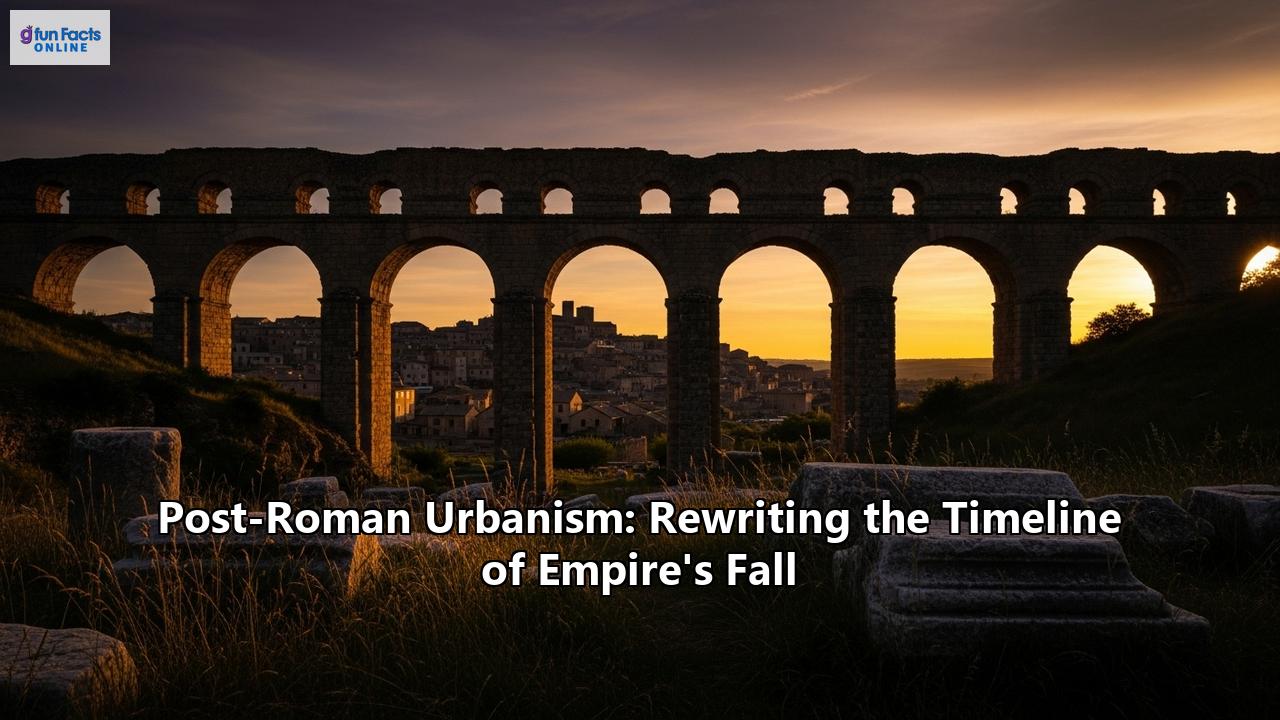
Vanishing Act or Grand Redesign? Rewriting the Timeline of Post-Roman Urbanism
For centuries, the story of the Western Roman Empire’s demise has been painted in broad, catastrophic strokes: a grand civilization extinguished, its magnificent cities falling silent, left to be reclaimed by ivy and myth. The term "Dark Ages" itself conjures images of a world plunged into shadow, where the sophisticated urban life that defined Rome gave way to rural squalor and ruin. Yet, a revolution in archaeology and historical analysis is meticulously rewriting this narrative, challenging the very idea of a sudden, uniform collapse. The story emerging from the soil is not one of simple death, but of a complex and fascinating transformation—a story of continuity, adaptation, and the birth of a new kind of city from the bones of the old.
This revised history moves beyond the simplistic notion of decline, instead exploring a period of profound transition that varied dramatically across the vast expanse of the former empire. While some urban centers did shrink drastically or disappear, many others survived, albeit in dramatically altered forms. They were not static ruins but dynamic landscapes where Roman traditions, Christian faith, and barbarian cultures collided and merged. Recent archaeological discoveries are pushing back against the old consensus, revealing that many "backwater" Roman towns were resilient and thriving far longer than previously believed, forcing a significant revision of the timeline of collapse. This article delves into the heart of this scholarly shift, examining the evidence that is transforming our understanding of what it meant to live in a city after the fall of Rome.
Beyond the Rubble: Challenging the "Catastrophist" View
The traditional narrative of urban collapse, often termed the "catastrophist" school of thought, was heavily influenced by literary sources and the monumental work of historians like Edward Gibbon, who famously pointed to barbarian invasions and the rise of Christianity as key factors in the Roman Empire's decline. This perspective saw cities as victims of a violent and abrupt end, their populations massacred or dispersed, and their civic institutions vanishing. The archaeological record, for a time, seemed to support this. Layers of dark, homogenous soil, known as "dark earth," found blanketing Roman strata in cities like London were interpreted as definitive evidence of abandonment and decay, a sign that urban life had ceased and nature had taken over.
However, over the past few decades, a "continuist" or "transformation" school of thought has gained significant traction, arguing that the end of the Roman West was a long, complex process rather than a single event. Proponents of this view contend that while the political superstructure of the Western Empire dissolved, many of its underlying social, economic, and cultural frameworks, particularly at a local level, persisted and evolved. They argue that the so-called "barbarian invasions" were often complex migrations and settlements, not just destructive raids, with Germanic peoples frequently interacting and trading with the Empire for generations before its final fragmentation.
This new perspective does not ignore the evidence of decline but reinterprets it. The population of Rome itself, for instance, plummeted from a peak of perhaps one million to as low as 30,000 by the end of the 6th century, a stark demographic collapse driven by the loss of its empire-spanning logistical network and the severing of its aqueducts during the Gothic Wars. Yet, even in its reduced state, Rome remained a potent symbol and an inhabited center. Across the former empire, the story was similarly nuanced. Instead of a uniform "end of urbanism," the evidence points to a period of radical reconfiguration, driven by a confluence of factors including political fragmentation, climate change, plagues, and profound religious shifts.
The New Urban Blueprint: Survival and Adaptation
The post-Roman city was a landscape of radical adaptation, where the grandiose public spaces of the classical world were repurposed to meet the needs of a new era. What had been a "consumer city," sustained by the wealth and resources of a vast empire, often had to become a more self-sufficient "production city" to survive. This transformation was etched into the very fabric of the urban environment.
The Repurposing of Public Space:The grand forums, once the beating heart of civic and commercial life, underwent significant changes. In Rome, the Forum Romanum was not simply abandoned to crumble. Instead, it saw continued, if sporadic, restoration and modification well into the Ostrogothic and Byzantine periods. Monarchs and aristocrats still used the space to project power, but its character shifted. Temples were converted into Christian churches, a powerful symbol of the new religious order supplanting the old. The Basilica of Maxentius, the last great addition to the Forum complex, highlights this transition from a civic and political center to one increasingly dominated by ecclesiastical concerns.
Similarly, other monumental structures were given new leases on life. Theaters and amphitheaters, their original spectacles of gladiatorial combat and drama no longer sustainable or socially acceptable, were transformed in ingenious ways. In cities like Arles and Nîmes, the amphitheaters were converted into fortified settlements, their sturdy arches providing the framework for houses, chapels, and public squares, effectively creating a city within a city. In Rome itself, the great theaters of Pompey and Marcellus became the foundations for the fortified palaces of powerful medieval families, their ancient stones a testament to both past glory and present power. This widespread practice of reusing ancient structures, known as spolia, was not merely a matter of convenience; it was a physical dialogue with the past, a way for new powers to anchor their legitimacy in the enduring legacy of Rome.
The Fading Lifelines: Infrastructure in DeclinePerhaps no feature of Roman urbanism was more impressive than its infrastructure, particularly the aqueducts that supplied cities with vast quantities of fresh water. The fate of these engineering marvels is a stark indicator of the changing scale of urban life. The maintenance of these systems was immensely expensive and required a level of centralized authority and technical expertise that largely vanished with the empire.
During the Gothic siege of Rome in 537 AD, the invaders deliberately cut the aqueducts, a strategic move that crippled the city. While the Byzantine general Belisarius later made repairs, the damage compounded centuries of neglect. The dramatic population decline meant that such vast water systems were no longer necessary; wells and the Tiber River could suffice for the shrunken populace. Across the former empire, the story is similar. A study in Spain found only a handful of aqueducts still in operation by the seventh century. Their abandonment speaks not only of technological loss but of a fundamental shift in the nature of the city itself—from a metropolis capable of supporting massive populations with complex amenities to smaller, more localized settlements.
The Rise of a New Power: The Church and the Bishop
As the secular authority of the Roman state waned, a new power rose to fill the vacuum: the Christian Church. In the cities of Late Antiquity, bishops evolved from purely spiritual leaders into crucial figures of civic administration and social cohesion. This shift was monumental. Constantine's Edict of Toleration and subsequent imperial favor endowed the Church with legal status, wealth, and property. Bishops were granted judicial authority, capable of presiding over civil lawsuits, and their churches became centers of public charity, taking over the state's role in supporting the poor.
This new role reshaped the urban landscape. Grand basilicas, often built on the sites of pagan temples or at the tombs of martyrs on the city's edge, created new focal points for urban life. The construction of churches, monasteries, and hospitals reflected a new set of social priorities centered on worship and care for the vulnerable. The very layout of cities began to reorient around these new ecclesiastical centers. In some towns in northern Etruria, as the old Roman center fragmented, new population hubs grew up around cathedrals or suburban cemeteries, creating a pattern of "urban villages" within the old Roman walls, separated by areas of abandonment or cultivation.
The economic power of the bishop also became a defining feature of the post-Roman city. Ecclesiastical authorities often controlled vast tracts of land and were key players in regional economic networks. In Ravenna, which became the capital of the Ostrogothic Kingdom and later the Byzantine Exarchate, the bishop played a vital economic role, and archaeological evidence points to the city being a major hub for trade with the Eastern Mediterranean. This fusion of religious and secular power, embodied in the figure of the bishop, was a defining characteristic of the transition from the classical to the medieval city.
Case Studies in Transformation: A Tale of Four Cities
The transition from Roman to medieval urbanism was not a monolithic process. The fate of each city was shaped by its unique geography, political circumstances, and the resilience of its inhabitants. Examining specific case studies reveals the diverse tapestry of post-Roman urban life.
Rome: The Declining HeartThe transformation of Rome itself is perhaps the most dramatic. As the political and economic center of a vast empire, its immense size was entirely dependent on tribute and trade. With the loss of its provinces, particularly the grain-rich lands of North Africa, the city became unsustainable. The population collapse was swift and severe. Yet, it was never truly abandoned. The remaining inhabitants clustered near the Tiber, while the monumental core, including the Forum, became a quarry for building materials and a site for new Christian churches. The city's ancient walls remained in use, enclosing a space far larger than its population required. The story of post-Roman Rome is one of contraction and fragmentation, but also of symbolic endurance, with the papacy slowly building a new kind of power on the ruins of the old empire.
London (Londinium): From Bustle to "Dark Earth"On the empire's northern frontier, the story of Londinium offers a different perspective. After its destruction by Boudica in AD 60, the city was rebuilt and became a major commercial hub and likely the provincial capital. However, by the late Roman period, its fortunes had waned. Archaeological excavations have revealed that large areas of the once-bustling city were covered by "dark earth" starting in the late Roman period, suggesting a significant change in land use. This layer, once thought to signify total abandonment, is now interpreted more complexly. It appears to be the result of the decay of timber and wattle-and-daub buildings, mixed with household waste and possibly representing a shift to horticulture and gardening within the city walls—a process of ruralization. While the defensive wall built in the 3rd century defined the city's perimeter for centuries to come, the life within those walls had profoundly changed, shrinking in population and economic vitality long before the final withdrawal of Roman legions.
Trier: The Enduring CapitalIn contrast to London, Trier on the Moselle River enjoyed a period of immense prosperity in Late Antiquity, serving as an imperial capital and one of the largest cities in the Roman world. Its legacy is preserved in the spectacular survival of monumental structures like the Porta Nigra, the Basilica of Constantine, and the Imperial Baths. After the withdrawal of imperial authority, Trier was sacked multiple times. Yet, life continued. Archaeological evidence shows the local Gallo-Roman population and incoming Franks repurposing the ruins of grand public buildings into makeshift housing. The city's imperial past and its role as a major Christian center, with a bishopric established early on, ensured its continued importance. The story of Trier is one of violent disruption followed by adaptation, where its Roman and Christian heritage provided the foundation for its survival and eventual re-emergence as a major medieval center.
Ravenna: The Eastern BastionAfter the collapse of the Western Empire, Ravenna became a city of paramount importance. Its strategic coastal location and defensible marshes made it the capital for the Ostrogothic king Theodoric and later the center of Byzantine power in Italy. This political prominence translated into economic vitality. Archaeological finds, particularly large quantities of amphorae from the Eastern Mediterranean, attest to Ravenna's role as a key node in long-distance trade networks. The city's spectacular mosaics and churches, built during this period, reflect its prosperity and its close ties to Constantinople. Ravenna demonstrates that the "fall" of Rome did not mean the end of sophisticated urban life everywhere; in some places, it heralded a new golden age under new rulers, with the Church and its bishops playing a central economic and political role.
Rewriting the Timeline: A More Complex Past
The emerging picture of post-Roman urbanism is one of profound and multifaceted change, not of a singular, apocalyptic collapse. The timeline of the "fall" is being rewritten, not as a sharp line in 476 AD, but as a long and regionally varied transition stretching from the 3rd to the 8th centuries. Recent archaeological work continues to challenge old assumptions. For example, excavations at Interamna Lirenas in Italy have shown that this supposedly average Roman town remained a thriving urban center for some 300 years longer than previously thought, suggesting that urban resilience may have been the norm, rather than the exception, in many parts of Italy.
The evidence compels us to abandon the idea of a simple binary between "Roman" and "barbarian," or "civilization" and "darkness." The post-Roman city was a crucible where these categories blurred. It was a place of dramatic population decline and infrastructural decay, but also of remarkable continuity and creative adaptation. It was a world where Roman forums became cattle fields, but also the sites of new churches; where amphitheaters fell silent, only to be reborn as fortified towns; and where the authority of the emperor was replaced by the growing power of the local bishop. By listening to the complex stories told by the stones and the soil, we gain a more nuanced and ultimately more fascinating understanding of how the classical world truly ended—not with a bang, but with a long, intricate, and endlessly inventive transformation.
Reference:
- https://www.cambridge.org/core/journals/antiquity/article/abs/gregor-kalas-the-restoration-of-the-roman-forum-in-late-antiquity-transforming-public-space-2015-xv228-pages-100-bw-illustrations-austin-university-of-texas-press-9780292760783-hardback-39-60/FBC852DF1C8CAAAF898A893D4CF8960A
- https://historicengland.org.uk/research/results/reports/1557/SOILANDBOTANICALSTUDIESOFTHE%22DARKEARTH%22
- https://www.google.com/search?q=time+in+London,+GB
- https://en.wikipedia.org/wiki/Roman_Forum
- https://christianhistoryinstitute.org/magazine/article/a-bishops-work-is-never-done
- https://www.cambridge.org/core/journals/antiquity/article/abs/future-for-dark-earth/98B789261090F933CE176B4BF4F971E5
- https://anhistoriersmiscellany.com/2021/08/07/dark-earth/
- https://www.researchgate.net/publication/303815299_The_Restoration_of_the_Roman_Forum_in_Late_Antiquity_Transforming_Public_Space_by_Gregor_Kalas
- https://www.google.com/search?q=time+in+Rome,+IT
- https://www.quora.com/Did-any-part-of-an-ancient-Roman-amphitheater-survive-into-modern-times-like-some-parts-of-the-Colosseum-have-done
- https://www.futurelearn.com/info/courses/enlightening-the-dark-ages-early-medieval-archaeology-in-italy/0/steps/262373
- http://www.romanaqueducts.info/aquasite/romaaftermath/index.html
- https://romeandvaticanpass.com/en/things-to-do/history-of-the-roman-forum
- https://www.tickets-rome.com/roman-forum/history/
- https://www.amusingplanet.com/2015/02/4-ancient-roman-amphitheatres-still-in.html
- https://openpublishing.psu.edu/ahd/content/afterlives-reuse-adaptation-and-transformation-romas-ancient-theaters
- https://brewminate.com/adaptive-reuse-of-ancient-buildings-in-rome/
- https://www.leidenmedievalistsblog.nl/articles/aqueduct-warfare-water-infrastructure-and-sieges-in-post-roman-europe
- https://www.researchgate.net/publication/259011184_Historical_and_Technical_Notes_on_Aqueducts_from_Prehistoric_to_Medieval_Times
- https://www.quora.com/What-happened-to-all-of-Romes-Aqueducts-after-the-fall-of-the-empire-Why-weren-t-they-used-in-medieval-towns-and-cities-like-other-Roman-buildings-were
- https://assets.ctfassets.net/4wrp2um278k7/5csxhFY7wXUOAgieI5OHSk/83c474443686871bb492e622e50aae19/9789048554072.pdf_extract.pdf
- https://theromanguy.com/italy-travel-blog/rome/influences-of-christianity-in-the-roman-empire/
- https://library.fiveable.me/greek-and-roman-cities/unit-8/impact-christianity-ancient-city/study-guide/bMx3aPocXjHdurtQ
- https://academic.oup.com/edited-volume/43183/chapter/362534901
- https://www.taylorfrancis.com/chapters/edit/10.4324/9781315108094-9-12/bishops-merchants-economy-ravenna-beginning-middle-ages-enrico-cirelli
- https://www.themontrealreview.com/2009/Economic-Origins-of-Roman-Christianity.php
- https://www.archdaily.com/869593/rome-urban-formation-and-transformation
- https://www.roman-britain.co.uk/places/londinium/
- https://en.wikipedia.org/wiki/Londinium
- https://whc.unesco.org/en/list/367/
- https://www.youtube.com/watch?v=0lpYmP9-x5U
- https://archaeologymag.com/2025/04/researchers-analyze-4000-roman-bricks-trier/
- https://etheses.whiterose.ac.uk/id/eprint/5015/6/Chapter%20Three%20e-thesis%20version.pdf