
Introduction: The Final Frontier Beneath Our Feet
For centuries, humanity has looked to the stars to find the unknown, charting the galaxies and mapping the topography of Mars with more precision than our own ocean floors. Yet, the most elusive and mysterious frontier lies not millions of light-years away, but a mere 3,000 kilometers beneath our feet. The Earth’s core, a blistering sphere of iron and fire, has long been the subject of speculation, myth, and scientific deduction. It is the engine of our planet, the generator of the magnetic shield that protects us from the solar wind, and the keeper of our world’s oldest secrets.
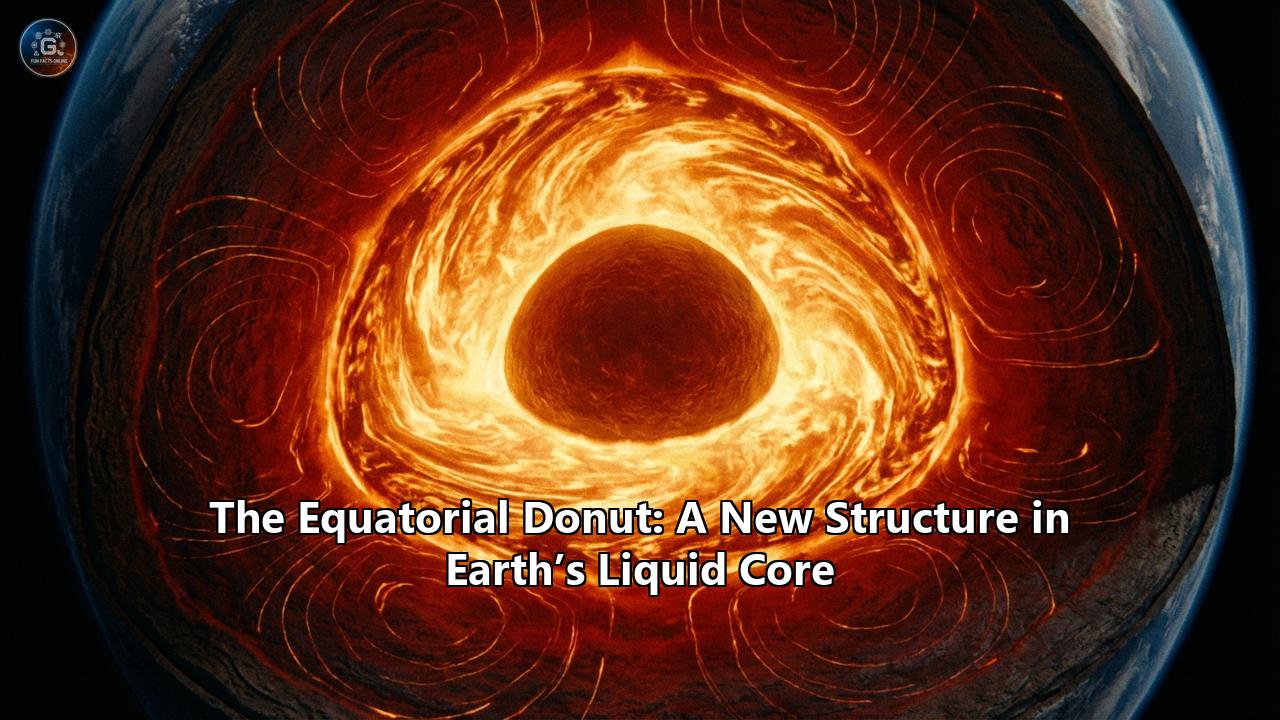
For decades, the standard model of the Earth’s interior has been relatively simple: a thin crust, a massive rocky mantle, a liquid outer core, and a solid inner core. We pictured these layers as uniform onion skins, spherical and consistent. But in 2024, a groundbreaking discovery by geophysicists at the Australian National University (ANU) shattered this simplistic view. Hidden within the churning liquid metal of the outer core, wrapping around the planet’s equator like a belt, lies a massive, donut-shaped structure—a torus of low-velocity material that has evaded detection for a century.
This structure, dubbed the "Equatorial Donut," represents a fundamental shift in our understanding of planetary dynamics. It is not just a quirk of geometry; it is a thermochemical anomaly that challenges our models of how the Earth generates its magnetic field, how heat flows from the center of the planet, and how the core interacts with the mantle above it. This discovery is akin to finding a new continent on a map we thought was complete.
In this comprehensive exploration, we will journey to the center of the Earth to understand the magnitude of this discovery. We will dissect the innovative seismic techniques that allowed scientists to "see" the invisible, explore the exotic chemistry of this hidden ring, and unravel the implications for the future of our planet’s magnetic field. This is the story of the Equatorial Donut.
Chapter 1: The Architecture of the Deep Earth
To appreciate the anomaly of the Equatorial Donut, we must first understand the "normal" architecture of our planet. The Earth is a differentiated body, meaning it has separated into layers based on density over its 4.5-billion-year history.
1.1 The Crust and Mantle
The surface we stand on is the crust, a brittle shell of silicate rock ranging from 5 to 70 kilometers in thickness. Below this lies the mantle, a 2,900-kilometer-thick layer of solid, silicate rock that behaves like a viscous fluid over geological timescales. The mantle is not static; it churns in slow-motion convection currents, driving the tectonic plates at the surface. At the bottom of the mantle lies the Core-Mantle Boundary (CMB), a jagged landscape of inverted mountains and deep valleys where solid rock meets liquid metal. This boundary, located roughly 2,891 kilometers down, is the ceiling of the core.
1.2 The Outer Core: The Ocean of Iron
Beneath the mantle lies the outer core, a shell of liquid iron and nickel about 2,200 kilometers thick. This is a world of extremes. Temperatures range from 4,000°C near the mantle to nearly 6,000°C near the inner core. The pressure is immense, millions of times greater than atmospheric pressure at sea level.
The fluid here is not stagnant. It flows with the viscosity of water, churning vigorously due to two main forces: thermal convection (heat rising from the bottom) and compositional convection (light elements released by the freezing inner core). These movements are twisted by the Earth's rotation, creating a planetary-scale dynamo that generates the Earth's magnetic field. Until recently, scientists believed this liquid ocean was relatively well-mixed and homogeneous, much like a pot of boiling soup. The discovery of the Equatorial Donut proves this assumption wrong.
1.3 The Inner Core: The Solid Heart
At the center of it all is the inner core, a solid ball of iron-nickel alloy with a radius of about 1,220 kilometers—slightly smaller than the Moon. Despite temperatures exceeding the surface of the Sun, the inner core remains solid because the pressure is so intense that the iron atoms are forced into a crystalline lattice. The inner core is slowly growing as the Earth cools, freezing the liquid outer core at its boundary and releasing heat and light elements that drive the dynamo above.
Chapter 2: The Science of Seeing the Invisible
How do we know what lies 3,000 kilometers beneath us? We cannot drill there; the deepest hole humanity has ever dug, the Kola Superdeep Borehole, reached only 12 kilometers—a mere scratch on the Earth’s skin. Instead, scientists must rely on indirect methods, primarily seismology.
2.1 The Seismic X-Ray
When an earthquake strikes, it releases massive amounts of energy in the form of seismic waves. These waves travel through the Earth like sound waves through a bell. By measuring how long it takes for these waves to travel from the quake's epicenter to seismometers on the other side of the planet, scientists can infer the density, temperature, and state of matter of the layers they pass through.
There are two main types of body waves:
- P-waves (Primary waves): Compressional waves that travel fastest and can move through both solids and liquids.
- S-waves (Secondary waves): Shear waves that move slower and can only travel through solids.
The fact that S-waves disappear when they hit the core was the first clue that the outer core is liquid. The specific speed at which P-waves travel tells us about the material's density. Generally, waves travel faster through denser, cooler, and more rigid material, and slower through hotter, less dense, or distinct chemical compositions.
2.2 The Limitations of Traditional Seismology
For decades, seismologists focused on the "first arrivals"—the very first P-waves to reach a detector after an earthquake. While effective for mapping the general structure of the Earth, this method has a major blind spot: it relies on direct paths. It’s like trying to understand the layout of a dark room by shining a single flashlight beam across it. You see a slice of the room, but you miss the corners and the details.
This limitation meant that volumetric coverage of the outer core was poor. Scientists could see "rays" of data passing through the core, but vast regions remained unmapped. This is why the Equatorial Donut remained hidden for so long; it sits in a region that was not well-sampled by the direct wave paths used in traditional studies.
2.3 The Breakthrough: Coda Correlation Wavefield
The discovery of the donut in 2024 was made possible by a novel technique pioneered by Hrvoje Tkalčić and Xiaolong Ma. Instead of looking only at the first hour of data after a massive earthquake, they analyzed the coda—the tail end of the seismic signal.
Imagine striking a gong. The initial "clang" is the direct wave. But the gong continues to shimmer and hum for a long time afterward. These reverberations are the waves bouncing back and forth, reflecting off boundaries and scattering through the material. In the Earth, these reverberations (the coda) bounce between the surface and the core multiple times.
By analyzing these late-arriving waves (hours after the quake), Tkalčić and Ma could effectively "illuminate" the entire outer core. They used a mathematical method called the Coda Correlation Wavefield (CCW), which looks for similarities in the coda signals across a global network of sensors. This allowed them to construct a 3D tomographic image of the outer core with unprecedented detail, revealing the slow-moving torus structure that circles the equator.
Chapter 3: Anatomy of the Equatorial Donut
The structure revealed by the CCW method is unlike anything previously seen in the core. It is a large, torus-shaped region confined to low latitudes, sitting parallel to the equatorial plane.
3.1 Location and Geometry
The donut is located at the very top of the outer core, hugging the Core-Mantle Boundary (CMB). It is not a spherical shell that covers the whole core like a peel; rather, it is a belt. It extends vertically for several hundred kilometers into the liquid core and wraps around the planet horizontally, following the equator.
To visualize it, imagine the Earth’s molten core as a giant orange. If you were to peel the orange, the donut would be a thick band of distinct material wrapped around the middle of the fruit, just beneath the skin.
3.2 Seismic Characteristics
The defining feature of this donut is its seismic velocity. P-waves traveling through this region move about 2% slower than they do in the rest of the outer core. In the precise world of geophysics, a 2% difference is massive. It indicates a significant change in the material properties of the fluid.
The slow velocity suggests two possibilities:
- High Temperature: The region is significantly hotter than the surrounding fluid.
- Chemical Composition: The region is enriched with lighter elements that slow down the seismic waves.
While temperature likely plays a role, the consensus among the discoverers is that chemistry is the primary driver. The donut represents a concentration of lighter chemical elements that have gathered at the top of the core, held in place by complex fluid dynamics.
Chapter 4: The Chemical Mystery
The Earth’s core is predominantly iron and nickel, but it is not pure. We know this because the core is "too light" to be made of pure metal. There is a density deficit of about 10% in the outer core, which implies the presence of light elements.
4.1 The Usual Suspects
The "light elements" usually cited in core studies are:
- Silicon (Si): Abundant in the rocky mantle, likely entered the core during Earth's formation.
- Oxygen (O): Also from the mantle, highly reactive with iron at high pressures.
- Sulfur (S): Siderophile (iron-loving) element, likely present in significant quantities.
- Hydrogen (H) and Carbon (C): Potential candidates, though harder to constrain.
The discovery of the Equatorial Donut suggests that these elements are not evenly distributed. Instead, they appear to be concentrated in this equatorial belt. The slow seismic speeds point specifically to an enrichment of silicon and oxygen, and possibly hydrogen.
4.2 Why a Donut?
Why would light elements gather in a ring around the equator? The answer lies in the physics of rotating fluids.
When the solid inner core freezes, it expels light elements (which don't fit well into the solid iron crystal lattice). These buoyant elements rise through the liquid outer core like bubbles in champagne. In a non-rotating Earth, they would simply rise to the top and form a uniform layer at the Core-Mantle Boundary.
However, the Earth rotates rapidly. This rotation creates strong Coriolis forces, which organize the flow of the liquid core. Instead of simple vertical rising, the fluid organizes into vertical cylinders or vortices parallel to the rotation axis (North-South).
The Equatorial Donut likely forms because light elements rising in the equatorial regions get trapped or channeled by these rotational forces. The fluid dynamics at the equator are distinct from the poles. The "tangent cylinder"—an imaginary cylinder touching the equator of the inner core—separates the core into distinct flow regimes. The donut sits outside this tangent cylinder, in a region where buoyancy and rotation interact to create a stable, chemically distinct reservoir.
Chapter 5: The Engine of the Geodynamo
The implications of this discovery for Earth’s magnetic field are profound. The magnetic field is generated by the geodynamo, a process where the motion of the electrically conductive liquid iron creates magnetic field lines.
5.1 The Role of Convection
The dynamo requires convection—the movement of fluid. This convection is driven by two sources:
- Thermal buoyancy: Hot fluid rising from the deep core.
- Compositional buoyancy: Light fluid (enriched in light elements) rising from the inner core boundary.
The Equatorial Donut represents a massive concentration of buoyant material. Its presence suggests that the convective patterns in the core are more complex than we thought. This "light" region might act as a lid or a blanket, altering the way heat flows from the core into the mantle at the equator.
5.2 Focusing the Field
The authors of the study suggest that the donut might act as a stabilizing lens for the magnetic field. By organizing the flow of liquid metal in the low latitudes, it could help structure the magnetic field into its dominant dipole (two-pole) shape. Without such structures, the magnetic field might be more chaotic or multipolar.
Furthermore, the presence of this structure implies that the magnetic field is not generated uniformly. The interaction between the main flow of the core and this slow-moving equatorial torus could be a critical component of the dynamo mechanism. It might even influence the frequency of magnetic reversals (when North and South poles flip).
Chapter 6: A Tale of Two Boundaries
To fully understand the Equatorial Donut, we must look at its neighbors. The donut sits at the top of the core, right up against the Core-Mantle Boundary (CMB). On the other side of this boundary, in the bottom of the mantle, lie the LLSVPs (Large Low-Shear-Velocity Provinces).
6.1 The Blobs Above
The LLSVPs are two massive, continent-sized "blobs" of rock that sit at the base of the mantle—one beneath Africa and one beneath the Pacific. Like the donut, these blobs are characterized by slow seismic velocities. They are denser and chemically distinct from the rest of the mantle, often referred to as "thermochemical piles."
The discovery of the Equatorial Donut creates a fascinating mirror image. We now have slow-velocity blobs at the bottom of the mantle and a slow-velocity ring at the top of the core.
- Are they connected? It is possible that the chemical interactions between the core and mantle are two-way streets. The LLSVPs might be influencing the heat flow out of the core, causing the liquid iron below them to flow differently, encouraging the formation of the donut. Conversely, the light elements in the donut might be reacting with the mantle rock, creating the chemical signature of the LLSVPs over billions of years.
- The Interface: The CMB is not a hard wall; it is a chemically active reaction zone. Silicon and oxygen from the donut could be leaking into the mantle, or mantle material could be dissolving into the donut.
6.2 The Taylor Columns
We previously mentioned the vertical vortices in the core. In fluid dynamics, these are known as Taylor Columns. The Taylor-Proudman theorem states that in a rapidly rotating fluid, velocity will not vary along the direction of the rotation axis. This tends to make the fluid move in rigid columns.
The Equatorial Donut interacts with these columns. It sits in the "low latitude" region where these columns would intersect the CMB. The slower velocity within the donut suggests that it might be a region where the rigid Taylor Column structure breaks down or is modified by the high concentration of light elements. The donut could be the "graveyard" for the light elements rising through the Taylor columns, accumulating at the top of the core before they can be remixed.
Chapter 7: Comparison with Other Planets
The discovery of the Equatorial Donut forces us to reconsider the internal structure of other planets. If Earth has such a structure, do Mars, Venus, or Mercury?
7.1 The Martian Core
Recent seismic data from the NASA InSight lander has revealed that the Martian core is larger and less dense than previously thought, implying a very high concentration of light elements (sulfur, oxygen, carbon, and hydrogen). However, Mars lacks a global magnetic field today. Could the absence of a structured "donut" or similar flow-organizing feature be part of the reason the Martian dynamo died? Or perhaps the Martian core is too stratified, with a thick layer of light elements choking off convection entirely.
7.2 The Venusian Enigma
Venus is Earth's twin in size but lacks a magnetic field. It rotates very slowly (once every 243 Earth days). Because the formation of Taylor Columns and the donut structure relies on rapid rotation (Coriolis force), Venus likely lacks an Equatorial Donut. This absence supports the idea that rotation-driven structures like the donut are crucial for organizing the flow that sustains a long-lived dynamo.
Chapter 8: Deep Time and Earth’s Formation
The existence of the Equatorial Donut may be a relic of Earth’s violent formation.
8.1 The Giant Impact
When the proto-Earth collided with the Mars-sized body Theia 4.5 billion years ago, the planet melted. As it cooled, the core differentiated from the mantle. The light elements trapped in the donut might be the primordial leftovers of this differentiation process.
8.2 Stratification
The donut represents a form of stratification. In a perfectly mixing core, the composition would be the same everywhere. Stratification implies that the core is not mixing efficiently in the upper regions. This has huge implications for the thermal history of the Earth. If the top of the core is stratified, it insulates the hot interior, trapping heat. This could mean the Earth’s core is cooling slower than we thought, extending the lifetime of our magnetic field and, by extension, the habitability of our planet.
Chapter 9: Future Horizons
The discovery of the Equatorial Donut is just the beginning. It has opened a new door for seismology and geophysics.
9.1 Verifying the Doughnut
The immediate next step for the scientific community is verification. Other teams will apply the Coda Correlation Wavefield method to different datasets to confirm the donut’s shape and extent. They will also look for finer details: Is the donut uniform, or does it have lumps? Does it change over time?
9.2 Laboratory Experiments
Mineral physicists will now race to simulate the conditions of the donut in the lab. Using diamond anvil cells, they will crush iron mixed with silicon, oxygen, and sulfur to extreme pressures and temperatures to see which mixture reproduces the 2% slowdown in seismic velocity observed in the donut. This will help pin down the exact "recipe" of the donut.
9.3 New Models of the Dynamo
Geodynamo modelers will need to update their computer simulations. Most current models assume a uniform outer core. Adding a chemically distinct, slow-moving equatorial torus to the simulations could solve long-standing problems, such as why the magnetic field reverses at irregular intervals or why the magnetic poles drift.
Conclusion: A New Map of the Underworld
The discovery of the Equatorial Donut is a humbling reminder of how little we know about our own home. We live on a thin raft of rock floating atop a complex, churning engine of fire and metal.
This donut is not just a geological curiosity. It is a vital component of the Earth system. It is a reservoir of light elements that helps drive the convection currents of the core. It is a structural lens that focuses the magnetic field, shielding our atmosphere from the ravages of space. It is a relic of our planet's birth and a governor of its thermal evolution.
As we refine our "seismic vision" with techniques like Coda Correlation, we will likely find more structures hiding in the deep. The core is not a featureless sphere; it is a dynamic, structured world with its own geography, weather, and history. The Equatorial Donut is the first major landmark on this new map of the underworld—a ring of fire and light elements that has silently watched over the Earth for billions of years, only now revealing itself to the curious minds on the surface.
For now, we can marvel at the complexity of our planet. The Earth is not just a rock in space; it is a living, moving, magnetic machine, and at its heart, wearing a belt of lighter fluid, spins the Equatorial Donut.
Reference:
- https://reporter.anu.edu.au/all-stories/doughnut-shaped-region-found-inside-earths-core-deepens-understanding-of-planets-magnetic-field
- https://www.youtube.com/watch?v=GljciCwOfyc
- https://www.sciencealert.com/mysterious-donut-structure-found-hidden-inside-earths-core
- https://www.livescience.com/planet-earth/earth-s-outer-core-may-hold-a-hidden-doughnut
- https://www.youtube.com/watch?v=DPN2CaUXyI0
- https://www.youtube.com/watch?v=ghq104tF3ZY
- https://lpg-umr6112.fr/wp-content/uploads/2023/04/ao2004.pdf
- https://arxiv.org/pdf/0807.0187
- https://en.wikipedia.org/wiki/Taylor_column
- https://www.researchgate.net/publication/12462867_Earth's_Core_and_the_Geodynamo
- https://discovery.ucl.ac.uk/id/eprint/10134605/1/Vocadlo_Hirose%20NatureReviews%20final%20ms.pdf
- https://pmc.ncbi.nlm.nih.gov/articles/PMC11364092/
- https://www.researchgate.net/publication/354099330_Light_elements_in_the_Earth's_core
- https://pmc.ncbi.nlm.nih.gov/articles/PMC4773879/
- https://www.mdpi.com/2073-4352/14/12/1016
- https://en.wikipedia.org/wiki/Large_low-shear-velocity_provinces
- https://www.youtube.com/watch?v=sM8K7A-DbXA