
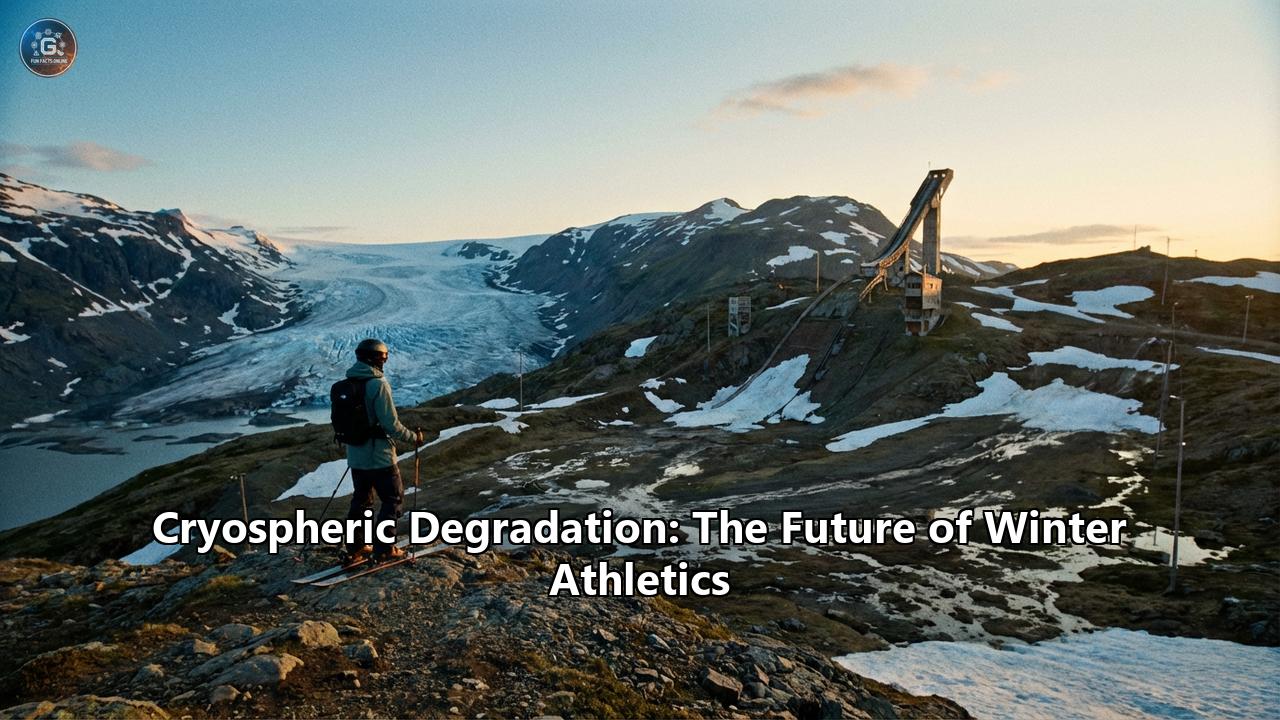
The crunch of fresh powder under a ski. The sharp, metallic carve of an ice skate on a frozen pond. The plumes of white breath in sub-zero air before a breathless, adrenaline-fueled downhill run. For generations, these visceral sensations have defined not just a season, but an entire culture. Winter sports have historically served as a breathtaking intersection of human endurance and the raw, untamed beauty of nature. But today, the crisp white canvas upon which these athletic feats are painted is rapidly shrinking, revealing a stark, brown reality underneath.
The global cryosphere—the frozen water part of the Earth system—is in an accelerated state of degradation. Shrinking glaciers, declining snowpack, and wildly erratic winter temperatures are rewriting the rules of winter athletics. From the highest echelons of the Olympic Games to the grassroots culture of local ski hills, the existential threat of climate change is forcing a profound and desperate reckoning. Winter sports are standing on thin ice, and the race to adapt is moving faster than a downhill slalom.
The Science of the Vanishing Winter
To understand the crisis facing winter athletics, one must first look at the staggering meteorological data defining our current decade. The winter of 2025–2026 has provided a grim preview of what climate models have long predicted. Across the American West, for instance, a historic snow drought has left mountain ranges barren. In February 2026, NASA satellite data revealed that snow covered just 139,322 square miles of the West—a staggering two-thirds below the normal average for this century, marking the lowest total in 25 years of satellite measurement. At the Salt Lake City Airport, a mid-February 2026 storm finally broke an agonizing 11-month streak without a single inch of snow, a drought record stretching back over 130 years.
This is not localized to North America. The European Alps, the historical epicenter of winter mountaineering and skiing, are experiencing dramatic shifts. Average January and February temperatures across the Alps are projected to increase by another 1°C over the next 25 years, with cold spells potentially decreasing by up to 66% under high-emissions scenarios by 2050. Globally, over the last 30 years, there has been a loss of 11 to 17 inches of national snowfall in the United States alone, with the traditional winter season contracting at both ends. Peak snowfall arrives later and melts earlier, drastically narrowing the window for winter recreation.
For winter sports, this cryospheric degradation is not merely an environmental footnote; it is the destruction of the playing field.
The Olympic Games: A Shrinking Pool of Winter Havens
Perhaps nowhere is the climate crisis more publicly visible than on the grand stage of the Winter Olympics. When Chamonix, France, hosted the inaugural Winter Games in 1924, events were held entirely outdoors, reliant wholly on the natural generosity of the season. A century later, nature has essentially withdrawn its permission.
Recent climate models have cast a long, dark shadow over the future of the Games. Researchers analyzed the 93 locations that have previously hosted or have the infrastructure to potentially host the Winter Olympics. The findings are chilling: by the 2050s, under mid-range warming scenarios, only 52 of those 93 cities will maintain the reliable climate conditions—specifically the natural snow depth and sub-freezing temperatures—necessary to host the event safely and fairly.
The outlook for the Paralympic Winter Games is even more dire. Because the Paralympics are traditionally held in March, a month later than the main Olympic events, they face a significantly warmer baseline. By the 2050s, only 22 of the 93 locations will remain viable for the Paralympics. If global emissions remain unchecked and we track toward a high-emissions scenario, by the 2080s, the number of viable Paralympic host cities could drop to just four worldwide.
The 2026 Winter Olympics in Milano-Cortina vividly illustrate this warming reality. Since Cortina d'Ampezzo first hosted the Winter Games in 1956, its average February temperatures have warmed by 6.4°F (3.6°C). The town now experiences 41 fewer freezing days annually than it did seven decades ago. Every single city that has hosted the Winter Olympics since 1950 has warmed significantly since its respective games. This reality has forced the International Olympic Committee (IOC) to fundamentally alter its planning, pivoting toward a strategy of rotating the Games among a permanent, shrinking pool of "climate reliable" hosts, whilst mandating that all future Olympic Games be "climate positive" by 2030.
The Frontlines: Professional Skiing's Calendar Chaos
Away from the quadrennial spectacle of the Olympics, the grueling, season-long grind of the International Ski and Snowboard Federation (FIS) World Cup is currently bearing the brunt of erratic winters. The professional alpine circuit has devolved into a logistical nightmare.
During the 2023/2024 season, FIS was forced to cancel an unprecedented 26 World Cup races due to weather-related reasons. Iconic downhill and super-G events in Garmisch-Partenkirchen, Germany, and Chamonix, France, were scrapped because of unseasonably warm temperatures and entirely unsafe snow conditions. The chaos continued into late 2024, when the highly anticipated women's Tremblant PwC World Cup in Quebec was canceled in December because temperatures simply refused to drop low enough to allow even for artificial snowmaking.
The resulting landscape is visually jarring and athletically perilous. Viewers tuning into modern ski broadcasts are routinely greeted by the dystopian image of a single, narrow ribbon of white, artificial snow snaking its way down a mountain composed entirely of brown dirt and green grass. Competing on these icy, man-made strips at speeds exceeding 80 miles per hour presents severe physical risks. The transition from hard artificial snow to soft, melting slush at the edges has led to a spike in catastrophic knee and joint injuries among elite athletes.
Recognizing that business as usual is no longer tenable, the Norwegian Ski Federation took the unprecedented step of formally demanding that FIS implement a "Climate-Friendly World Cup Calendar". Their landmark report, "Change the Course," argued that the traditional late-October start to the ski season is no longer scientifically or morally justifiable. They proposed delaying the start of the season to November, geographic clustering of races to minimize transatlantic air travel and emissions, and moving the World Championships to later in the season to align with the new, delayed realities of peak winter.
Furthermore, the crisis prompted a historic collaboration: in late 2024, the United Nations' World Meteorological Organization (WMO) formally partnered with FIS. It marked the first time a UN specialized agency partnered with an international sports federation, a move aimed at using advanced meteorological data to navigate the bleak future of mountain sports. As WMO Secretary-General Celeste Saulo gravely noted, canceled sporting fixtures are literally "the tip of the iceberg" of a much larger crisis threatening mountain ecosystems and global fresh water supplies.
The Economic Avalanche in Ski Towns
While elite athletes battle icy strips, the localized economies built around winter sports are facing total systemic collapse. The winter sports industry is a massive economic engine. In states like Colorado, the ski industry brings in nearly $5 billion annually and employs over 46,000 people. But when the snow fails to fall, the entire ecosystem fractures.
The early months of 2026 provided a brutal case study. With Colorado snowpack sitting at historically low levels—hovering around 57% of normal by January, with major resorts like Vail and Breckenridge operating with less than 65% of their terrain open—visitation plummeted. Vail Resorts, the largest mountain-resort operator in North America, reported a devastating 20% decline in visitors. Colorado Ski Country USA confirmed that early-season visits were down by "sizable double digits".
The ripple effect of a snow drought is catastrophic for local mountain towns. It isn't just the corporate mega-resorts losing lift ticket revenue; it is the independent ski rental shops reporting 20-30% drops in sales, the half-empty boutique hotels, and the restaurants forced to cut staff hours. "If we think about who's actually impacted, it's that small business," noted one Colorado local. The loss of reliable March snowfall has practically erased the lucrative spring break tourist rush, pushing many low-elevation and independent ski hills to the brink of bankruptcy. Bank of America researchers have warned that by 2050, a projected 20-30% decline in snow accumulation could mean that only high-altitude resorts remain economically viable, resulting in a mass die-off of beloved local ski areas.
Technological Band-Aids: The Artificial Snow Paradox
To survive, the winter sports industry has increasingly turned to technology, relying on a massive, carbon-intensive life-support system: artificial snowmaking. At the 2022 Beijing Olympics, organizers generated virtually 100% of the snow used for competition. This trend is continuing; the 2026 Milano-Cortina games rely heavily on massive reserves of manufactured snow.
However, we are rapidly discovering the absolute limits of this technological band-aid. Artificial snowmaking is not magic; it requires a specific meteorological threshold known as the "wet-bulb temperature" (a combined metric of air temperature and humidity) to be below 28 degrees Fahrenheit. As one expert bluntly put it, "Snow-making machines still need cold air, and cold air is disappearing". When cities like Denver experience 50-degree days in January, the massive infrastructure of water pipes and snow cannons becomes entirely useless.
Furthermore, artificial snow presents a deeply troubling environmental paradox. Snowmaking is incredibly energy and water-intensive. Future Olympic games may require upward of 2.4 million cubic meters of manufactured snow—the equivalent of 380 Olympic-sized swimming pools of water. While resorts argue that snowmaking is merely "borrowing" water that eventually melts back into the watershed, environmental hydrologists point out that machine-made snow does not replicate the natural, slow-release storage function of a deep mountain snowpack.
In arid regions already battling megadroughts, the optics and ethics of blasting millions of gallons of water onto a ski slope are becoming highly contentious. In states like Arizona, resorts have resorted to making snow out of treated municipal wastewater—a practice that has sparked over a decade of protests from Indigenous groups, such as the 13 Native American tribes who consider the San Francisco Peaks sacred. Resort operators are stuck in a Catch-22: without artificial snow, their businesses die; but generating artificial snow further strains the very water and energy grids driving the climate crisis in the first place.
Some resorts are pivoting to "snow farming"—the practice of stockpiling massive mounds of snow at the end of the winter, covering them with insulated tarps, and preserving them through the blistering heat of summer to guarantee a base layer for the following autumn. It is an ingenious adaptation, but also a deeply dystopian indicator of how far the industry has to go to manufacture a season that no longer occurs naturally.
Grassroots Culture and the Accessibility Crisis
While the cancellation of World Cup races grabs headlines, the quietest and perhaps most tragic casualty of cryospheric degradation is grassroots winter culture.
Winter sports were born on frozen community ponds, backyard sledding hills, and local, rope-tow ski areas. As winters shrink and natural freezes become a rarity, outdoor pond hockey—the soul of the sport in North America and Europe—is vanishing. Urban rail yards and local terrain parks are delaying their openings by months, if they open at all.
Because low-elevation, affordable ski hills are the first to close due to rising temperatures, the sport of skiing is being forced higher up the mountains to elite, well-capitalized mega-resorts. This altitude shift is triggering an accessibility crisis. Winter sports have always battled the stigma of elitism, but climate change is exacerbating the divide. If the only places left to ski or snowboard are luxury resorts operating above 10,000 feet, winter athletics will become the exclusive purview of the ultra-wealthy. The pipeline for future athletes will dry up; kids who grow up in cities that no longer see snow will never ask for a snowboard for their birthday, nor will they learn the quiet resilience that comes from enduring a bitter winter day.
Athlete Advocacy: Turning Passion Into Policy
The athletes themselves are refusing to let their sports melt away in silence. As the people who spend their lives interacting intimately with the cryosphere, winter athletes have become some of the most potent, firsthand witnesses to climate change. They are transforming their grief into militant political advocacy.
Leading this charge is Protect Our Winters (POW). Founded in 2007 by professional snowboarder Jeremy Jones, POW has evolved into a formidable political force, uniting 181 million outdoor enthusiasts into a bipartisan voting bloc known as the "Outdoor State". POW recognizes that the outdoor recreation industry has immense economic leverage, and they use it to lobby aggressively on Capitol Hill for clean air, public land protection, and monumental climate legislation.
Through their "Athlete Alliance," POW trains hundreds of professional skiers, snowboarders, ice climbers, and alpinists to be climate advocates. These athletes leverage their massive social media followings not just to post highlight reels, but to document the collapsing glaciers and shortening seasons they witness globally. In Europe, POW's "Reframe Your Journey" campaign has actively pushed the culture of winter sports toward sustainability, challenging athletes and fans to utilize public rail networks and low-emission travel to reach the mountains, directly attacking the massive carbon footprint of sports tourism.
For athletes, this fight is intensely personal. "For the ski industry, low snow isn’t just fewer powder days," says Erin Sprague, CEO of Protect Our Winters. "It means shorter seasons, higher operating costs, and real safety consequences. Drought creates unstable snowpack and, tragically, we’ve seen record avalanche deaths this season". The psychological toll—often referred to as 'ecological grief'—is profound among athletes who are watching the landscapes that defined their lives literally dissolve beneath their boots.
The Final Run
The future of winter athletics is a reflection of the future of the planet. We are currently manufacturing a season that the Earth is increasingly unwilling to provide. If current high-emissions trajectories continue, the image of an athlete carving through deep, natural powder will soon transition from a live, real-time broadcast to a nostalgic historical archive.
However, the descent into a snowless future is not yet an inevitability. Climate models make it clear: if the global community can meet the Paris Agreement goals and limit warming to 2°C above pre-industrial levels, the worst impacts can be mitigated. Under those conditions, the vast majority of Olympic host cities would remain viable through the end of the century, and the economic backbone of mountain towns could be preserved.
Winter sports have always been about overcoming the elements—finding balance, speed, and grace in the face of harsh, unforgiving gravity and cold. Now, the entire culture must apply that same resilience to saving the elements themselves. The fading white canvas of winter can still be saved, but the window to act is melting fast. The sport is no longer just about who can reach the bottom of the mountain the fastest; it is about ensuring there is still a mountain covered in snow for the generations waiting at the top.
Reference:
- https://www.fis-ski.com/inside-fis/news/2024-25/fis-and-wmo-partnership-highlights-the-harmful-effects-of-climate-change-on-winter-sports-and-tourism
- https://www.sierraclub.org/sierra/western-snow-drought-threatens-ski-season-and-much-more
- https://www.jupiterintel.com/blog/does-the-winter-olympics-have-a-future-in-the-alps
- https://institute.bankofamerica.com/sustainability/snow-trends-impact-on-ski-resorts.html
- https://www.youtube.com/watch?v=UdaY-zVPbrs
- https://www.climatecentral.org/climate-matters/2026-warming-winter-olympics
- https://calgaryherald.com/news/future-olympic-games-locations-calgary-weather-climate-change
- https://www.eesi.org/articles/view/on-thin-ice-rethinking-the-future-of-winter-sports-in-a-changing-climate
- https://apnews.com/article/ski-races-canceled-garmisch-9448a87a0d85bf554b3371a0bfb853b3
- https://skiracing.com/cancellation-of-the-2024-tremblant-pwc-world-cup-due-to-insufficient-cold-weather/
- https://skiracing.com/norwegian-ski-federation-to-fis-need-for-climate-friendly-world-cup-calendar/
- https://www.thecooldown.com/outdoors/colorado-low-snowpack-ski-season/
- https://www.9news.com/article/news/local/colorado-snow-drought-economic-challenges-ski-resorts-businesses/73-51cf493a-8352-4270-9d95-591c3899bfcc
- https://grist.org/energy/ski-resorts-are-increasingly-reliant-on-snowmaking-but-at-what-cost/
- https://protectourwinters.org/pow-international/
- https://socialmovements.trinity.duke.edu/groups/protect-our-winters-pow.html
- https://protectourwinters.org/pow-alliance/athlete-alliance/
- https://protectourwinters.eu/wp-content/uploads/2023/08/POW_EU_Impact_Report-small.pdf