
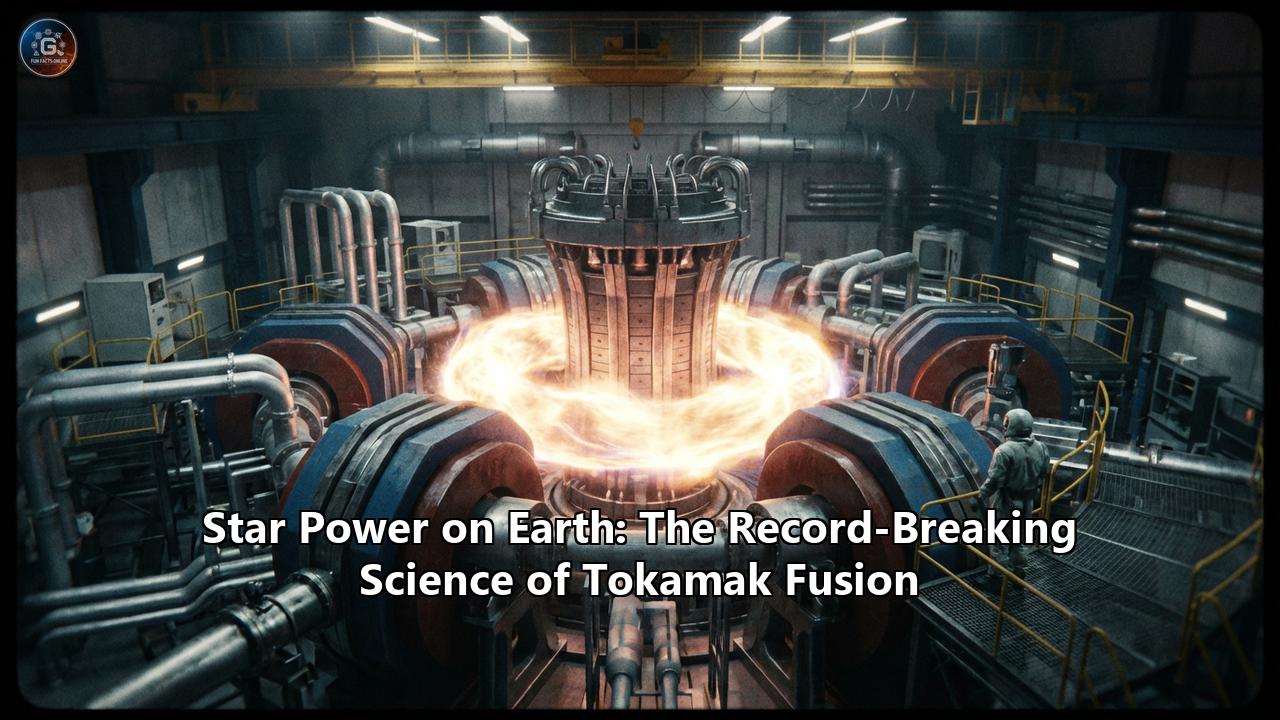
The dream of capturing the power of the stars is no longer the stuff of science fiction; it is an engineering reality being forged in laboratories across the globe. As humanity stands on the precipice of a clean energy revolution, the tokamak—a doughnut-shaped magnetic bottle designed to hold the hottest substance in the universe—has emerged as the frontrunner in the race for unlimited carbon-free power.
This is not merely a story of heating gas; it is a saga of defying nature’s limits. From the record-breaking sustained plasmas of China’s "Artificial Sun" to the raw power outputs of the UK’s JET reactor and the high-tech wizardry of private companies in the US, the years 2024 and 2025 have marked a turning point in fusion history. We are no longer just asking if it can be done, but when it will power our grid.
Part I: The Celestial Mechanic – How to Build a Star
To understand the magnitude of recent achievements, one must first grasp the sheer audacity of the tokamak concept. Our Sun is a fusion reactor, but it operates on a principle of brute force that is impossible to replicate on Earth: gravity.
The Sun vs. The MachineDeep inside the Sun, the crushing weight of $2 \times 10^{30}$ kilograms of hydrogen creates immense pressure (265 billion bar). Under these conditions, protons are forced together, overcoming their natural electrostatic repulsion to fuse into helium. This "proton-proton chain" is incredibly inefficient by volume; a cubic meter of the Sun’s core generates about as much heat as a compost heap. The Sun only shines because it is enormous.
On Earth, we cannot recreate stellar gravity. To make fusion work in a reactor that fits in a building, we must compensate for the lack of pressure by turning up the heat—to temperatures ten times hotter than the center of the Sun. We need 150 million degrees Celsius. At these energies, matter ceases to exist as a solid, liquid, or gas; it becomes plasma, a soup of stripped electrons and naked atomic nuclei.
The Magnetic BottleNo material vessel can hold this "star stuff." It would instantly melt any container. The solution is the Tokamak (a Russian acronym for Toroidal Chamber with Magnetic Coils).
- Toroidal Field: Huge superconducting magnets wrap around the doughnut to create a "long way around" magnetic field (the toroidal direction), acting as the primary cage.
- Poloidal Field: A central solenoid (a giant electromagnet in the hole of the doughnut) induces a massive electrical current inside the plasma itself. This current generates a secondary magnetic field that twists around the torus (the poloidal direction).
- The Result: A helical magnetic field that spirals like the stripes on a candy cane, trapping the charged particles of the plasma in endless loops, keeping them suspended away from the metal walls.
Part II: The Record-Breakers of 2024-2025
The last two years have seen a "Sputnik moment" for fusion, with records falling in rapid succession across the globe.
1. China’s Marathon Runner: EAST (The "Artificial Sun")
In January 2025, the Experimental Advanced Superconducting Tokamak (EAST) in Hefei, China, shattered the world record for plasma duration.
- The Record: EAST sustained a high-confinement steady-state plasma for 1,066 seconds (nearly 18 minutes).
- Why It Matters: Previous records were measured in seconds. Fusion power plants must run 24/7. Achieving high-confinement mode (H-mode)—a state of turbulence suppression where the plasma pressure jumps dramatically—for over 15 minutes proves that we can stabilize these volatile reactions over "reactor-relevant" timescales.
- The Tech: EAST uses fully superconducting magnets (unlike older copper-coil machines that overheat) and advanced radio-frequency heating to drive the current, proving that continuous operation is engineeringly feasible.
2. The Heat Master: KSTAR (South Korea)
While EAST goes for duration, South Korea’s KSTAR (Korea Superconducting Tokamak Advanced Research) goes for intensity.
- The Record: In early 2024, KSTAR maintained a plasma temperature of 100 million degrees Celsius for 48 seconds.
- Why It Matters: This is the "Goldilocks" zone for deuterium-tritium fusion. Many reactors can get hot for a split second, but holding 100 million degrees—seven times hotter than the Sun—requires mastering the "feedback loop" of plasma control.
- The Upgrade: KSTAR recently replaced its carbon "divertor" (the exhaust system) with one made of tungsten. Tungsten has the highest melting point of any metal (3,422°C), and this record proved that tungsten components can handle the extreme heat flux without melting and poisoning the plasma.
3. The Grand Finale: JET (United Kingdom)
The Joint European Torus (JET) in Oxford has been the workhorse of fusion for 40 years. In its final run before decommissioning in 2024, it went out with a bang.
- The Record: JET produced 69 Megajoules of fusion energy in a single 5-second pulse, using a fuel mix of Deuterium and Tritium (D-T).
- Why It Matters: Most reactors run on Deuterium-Deuterium (D-D) because it's non-radioactive and easier to handle. But real commercial reactors will use D-T because it fuses much more easily. JET is one of the only machines capable of handling Tritium. This record didn't just heat gas; it generated actual nuclear energy, proving the physics models for the massive ITER project are correct.
4. The Tungsten Titan: WEST (France)
In May 2024, the WEST tokamak set a record by sustaining a 50 million degree plasma for 6 minutes using a full tungsten wall.
- The Significance: Carbon walls act like sponges, soaking up the tritium fuel. This is a dealbreaker for commercial plants because tritium is incredibly rare and expensive. Tungsten doesn't absorb fuel. WEST’s achievement proved we can run long pulses with "non-stick" walls, solving a critical economic hurdle for future power plants.
Part III: The Engineering of the Impossible
Building a star on Earth requires solving some of the hardest engineering problems in history.
1. The Superconducting Revolution: LTS vs. HTS
The magnetic cage is the single most expensive component of a tokamak.
- Low-Temperature Superconductors (LTS): Used in ITER and KSTAR. These (typically Niobium-Tin, $Nb_3Sn$) must be cooled to 4 Kelvin (-269°C) using liquid helium. They are massive, expensive, and fragile.
- The Game Changer (HTS): Private companies like Commonwealth Fusion Systems (CFS) are pioneering High-Temperature Superconductors made of Rare-Earth Barium Copper Oxide (REBCO) tape. These can operate at "warmer" temperatures (20 Kelvin) and, more importantly, can generate much stronger magnetic fields (20 Tesla vs. 12 Tesla).
- The Physics Win: The power of a fusion reactor scales with the fourth power of the magnetic field ($B^4$). Doubling the magnetic field strength makes the reactor 16 times more powerful—or allows you to build it 16 times smaller. This is why private industry believes they can beat government projects: better magnets mean smaller, cheaper ships.
2. The Divertor: The Ultimate Exhaust Pipe
As helium "ash" builds up from the fusion reaction, it must be removed, or it will choke the fire. The divertor is a device at the bottom of the tokamak that acts as an exhaust system. It faces the greatest heat flux of any object ever built by man—equivalent to 10-20 MW per square meter. That is like pressing your hand against the surface of a re-entering space shuttle.
- The Innovation: Engineers are moving away from solid blocks to "monoblocks"—small tiles of tungsten bonded to copper cooling pipes. KSTAR and WEST have proven that these can survive the hellish conditions, provided we can control the plasma instabilities.
3. Taming the Beast: Instabilities
Plasma is essentially an electrical fluid, and it hates to be caged. It thrashes around, creating instabilities:
- ELMs (Edge Localized Modes): These are like "solar flares" on the surface of the plasma. If they touch the wall, they can melt the tungsten.
- Disruptions: The entire plasma current can collapse in milliseconds, slamming millions of amps of current into the reactor walls.
- The Fix: Modern tokamaks use "Resonant Magnetic Perturbations" (RMP)—small, precise magnetic coils that tickle the edge of the plasma to release pressure gently, like a safety valve, preventing the big explosions.
Part IV: The Commercial Race – Private Sector Velocity
While the massive international project ITER (International Thermonuclear Experimental Reactor) in France slowly marches toward its first full-power operations in the mid-2030s, agile startups are trying to leapfrog the timeline.
Commonwealth Fusion Systems (SPARC):Spun out of MIT, CFS is currently building SPARC in Devens, Massachusetts. It is designed to be the first machine to achieve Net Energy (Q > 1), meaning it produces more fusion heat than the electricity used to heat it.
- Status: The facility is under construction, with HTS magnets already successfully tested. They aim for first plasma by late 2026/2027. If successful, this validates the "high field, compact reactor" approach.
Based in the UK, this company uses a different shape: the Spherical Tokamak. instead of a doughnut, it looks like a cored apple.
- The Advantage: The spherical shape is naturally more stable and efficient, requiring less magnetic power to hold the plasma.
- Achievement: Their ST40 reactor was the first privately funded machine to hit 100 million degrees Celsius. They are now designing a pilot plant to demonstrate grid-capable power.
Part V: Safety, Regulation, and the Future Economy
The best news for fusion came not from a physics lab, but from a regulator's office.
The NRC Decision (2023):The US Nuclear Regulatory Commission voted to regulate fusion plants as "Particle Accelerators" (Part 30) rather than "Nuclear Fission Reactors" (Part 50).
- Why this is huge: Fission regulations require billions of dollars in capitalization, massive exclusion zones, and decades of licensing due to meltdown risks and high-level waste. Fusion has neither.
No Meltdown: If a fusion reactor fails, the plasma cools instantly and the reaction stops. It's like blowing out a candle; physics makes a runaway reaction impossible.
No Long-Lived Waste: The primary byproduct is Helium (harmless). The steel walls do get radioactive, but the half-life is short (about 100 years vs. 10,000+ years for fission waste).
- Economic Impact: This decision drastically lowers the barrier to entry, allowing startups to build pilot plants near cities and industrial centers.
Current projections suggest fusion could achieve a Levelized Cost of Electricity (LCOE) of $60–$70/MWh. While higher than wind or solar, fusion provides baseload power—it works at night and when the wind isn't blowing. It is the perfect clean partner to renewables, potentially replacing coal and gas plants entirely without needing massive battery storage.
Conclusion: The Dawn of the Stellar Age
The "Artificial Suns" of Earth are rising. The records set by EAST, KSTAR, and JET in 2024 and 2025 are not just data points; they are the proof of concept for a new era of civilization. We have mastered the magnets, we have tamed the heat, and we have begun to forge the materials that can withstand the heart of a star.
For decades, the joke was that "fusion is 30 years away and always will be." That joke is now obsolete. With the physics proven and the commercial race igniting, fusion is no longer a question of physics—it is a question of engineering and scale. The Star Power age is dawning.
Reference:
- https://www.quora.com/Which-type-of-energy-production-is-more-efficient-a-tokamak-or-a-stellarator-Which-one-is-closer-to-being-used-commercially-and-why
- https://en.wikipedia.org/wiki/Spherical_tokamak
- https://www.iaea.org/bulletin/magnetic-fusion-confinement-with-tokamaks-and-stellarators
- https://medium.com/predict/record-breaking-spherical-tokamak-promises-a-fusion-revolution-a266af5073dd
- https://www.fusionindustryassociation.org/nrc-decision-separates-fusion-energy-regulation-from-nuclear-fission/
- https://www.pillsburylaw.com/en/news-and-insights/nrc-fusion-energy-nuclear-fission-regulation.html
- https://www.fusionindustryassociation.org/learn-about-fusion-energy/fusionandfission/
- https://www.iaea.org/bulletin/safety-in-fusion
- https://www.nucnet.org/news/capital-costs-are-high-but-can-be-reduced-to-economically-competitive-level-10-4-2021