
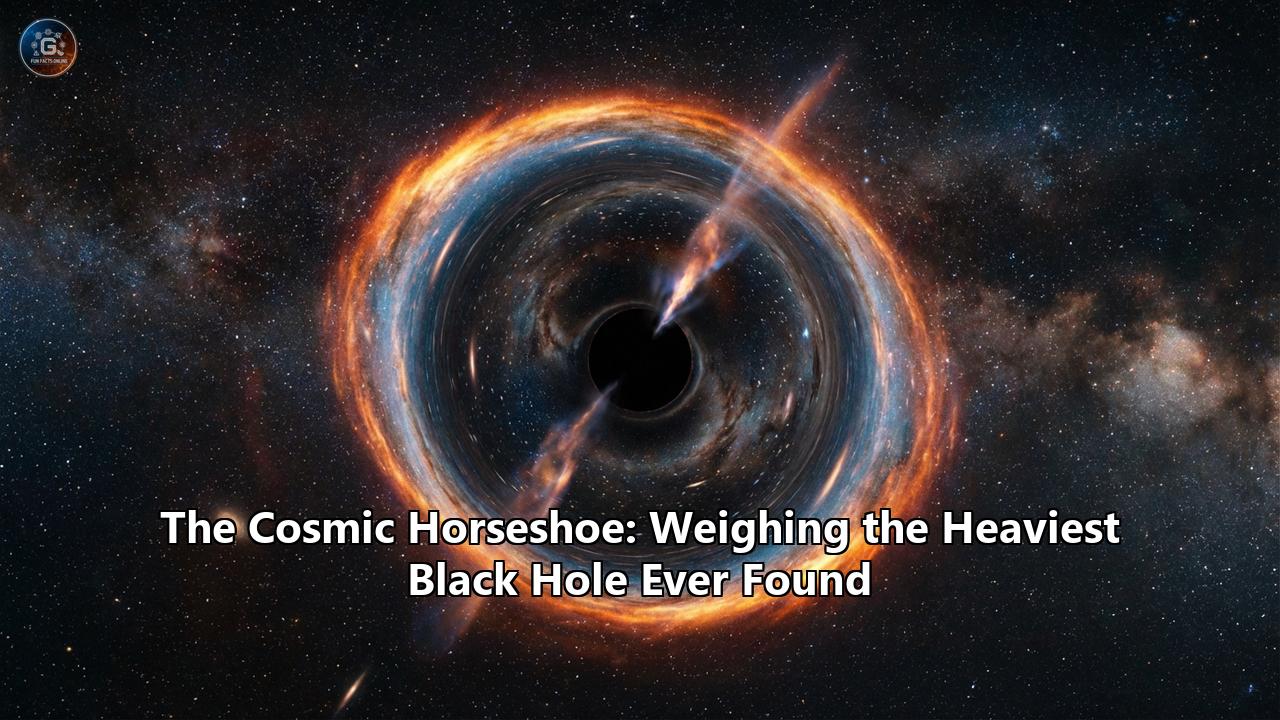
In the vast, silent cathedral of the cosmos, where galaxies drift like dust motes in a sunbeam, there exists a structure so perfectly aligned, so visually arresting, that it has captivated astronomers since its discovery. It is called the Cosmic Horseshoe. For years, it was famous for its beauty—a near-perfect "Einstein Ring" where the gravity of a massive foreground galaxy has warped the light of a distant background galaxy into a luminous, horseshoe-shaped arc.
But recently, the Cosmic Horseshoe has become famous for something else. Something invisible. Something terrifyingly heavy.
Buried deep within the heart of the lensing galaxy—a giant elliptical known as LRG 3-757—astronomers have weighed a monster. It is an ultramassive black hole, a gravitational titan boasting a mass of approximately 36 billion times that of our Sun. This measurement, confirmed in late 2025, places it firmly as one of the heaviest black holes ever detected, and potentially the heaviest ever weighed with such high precision. It is a discovery that challenges our understanding of how the universe grows, how galaxies evolve, and ultimately, how massive a single object can become before the laws of physics say "stop."
This is the story of that discovery. It is a story that spans billions of light-years, combining the genius of Albert Einstein, the power of modern supercomputing, and the relentless curiosity of the human spirit. To understand the weight of this beast, we must first understand the scale of the laboratory in which it was weighed.
Part I: The Geometry of Spacetime
To weigh a ghost, you cannot use a scale. You must use the universe itself.
The story begins not with a telescope, but with a pen and paper in Berlin, 1915. When Albert Einstein published his General Theory of Relativity, he upended the Newtonian view of gravity as a force pulling objects together. Instead, Einstein proposed that gravity was a curvature of spacetime. Massive objects—like stars and galaxies—dent the fabric of the universe, much like a bowling ball dents a trampoline.
One of the most startling predictions of this theory was that this curvature should affect not just physical objects, but light itself. If a beam of light passes near a massive object, it should follow the curve of spacetime, bending its path. Einstein realized that if a massive object stood directly between an observer and a distant light source, that massive object would act like a lens. It would bend the light around it, magnifying and distorting the background object.
For decades, this was a mathematical curiosity. Einstein himself doubted humanity would ever observe it; the alignment required was too precise, the stars too distant. He famously noted in 1936, "There is no great hope of observing this phenomenon directly."
He was wrong. He had underestimated the sheer density of the cosmos and the scale of galaxies.
In the late 20th century, as telescopes grew more powerful, astronomers began to spot them: strange, blue arcs smeared around yellow-red blobs. These were Gravitational Lenses. The yellow-red blob was a massive foreground galaxy, and the blue arc was a young, star-forming galaxy billions of light-years behind it, its light warped and magnified by the foreground galaxy's gravity.
The Cosmic Horseshoe is one of the most spectacular examples of this phenomenon. Discovered in 2007 by the Sloan Digital Sky Survey, it is located in the constellation Leo. The system consists of a massive Luminous Red Galaxy (LRG 3-757) sitting about 4.6 billion light-years away. Directly behind it, at a distance of about 10 billion light-years, sits a star-forming galaxy.
The alignment is nearly perfect. The gravity of LRG 3-757 grabs the light from the background galaxy—light that has been traveling for 10 billion years—and bends it into a ring of 300 degrees, a nearly complete circle. It looks like a horseshoe of blue fire surrounding a sphere of amber light.
For years, this system was a poster child for General Relativity. But in the 2020s, astronomers realized it was also a scale.
Part II: The Challenge of the Inactive Giants
To understand why the weighing of the Cosmic Horseshoe's black hole is so revolutionary, we must look at how we usually find black holes.
Most black holes are found because they are messy eaters. When a black hole actively consumes gas and dust, that material heats up to millions of degrees, glowing brightly in X-rays and radio waves. These are Quasars or Active Galactic Nuclei (AGN). They are beacons visible across the universe. Because the gas orbits the black hole, we can measure the speed of that gas and use simple orbital mechanics (Kepler’s laws) to calculate the black hole's mass.
But these "active" black holes are the minority. The vast majority of supermassive black holes in the universe are "quiet" or "inactive." They have long since eaten the gas in their vicinity and now sit silently in the dark. Our own Milky Way’s black hole, Sagittarius A, is one of these quiet types (mostly).
Weighing a quiet black hole is incredibly difficult. You cannot see an accretion disk because there isn't one. You have to look at the stars orbiting near the center of the galaxy. If there is a huge mass in the center, the stars will be whipping around at tremendous speeds to avoid falling in. By measuring the "velocity dispersion"—the jumbled chaos of stellar speeds—near the core, astronomers can infer the mass of the black hole.
However, this method has a limit. To see the motion of individual stars or small groups of stars near the center, you need incredibly sharp resolution. We can do this for nearby galaxies (like M87 or Andromeda). But for a galaxy 5 billion light-years away? The center of the galaxy is just a single pixel. The "sphere of influence" of the black hole—the region where its gravity dominates over the rest of the galaxy's stars—is too small to resolve.
This created a blind spot in astronomy. We knew ultramassive black holes must exist in the distant universe, but we had no way to weigh them. We were like census takers who could only count people living in our own apartment building.
Enter the Cosmic Horseshoe.
Part III: The Breakthrough
In 2025, a team of researchers led by astronomers from the University of Portsmouth and the Federal University of Rio Grande do Sul tackled this problem with a novel, hybrid approach. They realized that the Cosmic Horseshoe offered a unique laboratory.
The "lens" (the galaxy LRG 3-757) is extremely massive. We know this because of how much it bends the light of the background galaxy. The wider the Einstein Ring, the more mass is present in the lens. By modeling the shape of the blue horseshoe arc with extreme precision, the team could calculate the total mass of the foreground galaxy.
But total mass isn't enough. That mass includes dark matter, stars, gas, and the black hole. How do you separate the black hole from the rest?
The team combined two cutting-edge datasets:
- Hubble Space Telescope imaging: This provided the high-resolution shape of the gravitational arc (the "lens model").
- MUSE Spectroscopy (from the Very Large Telescope): This provided the speed of the stars within the lensing galaxy (stellar kinematics).
The breakthrough came from the realization that the black hole's gravity affects the lens in a subtle but distinct way compared to the dark matter or stars. A black hole is a "point mass"—all its weight is concentrated in the center. Dark matter is a "halo"—spread out over a huge area.
When the team tried to simulate the Cosmic Horseshoe using only stars and dark matter, the math didn't work. The bending of the light in the very center of the image, combined with the high speed of the stars in the core, could not be explained. The models kept breaking. The stars in the center were moving too fast, and the light near the center was being bent too sharply.
They added a black hole to the simulation. They started small: 1 billion solar masses. Still not enough. 10 billion. Closer. 20 billion. Almost.
When they dialed the mass up to 36 billion solar masses, the simulation snapped into focus. Suddenly, the math perfectly matched the reality. The speed of the stars and the warp of the background light were in perfect harmony.
The result was a shock. 36 billion solar masses.
To put that number in perspective:
- The black hole at the center of the Milky Way (Sagittarius A) is 4 million solar masses.
- The famous black hole in M87 (imaged by the Event Horizon Telescope) is 6.5 billion solar masses.
- The Cosmic Horseshoe black hole is nearly 6,000 times more massive than the one in our own galaxy.
If you replaced our Sun with this black hole, its event horizon (the point of no return) would not just swallow the Earth; it would swallow the entire solar system, extending out far beyond the orbit of Pluto, reaching into interstellar space. It is a hole in reality the size of a solar system.
Part IV: The Ultramassive League
The discovery of a 36-billion-solar-mass object catapulted the Cosmic Horseshoe into the rare and terrifying league of Ultramassive Black Holes (UMBHs).
For a long time, astronomers distinguished only between "stellar-mass" black holes (formed from dying stars, 10-100 times the mass of the Sun) and "supermassive" black holes (millions to billions of solar masses). But as discoveries like the one in Abell 1201 (weighed at roughly 33 billion solar masses in 2023) and now the Cosmic Horseshoe piled up, it became clear that a new weight class was needed.
Ultramassive black holes are those exceeding 10 billion solar masses. They are the dinosaurs of the cosmos—ancient, gargantuan, and largely mysterious.
The existence of such objects poses a "chicken or egg" problem for cosmology.
Did the galaxy form first, and then the black hole grew by eating gas? Or did the black hole form first, acting as a seed around which the galaxy coalesced?
In the local universe, there is a well-known relationship called the M-sigma relation. It states that the mass of a central black hole is usually about 0.1% of the mass of the galaxy's central bulge of stars. It’s a tight correlation, suggesting the black hole and galaxy grow together, regulating each other.
But the Cosmic Horseshoe breaks this rule. The black hole is "over-massive." It accounts for a much larger fraction of its galaxy's mass than expected. This suggests that for these most extreme galaxies, the black hole might have had a head start, or perhaps the galaxy is the result of many "dry mergers"—collisions between galaxies where there wasn't much gas to make new stars, but the black holes merged, causing the central monster to grow faster than the stellar population.
We are looking at a fossil. LRG 3-757 is a "red and dead" galaxy. It has stopped making new stars. It is an elliptical giant, likely the product of billions of years of galactic cannibalism. Its central black hole is the victor of countless gravitational wars, having consumed or merged with every other black hole that dared to enter its territory.
Part V: The Inami Limit – Can They Grow Forever?
One of the most fascinating aspects of the Cosmic Horseshoe discovery is how close it gets to the theoretical "ceiling" of black hole growth.
Physicists believe there is a limit to how big a black hole can grow via accretion (eating gas). This is often called the Inami Limit or the disk-fragmentation limit, and it is estimated to be somewhere between 50 billion and 270 billion solar masses.
Here is the physics behind the limit:
To feed a black hole, gas must spiral inward in an accretion disk. As it spirals, friction heats it up, and it falls in. However, if a black hole gets too massive, the physics of the disk changes. The event horizon becomes so large that the gas disk is pushed further out, where gravity is weaker. At these vast distances, the gas cools down. If the gas gets too cold, it becomes unstable. Instead of spiraling smoothly into the black hole, the gas clumps together under its own gravity and collapses to form stars.
Essentially, once a black hole reaches ~50 billion solar masses, its food supply turns into stars before it can be eaten. The black hole cuts off its own food source.
The Cosmic Horseshoe black hole, at 36 billion solar masses, is knocking on the door of this limit. It suggests we are seeing the "end game" of black hole evolution. These are the largest single objects that can likely exist in the universe. To grow larger, they can no longer eat gas; they must merge with other ultramassive black holes—a cataclysmic event that would shake the very fabric of spacetime with low-frequency gravitational waves.
Part VI: The Future of the Past
Why does this matter to us, sitting on a small rock 5 billion light-years away?
First, it validates our understanding of gravity. The fact that General Relativity works so precisely that we can use it to weigh a dark object across half the observable universe is a triumph of human intellect.
Second, it opens a new window. The technique used to weigh the Cosmic Horseshoe—combining gravitational lensing with stellar dynamics—is a proof of concept. With upcoming missions like the European Space Agency’s Euclid telescope and NASA’s Nancy Grace Roman Space Telescope, we are about to find thousands of new gravitational lenses.
Euclid, for instance, is designed to map the geometry of the dark universe. It will discover tens of thousands of Einstein Rings. Among them will be hundreds of "Cosmic Horseshoes." We are entering an era of Black Hole Demographics. Instead of studying just one or two monsters, we will be able to conduct a census of the heavyweight population of the universe.
We will learn if 36 billion is an anomaly or a standard upper limit. We will learn if these monsters exist in the early universe, which would break our models of cosmic time (how could something get that big that fast?). We will learn the true role these dark titans play in shaping the galaxies we see today.
Conclusion
The Cosmic Horseshoe is a beautiful accident of celestial mechanics. A chance alignment of two galaxies that allows us to see the invisible. But it is also a warning and a wonder. It reminds us that the universe operates on scales that dwarf human comprehension.
Deep in the constellation Leo, in a galaxy that stopped making stars eons ago, sits a sphere of darkness 36 billion times the mass of our Sun. It is silent. It is sleeping. It has eaten everything there is to eat. And thanks to a trick of light and gravity first scribbled on a notepad in 1915, we know exactly how much it weighs.
As we look up at the night sky, we must remember: the darkness is not empty. It is heavy. And the universe is full of monsters waiting to be weighed.
Reference:
- https://universemagazine.com/en/mystery-of-the-cosmic-horseshoe-discovery-of-a-record-breaking-gravitational-monster/
- https://www.earth.com/news/largest-ultramassive-black-hole-ever-seen-cosmic-horseshoe-lrg-3-757/
- https://apicciano.commons.gc.cuny.edu/2025/08/31/with-the-mass-of-36-billion-suns-cosmic-horseshoe-might-be-the-biggest-black-hole-ever-found/
- https://www.livescience.com/space/black-holes/cosmic-horseshoe-may-contain-black-hole-the-size-of-36-billion-suns-one-of-the-largest-ever-detected
- https://www.thebrighterside.news/post/astronomers-detect-the-largest-black-hole-ever-observed-mass-equal-to-36-billion-suns/
- https://www.reddit.com/r/spaceporn/comments/1pyvczk/36_billion_solar_masses_cosmic_horseshoe_galaxy/
- https://www.sciencedaily.com/releases/2025/08/250810093231.htm
- https://www.zmescience.com/science/news-science/a-supermassive-black-hole-36-billion-times-the-mass-of-the-sun-might-be-the-heaviest-ever-found/
- https://mappingignorance.org/2025/08/12/cosmic-horseshoe-galaxy-harbours-the-most-massive-black-hole-ever-detected/
- https://www.news9live.com/science/black-hole-revealed-by-gravitational-lensing-is-among-largest-known-au941-2089749
- https://www.forbes.com/sites/jamiecartereurope/2023/03/28/einstein-ring-light-bending-reveals-one-of-the-biggest-black-holes-ever-found/
- https://www.reddit.com/r/space/comments/14pptku/gravitational_lensing_has_been_used_for_the_first/
- https://www.youtube.com/watch?v=mqHD2lVSsqQ
- https://www.livemint.com/mint-lounge/business-of-life/gravitational-lensing-reveals-one-of-the-biggest-black-holes-ever-found-111680248887278.html
- https://ras.ac.uk/news-and-press/research-highlights/light-bending-gravity-reveals-one-biggest-black-holes-ever-found
- https://newatlas.com/space/ultramassive-black-hole-abell-1201/
- https://arxiv.org/abs/2303.15514
- https://www.livescience.com/physics-mathematics/record-breaking-gravitational-wave-puts-einsteins-relativity-to-its-toughest-test-yet-and-proves-him-right-again