
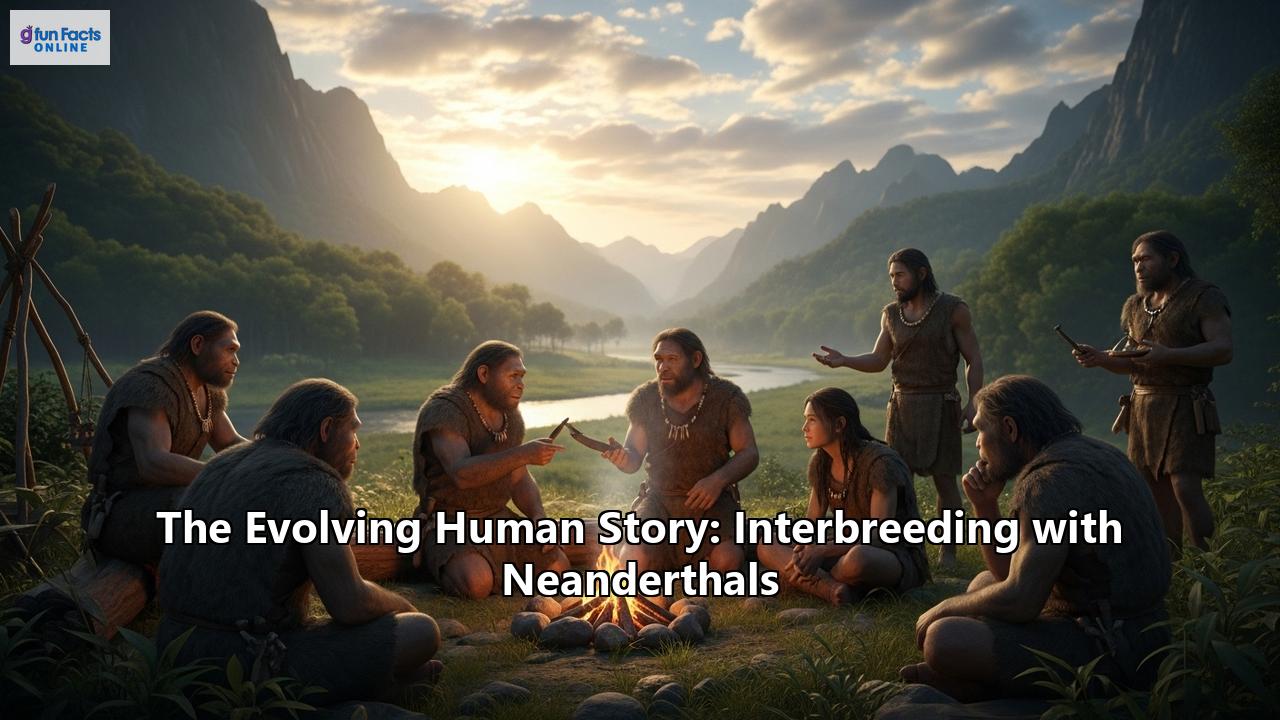
An intricate narrative of our own origins lies etched within the very fabric of our DNA, a story far more complex and intertwined than we once ever imagined. For decades, the tale of our species, Homo sapiens, was told as a linear march of progress, a triumphant replacement of all other human forms. But the whispers from our ancient past, carried in fossilized bones and decoded from the ghostly remnants of ancient genomes, have revealed a far more intimate and fascinating truth. This is the story of a time when we were not the only humans on Earth, a time of encounters, interactions, and a shared legacy with our closest extinct relatives: the Neanderthals. It's a story that has profoundly reshaped our understanding of what it means to be human, revealing that in a very real sense, the Neanderthals never truly vanished—they live on within us.
Part 1: The Encounter - A World of Two Humans
*A Tale of Two Hominins: Neanderthals and Homo sapiens---
To understand the story of interbreeding, we must first picture the world as it was, a world populated by different kinds of humans.
---The World of the Neanderthals---
The first Neanderthal fossils were unearthed in the Neander Valley in Germany in 1856, and for a long time, our perception of these ancient people was colored by caricature. They were often depicted as brutish, hunched-over cavemen. However, modern science has painted a much more nuanced and sophisticated picture of Homo neanderthalensis.
Neanderthals evolved in Europe and Asia, while our own species, Homo sapiens, was evolving in Africa. They were well-established in Eurasia by 400,000 years ago and had a vast geographical range, from Portugal in the west to the Altai Mountains of Siberia in the east. They were supremely adapted to the often harsh and fluctuating climates of the Pleistocene, or Ice Age. Their physical build reflects these adaptations: they were shorter and stockier than modern humans, a physique that would have conserved heat in colder environments. They possessed a large nose, which may have helped to warm and humidify the cold, dry air they breathed. Their brains were, on average, larger than those of modern humans.
Far from being primitive, Neanderthals had a complex culture. They were skilled hunters of large game, such as mammoths, reindeer, and rhinoceroses, but their diet was not exclusively carnivorous. Evidence from their dental plaque and fossilized feces shows they also consumed a variety of plants, including grains, nuts, and berries, and even had knowledge of medicinal plants. They were proficient in making and using fire, which provided warmth, protection, and a means to cook their food. They crafted a sophisticated toolkit known as the Mousterian industry, which included a variety of stone tools for different tasks, such as hunting, butchering, and woodworking.
There is also growing evidence of their symbolic and social lives. They likely lived in small, family-based groups and cared for their sick and elderly. Some of the most poignant evidence of their humanity comes from their burial practices. At sites like Shanidar Cave in Iraq, there is evidence that they intentionally buried their dead, sometimes with offerings such as flowers. They also created personal adornments, such as perforated shells and animal teeth, and may have been responsible for some of the earliest forms of art, including cave paintings and engravings.
---The Rise of Homo sapiens---
Meanwhile, in the vast continent of Africa, our own story was unfolding. The earliest fossils of Homo sapiens have been found in Africa, dating back to around 300,000 years ago. Anatomically, these early modern humans were different from Neanderthals. They had a more slender build, a higher and more rounded skull, a smaller brow ridge, and a prominent chin.
Our early ancestors in Africa also had a rich and complex culture. They developed sophisticated toolkits, including projectile weapons, which may have given them an advantage in hunting. They had a diverse diet that included not only large game but also fish and shellfish, indicating a flexible and adaptable approach to subsistence. There is also abundant evidence of symbolic behavior, including the use of pigments like ochre for body decoration or ritual purposes, the creation of personal ornaments, and the development of art. They also appear to have had larger social networks and engaged in long-distance trade.
Out of Africa: The Great Human ExpansionFor hundreds of thousands of years, Neanderthals and Homo sapiens remained largely separate, evolving on different continents. But that began to change as modern humans started to expand their range beyond Africa. This "Out of Africa" migration was not a single event but a series of waves. Early forays into the Levant (the region of the Middle East bordering the Mediterranean) may have occurred as early as 177,000 to 194,000 years ago, as evidenced by fossils found in Misliya Cave in Israel.
However, the main wave of migration that led to the peopling of the rest of the world is thought to have occurred between 50,000 and 70,000 years ago. As these modern humans moved into Eurasia, they entered a world already inhabited by another human species: the Neanderthals.
When and Where They Met: A Timeline and Geography of CohabitationThe encounters between Homo sapiens and Neanderthals were not fleeting. Genetic and archaeological evidence suggests that the two human groups coexisted in various parts of Eurasia for thousands of years. The first contact likely happened in the Middle East, a crossroads between Africa and Eurasia.
Recent discoveries have pushed back the timeline of these interactions significantly. In Skhul Cave on Mount Carmel in Israel, the fossil of a child dating back 140,000 years shows a mix of Homo sapiens and Neanderthal features, providing the earliest known physical evidence of interbreeding. This suggests that social and biological interactions were occurring long before the main wave of modern humans left Africa.
Further evidence of cohabitation and potential interaction comes from numerous archaeological sites across Eurasia. In the Zagros Mountains of modern-day Iran and Iraq, researchers have identified a potential contact zone where the habitats of Neanderthals and modern humans overlapped. Sites like Shanidar Cave provide evidence of a long Neanderthal presence in a region that would later be populated by modern humans.
In Europe, the arrival of modern humans around 45,000 years ago led to a period of coexistence with Neanderthals that lasted for several thousand years. At a site near Ranis, Germany, genetic analysis of bone fragments has shown that modern humans were present in Northern Europe 45,000 years ago, at the same time as Neanderthals. In Romania, a 40,000-year-old Homo sapiens mandible was found to have a significant amount of Neanderthal DNA, suggesting a recent Neanderthal ancestor.
The Pleistocene Stage: An Ever-Changing WorldThese encounters did not happen in a static world. The Pleistocene epoch was a time of dramatic climate fluctuations, with long glacial periods, or "ice ages," punctuated by warmer interglacial periods. These climatic shifts profoundly shaped the landscapes of Eurasia and influenced the distribution of both Neanderthals and modern humans.
During colder periods, vast ice sheets covered much of northern Europe, forcing both human populations into southern refugia, such as the Iberian Peninsula, Italy, and the Balkans. During warmer periods, these populations could expand their ranges again. These cycles of contraction and expansion would have brought different groups into contact, creating opportunities for interaction and interbreeding. The changing climate also affected the availability of resources, influencing diet and hunting strategies. Neanderthals, for example, were highly adaptable, hunting reindeer in the cold and red deer in the warmer periods.
Part 2: The Evidence - Uncovering a Shared Past
For a long time, the idea that humans and Neanderthals interbred was a contentious one. But in recent decades, a wealth of evidence from both fossils and genetics has turned this once-fringe hypothesis into a cornerstone of our understanding of human evolution.
Whispers in the Bones: The Fossil EvidenceThe first clues of interbreeding came not from DNA but from the bones of our ancestors. For decades, paleontologists had unearthed fossils that didn't fit neatly into the categories of either Neanderthal or modern human. These "intermediate" or "mosaic" fossils displayed a blend of traits from both groups.
The caves of Skhul and Qafzeh in Israel have yielded a treasure trove of such fossils. The remains of at least 10 individuals from Skhul and 15 from Qafzeh, dating from around 120,000 to 90,000 years ago, show a mix of anatomical features. For example, the Skhul V individual has prominent brow ridges and a projecting face, characteristic of Neanderthals, but a rounded braincase similar to modern humans. The recent re-analysis of the Skhul I child's skull, dating back 140,000 years, has confirmed its hybrid nature, with a modern human-like skull shape but a Neanderthal-like lower jaw and inner ear structure.
Another famous example is the "Lapedo Child," a 24,500-year-old skeleton of a young boy found in Portugal. This fossil, much younger than the Skhul remains, also displays a mosaic of features, with the stocky limbs of a Neanderthal but the chin and lower jaw of a modern human.
While these mosaic fossils were highly suggestive, they were not definitive proof of interbreeding. It was possible that they represented a shared ancestral population or simply variation within a single species. The definitive answer would have to come from a new and powerful tool: ancient DNA.
The Genetic Revolution: Reading the Neanderthal GenomeThe idea of extracting and sequencing DNA from extinct organisms was once the realm of science fiction. Ancient DNA is incredibly fragile, degrading over time into tiny fragments. It is also highly susceptible to contamination from modern DNA, especially from the humans who excavate and handle the fossils.
---The Pioneers of Ancient DNA---
Overcoming these challenges was the life's work of a generation of scientists, most notably the Swedish geneticist Svante Pääbo. Pääbo and his team at the Max Planck Institute for Evolutionary Anthropology in Leipzig, Germany, spent years developing new techniques for extracting, sequencing, and analyzing ancient DNA. They pioneered the use of "clean rooms" to prevent contamination and developed sophisticated computational methods to piece together the fragmented genetic code of ancient organisms.
Pääbo's early work involved extracting DNA from Egyptian mummies and other ancient remains. He then turned his attention to our closest extinct relatives, the Neanderthals. In 1997, his team succeeded in sequencing a small piece of mitochondrial DNA (mtDNA) from a Neanderthal fossil. MtDNA is more abundant in cells than nuclear DNA, making it easier to recover from ancient samples. The results showed that Neanderthal mtDNA was distinct from that of modern humans, suggesting that they were a separate species.
---The Bombshell Discovery---
The real breakthrough came in 2010, when Pääbo's team published the first draft of the complete Neanderthal nuclear genome, sequenced from the bones of three female Neanderthals found in Vindija Cave, Croatia. This monumental achievement allowed for a direct comparison of the Neanderthal genome with that of modern humans.
The results were stunning. The study revealed that people of non-African descent have between 1% and 4% Neanderthal DNA in their genomes. This was the smoking gun, the irrefutable evidence that Homo sapiens and Neanderthals had interbred. The timing of this interbreeding was estimated to have occurred after modern humans migrated out of Africa, likely between 47,000 and 65,000 years ago.
This discovery sent shockwaves through the scientific community and fundamentally changed our understanding of human origins. It meant that the "Out of Africa" story was not one of simple replacement but of complex interaction and admixture.
The Nature of the Interactions: A Glimpse into a Shared WorldThe evidence of interbreeding raises a tantalizing question: what were these encounters like? Were they peaceful exchanges, violent confrontations, or something in between? While the archaeological record cannot give us all the answers, it does offer some intriguing clues about the nature of the interactions between Neanderthals and modern humans.
The fact that interbreeding occurred at all suggests that the two groups did not see each other as entirely alien. They were able to recognize each other as potential mates and produce fertile offspring. This implies a level of social and biological compatibility.
There is also evidence of cultural exchange. At some sites, there is a blending of tool technologies. The Châtelperronian industry in France and Spain, for example, features tools that seem to combine elements of the Neanderthal Mousterian tradition with the more advanced blade technology of modern humans. While it is debated whether Neanderthals developed this technology independently or learned it from modern humans, it suggests a period of cultural contact.
Recent discoveries in Tinshemet Cave in Israel have revealed that Neanderthals and Homo sapiens* not only lived in the same region but also shared aspects of their daily life, including tool-making techniques and even funerary practices. This suggests a long-term and intertwined relationship.
Of course, the interactions were likely not always peaceful. Competition for resources, such as food and shelter, would have been a reality, especially in the face of a changing climate. The arrival of modern humans in Europe and Asia coincided with the decline and eventual extinction of the Neanderthals, suggesting that competition may have played a role.
Part 3: The Legacy - The Neanderthal Within Us
The legacy of these ancient encounters is written in our genes. For those of us with ancestry outside of Africa, a small but significant part of our genetic makeup is a direct inheritance from our Neanderthal relatives. This genetic legacy is not just a curiosity; it has a real and ongoing impact on our biology, from our appearance to our health.
The Gift of Genes: Neanderthal DNA in Modern Humans---How Much and Who Carries It?---
On average, people of European and Asian descent have about 1% to 2% Neanderthal DNA. The percentage can be slightly higher in East Asians. Interestingly, recent studies have also found traces of Neanderthal DNA in modern African populations, challenging the long-held belief that interbreeding only occurred outside of Africa. This suggests a more complex pattern of migration and gene flow, with some modern humans migrating back into Africa after interbreeding with Neanderthals.
---A Double-Edged Sword: The Functional Significance of Neanderthal Genes---
The Neanderthal DNA that has persisted in our genomes is not just a random collection of genes. In many cases, it appears to have been preserved because it offered a selective advantage to our ancestors as they moved into new environments.
Boosting the Immune System:One of the most significant contributions of Neanderthal DNA is to our immune system. As modern humans migrated out of Africa, they would have encountered new pathogens to which they had no immunity. Neanderthals, having lived in Eurasia for hundreds of thousands of years, would have been well-adapted to these local diseases. By interbreeding with Neanderthals, modern humans acquired a "genetic toolkit" that helped them fight off these new infections. Several genes involved in the immune response, such as those for Toll-like receptors that play a key role in the body's first line of defense, show a high frequency of Neanderthal variants.
Skin, Hair, and Adaptation to New Environments:Neanderthal DNA has also influenced our physical traits. Some Neanderthal gene variants are associated with hair and skin characteristics, including hair color and skin tone. These genes may have helped our ancestors adapt to the different levels of sunlight in Eurasia. For example, some Neanderthal alleles are linked to the production of keratin, a fibrous protein that gives toughness to skin, hair, and nails. This could have provided better insulation in colder climates.
The Dark Side of the Legacy: A Link to Modern Diseases:However, the genetic legacy of the Neanderthals is a double-edged sword. Some of the gene variants that were advantageous in the past may be detrimental in our modern environments.
Neanderthal DNA has been linked to an increased risk for a range of modern diseases. These include autoimmune diseases like lupus and Crohn's disease, where the immune system mistakenly attacks the body's own tissues. This may be a downside of the "boosted" immune system we inherited.
There are also associations with type 2 diabetes, blood clotting disorders, and even the severity of COVID-19. A gene cluster on chromosome 3, inherited from Neanderthals, has been identified as a major genetic risk factor for severe COVID-19.
Behavioral Traits: Mood, Sleep, and Addiction:The influence of Neanderthal DNA may even extend to our behavior. Some studies have found associations between Neanderthal gene variants and mood disorders like depression, as well as nicotine addiction. Other variants may affect our sleeping patterns. The reasons for these associations are still being explored, but they highlight the complex and far-reaching impact of our ancient inheritance.
The "Deserts" in Our Genome: What's Missing and WhyJust as revealing as the Neanderthal DNA that is present in our genomes is the DNA that is conspicuously absent. There are large regions of our genome that are "deserts" of Neanderthal ancestry. These deserts are often found on the X chromosome and in genes that are expressed in the testes.
This suggests that some Neanderthal gene variants were harmful to modern humans and were weeded out by natural selection. The lack of Neanderthal DNA in genes related to male fertility suggests that male hybrids may have had reduced fertility, a common issue when two different species interbreed.
Part 4: The Bigger Picture - Rethinking Human Evolution
The discovery of interbreeding with Neanderthals has been a paradigm shift in our understanding of human evolution. It has replaced a simple, linear story of replacement with a much more complex and fascinating narrative of interaction and admixture.
A More Complex Story: Beyond the Replacement ModelFor a long time, the prevailing theory of modern human origins was the "Recent African Origin" or "Out of Africa" model, which posited that modern humans evolved in Africa and then spread out and replaced all other archaic human populations without any significant interbreeding. The evidence of interbreeding with Neanderthals has shown that this model is too simplistic.
The story of human evolution is not a neat family tree but a tangled web. It is a story of multiple human lineages coexisting and interacting, a story of gene flow and shared ancestry. This more complex picture is not limited to Neanderthals. The sequencing of ancient DNA has also revealed the existence of another archaic human group, the Denisovans, who lived in Asia and also interbred with modern humans.
The End of the Neanderthals: A Fading LightAround 40,000 years ago, after a reign of hundreds of thousands of years, the Neanderthals disappeared from the fossil record. The reasons for their extinction are still debated, but it was likely a combination of factors.
The arrival of large populations of modern humans would have led to increased competition for resources. The fluctuating climate of the late Pleistocene may have also played a role, creating environmental stress. It is also possible that the Neanderthals were, to some extent, absorbed into the larger and more genetically diverse modern human population through interbreeding. Their small and fragmented populations may have made them vulnerable to these pressures.
Beyond Neanderthals: The Denisovan ConnectionThe story of archaic interbreeding doesn't end with the Neanderthals. In 2010, the same year the Neanderthal genome was published, Svante Pääbo's team announced another incredible discovery. They had sequenced DNA from a 40,000-year-old finger bone found in Denisova Cave in Siberia. The DNA was distinct from both Neanderthals and modern humans, revealing a previously unknown group of archaic humans: the Denisovans.
Subsequent research has shown that Denisovans also interbred with modern humans, particularly the ancestors of modern Melanesians, who carry up to 6% Denisovan DNA. This discovery has added another layer of complexity to our understanding of human origins, showing that our ancestors encountered and interacted with a variety of human forms as they spread across the globe.
Conclusion: A Shared Human Story
The revelation that our ancestors interbred with Neanderthals has profoundly changed our perception of ourselves and our place in the natural world. It has blurred the lines between "us" and "them" and has shown that the human story is one of connection and shared heritage.
The Neanderthals were not a failed side branch of human evolution; they were a successful and adaptable human species with a rich culture and a long history. Their story is our story, and their legacy lives on in our genes, shaping our biology in ways we are only just beginning to understand.
The ongoing research into our ancient past continues to reveal new surprises and challenge our long-held assumptions. The evolving human story is a testament to the power of scientific discovery to rewrite our own narrative, to uncover the deep and complex connections that bind us to our ancient relatives, and to remind us that we are all part of a single, intricate, and ongoing human story.
Reference:
- https://www.sciencelearn.org.nz/resources/2024-extracting-ancient-dna
- https://en.wikipedia.org/wiki/Neanderthal
- https://news.stanford.edu/stories/2018/10/modern-humans-inherited-viral-defenses-neanderthals
- https://www.sfu.ca/~donyang/adnaweb/Yang%20DY%20JAS2005a.pdf
- https://owlcation.com/stem/8-neanderthal-traits-in-modern-humans
- https://core.ac.uk/download/pdf/56376205.pdf
- https://www.sciencedaily.com/releases/2016/03/160314091128.htm
- https://europe.factsanddetails.com/article/entry-57.html
- https://www.thesciencebreaker.org/breaks/evolution-behaviour/the-daily-life-of-neandertals
- https://www.sapiens.org/biology/neanderthal-diet/
- https://library.fiveable.me/world-prehistory/unit-4/neanderthal-anatomy-behavior-culture/study-guide/pLy1gwcNy6bMR1wp
- https://www.pathwayz.org/Tree/Plain/NEANDERTHAL+CULTURE+%26+TOOLS
- https://europe.factsanddetails.com/article/entry-55.html
- https://medlineplus.gov/genetics/understanding/dtcgenetictesting/neanderthaldna/
- https://www.donsmaps.com/neanderthalart.html
- https://news.artnet.com/art-world/neanderthals-made-art-too-startling-new-research-suggests-2650173
- https://news.cornell.edu/stories/2023/06/lingering-effects-neanderthal-dna-found-modern-humans
- https://en.wikipedia.org/wiki/Early_modern_human
- https://humanorigins.si.edu/human-characteristics/social-life
- https://www.youtube.com/watch?v=D8vYSiKE3E4
- https://news.vanderbilt.edu/2016/02/11/neanderthal-dna-has-subtle-but-significant-impact-on-human-traits/
- https://news.harvard.edu/gazette/story/2014/01/neanderthals-dna-legacy-linked-to-modern-ailments/
- https://www.biotechniques.com/molecular-biology/ancient-dna-modern-methods-of-extraction/
- https://www.technologynetworks.com/genomics/news/neanderthal-dna-has-lingering-effects-in-modern-humans-374462
- https://www.livescience.com/health/genetics/10-unexpected-ways-neanderthal-dna-affects-our-health
- https://dergipark.org.tr/en/download/article-file/1489695
- https://pubmed.ncbi.nlm.nih.gov/30875054/
- https://www.tandfonline.com/doi/full/10.1080/20548923.2016.1258824
- https://www.britannica.com/biography/Svante-Paabo
- https://pmc.ncbi.nlm.nih.gov/articles/PMC9910432/
- https://leakeyfoundation.org/svante-paabo-wins-nobel-prize-ancient-dna/
- https://academic.oup.com/nsr/article/11/9/nwae120/7636505
- https://geneticsunzipped.com/transcripts/2022/10/20/svante-paabo-ancient-humans
- https://www.news-medical.net/health/The-Effects-of-Neanderthal-DNA-on-Modern-Human-Health.aspx
- https://www.newsweek.com/neanderthal-dna-poor-immune-system-1807344
- https://www.pasteur.fr/en/neanderthal-genes-gave-modern-humans-immunity-boost-allergies