
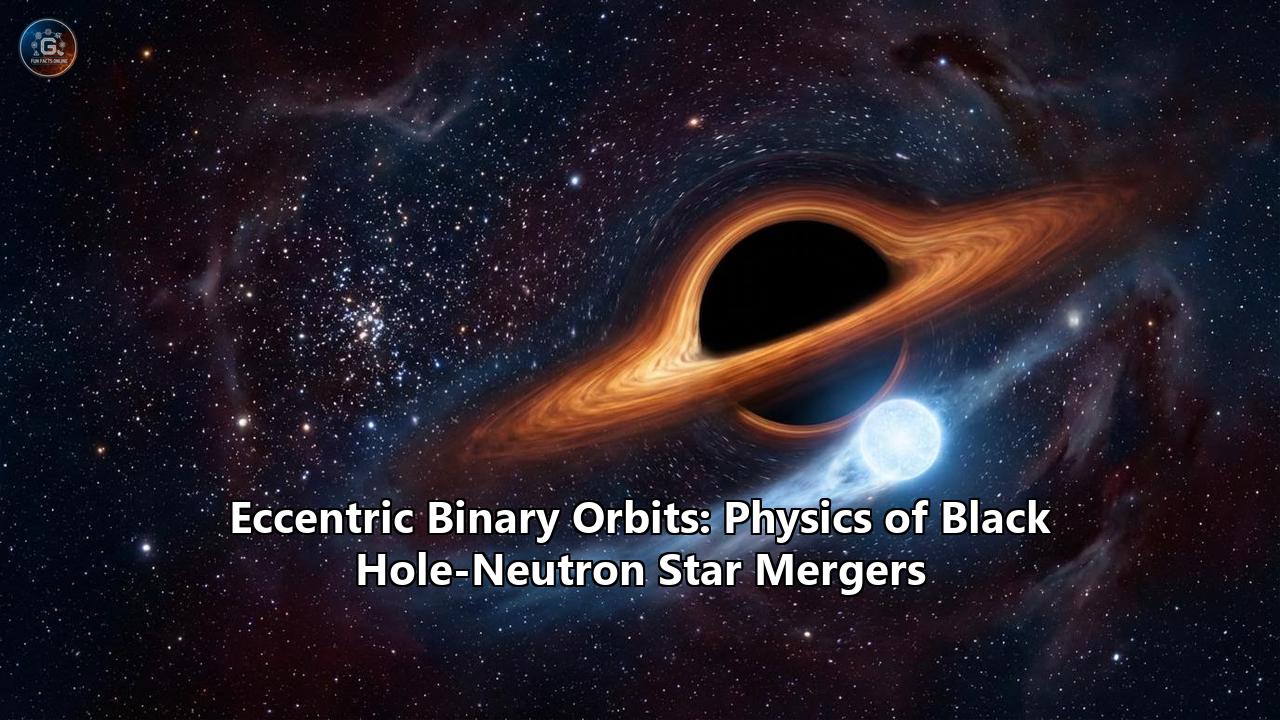
For decades, astrophysicists operated under a relatively elegant, albeit simplified, assumption regarding the universe’s most extreme gravitational dances: by the time compact objects like black holes and neutron stars collide, their orbits are almost perfectly circular. The immense loss of energy radiated away as gravitational waves during their millions of years of inspiral was thought to inevitably smooth out any elliptical stretching, forcing the binary pair into a symmetric, tightening spiral. However, the cosmos is rarely as tidy as our foundational models suggest. Recent breakthroughs in gravitational-wave astronomy—most notably the revolutionary analysis of the merger event GW200105 published in March 2026—have shattered this paradigm, proving that black holes and neutron stars can plunge into one another in highly elliptical, eccentric orbits.
This revelation is not merely a geometric curiosity; it is a profound Rosetta Stone for decoding the hidden, violent environments of the universe. An eccentric black hole-neutron star (BH-NS) merger offers an unprecedented window into the chaotic dynamics of dense star clusters, the complex physics of hierarchical multi-star systems, and the extreme limits of Albert Einstein’s General Theory of Relativity. To understand the magnitude of this cosmic phenomenon, we must dive deep into the mechanics of these exotic binaries, the environments that forge them, and the staggering physics that governs their final, catastrophic union.
The Anatomy of an Extreme Binary
To grasp the physics of a BH-NS merger, one must first understand the sheer extremity of the objects involved. A neutron star is the collapsed core of a massive star, packing up to two times the mass of our Sun into a sphere no larger than a city. Its density is so immense that a single teaspoon of its material would weigh billions of tons on Earth. A black hole, conversely, is an object where gravity has overwhelmed all other fundamental forces, collapsing matter into a singularity bounded by an event horizon—a boundary beyond which not even light can escape.
When these two titans are bound in a binary system, they warp the very fabric of spacetime around them. According to General Relativity, as they orbit a common center of mass, they accelerate and churn the cosmic fabric, radiating orbital energy outward in the form of gravitational waves. In a standard scenario—often termed "isolated binary evolution"—two massive stars are born together, live their lives, and undergo supernovae. By the time both have collapsed into compact objects and drifted close enough to merge, the continuous emission of gravitational waves has circularized their orbit.
An eccentric orbit, however, operates on a vastly different set of physical rules. Instead of tracing a neat circle, the neutron star and the black hole trace an elongated oval. The distance between them fluctuates wildly during each orbital period. At apoapsis (the farthest point), the objects are relatively distant, and their orbital velocities drop. But as they swing inward toward periapsis (the closest approach), gravity aggressively takes over, whipping the objects to a significant fraction of the speed of light.
Under the purview of General Relativity, this creates a phenomenon known as extreme periapsis precession. In Newtonian mechanics, an unperturbed elliptical orbit traces the same path repeatedly. In the extreme gravity of a BH-NS binary, spacetime itself is so intensely curved that the orientation of the ellipse shifts forward with every single orbit. If one could view the system from "above," the orbital path would look less like a single oval and more like the complex, overlapping loops of a Spirograph toy. The gravitational wave emission from such a system is not the steady, rising "chirp" of a circular binary, but rather a chaotic series of violent "bursts" that occur every time the two masses scream past each other at periapsis, followed by periods of relative quiet as they retreat.
The Smoking Gun of Chaotic Origins
If gravitational wave emission acts to circularize orbits over time, how can an eccentric BH-NS binary exist at the moment of a merger? The presence of orbital eccentricity just moments before the final collision is a definitive "smoking gun" that the system did not form in a quiet, isolated patch of space. It demands a violent, dynamic origin story where the binary was formed rapidly, leaving no time for the orbit to circularize before the merger occurred.
Astrophysicists have identified several "dynamical formation channels" capable of producing these eccentric cosmic crashes:
1. Globular Clusters and Nuclear Star ClustersIn the cores of ancient globular clusters or the nuclear star clusters at the centers of galaxies, stellar density is millions of times higher than in our solar neighborhood. Here, compact objects undergo chaotic gravitational billiards. A lone black hole might encounter an existing binary system containing a neutron star. Through a complex three-body interaction, the black hole can dynamically eject the neutron star's original companion and capture the neutron star for itself. Because this gravitational capture happens rapidly and violently, the resulting orbit is almost always highly elliptical.
2. Hierarchical Triples and the Kozai-Lidov MechanismA significant fraction of eccentric mergers may originate from isolated field triples—systems born with three stars. If the inner two stars collapse into a black hole and a neutron star, the gravitational influence of the third, distant companion can exert a periodic torque on the inner binary. Through a relativistic process known as the Kozai-Lidov mechanism, the third body can force the inner binary to trade orbital inclination for extreme eccentricity. The inner objects are squeezed into a needle-like orbit, plummeting toward each other so rapidly that they merge before the waves can round out their path. Recent statistical estimates suggest that if roughly one-third of observed BH-NS mergers show measurable eccentricity, a vast majority of those could be the direct result of these hierarchical triple interactions.
3. Active Galactic Nuclei (AGN) DisksSupermassive black holes at the centers of active galaxies are surrounded by swirling, super-dense disks of gas. Smaller stellar-mass black holes and neutron stars can become trapped in this gaseous disk. Driven by gas drag and "migration traps," these compact objects are herded together. The viscous, dense environment can catalyze rapid, highly eccentric captures, leading to mergers deeply embedded in the galactic core.
The Physics of the Final Plunge
As an eccentric BH-NS binary approaches its final moments, the physics becomes extraordinarily complex, pushing our supercomputer simulations to their absolute limits. The fate of the neutron star in these final milliseconds depends on a delicate interplay between the black hole’s mass, the black hole’s spin, the orbital eccentricity, and the neutron star’s "Equation of State" (EoS)—the quantum mechanical rules that govern the ultra-dense nuclear matter.
There are two primary outcomes for the merger:
The Direct Plunge: If the black hole is very massive, or if the neutron star is highly compact (a "stiff" EoS), the neutron star may cross the black hole’s Innermost Stable Circular Orbit (ISCO) and fall entirely through the event horizon without breaking apart. In an eccentric orbit, the velocity at periapsis is much higher than in a circular orbit, increasing the likelihood that the neutron star essentially shoots straight into the black hole. In this scenario, the universe swallows the neutron star whole. Spacetime rings out with a final, powerful gravitational wave, but no light or matter is left behind; the merger is entirely dark. Tidal Disruption: If the black hole is less massive, highly spinning, and the neutron star is relatively "fluffy" (a "soft" EoS), the black hole's tidal forces will rip the neutron star apart before it reaches the event horizon. The gravitational pull on the near-side of the neutron star vastly exceeds the pull on the far-side. The neutron star undergoes "spaghettification," shattering into a spectacular stream of super-heated nuclear plasma.Eccentricity completely alters the dynamics of this tidal disruption. In a circular orbit, the disruption is a continuous, smooth peeling away of matter. In an eccentric orbit, the neutron star might endure a "grazing" passage. During a close periapsis swing, the black hole’s tidal field might strip away only the outer layers of the neutron star. The surviving core of the neutron star then swings back out to apoapsis, violently oscillating and bleeding mass, only to return for a final, lethal pass. This multi-stage disruption creates complex, chaotic accretion disks around the black hole and can profoundly alter the amount of matter ejected into interstellar space.
Forging Gold: Kilonovae and Gamma-Ray Bursts
When a neutron star is violently disrupted, the consequences are observable across the entire electromagnetic spectrum. The material violently ejected from the system is incredibly rich in neutrons. As this plasma expands and cools, the heavy density of neutrons allows for rapid neutron capture—the "r-process." This nucleosynthesis is responsible for forging the heaviest elements in the universe, including gold, platinum, and uranium.
The radioactive decay of these freshly minted, highly unstable heavy elements releases a tremendous amount of energy, creating a glowing thermal transient known as a kilonova. The presence of eccentricity prior to the merger directly impacts the kilonova's brightness and duration. Because an eccentric orbit can cause a more explosive, violent collision—sometimes expelling mass at different angles and velocities than a circular inspiral—the resulting kilonova ejecta can be distributed asymmetrically.
Simultaneously, the material that does not escape falls back into a wildly spinning accretion torus around the newly formed, heavier black hole. The magnetic fields embedded in this swirling plasma become twisted and amplified to mind-boggling strengths. Within a fraction of a second, these magnetic fields can launch twin jets of relativistic particles perpendicular to the disk. If one of these jets points toward Earth, we observe it as a Short Gamma-Ray Burst (sGRB), one of the most energetic explosions since the Big Bang. The unique disk formation dynamics caused by an eccentric merger might explain some of the anomalous, highly variable sGRB light-curves that astronomers have puzzled over for decades.
The Data Analysis Marvel: Decoding GW200105
Identifying an eccentric orbit from a gravitational wave signal is an awe-inspiring feat of modern mathematics and computational physics. For years, the detection algorithms used by the LIGO, Virgo, and KAGRA collaborations relied heavily on waveform templates that assumed circular orbits. This was partly a theoretical bias, but largely a computational necessity: calculating the General Relativistic waveforms for eccentric orbits requires tracking a vastly more complex set of parameters, demanding exponential increases in processing power.
The turning point arrived with the rigorous re-analysis of the event GW200105. Originally detected in January 2020, this event was already historically significant as the first compelling evidence of a BH-NS merger, featuring a black hole roughly 13 times the mass of our Sun colliding with a neutron star. However, the real magic happened in early 2026, when an international team of scientists deployed a novel, state-of-the-art waveform model capable of simultaneously analyzing both orbital eccentricity and "precession" (the wobbling of the orbit caused by the misalignment of the black hole's spin).
The difficulty in this analysis lay in a mathematical phenomenon called "waveform degeneracy." A binary system whose orbit is wobbling due to spin precession can produce a modulated gravitational wave signal that looks frustratingly similar to the bursts produced by an eccentric orbit. To untangle the two effects, researchers utilized advanced Bayesian statistical inference, pitting thousands of theoretically generated waveforms against the raw, noisy data captured by the interferometers.
The results were unequivocal. The Bayesian analysis excluded a circular orbit at a confidence level exceeding 99.5%, inferring a median orbital eccentricity of roughly 0.145 at a gravitational-wave frequency of 10 Hz. In the hyper-precise realm of gravitational wave astronomy, an eccentricity of ~0.145 right before merger is astonishingly high. It conclusively established that the prevailing theoretical paradigm—that BH-NS mergers arise solely from a single, circularized evolutionary channel—was fundamentally incomplete.
The Future of the Cosmic Symphony
The confirmation of eccentric BH-NS mergers acts as a clarion call for the future of astrophysics. It necessitates a massive overhaul of the waveform libraries used by ground-based detectors, ensuring that future searches are attuned to the chaotic, bursting signals of elliptical crashes. Without these updated templates, we risk remaining blind to a massive population of the universe's most extreme events, effectively deaf to a whole register of the cosmic symphony.
Furthermore, this discovery sets the stage for the next generation of observatories. Facilities currently under development, such as the space-based Laser Interferometer Space Antenna (LISA) and ground-based titans like the Einstein Telescope and Cosmic Explorer, will have unprecedented sensitivity at lower frequencies. While LIGO and Virgo catch these binaries in the final fractions of a second before impact, LISA will be able to observe these eccentric binaries years, or even decades, before they merge. Astronomers will be able to watch the Spirograph orbits evolve in real-time, tracking the exact rate at which eccentricity bleeds away into the fabric of spacetime, and definitively tracing the binary back to its specific dynamical birthplace.
The physics of eccentric black hole-neutron star mergers represents the ultimate frontier of multi-messenger astronomy. These events are not just collisions of dead stars; they are the universe's ultimate particle accelerators, gravitational laboratories, and heavy-element foundries combined into one. By capturing the twisted, elliptical final moments of these cosmic titans, humanity is slowly unraveling the chaotic choreography of the dark universe, proving once again that reality is far more beautiful, and far more violent, than we ever dared to imagine.
Reference:
- https://www.livescience.com/space/black-holes/universe-shaking-collision-of-black-hole-and-neutron-star-could-upend-our-understanding-of-monster-cosmic-mergers
- https://bioengineer.org/elliptical-orbits-shed-new-light-on-black-hole-neutron-star-mergers/
- https://www.space.com/astronomy/black-holes/black-hole-and-neutron-star-mergers-push-the-laws-of-physics-with-their-odd-orbits
- https://academic.oup.com/mnras/advance-article/doi/10.1093/mnras/stag323/8483881
- https://www.eurekalert.org/news-releases/1119016
- https://research.birmingham.ac.uk/en/publications/orbital-eccentricity-in-a-neutron-star-black-hole-binary-merger/
- https://www.frontiersin.org/journals/astronomy-and-space-sciences/articles/10.3389/fspas.2020.00046/full
- https://www.researchgate.net/publication/394540481_GW200105_A_detailed_study_of_eccentricity_in_the_neutron_star-black_hole_binary
- https://www.researchgate.net/publication/354620059_A_kilonova_from_an_ultra-quick_merger_of_a_neutron_star_binary
- https://arxiv.org/html/2503.15393v1