
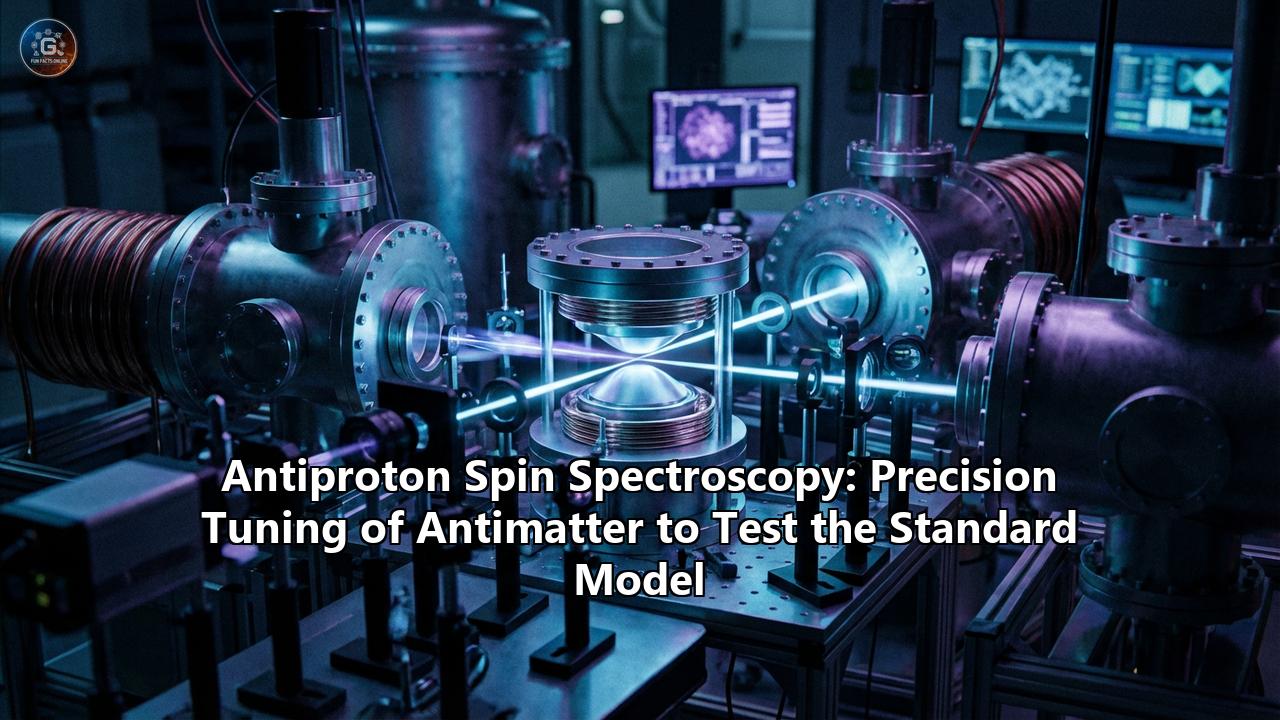
Introduction: The Great Cosmic Vanishing Act
In the grand ledger of the universe, there is a massive accounting error. It is a discrepancy so profound that it challenges the very bedrock of our understanding of existence. According to the Standard Model of particle physics—our best theory for describing the fundamental building blocks of reality—the Big Bang should have produced equal amounts of matter and antimatter. For every proton created in the searing heat of the early universe, there should have been an antiproton; for every electron, a positron.
Matter and antimatter are cosmic twins with a volatile relationship: when they meet, they annihilate instantly, transforming their mass entirely into energy. If the theory held perfectly true, the infant universe would have been a soup of annihilation, leaving behind nothing but a bath of dull radiation. Stars, galaxies, planets, and life itself would never have formed.
Yet, here we are. We live in a universe overflowing with matter. We are made of matter. The screen you are reading this on is made of matter. Antimatter, meanwhile, has seemingly vanished, relegated to the status of a rare and fleeting exoticism produced only in high-energy collisions or radioactive decays.
Where did it all go? What tipped the scales?
This mystery, known as baryon asymmetry, is one of the most significant unsolved problems in physics. To solve it, scientists are not looking out into the deep cosmos with telescopes, but rather zooming in on the tiniest constituents of reality with "microscopes" of unimaginable precision. They are hunting for a flaw in the mirror—a tiny, subtle difference between matter and antimatter that allowed matter to survive.
Leading this detective story is the BASE collaboration (Baryon Antibaryon Symmetry Experiment) at CERN. In a groundbreaking achievement announced in late 2025, they have taken a giant leap forward. By performing the first-ever coherent quantum transition spectroscopy on a single antiproton, they have unlocked a new realm of precision. They are not just measuring antimatter; they are tuning into its quantum heartbeat, listening for the faintest discord that could explain why we exist at all.
This article delves deep into the physics, the technology, and the sheer audacity of this experiment. We will explore how one traps a particle that destroys anything it touches, how to measure the magnetism of a single ghost particle, and what this recent breakthrough means for the future of physics.
Part 1: The Mirror Symmetry of the Universe
To understand the magnitude of the BASE experiment, we must first understand the rulebook it is trying to break: CPT Symmetry.
The Three Pillars
Physics is built on symmetries—transformations that leave the laws of nature unchanged. A perfect circle looks the same no matter how you rotate it; that is rotational symmetry. In the subatomic world, there are three fundamental discrete symmetries:
- Charge Conjugation (C): Swapping particles for antiparticles (flipping positive charge to negative, and vice versa).
- Parity (P): Reflecting the universe in a mirror (swapping left for right).
- Time Reversal (T): Running the movie of the universe backward.
For a long time, physicists believed nature respected these symmetries individually. But in the mid-20th century, we were shocked to find that the weak nuclear force—the force responsible for radioactive decay—violates them. It distinguishes between left and right (P-violation) and even between matter and antimatter (CP-violation).
However, there is one final fortress that has never fallen: CPT Symmetry. This theorem states that if you apply all three transformations at once—swap matter for antimatter, reflect it in a mirror, and reverse time—the laws of physics must remain exactly the same.
The CPT Theorem
The CPT theorem is not just a suggestion; it is a mathematical cornerstone of Quantum Field Theory. It implies that a particle and its antiparticle must have:
- Exactly the same mass.
- Exactly the same lifetime.
- Exactly the same magnitude of charge (but opposite sign).
- Exactly the same magnetic moment (but opposite sign).
If the BASE experiment finds even a one-part-in-a-trillion difference between the magnetic moment of a proton and an antiproton, CPT symmetry falls. If CPT falls, the Standard Model collapses. It would require a complete rewriting of our understanding of space, time, and relativity. It would be the most significant discovery in the history of physics since Einstein.
And crucially, such a violation might provide the "leak" in the early universe that allowed matter to win the war against antimatter.
Part 2: The Antiproton — A Volatile Subject
The subject of our scrutiny is the antiproton. Discovered in 1955 by Emilio Segrè and Owen Chamberlain (who won the Nobel Prize for it), the antiproton is the negative twin of the proton.
Studying it is a nightmare. You cannot put it in a test tube. You cannot hold it with tweezers. If an antiproton touches a single atom of air, or the wall of a container, it annihilates. To study it, you must keep it in a perfect vacuum, suspended in nothingness, far away from any ordinary matter.
This is where the Penning Trap comes in.
The Penning Trap: A Cage of Fields
Imagine trying to hold a marble in place using only air currents. That is roughly the challenge of trapping a charged particle. You cannot hold a charged particle stable with static electric fields alone (a rule known as Earnshaw's Theorem).
The Penning trap circumvents this by using a clever combination of:
- A Static Magnetic Field ($B$): This forces the charged particle to move in a tight circle. It confines the particle radially (preventing it from flying out sideways).
- A Static Electric Field ($E$): This pushes the particle from the top and bottom, trapping it axially (preventing it from flying up or down).
Inside this trap, the antiproton performs a complex dance composed of three distinct motions:
- Cyclotron Motion: A fast, tight circle around the magnetic field lines.
- Axial Motion: A bouncing up-and-down movement along the field lines.
- Magnetron Motion: A slow, large circular drift around the center of the trap.
By measuring the frequencies of these motions, physicists can determine the particle's properties with exquisite precision. But BASE goes further. They don't just want to know how the antiproton moves; they want to know how it spins.
Part 3: The g-Factor and the Quantum Compass
Every proton and antiproton acts like a tiny bar magnet. This intrinsic magnetism is linked to its spin. The strength of this magnet is defined by a number called the $g$-factor.
For a simple, point-like particle (like an electron), the Dirac equation predicts a $g$-factor of exactly 2. But protons and antiprotons are not simple point particles; they are messy bags of quarks and gluons. Their internal complexity creates a "magnetic moment anomaly," making their $g$-factor significantly different from 2 (around 5.586 for the proton).
The goal of BASE is to measure the antiproton's $g$-factor ($g_{\bar{p}}$) and compare it to the proton's $g$-factor ($g_p$).
The Formula for Truth
To find the $g$-factor, the scientists need to measure two frequencies essentially simultaneously:
- The Cyclotron Frequency ($\nu_c$): How fast the particle orbits in the magnetic field. This tells us about the magnetic field strength and the particle's charge-to-mass ratio.
- The Larmor Frequency ($\nu_L$): How fast the particle's internal spin precesses (wobbles) like a gyroscope in that same magnetic field.
The $g$-factor is simply the ratio of these two:
$$ g = 2 \times \frac{\nu_L}{\nu_c} $$
It sounds simple. In practice, measuring the spin precession of a single particle is one of the hardest tasks in experimental physics. You cannot "see" the spin. You have to trick the particle into revealing it.
Part 4: The Continuous Stern-Gerlach Effect
In the 1920s, Stern and Gerlach fired silver atoms through a magnetic field gradient to see their paths split based on their spin. BASE uses a modern, non-destructive version of this called the Continuous Stern-Gerlach Effect, pioneered by Nobel laureate Hans Dehmelt.
Here is the trick:
- You create a "magnetic bottle"—a region where the magnetic field is inhomogeneous (stronger at the edges than in the center).
- Because the antiproton is a tiny magnet, its energy changes depending on whether its spin is aligned UP or DOWN relative to the field.
- This energy difference couples the spin to the particle's axial frequency (its bounce rate).
If the antiproton spin flips from UP to DOWN, its bouncing frequency changes slightly. And by "slightly," we mean a shift of about 170 millihertz out of a frequency of nearly 1 megahertz.
Detecting this shift is like noticing a single extra drop of water in a swimming pool by measuring the water level.
The "Double Trap" Innovation
There is a catch. The "magnetic bottle" needed to detect the spin ruins the precision of the frequency measurement. The strong magnetic gradient smears out the resonance, making it impossible to get a high-precision reading.
For years, this limited experiments. Then, the BASE collaboration introduced the Double Penning Trap system.
- Trap 1: The Precision Trap. A region with an incredibly uniform magnetic field. Here, the particle's cyclotron frequency is measured with high precision, and the spin transitions are induced.
- Trap 2: The Analysis Trap. A region with the strong magnetic bottle. Here, the particle is sent only to check if its spin has flipped.
The antiproton is shuttled back and forth between these traps. It's a quantum logistical masterpiece: measuring in the quiet room, checking the result in the loud room.
Part 5: The 2025 Breakthrough — Coherent Quantum Control
Until recently, inducing the spin flip in the Precision Trap was an "incoherent" process. Scientists would blast the antiproton with noise (a range of microwave frequencies) and hope the spin flipped. It was like trying to flip a light switch by throwing a handful of rocks at it. It worked, but it was messy, slow, and limited the resolution (the sharpness) of the measurement.
The August 2025 announcement changed everything.For the first time, the BASE team demonstrated Coherent Quantum Transition Spectroscopy. Instead of throwing rocks, they reached out with a "laser pointer"—a precisely timed, coherent microwave pulse.
Rabi Oscillations
They observed Rabi oscillations. This is a signature quantum phenomenon where the particle smoothly oscillates between the "spin-up" and "spin-down" states, rather than just jumping randomly.
This control allows for:
- Narrower Linewidths: The resonance peak is 16 times narrower than before. In spectroscopy, narrower means more precise. It's the difference between finding a radio station on an old analog dial versus a digital tuner.
- High Probability: They achieved a spin-flip probability of over 80%.
- Speed: The measurement is faster, allowing for more data to be taken in less time.
This technique treats the single antiproton as a Qubit—the fundamental unit of a quantum computer. BASE has effectively turned an antimatter particle into a quantum sensor of its own existence.
The Result: This new method is projected to improve the precision of the antiproton $g$-factor measurement by a factor of 25. The previous record (set by BASE in 2017) was already accurate to 1.5 parts in a billion. The new measurements are pushing into the realm of parts per trillion.Part 6: Interpreting the Silence — The Standard Model Extension
So far, every measurement—including the 2017 record and the initial runs of the new setup—has shown that $g_p$ and $g_{\bar{p}}$ are identical (within error bars).
Is this a failure? Absolutely not.
In precision physics, a "null result" is a powerful weapon. By proving that protons and antiprotons are identical to such an extreme degree, BASE places handcuffs on theoretical physicists who want to propose exotic new theories.
These constraints are quantified using the Standard Model Extension (SME). The SME is a theoretical framework that catalogs all possible ways Lorentz symmetry and CPT symmetry could break. It contains dozens of coefficients (like $\tilde{b}_p^Z$) that represent different "directions" in which the laws of physics might be skewed.
The BASE results have set the strictest limits ever on these coefficients. They tell us that if CPT violation exists:
- It must be smaller than $1.8 \times 10^{-24}$ GeV.
- It doesn't interact with gravity in any obvious way (tested by measuring as the Earth orbits the Sun).
We are effectively mapping the "shoreline" of the Standard Model. We haven't found a new continent yet, but we have ruled out monsters in a vast area of the ocean.
Part 7: The Competition — A Global Race
BASE is not alone in the antimatter factory at CERN. The Antiproton Decelerator (AD) hall is a bustling hub of rival (and collaborating) experiments:
- ALPHA: Famous for trapping antihydrogen atoms (an antiproton orbiting a positron) and performing laser spectroscopy on them. They test CPT by checking if the color of light absorbed by antihydrogen is the same as hydrogen.
- ASACUSA: Uses lasers to study antiprotonic helium (a helium atom where an electron is replaced by an antiproton). They measure the antiproton's mass with high precision.
- AEgIS & GBAR: These experiments are dropping antimatter to see if it falls down or falls up (testing the Weak Equivalence Principle).
BASE stands out because it works with the naked antiproton nucleus, not an atom. This removes the complications of binding energy and electron interactions, offering the purest magnetic measurement of the baryon itself.
Part 8: The Future — BASE-STEP and Portable Antimatter
Perhaps the most sci-fi development on the horizon is BASE-STEP.
The greatest enemy of the BASE experiment is magnetic noise. The CERN accelerator hall is a noisy place—massive magnets cycling, cranes moving, other experiments pulsing. It limits the ultimate precision of the $g$-factor measurement.
The solution? Take the antimatter somewhere else.
BASE-STEP is a transportable antiproton trap. It is a truck-sized device containing a superconducting magnet and a cryogenic vacuum chamber. The plan is to:
- Catch antiprotons at CERN.
- Load them into the portable trap.
- Drive the truck out of the experimental hall to a quiet, dedicated precision laboratory.
- Perform measurements with 10x or 100x better stability.
This concept of "take-out antimatter" could revolutionize the field, allowing high-precision tests to happen in laboratories completely disconnected from the chaotic environment of a particle accelerator.
Conclusion: The Unbroken Mirror
As of late 2025, the mirror remains unbroken. The proton and the antiproton appear to be perfect reflections of one another. The mystery of the missing antimatter remains unsolved.
But the silence is getting louder. With the advent of coherent spin spectroscopy, we are listening to the universe with unprecedented clarity. If there is a crack in the CPT mirror—a whisper of asymmetry that explains our existence—the BASE collaboration is closer than ever to hearing it.
Until then, we celebrate the triumph of human ingenuity: the ability to trap a single particle of "anti-reality," hold it still for months, and tickle its quantum spin to see if it giggles differently than its twin. In doing so, we define the very boundaries of what we know about the universe.
Key Takeaways:- The Breakthrough: First observation of Rabi oscillations in a single antiproton spin (August 2025).
- The Goal: Compare proton and antiproton magnetic moments to test CPT symmetry.
- The Implication: Any difference could explain the matter-antimatter asymmetry of the universe.
- The Precision: Moving from parts-per-billion to parts-per-trillion accuracy.
- The Future: Portable antimatter traps (BASE-STEP) to eliminate magnetic noise.
For more deep dives into the frontiers of physics, stay tuned to [Your Website Name].
Reference:
- https://base.web.cern.ch/node/98
- https://scitechdaily.com/cern-experiments-reveal-no-difference-in-mass-of-proton-and-antiproton/
- https://press.uni-mainz.de/riddle-of-matter-remains-unsolved-proton-and-antiproton-share-fundamental-properties/
- https://base.web.cern.ch/content/improved-measurement-magnetic-moment-antiproton
- https://www.research-collection.ethz.ch/bitstream/handle/20.500.11850/616734/3/s10053-023-00672-y.pdf
- https://base.web.cern.ch/content/antiproton-magnetic-moment
- https://home.cern/science/experiments/base
- https://www.voyagepourproxima.fr/docs/2017-BASE-AntiprotonMagneticMoment.pdf
- https://en.wikipedia.org/wiki/Standard-Model_Extension
- https://pubmed.ncbi.nlm.nih.gov/29052625/