
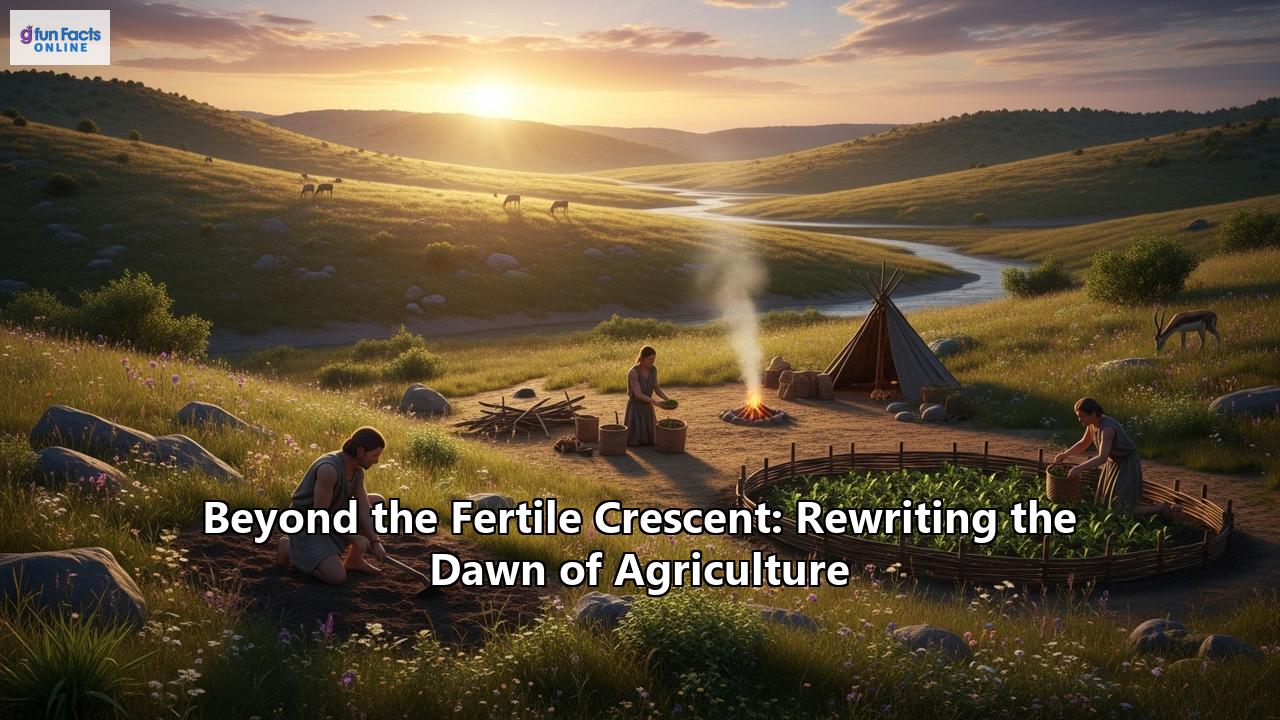
For generations, the story of agriculture’s dawn was a simple, linear tale. It began, we were told, in a single, verdant arc of land in the Middle East—the Fertile Crescent. Here, around 10,000 BCE, our ancestors first traded their nomadic, hunter-gatherer existence for a settled life of cultivation, domesticating wheat and barley, and taming sheep and goats. This "Neolithic Revolution" was presented as a singular spark that ignited civilization, a revolutionary idea that spread outwards, transforming societies across the globe. This narrative, however, is being dramatically rewritten. A wealth of archaeological and genetic evidence now reveals a far more complex and fascinating story: the dawn of agriculture was not a single sunrise but a symphony of dawns, a chorus of innovation that erupted independently in multiple, unconnected corners of the world.
From the highlands of New Guinea to the river valleys of China, and from the mountains of the Andes to the woodlands of North America, different peoples, driven by unique environmental pressures and cultural ingenuity, embarked on their own agricultural journeys. They domesticated a diverse and often surprising array of plants and animals, developing unique farming techniques and technologies that were exquisitely adapted to their local landscapes. This article journeys beyond the traditional narrative, exploring the independent origins of agriculture across the globe, celebrating the diverse genius of our ancestors, and rewriting the very story of how we came to be a planet of farmers.
The Traditional Cradle: Revisiting the Fertile Crescent
The Fertile Crescent, a crescent-shaped region stretching from the Persian Gulf through modern-day Iraq, Syria, Lebanon, Jordan, Israel, and Egypt, has long been celebrated as the birthplace of agriculture. This distinction is not without merit. The region’s unique geography, with its variety of elevations and climates, fostered a remarkable biodiversity, including the wild ancestors of what would become the "Neolithic founder crops." These eight plants—emmer wheat, einkorn wheat, barley, lentils, peas, chickpeas, bitter vetch, and flax—possessed traits that made them ideal candidates for domestication, such as being annual, self-pollinating, and highly nutritious.
The transition from hunting and gathering to settled agriculture in the Fertile Crescent was a gradual process that unfolded over thousands of years. Archaeological evidence from sites like Ohalo II in Israel shows that as far back as 23,000 years ago, people were intensively harvesting wild grains. At Göbekli Tepe in modern-day Turkey, a site of monumental religious structures dating back to 9600 BCE, evidence suggests that the hunter-gatherers who built it were also beginning to cultivate wild cereals. These early experiments laid the groundwork for true domestication, a process that involved selecting for desirable traits like larger seeds and non-brittle stalks that didn't shatter upon harvesting.
By 9500 BCE, domesticated forms of wheat and barley were being cultivated, and the first evidence of animal domestication appeared, with goats and sheep being the first to be brought into the fold, followed by pigs and cattle. This agricultural package proved to be incredibly successful. The ability to produce a reliable surplus of food allowed for the establishment of permanent settlements, some of which, like Jericho, grew into the world's first towns, complete with defensive walls and towers.
The impact of this agricultural revolution on society in the Fertile Crescent was profound. It led to population growth, the development of new technologies like pottery for storing grain and irrigation to expand arable land, and the emergence of more complex social structures. The control of surplus food likely led to the rise of a priestly or ruling class, who managed the storage and distribution of grain. This, in turn, fueled the development of writing, which is believed to have initially emerged as a means of record-keeping for agricultural goods. While the Fertile Crescent's role in the history of agriculture is undeniable, it is now clear that it was not the only place where this momentous transformation occurred.
A Tale of Two Rivers: Rice and Millet in Ancient China
Far from the Fertile Crescent, another major center of agricultural innovation was emerging in the river valleys of what is now China. Here, not one, but two distinct agricultural systems developed independently, each based on a different staple grain.
In the humid, subtropical environment of the Yangtze River Valley in southern China, the domestication of rice (Oryza sativa) began as early as 10,000 to 8,000 years ago. Archaeological sites like Hemudu and Shangshan have yielded some of the earliest evidence of rice cultivation, including rice husks used as temper in pottery and sophisticated tools for cultivation. The transition from wild rice to domesticated varieties was a long process, but by 7,700 years ago, rice cultivation was well-established. These early farmers developed sophisticated techniques to manage water, creating paddy fields to flood and drain their crops, a hallmark of rice cultivation that continues to this day.
Meanwhile, in the drier, more temperate climate of the Yellow River Valley in northern China, a different agricultural revolution was unfolding. Here, the focus was on the domestication of two types of millet: foxtail millet and broomcorn millet. Evidence from sites like Peiligang and Cishan shows that the exploitation of wild millet dates back as far as 23,000 years ago, with domestication occurring around 8,000 to 7,000 years ago.
The domestication of animals also played a crucial role in the development of Chinese agriculture. Pigs were among the earliest animals to be domesticated in China, with evidence dating back 10,000 years. Pigs were a valuable source of meat and fat, and their ability to consume scraps and waste made them a perfect fit for a settled agricultural lifestyle. Chickens were also domesticated in China as early as 8,000 years ago, initially perhaps for cockfighting, but later for their eggs and meat.
The shift to agriculture in China, as in the Fertile Crescent, had a profound impact on society. It led to the establishment of permanent villages, population growth, and the development of complex social hierarchies. The production of surplus grain allowed for craft specialization, with the emergence of skilled artisans who produced intricate pottery and jade carvings. The control of agricultural resources also became a source of power, laying the groundwork for the emergence of the first Chinese dynasties. The distinct agricultural systems of the north and south, based on millet and rice respectively, also contributed to the development of unique regional cultures that would continue to shape Chinese civilization for millennia.
The Three Sisters and Floating Gardens: Ingenuity in Mesoamerica
Across the Pacific, in the highlands and lowlands of Mesoamerica—a region stretching from central Mexico to northern Costa Rica—another independent agricultural revolution was taking shape, based on a trio of crops that would become central to the diets of many Indigenous peoples of the Americas: maize, beans, and squash.
The domestication process in Mesoamerica was staggered over several thousand years. Squash (Cucurbita pepo) appears to have been the first to be domesticated, with evidence from Guilá Naquitz Cave in Oaxaca, Mexico, dating back 10,000 years. Initially, squash was likely cultivated for its edible seeds and for use as containers, as the flesh of early varieties was bitter.
Maize (corn), the crop that would become the cornerstone of Mesoamerican agriculture, has a more complex history. Genetic and archaeological evidence points to its domestication from a wild grass called teosinte in the Balsas River Valley of southern Mexico around 9,000 years ago. The transformation from the small, hard-cased kernels of teosinte to the larger, more palatable cobs of maize was a testament to the selective breeding skills of early Mesoamerican farmers. However, it took several thousand years for maize to become a staple food crop. The final member of the trio, beans, was domesticated later, completing what is now famously known as the "Three Sisters."
The genius of the Three Sisters system lies in its symbiotic relationship. When planted together, the corn provides a stalk for the beans to climb, the beans fix nitrogen in the soil, enriching it for the other plants, and the broad leaves of the squash spread across the ground, shading the soil to retain moisture and prevent the growth of weeds. This sophisticated intercropping system was a highly sustainable and productive form of agriculture.
Mesoamerican farmers also developed other innovative agricultural techniques. In the swampy, lake-filled Valley of Mexico, the Aztecs perfected the use of chinampas, or "floating gardens." These were artificial islands built up from the lakebed, created by weaving together reeds and piling on layers of mud and vegetation. The rich, fertile soil and the constant supply of water from the surrounding canals made the chinampas incredibly productive, allowing for up to seven harvests a year and supporting the dense population of the Aztec capital, Tenochtitlan. In other areas, slash-and-burn agriculture was used to clear forested land for cultivation.
The advent of agriculture had a profound impact on Mesoamerican societies, paving the way for the rise of great civilizations like the Olmec, Maya, and Zapotec. The surplus of food supported large, settled populations, the growth of cities, and the development of complex social and political structures. Maize, in particular, became deeply embedded in the cultural and religious life of these societies, often depicted in their art and featuring prominently in their creation myths. The ability to produce and control agricultural surplus was a key factor in the rise of powerful ruling elites and the construction of monumental architecture that still awes us today.
Potatoes, Quinoa, and High-Altitude Farming: The Andean Achievement
In the challenging environment of the Andes mountains of South America, another remarkable story of agricultural innovation unfolded. Here, in the high-altitude Altiplano, ancient peoples domesticated a unique suite of crops and animals that were perfectly adapted to the harsh conditions of mountain life.
The two most important crops to emerge from the Andes were the potato and quinoa. The domestication of the potato began as early as 8,000 to 10,000 years ago, making it one of the earliest domesticated plants in the Americas. Over millennia, Andean farmers developed thousands of varieties of potatoes, adapted to different altitudes and microclimates. They also developed a sophisticated method of freeze-drying potatoes, called chuño, which allowed them to be stored for long periods, providing a crucial buffer against food shortages. Quinoa, a highly nutritious grain-like crop, was also domesticated in the Andes around 7,000 years ago, providing a vital source of protein.
In addition to these staple crops, Andean peoples also domesticated a unique set of animals. The llama and the alpaca, two species of camelids, were domesticated around 6,000 years ago. Llamas were used as pack animals, essential for transporting goods through the rugged mountain terrain, while alpacas were prized for their fine wool. The guinea pig was also domesticated in the Andes, providing an important and easily raised source of meat.
To farm the steep slopes of the Andes, ancient farmers developed a number of ingenious techniques. The most famous of these is terrace farming, or andenes. These were a series of stone-walled terraces built into the mountainside, which created level plots of land for farming, prevented soil erosion, and improved water absorption. In the high-altitude plains around Lake Titicaca, another sophisticated technique called waru waru, or raised fields, was developed. This involved creating a series of raised planting beds separated by canals. The canals provided irrigation and a source of nutrient-rich sediment, while the water in the canals absorbed heat during the day and released it at night, protecting the crops from the frequent frosts of the Altiplano.
The development of agriculture in the Andes had a profound impact on the societies that lived there, providing the economic foundation for powerful civilizations like the Moche and the Inca. The ability to produce a surplus of food and the organization required to build and maintain large-scale agricultural infrastructure like terraces and irrigation canals were key factors in the rise of centralized states and powerful ruling classes. The Inca, in particular, were masters of agricultural organization, with a state-controlled system of food production and storage that ensured the stability of their vast empire.
From the Amazon to New Guinea: Gardens of the Tropics
The story of agriculture's independent origins is not limited to the major centers of civilization. In the tropical regions of the Amazon and New Guinea, people also developed unique and sophisticated forms of agriculture, often based on root crops and tree crops rather than grains.
In the Amazon Basin, a region once thought to be a "counterfeit paradise" incapable of supporting large, settled populations, recent research has revealed a long history of plant domestication and landscape management. Here, the focus was on root crops like manioc (cassava) and sweet potatoes, which were domesticated as early as 10,000 years ago. Instead of large, open fields, Amazonian farmers created "forest islands," clearing small patches of forest to create gardens where they cultivated a variety of crops.
One of the most remarkable innovations of Amazonian agriculture was the creation of terra preta, or "black earth." This incredibly fertile soil was created by adding a mixture of charcoal, pottery shards, bones, and other organic matter to the naturally poor soils of the Amazon. The charcoal, produced through a process of "slash-and-char" rather than slash-and-burn, is highly stable and helps to retain nutrients and moisture in the soil. The existence of large areas of terra preta suggests that pre-Columbian Amazonia was home to much larger and more complex societies than previously thought.
Meanwhile, in the highlands of New Guinea, another independent agricultural revolution was taking place, based on the cultivation of taro and bananas. The Kuk Swamp archaeological site provides a remarkable record of this development, with evidence of plant exploitation dating back 10,000 years and clear evidence of agriculture by 7,000-6,500 years ago. The farmers of Kuk Swamp developed sophisticated techniques for draining wetlands, creating raised beds and mounds for planting their crops.
The domestication of taro, a starchy root crop, and bananas, which are native to the region, provided a reliable source of carbohydrates for the highland populations. Unlike the grain-based agriculture of the Fertile Crescent and China, the agriculture of New Guinea was based on vegetative propagation, using cuttings and suckers to grow new plants. Despite the early development of agriculture, societies in New Guinea remained relatively small-scale and egalitarian, with a social structure often described as the "big man" system, where influence is based on personal charisma and the ability to organize feasts and exchanges, rather than on inherited status. The introduction of the sweet potato from South America around 300 years ago had a significant impact on highland societies, as it could be used as fodder for pigs, which became a major form of wealth and a central part of ceremonial life.
A Mosaic of Innovation: Africa's Diverse Agricultural Origins
The African continent, the cradle of humanity, also witnessed a complex and diverse history of agricultural origins, with multiple independent centers of domestication. The traditional narrative that agriculture spread to sub-Saharan Africa from the Fertile Crescent has been largely overturned by evidence of indigenous innovation across the continent.
In the Sahel, the vast semi-arid region south of the Sahara, sorghum and pearl millet were domesticated around 3000 BCE. Archaeological sites like Dhar Tichitt in Mauritania show evidence of large, settled communities that cultivated millet and herded cattle. The development of agriculture in the Sahel was a response to the drying of the Sahara, which pushed people and their livestock into more well-watered areas.
In West Africa, a different agricultural system emerged, based on the domestication of yams and African rice. The Niger River basin has been identified as a major cradle of African agriculture, where yams were domesticated from a forest species and African rice was independently cultivated. This agricultural package, along with the domestication of cowpeas and oil palms, supported the growth of populations in the region and played a crucial role in the Bantu migrations, which spread agriculture and ironworking throughout much of sub-Saharan Africa.
The Ethiopian Highlands represent another independent center of domestication, where unique crops like teff, a tiny but highly nutritious grain, and coffee were first cultivated. Teff has been a staple food in Ethiopia for thousands of years, used to make the traditional flatbread injera, and its cultivation is deeply embedded in the cultural and ritual life of the region.
The development of agriculture in Africa, as in other parts of the world, led to profound social and cultural changes. It enabled the growth of larger, more settled populations, the development of new technologies, and the emergence of more complex social and political structures. The diversity of agricultural systems across the continent also reflects the ingenuity and adaptability of African peoples in responding to a wide range of environmental conditions.
The Lost Crops of a Forgotten Revolution: Eastern North America
For a long time, it was believed that agriculture in Eastern North America was an import from Mesoamerica, with the "Three Sisters" of maize, beans, and squash arriving as a complete package. However, archaeological and genetic evidence now shows that the Eastern Woodlands of North America were another independent center of plant domestication, with a unique suite of crops known as the "Eastern Agricultural Complex."
Long before the arrival of maize, Native Americans in this region had domesticated a variety of local plants, including sunflower, sumpweed (or marsh elder), and several species of chenopod (a relative of quinoa). The earliest evidence for the domestication of these plants dates back to around 2,500 BCE, making this one of the world's oldest centers of agricultural innovation. These "lost crops," as they are sometimes called, were a vital part of the diet of the peoples of the Eastern Woodlands for thousands of years.
The development of this indigenous agricultural system had a significant impact on the societies of the region, contributing to a more sedentary lifestyle and the development of complex cultures like the Adena and Hopewell, known for their elaborate burial mounds and extensive trade networks. The cultivation of these native crops laid the social and economic groundwork for the later adoption of maize agriculture.
Maize was introduced to the Eastern Woodlands from the Southwest around 200 BCE, but it did not become a staple crop until around 900 CE. When it was fully adopted, it had a transformative effect on societies like the Mississippian culture, which built large, fortified cities like Cahokia and developed complex chiefdoms. The success of maize agriculture eventually led to the decline and abandonment of the Eastern Agricultural Complex, with many of its domesticated plants returning to their wild forms. The story of the Eastern Agricultural Complex is a powerful reminder of the diversity of agricultural pathways and the forgotten histories that are being uncovered by modern science.
A New Story of Human Ingenuity
The dawn of agriculture was not a single event, but a global phenomenon, a testament to the creativity and resilience of our ancestors. From the terraced mountainsides of the Andes to the fertile river valleys of China, and from the swamps of New Guinea to the woodlands of North America, different peoples, in different times and places, independently unlocked the secrets of cultivation and domestication. This revised narrative of agricultural origins challenges us to see the past not as a linear progression from a single source, but as a rich tapestry of diverse innovations. It highlights the deep connection between human societies and their environments, and the remarkable ability of our species to adapt and thrive in a changing world. By looking beyond the Fertile Crescent, we gain a deeper appreciation for the complex and multifaceted story of how we became a planet of farmers, a story that continues to shape our world today.
Reference:
- https://kids.kiddle.co/Eastern_Agricultural_Complex
- https://floranorthamerica.org/Chapter_9
- https://www.researchgate.net/publication/383299332_Eastern_North_America_An_Independent_Center_of_Agricultural_Origins
- https://pubmed.ncbi.nlm.nih.gov/16894156/
- https://oercommons.org/courseware/lesson/87861/student/?section=1
- https://gailewagner.weebly.com/sequence-of-domestication-in-eastern-north-america.html
- https://library.fiveable.me/key-terms/apush/eastern-woodlands-cultures
- https://utoronto.scholaris.ca/server/api/core/bitstreams/689454fa-defa-47d8-8583-36b2fac8e687/content
- https://apps.jefpat.maryland.gov/archeobotany/NativeHorticultureTimeline.htm
- https://www.pnas.org/doi/10.1073/pnas.0604335103
- https://pubmed.ncbi.nlm.nih.gov/15241413/
- https://repository.si.edu/server/api/core/bitstreams/05a7fe52-ce8c-4f11-b466-bf2b40baa4f4/content
- https://www.jtbrandt.com/essays/mississippian-maize-agriculture-not-merely-a-staple-crop-but-a-way-of-life
- https://www.researchgate.net/figure/Timeline-of-Eastern-Agricultural-Complex-crop-cultivation-and-domestication-Light-grey_fig1_318227950
- https://www.britannica.com/topic/agriculture/North-America
- https://www.ebsco.com/research-starters/anthropology/mississippian-mound-building-culture-flourishes
- https://en.wikipedia.org/wiki/Windover_Archeological_Site
- https://www.researchgate.net/publication/8468576_Origin_of_extant_domesticated_sunflowers_in_eastern_North_America
- http://www.americanyawp.com/text/01-the-new-world/
- https://www.researchgate.net/publication/318227950_Growing_the_lost_crops_of_eastern_North_America's_original_agricultural_system
- https://pmc.ncbi.nlm.nih.gov/articles/PMC12079124/
- https://www.thoughtco.com/ancient-farming-concepts-techniques-171877
- https://www.pnas.org/doi/10.1073/pnas.0902617106
- https://www.thearchcons.org/windover/
- https://en.wikipedia.org/wiki/Eastern_Agricultural_Complex
- https://www.researchgate.net/publication/6893249_Eastern_North_America_as_an_independent_center_of_plant_domestication
- https://www.encyclopedia.com/humanities/encyclopedias-almanacs-transcripts-and-maps/mound-builders-poverty-point-adena-hopewell-and-mississippian-cultures
- https://en.wikipedia.org/wiki/Koster_Site
- https://www.britannica.com/topic/Native-American/Eastern-Woodland-cultures
- http://www.waldeneffect.org/blog/Eastern_agricultural_complex/
- https://courses.lumenlearning.com/suny-hccc-worldcivilization/chapter/eastern-woodland-culture/