
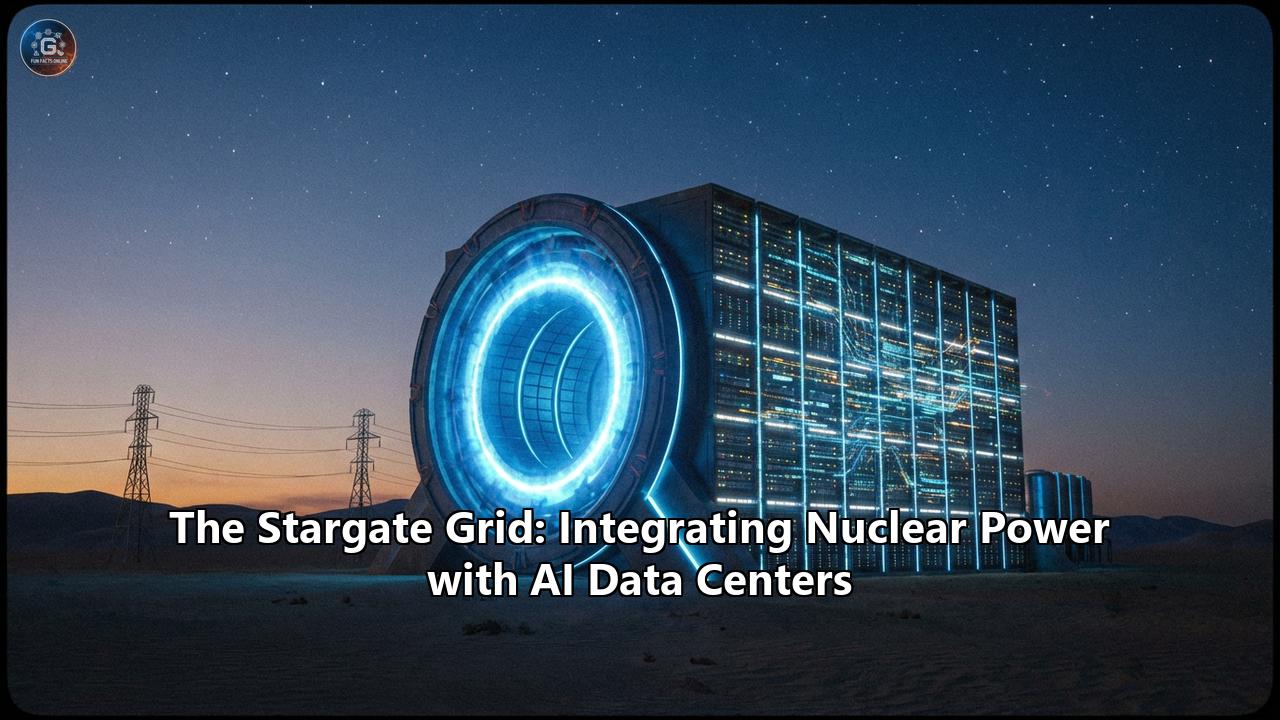
The dawn of the "Stargate" era wasn’t marked by a single ribbon-cutting ceremony, but by the quiet, hum of cooling fans and the steady vibration of steam turbines syncing with the grid. It was the sound of a desperate industrial pivot. By late 2024, the artificial intelligence industry faced an existential wall: the world was running out of electricity to feed its digital gods. The solution that emerged—an unprecedented fusion of silicon and uranium—has come to be known as The Stargate Grid.
As we stand here in early 2026, looking back at the whirlwind of the last eighteen months, the landscape of the internet and global energy has been irrevocably altered. The $500 billion initiative, loosely organized under the banner of "Project Stargate," has done more than just build supercomputers; it has resurrected the nuclear power industry, redrawn national power grids, and created a new geopolitical asset class: the Nuclear Compute Reserve.
This article explores the genesis, architecture, and implications of the Stargate Grid—the most complex machine ever built by human hands, designed to birth the first Artificial General Intelligence (AGI).
Part I: The Kilowatt Cliff
Why the Old Grid Failed the AI RevolutionTo understand the Stargate Grid, one must first understand the crisis that necessitated it. In 2023 and 2024, the explosion of Generative AI—led by OpenAI’s GPT-4, Google’s Gemini, and Anthropic’s Claude—sent shockwaves through the global power infrastructure.
For decades, data center power consumption was a rounding error in national energy policies, hovering around 1-2% of global demand. But AI training clusters are not normal data centers. A standard rack of servers might consume 10 kilowatts (kW) of power. An NVIDIA H100 or Blackwell-based training cluster consumes upwards of 100 kW per rack. When clustered together in the tens of thousands to train models with trillions of parameters, the power density becomes unmanageable for traditional grids.
By mid-2025, a report by the International Energy Agency (IEA) confirmed what tech CEOs feared: data center electricity consumption was on track to double by 2030, reaching 1,000 TWh—roughly equivalent to the entire electricity consumption of Japan.
The Intermittency TrapSilicon Valley had spent the 2010s purchasing "green energy credits" to claim carbon neutrality. They bought wind and solar power on paper, but the physical electrons flowing into their servers often came from coal or gas. AI, however, does not sleep. Training runs can last for months and require 99.999% uptime. You cannot train a frontier model on intermittent power; if the wind stops blowing in West Texas, the GPU cluster cannot simply "pause" without massive efficiency losses.
Batteries were too expensive at the gigawatt scale needed. Fossil fuels were politically toxic and increasingly regulated. The tech giants were trapped. They had the chips, they had the data, and they had the capital. But they didn't have the juice.
This bottleneck birthed the "Stargate" concept—originally a codename for Microsoft and OpenAI’s proposed $100 billion supercomputer, but soon a colloquialism for the entire industry’s shift toward self-sufficient, nuclear-powered mega-campuses.
Part II: The Nuclear Renaissance
Fission Comes in from the ColdThe turning point came in rapid succession during the "Nuclear Autumn" of 2024.
- Microsoft stunned the energy world by signing a 20-year deal to restart Unit 1 at Three Mile Island, the site of America's most infamous nuclear accident. The symbolism was potent: Big Tech was so hungry for power they would resurrect the dead to get it.
- Amazon Web Services (AWS) purchased a data center campus directly connected to the Susquehanna Steam Electric Station in Pennsylvania, effectively buying the nuclear plant's output "behind the meter" to bypass the public grid entirely.
- Google partnered with Kairos Power to deploy a fleet of advanced Small Modular Reactors (SMRs) by 2030.
But these were merely opening skirmishes. The true "Stargate" revelation came in early 2025 with the announcement of the broader Stargate Project coalition involving OpenAI, SoftBank, Oracle, and MGX. This wasn't just about buying power; it was about building it.
The Stargate ArchitectureThe Stargate Grid is not a single location. It is a distributed network of "Gigawatt Campuses." A typical Stargate-class facility differs radically from the data centers of the 2010s.
- The Core: A central training cluster housing 2 to 4 million GPUs.
- The Heart: On-site power generation ranging from 1GW to 5GW.
- The Shield: Massive thermal management systems, often utilizing liquid cooling loops that rival municipal water works in scale.
The primary power source for these behemoths? The Small Modular Reactor (SMR).
Unlike the cathedral-sized cooling towers of the 20th century, SMRs are factory-built, ship-portable nuclear batteries. Companies like X-Energy, NuScale, and TerraPower (backed by Bill Gates) designed these reactors to be "walk-away safe"—meaning physics, not human operators, shuts them down in an emergency.
In the Stargate Grid, SMRs are deployed in "six-packs" or "twelve-packs" directly adjacent to the server halls. This proximity is crucial. By generating power meters away from where it is consumed, tech companies avoid the "transmission queue"—the decade-long waiting list to connect new power plants to the national grid. They are effectively building private, islanded microgrids that only sip from the public grid for backup.
Part III: The Stargate Grid Ecosystem
A New Industrial GeographyThe requirement for massive water cooling and nuclear zoning has redrawn the map of the American technology sector. Silicon Valley is too dense, too regulated, and too seismically active for the Stargate Grid. The new capitals of AI are in the "Energy Belt."
1. The Pennsylvania-Ohio Corridor (The Rust Belt Revival)The Rust Belt has become the "Brain Belt." With its abundance of fresh water (cooling), existing nuclear sites (grid interconnects), and industrial zoning, Pennsylvania has seen billions in investment. The restart of Three Mile Island was just the beginning. Entire decommissioned coal plants are being retrofitted—not to burn coal, but to serve as pre-wired sites for SMRs and data centers. The transmission lines are already there; they just needed a new power source.
2. The Texas TriangleTexas, with its independent ERCOT grid and deregulation-friendly policies, hosts the largest of the Stargate nodes. The "Texas Gigacluster" near Abilene is rumored to be the primary site for the Phase 5 OpenAI supercomputer. Here, the sheer availability of land allows for a hybrid approach: massive solar arrays provide cheap power during the day for non-critical inference tasks, while a bank of gas turbines and planned SMRs handle the relentless baseload of model training.
3. The Pacific Northwest (The Hydro-Nuclear Hybrid)Washington and Oregon, long favored for their cheap hydro power, are evolving. The hydro capacity is maxed out. Now, tech giants are working with Energy Northwest to site SMRs near existing hydro dams, creating a redundant power mix of river and atom.
Part IV: The Engineering Challenges
Physics Bites BackBuilding the Stargate Grid is not merely a matter of writing checks. The engineering hurdles encountered over the last year have been immense.
The Heat Death of the Data CenterA 5GW data center produces 5GW of heat. That is enough thermal energy to heat a medium-sized city in winter. Removing this heat is the primary limit on AI density. The Stargate facilities have abandoned air cooling entirely. They utilize Direct-to-Chip Liquid Cooling and Immersion Cooling, where server blades are submerged in baths of non-conductive dielectric fluid.
The "hot water" output from these centers is massive. In Nordic countries, this waste heat is piped into District Heating Systems to warm homes. In the US, where such infrastructure is rare, the Stargate Grid utilizes massive evaporation towers, consuming millions of gallons of water daily. This has sparked the "Water Wars," with local agricultural communities suing tech giants over aquifer depletion—a legal battleground that is defining 2026.
The Grid Synchronization ProblemNuclear reactors prefer to run at 100% power, 24/7. AI workloads, while intense, can be "bursty." If a training run crashes or a checkpointing operation occurs, power demand can drop by hundreds of megawatts in milliseconds. A standard nuclear reactor cannot ramp down that fast.
To solve this, the Stargate Grid utilizes massive load banks and battery buffers. When the AI pauses, the excess nuclear power is diverted to charge utility-scale batteries or, in some designs, to produce green hydrogen via electrolysis. This hydrogen is then stored as backup fuel, creating a closed-loop energy ecosystem.
Part V: The Geopolitical Arms Race
Compute SovereigntyThe Stargate Grid is not just a commercial endeavor; it is a national security asset. By 2025, the US government recognized that the nation with the largest AGI training cluster would likely dominate the 21st century economically and militarily.
The China FactorChina faces a different constraint. While it has a robust nuclear construction sector (building reactors faster than the US), it is strangled by US export controls on advanced GPUs (NVIDIA H100s/B200s). The US strategy is a pincer movement: choke China’s chip supply while outbuilding them on power infrastructure.
However, this has led to a "Sovereign AI" panic. Nations like France, UAE, and Japan are rushing to build their own mini-Stargates. The UAE, with its deep pockets and autocratically streamlined zoning laws, is aggressively courting OpenAI and Microsoft, offering "power abundance" that the US struggles to permit. This has forced Washington to explore "National Security Corridors" for power transmission, effectively overruling local opposition to fast-track nuclear sites for AI.
The "AI Permitting Reform" Act of 2025In a rare display of bipartisanship, the US passed legislation in late 2025 to streamline nuclear licensing for data centers. The deal was simple: Republicans got nuclear deregulation; Democrats got strict provisions that the AI models trained on these grids would be subject to safety evaluations. This legislative framework is the legal bedrock of the Stargate Grid.
Part VI: The Economics of the Stargate
The Trillion Dollar BetThe numbers associated with the Stargate Grid are numbing. A single 1GW SMR-powered campus can cost $20-30 billion. The full build-out of the proposed US AI infrastructure by 2030 is estimated at $2 trillion.
Financing the GridTech balance sheets, though massive, cannot absorb this alone. This has given rise to AI Infrastructure Investment Funds. giants like BlackRock, in partnership with Microsoft (the MGX vehicle), have created vehicles to tap sovereign wealth funds and pension systems. The pitch is stable returns: "Compute is the oil of the 21st century. Owning the power plant that refines it is like owning an oil refinery in 1920."
The Cost of IntelligenceThe Stargate Grid has inverted the economics of AI. In 2023, the cost of compute was driven by chip shortages. In 2026, the cost is driven by the Levelized Cost of Energy (LCOE) and capital expenditure on infrastructure.
This has created a moat. Startups cannot afford to build Stargates. The AI landscape is solidifying into an oligopoly of "The Hyperscalers" (Microsoft, Amazon, Google, Meta) and "The State-Backed" (China, UAE). The dream of "democratized AI" is dying; the future belongs to those who own the gigawatts.
Part VII: The Environmental Paradox
Green or Grey?The environmental narrative of the Stargate Grid is complex. On one hand, it is the largest deployment of carbon-free energy in history. By anchoring the nuclear supply chain, Big Tech is lowering the cost of SMRs for everyone, potentially decarbonizing the broader grid faster than policy alone could have.
On the other hand, the "embodied carbon" of building these massive concrete fortresses is immense. furthermore, the sheer addition of 50-100GW of new load effectively cancels out years of efficiency gains in other sectors.
Critics argue that using pristine nuclear energy to generate "deepfake videos and chatbots" is a resource allocation tragedy. Proponents argue that AGI will solve material science problems (like better batteries or carbon capture) that ultimately pay off the carbon debt.
The Nuclear Waste QuestionWith the resurgence of nuclear comes the resurgence of the waste debate. The Stargate solution so far has been "dry cask storage" on site—essentially kicking the can down the road. However, part of the 2025 legislation includes new funding for a permanent repository, likely reopening the Yucca Mountain debate or exploring deep borehole disposal, funded by a tax on AI compute cycles.
Part VIII: Future Outlook (2026-2035)
Beyond FissionAs we look toward the 2030s, the Stargate Grid is evolving.
The Fusion HorizonWhile SMRs are the workhorse of the 2020s, the 2030s may belong to fusion. Microsoft’s purchase agreement with Helion Energy (for fusion power by 2028) was viewed with skepticism in 2023, but early pilots are promising. If fusion becomes viable, the "fuel" constraint of uranium disappears, leaving only the heat dissipation limit.
Optical Computing and EfficiencyThe Stargate Grid is so expensive that it is driving a revolution in chip efficiency. The industry is desperate to move away from electron-based switching to photonics (optical computing). If successful, this could reduce power consumption by 90%, turning the Stargate Grid from a power-hungry monster into a power-surplus provider for the rest of the nation.
The Planetary ComputerUltimately, the Stargate Grid is more than just infrastructure. It is the physical nervous system of a new intelligence. We are wrapping the planet in a layer of silicon, copper, and cooling fluid, fed by the splitting of the atom.
In 2024, we asked if AI was smart enough.
In 2026, we ask if we are strong enough to power it.
The Stargate Grid is our answer. It is a gamble of colossal proportions—a bet that the intelligence we create will be worth the energy we consume to birth it. The turbines are spinning. The cooling pumps are roaring. The training has begun.
Deep Dive Sections
1. The Technology of SMRs in Data Centers
Small Modular Reactors represent a paradigm shift from "stick-built" reactors.
- Safety: Designs like the Kairos Power reactor use molten fluoride salt as a coolant instead of water. Salt can't boil away at low pressure, making a Fukushima-style explosion physically impossible. This allows these reactors to be placed much closer to population centers and data campuses.
- Modularity: A data center expands rack by rack. SMRs expand module by module. NuScale’s VOYGR power plant can house up to 12 modules, each producing 77 MWe. A tech company can start with 4 modules and add more as their GPU cluster grows.
- DC Coupling: There is a movement to design "Direct Current" (DC) nuclear plants. Traditional plants generate AC, which is converted to DC for servers, losing power in the conversion. Future Stargate nodes aim to generate DC directly from the turbine hall to the server rack, improving efficiency by 15-20%.
2. The "Last Mile" Power Problem
The biggest bottleneck for AI isn't generating power; it's moving it. High Voltage transmission lines take 7-10 years to permit and build.
- The Colocation Solution: This is why the Talen Energy / AWS deal was revolutionary. By placing the data center on the nuclear plant's property, they legally avoided using the transmission grid. This "behind-the-meter" loophole is now the gold standard for site selection.
- Grid Resentment: This practice has angered utilities. If Amazon buys all the clean power from a nuclear plant, that power is removed from the public grid, which must then spin up gas or coal plants to compensate. This is known as "Resource Shuffling" and is becoming a major regulatory battleground.
3. The Workforce Crisis
You can build a reactor in a factory, but you need a nuclear engineer to run it. The US nuclear workforce has atrophied since the 1990s.
- The AI-Nuclear Training Pipeline: Universities in the Rust Belt (Penn State, Purdue, Ohio State) are receiving massive grants from Microsoft and Google to fast-track nuclear engineering degrees.
- Automation: Ironically, AI is being used to run the power plants that feed the AI. Automated control rooms are being designed to reduce the headcount needed to operate an SMR fleet, though the Nuclear Regulatory Commission (NRC) remains cautious.
4. The Global Competitors
- China: China is building "Data Center Clusters" in its western desert regions, pairing massive solar/wind farms with ultra-high-voltage transmission lines (UHVDC) to send compute power to the eastern cities. They are less reliant on SMRs and more reliant on brute-force infrastructure buildouts.
- Europe: Europe is lagging. High energy prices and fragmentation have made it difficult to site Stargate-class facilities. The "FLAP-D" markets (Frankfurt, London, Amsterdam, Paris, Dublin) are power-constrained. Europe is focusing on "Inference at the Edge" rather than massive training clusters, potentially ceding the AGI development race to the US and China.
5. Conclusion: The Stargate Legacy
The Stargate Grid is the pyramids of the digital age—monumental structures built to house a power greater than ourselves. Whether they become the tombs of our climate goals or the launchpads for a post-scarcity civilization depends on the next decade of execution. But one thing is certain: the era of "free" internet energy is over. The internet is now heavy, hot, and radioactive. Welcome to the Stargate.
Reference:
- https://apcoworldwide.com/blog/the-stargate-initiative-a-catalyst-for-the-next-energy-revolution/
- https://www.nuclearbusiness-platform.com/media/insights/tech-giants-are-investing-billions-in-nuclear
- https://www.etcentric.org/microsoft-openai-considering-a-supercomputer-data-center/
- https://www.theregister.com/2024/04/01/microsoft_openai_5gw_dc/
- https://switchgear-magazine.com/tm-news/business/the-future-of-power-stargates-grids-for-ai/
- https://www.youtube.com/watch?v=58zHJL1dKtw
- https://www.datacenters.com/news/exploring-small-modular-reactors-as-the-next-energy-frontier
- https://apnews.com/article/climate-data-centers-amazon-google-nuclear-energy-e404d52241f965e056a7c53e88abc91a
- https://www.imperialdatacenter.com/small-modular-reactors-the-nuclear-option-for-powering-data-centers
- https://techinsight.net/infrastructure/microsoft-and-openai-partner-for-115-billion-stargate-data-center-project/
- https://www.maginative.com/article/microsoft-and-openai-plan-100-billion-stargate-ai-supercomputer/
- https://introl.com/blog/smr-nuclear-power-ai-data-centers-2025