
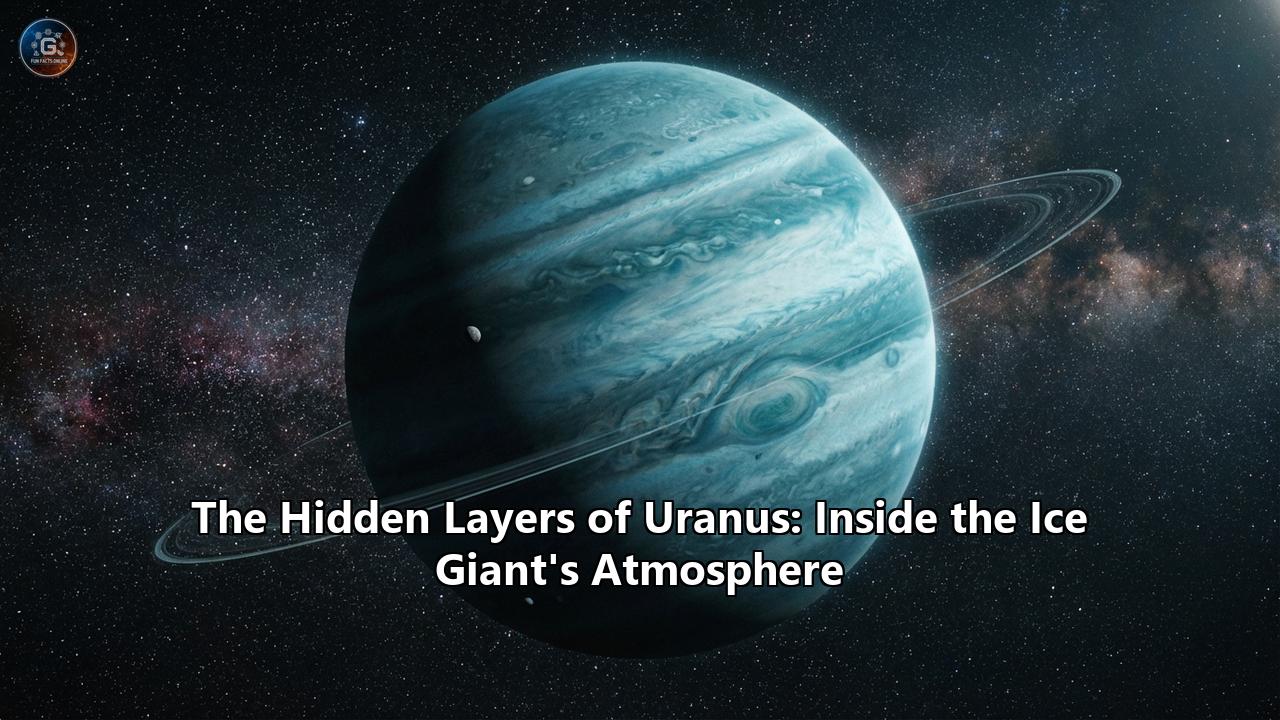
When NASA’s Voyager 2 spacecraft skimmed past Uranus in the winter of 1986, it sent back images of a seemingly tranquil, featureless, pale-blue sphere. For decades, the seventh planet from the Sun was unfairly stigmatized as the solar system’s most boring world—a frozen, stagnant cue ball quietly rolling along its orbital path. But as modern astronomy has peeled back the hazy veil of this distant ice giant, a radically different picture has emerged. Today, we know Uranus is a wildly dynamic, tempestuous world full of hidden superstorms, bizarre magnetic anomalies, and layered atmospheric depths that challenge our fundamental understanding of planetary science.
Far from being a static sphere of gas, Uranus is a complex, layered world driven by extraordinary atmospheric chemistry, extreme seasonal shifts, and a surprisingly elusive internal heat engine. From scorching auroras in its upper ionosphere to pitch-black, crushing depths where it literally rains diamonds, the atmosphere of Uranus is a masterclass in cosmic extremes.
The Recipe for an Ice Giant: The Chemical Palette
To understand the atmosphere of Uranus, we must first look at what it is made of. Like Jupiter and Saturn, Uranus possesses a thick gaseous envelope, but the proportions of its ingredients categorize it into a completely different planetary class: the ice giants.
By volume, the outermost layers of Uranus's atmosphere consist primarily of molecular hydrogen (82.5%) and helium (15.2%). However, unlike the larger gas giants, hydrogen and helium make up only a tiny fraction of the planet's overall mass (roughly 0.5 to 1.5 Earth masses). The true character of Uranus is defined by its heavier volatile compounds—which astronomers refer to as "ices"—such as water, ammonia, and methane.
It is the methane, making up roughly 2.3% of the upper atmosphere, that acts as the planet’s signature cosmic paint. Methane gas is highly efficient at absorbing red and yellow wavelengths of sunlight. When the sun’s light enters the Uranian atmosphere, the red light is swallowed by the methane, while the blue and green light is reflected back into space. This chemical filtration gives Uranus its iconic, ethereal cyan glow.
But the atmosphere we see is merely the ceiling of a much deeper, vastly more complex structure. The Uranian atmosphere lacks a mesosphere entirely, instead dividing itself into three distinct, highly active layers: the troposphere, the stratosphere, and the searingly hot thermosphere/ionosphere.
Plunging into the Depths: The Troposphere and its Hidden Clouds
If you were to dive into the Uranian atmosphere, your journey would begin in the troposphere, the deepest, densest, and most weather-active layer of the planet's atmospheric shell. Extending from roughly 50 kilometers (31 miles) above the "surface" (the point where atmospheric pressure equals one Earth bar) down to 300 kilometers (186 miles) below it, the troposphere is a place of crushing pressures and record-breaking cold.
In fact, Uranus boasts the coldest planetary atmosphere in the entire solar system. As you descend through the upper troposphere, temperatures plummet to a staggering 49 Kelvin (−224°C or −371°F). This deep freeze acts as a sharp boundary—a tropopause—that bottles up the planet's internal weather systems.
Hidden beneath this frigid boundary lies a stacked, multi-tiered architecture of alien cloud decks, separated by shifting pressures and temperatures. Unlike the water-based clouds of Earth, Uranus’s cloud layers are stratified by their freezing points:
- The Methane Deck (1.2 bar): At the highest visible level, wispy, thin clouds of frozen methane ice drift through the pale blue sky.
- The Hydrogen Sulfide and Ammonia Deck (3–10 bar): Plunging deeper, the pressure builds, and clouds formed from hydrogen sulfide (the chemical that gives rotten eggs their smell) and ammonia begin to coalesce.
- The Ammonium Hydrosulfide Deck (20–40 bar): Deeper still, in pitch darkness, extreme pressures force the creation of dense, swirling clouds of ammonium hydrosulfide.
- The Water Clouds (Below 50 bar): At the deepest observable atmospheric depths, where the crushing weight of the gas above acts like a vice, we find clouds of super-chilled water.
Below these cloud layers, the atmosphere transitions seamlessly into the planet's mantle—not a rocky shell, but a hot, dense, supercritical ocean of liquid water, ammonia, and methane. Because Uranus lacks a solid surface, its atmosphere simply gets thicker and hotter until the gases are compressed into a bizarre, electrically conductive fluid often referred to as a water-ammonia ocean.
The Stratospheric Smog
Ascending above the weather-laden troposphere, we enter the stratosphere, a vast region spanning from 50 kilometers to roughly 4,000 kilometers above the planet's nominal surface.
The stratosphere of Uranus is, essentially, a factory for extraterrestrial smog. When ultraviolet radiation from the distant Sun strikes the methane molecules hovering near the top of the troposphere, it breaks them apart in a process called photolysis. The fragments recombine to form heavier hydrocarbon molecules like ethane, acetylene, and diacetylene.
As these hydrocarbons sink back into the colder lower stratosphere, they condense into incredibly fine, hazy layers of smog. It is this high-altitude hydrocarbon haze that obscures the deeper, churning storm clouds from our view, giving Uranus its historically smooth, "bland" appearance. Interestingly, the presence of these hydrocarbons helps to gently warm the stratosphere, preventing it from remaining as impossibly cold as the layer below it.
The Thermosphere and Ionosphere: A 3D Map of a Magnetic Mystery
The outermost shell of the Uranian atmosphere, extending from 4,000 kilometers to as far as 50,000 kilometers out into space, is the thermosphere, which gradually transitions into a charged ionosphere and exosphere. For decades, this region was one of the greatest mysteries in planetary science.
Measurements from Voyager 2 indicated that the upper atmosphere was inexplicably hot—registering up to 800-850 Kelvin (roughly 577°C or 1,070°F). Because Uranus is nearly 1.8 billion miles from the Sun, solar radiation alone is entirely insufficient to generate such intense heat. What was warming the edge of space around an ice giant?
In February 2026, the scientific community received a monumental breakthrough. An international team of astronomers utilizing the James Webb Space Telescope (JWST) successfully mapped the vertical structure of Uranus’s upper atmosphere in three dimensions for the very first time. By tracking the faint infrared glow of charged molecules (trihydrogen cations) over a full Uranian rotation, scientists were able to measure exactly how energy moves upward through the planet’s outer layers.
The JWST data revealed a breathtaking, dynamic upper atmosphere. The team found that temperatures peak between 3,000 and 4,000 kilometers above the clouds, while ion densities reach their maximum around 1,000 kilometers up. Crucially, the observations confirmed a long-suspected trend: Uranus's upper atmosphere has actually been steadily cooling since the 1990s. The new average temperature of the ionosphere was recorded at roughly 426 Kelvin (150°C)—significantly cooler than the readings taken during the Voyager era.
Furthermore, JWST's sharp vision revealed glowing bands of auroras near the planet's magnetic poles, alongside unexpected "dark regions" where ion density was severely depleted. Unlike Earth, which has a magnetic field relatively aligned with its spin, Uranus’s magnetic field is violently lopsided, tilted by 59 degrees away from its rotational axis and entirely off-center from the planet's core. The 2026 3D mapping proved that this skewed, asymmetric magnetic field is actively warping the ionosphere, directly dictating where and how auroras form high above the hydrocarbon clouds.
A World on Its Side: Seasons and Superstorms
To comprehend the weather patterns brewing inside these layers, one must account for Uranus’s most famous quirk: it orbits the Sun completely on its side.
Uranus has an extreme axial tilt of 98 degrees. While Earth spins like a top, Uranus rolls along its orbital plane like a barrel. This bizarre orientation—likely the result of a catastrophic collision with an Earth-sized protoplanet billions of years ago—creates the most extreme seasonal variations in the solar system. A single year on Uranus lasts 84 Earth years. Because of its tilt, one pole will bake in continuous, direct sunlight for 21 Earth years, while the opposite hemisphere is plunged into a dark, frozen, 21-year-long winter.
When Voyager 2 flew by in 1986, it was the peak of the southern hemisphere's summer, and the atmosphere appeared quiet. But as Uranus slowly moved toward its equinox in 2007—the moment when the Sun shone directly over its equator—the entire atmosphere seemingly woke up. Hubble and ground-based telescopes watched in awe as gigantic, brilliant white storm clouds erupted across the planet. Swirling storms roughly three-quarters the diameter of Earth were spotted tearing through the methane-laden upper atmosphere.
Even more astounding are the winds that drive these tempests. Despite the frigid temperatures and lack of solar energy, the zonal winds on Uranus travel in retrograde (opposite to the planet's rotation) at the equator and prograde at the poles, reaching terrifying speeds of up to 900 km/h (560 mph or 240 m/s).
But why are these storms so violently unpredictable, appearing and disappearing seemingly at random? In September 2024, scientists finally uncovered the secret ingredient controlling Uranus's superstorms: the methane itself.
Researchers discovered that methane in the deep atmosphere acts like an atmospheric "wet blanket". At the equator and mid-latitudes, the atmosphere becomes heavily saturated with methane, forming a dense, stable layer that traps internal heat below it, effectively suppressing the formation of major storms. However, at the planet's poles, there isn't enough methane to create this stable blanket. As a result, heat from the planet's interior can easily rise to the surface, causing massive thermal turbulence that triggers ultraviolent, short-lived superstorms. It is a cycle not entirely unlike Earth's water cycle, but operating with hydrocarbons on a gargantuan, planetary scale.
The Engine Below: Solving the Internal Heat Mystery
The mechanism driving these storms requires heat to rise from the interior, which brings us to the greatest puzzle of Uranus's atmosphere: its missing internal heat.
For decades, astronomers referred to this as the "energy crisis" of the ice giants. Neptune, Uranus’s near-twin in size and composition, radiates 2.61 times as much energy into space as it absorbs from the Sun, indicating a robust, hot core driving massive atmospheric storms. Uranus, by contrast, seemed electromagnetically dead. Measurements indicated it radiated a mere 1.06 times the solar energy it received, with a total internal heat flux so low (0.042 W/m²) that it was actually less than the internal heat generated by the Earth. This lack of an internal thermal engine was long cited as the reason for Uranus's visually bland atmosphere and sluggish tropospheric convection.
However, the textbooks were rewritten in July 2025. A groundbreaking study from the University of Houston, utilizing decades of spacecraft data and advanced computer modeling, finally detected the missing thermal signature. The research definitively proved that Uranus does generate its own internal heat, emitting approximately 12.5% more heat than it absorbs from the Sun.
This revelation was monumental. It confirmed that Uranus is still slowly leaking ancient, primordial heat left over from its violent formation 4.5 billion years ago. While its internal heat flux is indeed much weaker than Jupiter's or Neptune's (which emit upwards of 100% more heat than they absorb), it is definitively there, slowly churning the water-ammonia mantle below and periodically fueling the localized atmospheric superstorms observed from Earth.
A New Era of Ice Giant Exploration
The atmosphere of Uranus is a mesmerizing paradox. It is the coldest place in the solar system, yet it harbors pockets of ancient, lingering heat. It appears as a tranquil, featureless blue orb, yet it is ravaged by 900 km/h winds and continent-sized superstorms governed by a global methane blanket. It is protected by an ionized upper atmosphere that is actively cooling down, shaped by a mangled, lopsided magnetic field that triggers glowing auroras in the dark.
For years, the sheer distance to Uranus—and the lack of dedicated spacecraft—left the planet shrouded in mystery, pieced together only by the brief 1986 flyby of Voyager 2 and the watchful eyes of Hubble and JWST. But the veil is lifting. The global planetary science community has placed a return to the ice giant at the top of its priority list. The highly anticipated Uranus Orbiter and Probe (UOP) mission, slated to launch in the early 2030s and arrive by 2044, will finally drop a dedicated atmospheric probe directly into these hidden layers.
When that probe plunges through the hydrocarbon smog, past the freezing methane clouds, and into the crushing depths of the water and ammonia decks, it will taste the chemistry of a world that has kept its secrets for billions of years. Until then, the pale blue dot at the edge of our solar system remains a testament to the beautiful, chaotic, and endlessly complex nature of planetary atmospheres.
Reference:
- https://www.space.com/18708-uranus-atmosphere.html
- https://www.universetoday.com/articles/uranus
- https://en.wikipedia.org/wiki/Atmosphere_of_Uranus
- https://study.com/academy/lesson/video/uranus-moons-rings-atmosphere-rotation.html
- https://en.wikipedia.org/wiki/Uranus
- https://www.skyatnightmagazine.com/news/uranus-webb-january-2025
- https://www.sciencedaily.com/releases/2026/02/260221000303.htm
- https://mashable.com/article/james-webb-space-telescope-uranus-auroras-timelapse-video
- https://www.sci.news/astronomy/webb-uranus-ionosphere-14572.html
- https://www.nationalgeographic.com/science/article/141113-starstruck-uranus-storm-astronomy-science
- https://en.wikipedia.org/wiki/Climate_of_Uranus
- https://www.livescience.com/space/uranus/scientists-finally-know-why-ultraviolent-superstorms-flare-up-on-uranus-and-neptune
- https://scitechdaily.com/a-hidden-heat-source-on-uranus-just-changed-what-we-know-about-planets/