
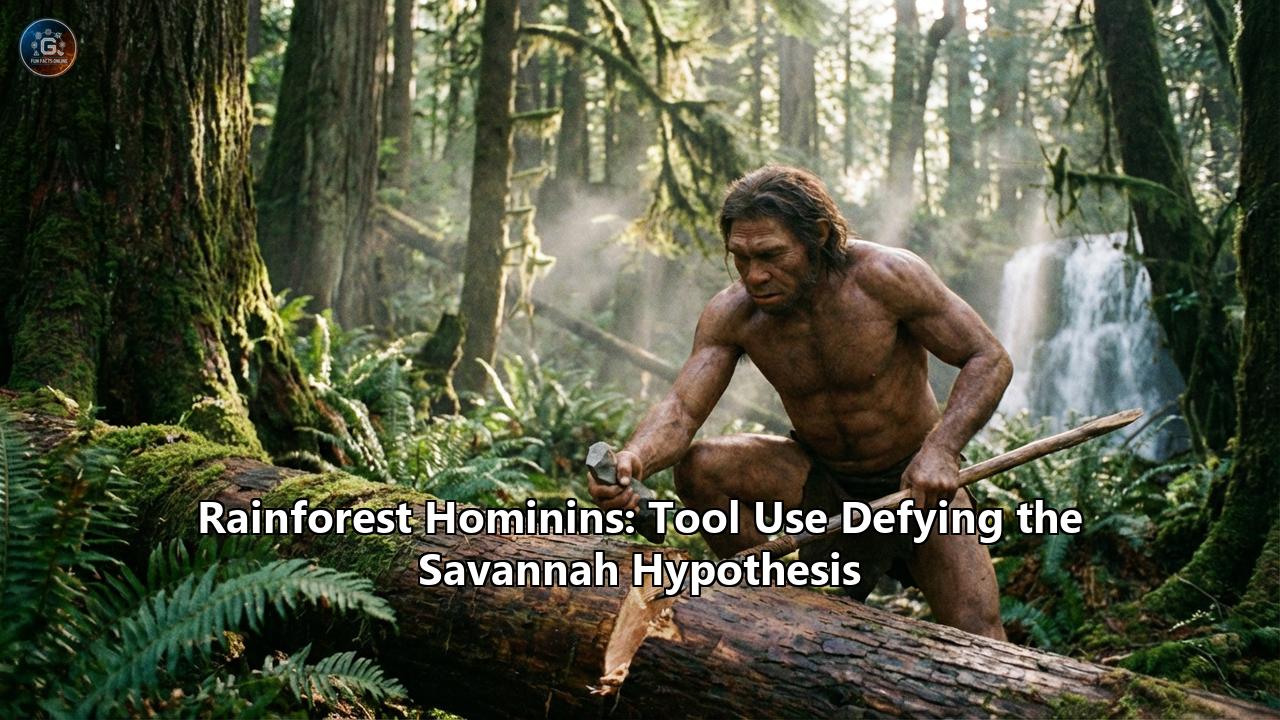
Introduction: The Golden Grass Mythos
For nearly a century, the story of human evolution has been painted in shades of gold and ochre. It is a story set against the backdrop of the African savannah, a vast, sun-drenched theater where the curtain rose on the first act of humanity. In this popular narrative, our ape-like ancestors, forced from the shrinking forests by a drying climate, descended from the trees and stepped tentatively onto the open grasslands. There, amidst the tall grasses and the stalking predators, they stood upright to see over the horizon. They freed their hands to hold weapons, developed sweat glands to cool their bodies under the equatorial sun, and expanded their brains to outwit the lions and hyenas that patrolled the plains.
This narrative, known as the Savannah Hypothesis, has been the bedrock of paleoanthropology since Raymond Dart discovered the Taung Child in 1924. It is a compelling, almost cinematic origin story. It suggests that the harsh, open crucible of the savannah forged the unique traits that define us: bipedalism, tool use, and complex social cooperation. It implies that to be human is to be a creature of the open edge, a conqueror of the grassy void.
But there is a problem with this story. It is becoming increasingly clear that it is, at best, incomplete and, at worst, fundamentally misleading.
Over the last two decades, a quiet revolution has been taking place in the remote, dripping interiors of the world’s tropical rainforests. From the dense canopies of Sri Lanka to the ancient jungle sediments of West Africa, archaeologists are unearthing evidence that shatters the golden grass mythos. They are finding that early humans—and perhaps even their archaic cousins—were not merely refugees from the forest, but masters of it. They were "Rainforest Hominins," equipped with specialized toolkits, deep ecological knowledge, and a behavioral plasticity that allowed them to thrive in some of the most challenging environments on Earth.
This article explores this paradigm shift. It journeys into the deep past to reveal how the discovery of rainforest adaptations is rewriting the biography of our species. We will examine the microlithic arrowheads of the Asian monkey hunters, the 150,000-year-old stone picks of West Africa, and the complex tool cultures of modern forest chimpanzees. Together, these clues tell a new story: that humanity was not born solely of the savannah, but was forged in the twilight of the canopy as much as the glare of the open plain.
Part I: The Savannah Hypothesis and Its Discontents
To understand the magnitude of the current shift, we must first understand the dominance of the Savannah Hypothesis.
The Romance of the Open Plain
The idea that the savannah was the cradle of humanity dates back to Lamarck and Darwin, but it was solidified in the 20th century. The narrative was driven by the location of the most famous fossil finds. The Rift Valley of East Africa and the caves of South Africa—sites like Olduvai Gorge, Laetoli, and Sterkfontein—are today largely open, arid landscapes. When we found Australopithecus and early Homo there, we assumed the landscape looked then as it does now.
The logic seemed impeccable.
- Bipedalism: Walking on two legs is efficient for covering long distances between scattered food sources in an open landscape.
- Thermoregulation: Our hairlessness and vertical posture reduce solar radiation exposure, a distinct advantage in a shadeless environment.
- Tool Use: The need to butcher large game or defend against pack hunters on the ground presumably drove the invention of stone tools (the Oldowan and Acheulean industries).
For decades, the rainforest was viewed as a "Green Desert"—an environment hostile to early humans. Anthropologists argued that protein in the rainforest is locked high in the canopy, hard to access without complex technology. The dense vegetation makes movement difficult, and the acidic soils dissolve bones, leaving no fossil record. Consequently, the rainforest was seen as a barrier to human expansion, a place we only entered recently, after the invention of agriculture.
Cracks in the Theory
The first cracks appeared with better paleo-environmental reconstruction. Analysis of ancient pollen and carbon isotopes from fossil sites revealed that many early hominins, including the famous "Lucy" (Australopithecus afarensis), lived in mosaic environments that included significant woodland and forest cover, not just open grassland.
Then came the realization that bipedalism might have arboreal roots. Observations of orangutans and gibbons showed that "assisted bipedalism" (walking on branches while holding onto others) is a common way to navigate the canopy. Perhaps we didn't stand up to leave the trees; perhaps we stood up inside them.
But the biggest blow has come from the archaeological record of Homo sapiens itself. New dating technologies and daring excavations in the tropics have shown that our species was penetrating deep rainforests tens of thousands of years earlier than the Savannah Hypothesis predicted.
Part II: The Deep Time of the African Rainforest
Africa is the cradle of humankind, and for a long time, researchers believed that cradle was lined with grass. However, recent discoveries in West and Central Africa are proving that the nursery also had a canopy.
The Côte d'Ivoire Revelation: 150,000 Years Ago
In a groundbreaking study published recently, researchers returned to a site known as Bété 1 in Côte d'Ivoire (Ivory Coast). Originally excavated in the 1980s, the significance of the stone tools found there was obscured by a lack of precise dating.
Using modern techniques like Optically Stimulated Luminescence (OSL), which measures the last time sediment was exposed to sunlight, the new team shocked the archaeological world. The stone tools—distinctive picks and large cutting implements—were dated to approximately 150,000 years ago.
This date is revolutionary. It places early Homo sapiens (or a very closely related archaic human) in the West African rainforest at the very dawn of our species.
- The Environment: Isotope and pollen analysis confirmed that 150,000 years ago, this region was indeed a dense, wet, tropical rainforest, not a savannah mosaic.
- The Tools: The tool assemblage was not the standard savannah toolkit. It included large, heavy-duty picks. While their exact function is debated, they may have been used for digging up tubers (underground storage organs) in the forest floor or processing heavy woody plant material.
This find destroys the idea that humans only entered the rainforest in the last 10,000-20,000 years. It suggests that from the very beginning, humans were experimenting with different biomes. We were not "savannah specialists" who later learned to live elsewhere; we were "ecological generalists" from the start.
Rio Campo and the Central African Refugium
Further south, in Equatorial Guinea, the Rio Campo site has yielded stone tools dating back 40,000 years. This is the Middle Stone Age (MSA), a period usually associated with the development of complex behavior in Southern and Eastern Africa.
The presence of MSA technology in the heart of the Central African rainforest demonstrates that these populations were not merely surviving; they were maintaining complex technological traditions. The tools found here are sophisticated, showing that the "savannah adaptation" of the MSA toolkit was flexible enough to be retooled for the jungle.
These populations likely used the forest as a refugium. During the erratic climate swings of the Pleistocene, when the savannahs might dry out into deserts, the rainforests remained stable. Far from being a "Green Desert," the forest may have been the safe harbor that allowed humanity to survive the climate bottlenecks of the Ice Ages.
Part III: The Monkey Hunters of Sri Lanka
If the African evidence shows us that humans could live in the rainforest, the evidence from Sri Lanka shows us how they mastered it. The caves of Sri Lanka, particularly Fa-Hien Lena, provide some of the most detailed and spectacular evidence of high-tech rainforest adaptation in the world.
The Microlith Revolution
Fa-Hien Lena is a massive cave complex in the wet zone of southwestern Sri Lanka. Excavations here have uncovered human occupation layers dating back 48,000 years.
What makes Fa-Hien Lena unique is the technology found there. The residents didn't use the clunky hand axes of the savannah. Instead, they produced microliths—tiny, razor-sharp flakes of quartz and chert, some no larger than a fingernail.
- The Function: These microliths were almost certainly the tips of projectile weapons—arrows or blowgun darts.
- The Prey: The animal bones found in the cave tell a clear story. These people were not hunting slow-moving ground game. They were hunting arboreal monkeys (macaques and langurs) and giant tree squirrels.
Hunting a monkey high in the canopy is incredibly difficult. They are fast, small, and agile. To catch them, you need speed, accuracy, and stealth. You cannot run them down; you must shoot them down. The microlithic technology of Sri Lanka represents one of the earliest uses of bow-and-arrow technology outside of Africa, specifically adapted for this vertical hunting ground.
Isotopes and the "Pure" Rainforest Diet
Critics might argue that these humans lived in the cave but foraged in nearby grasslands. To test this, scientists analyzed the stable carbon and oxygen isotopes in the tooth enamel of the humans found in the cave.
The results were definitive. The isotopic signature showed a diet derived almost exclusively from the rainforest. There was no "savannah mixing." For tens of thousands of years, these populations lived, hunted, and died within the closed canopy.
Bone Tools and Textiles
Alongside the stone tools, archaeologists found sophisticated bone tools. Some of these were awls and scrapers, likely used for working animal hides or plant fibers. This suggests the manufacture of clothing or bags—essential for protection against the insects, leeches, and thorns of the jungle undergrowth.
The Sri Lankan evidence is the "smoking gun" against the Savannah Hypothesis. It proves that by 45,000 years ago, Homo sapiens had a specialized, distinct "Rainforest Culture" that was technologically distinct from the cultures of the open plains.
Part IV: The Mystery of the Archaic Hominins
The story becomes even more intriguing when we look at our cousins. Did Homo erectus, the Denisovans, or the "Hobbits" (Homo floresiensis) live in the rainforest?
Homo erectus: The Savannah Specialist?
Homo erectus is traditionally viewed as the ultimate savannah walker—the species that left Africa and spread across the Old World. In Southeast Asia (Java), H. erectus survived for a long time. However, paleo-environmental reconstruction suggests that H. erectus in Java preferred open woodlands and riverine environments.There is a theory, supported by some recent studies, that the expansion of the rainforest in Southeast Asia might have actually doomed H. erectus. As the climate warmed and the grasslands of Java were swallowed by the jungle, H. erectus—specialized for the open—could not compete. They went extinct around the time the rainforest took over.
The Contrast with Homo sapiens
This highlights the unique "secret weapon" of Homo sapiens: Plasticity.
When the rainforests expanded, H. erectus retreated or died out. When H. sapiens arrived in Southeast Asia (around 70,000 years ago, as seen in sites like Lida Ajer in Sumatra), we didn't die. We adapted. We invented the blowpipe, the snare, and the toxic dart. We learned to eat toxic yams by leaching them in water.
This contrast suggests that the "Savannah Hypothesis" might actually be true for Homo erectus—they were indeed creatures of the open. But it is false for modern humans. The defining trait of our species is not that we are "savannah apes," but that we are "context-independent apes."
The Hobbit Enigma
Homo floresiensis, the tiny hominin of Flores, Indonesia, adds another wrinkle. Living on a tropical island, they likely navigated a mix of tropical forest and savannah. Their small stature (insular dwarfism) is a classic adaptation to island resources, but it may also have been an advantage in navigating dense vegetation. However, clear evidence of their tool use being specifically "rainforest-adapted" is still being investigated.Part V: The Comparative Ape – Chimpanzees in the Congo
To understand the tools of our ancestors, we often look to our living relatives. The Savannah Hypothesis was often bolstered by studies of chimpanzees in open woodlands (like Gombe), where they use sticks to fish for termites.
But what about rainforest chimpanzees?
Recent extensive studies in the Congo Basin (specifically the Goualougo Triangle and the Bili-Uéré region) have revealed a "Chimpanzee Stone Age" that looks very different from the savannah version.
The Complex Toolkits of the Goualougo
In the deep forests of the Congo, chimpanzees have been observed using complex tool sets. They don't just use one stick; they use a "puncture stick" to break open a termite mound and a separate "fishing probe" with a frayed end (which they manufacture by chewing) to extract the insects.
This is sequential tool use, involving foresight and planning. It happens deep in the forest, driven by the need to access high-value protein sources (termites and ants) that are fortified in hard mounds.
The Bili Apes
In the Bili-Uéré region of the DRC, chimpanzees living in a mosaic of forest and savannah show distinct cultural traits. They use long probes for driver ants and have unique nesting behaviors.
The key takeaway from primatology is that forest environments drive innovation just as much as savannahs. The complexity of the forest—with its hidden foods, hard-shelled nuts, and fortified insect nests—creates a "cognitive demand" that selects for tool use. The idea that the savannah is the only place that makes you "smart" is scientifically bankrupt.
Part VI: The "Versatility" Hypothesis
So, if the Savannah Hypothesis is dead, what replaces it?
The emerging consensus is the Variability Selection Hypothesis (or Versatility Hypothesis). Proposed by paleoanthropologist Rick Potts, this theory posits that human evolution was not driven by a single environment (like the savannah), but by environmental instability.
The climate of the Pleistocene was chaotic. It swung wildly between wet and dry, hot and cold. Forests became grasslands; grasslands became deserts; deserts became lakes.
The hominins that survived—our ancestors—were not the ones who were perfectly adapted to the grass. They were the ones who could handle the change.
- They could hunt in the open and forage in the forest.
- They could make big hand axes for elephants and tiny arrowheads for monkeys.
- They could eat antelope and toxic rainforest yams.
The rainforest evidence is the final piece of this puzzle. It proves that our adaptability was not just "making do" at the edges. We were capable of mastering the most complex, three-dimensional, biologically diverse environments on the planet.
Part VII: The Technology of the Canopy
Let’s look closer at the specific technologies that allowed this defiance of the savannah.
1. Projectile Technology:The bow and arrow (or blowgun) is the ultimate rainforest tool. In the open savannah, you can throw a spear. In the dense undergrowth, a spear is useless—it hits a branch. A small, high-velocity projectile that can thread through the leaves is essential. The microliths of Sri Lanka are the physical embodiment of this adaptation.
2. Poison:While hard to find in the archaeological record, ethnographic analogy suggests that rainforest tool use is intimately tied to chemistry. Rainforests are full of toxins (in plants, frogs, insects). Indigenous rainforest peoples today use these toxins for hunting (poison darts). It is highly likely that early humans in the rainforests of Africa and Asia were the first bio-chemists, harnessing nature's poisons to kill prey high in the canopy.
3. Plant Processing:Rainforests are full of carbohydrates, but they are often locked in toxic or fibrous tubers (yams). The "picks" of West Africa and the "hoes" found in other contexts suggest a heavy reliance on digging and processing plants. This requires not just stone tools, but the knowledge of fire and leaching to make food edible.
Part VIII: Why This Matters Today
The collapse of the Savannah Hypothesis is not just an academic correction; it changes how we view ourselves.
1. We are not "Fish Out of Water"Evolutionary psychology often argues that modern humans are "mismatched" to the modern world because we are designed for the savannah. They claim we like park-like landscapes, open views, and social groups of 150 because that's what life was like on the African plains.
The rainforest evidence suggests this is too simplistic. We are designed for diversity. We are just as at home in the sensory overload of a jungle or the verticality of a city as we are on a golf course (which mimics the savannah).
2. The Conservation ImplicationFor decades, the "Green Desert" theory subtly justified the neglect of rainforest indigenous history. It portrayed rainforests as "pristine wilderness" untouched by humans until recently.
The archaeology shows that humans have been managing, altering, and living in rainforests for tens of thousands of years. The "virgin rainforest" is a myth. Understanding how early humans lived sustainably in these environments for millennia—without destroying them—could offer vital lessons for modern conservation.
3. The Resilience of Our SpeciesAs we face our own climate crisis, the story of the Rainforest Hominins offers hope. It reminds us that our species is defined by its ability to adapt to radical environmental shifts. We survived the freezing of the ice ages and the greening of the tropics. We are the ultimate survivors, not because we are strong, but because we are creative.
Conclusion: The Green Cradle
The savannah will always be a part of our story. It is where we learned to run, and it is where many of our most famous fossils lie. But it is only half the picture.
The other half lies in the dappled light of the rainforest floor, where 150,000 years ago, a human crouched in the mud, fashioning a stone pick to dig for a yam. It lies in the high caves of Sri Lanka, where a hunter sharpened a piece of quartz the size of a grain of rice, looking up at the canopy with calculating eyes.
These "Rainforest Hominins" were not anomalies. They were pioneers. They defied the limitations of their anatomy and the expectations of 20th-century science. They proved that to be human is to be at home everywhere. The "Green Hell" was, in fact, a "Green Cradle," a crucible of innovation that taught us how to conquer the vertical world long before we built our first skyscraper.
As we continue to dig in the jungles of the world, we can expect the curtain to rise on even more acts of this incredible drama, revealing that the roots of humanity are tangled deep in the forest floor.
Reference:
- https://en.wikipedia.org/wiki/Savannah_hypothesis
- https://socialsci.libretexts.org/?title=Courses%2FLumen_Learning%2FBook%3A_Western_Civilization_%28Lumen%29%2F02%3A_Ch._1%0AThe_Study_of_History_and_the_Rise_of_Civilization%2F02.5%3A_The_Evolution_of_Humans
- https://lifestyle.sustainability-directory.com/area/savannah-hypothesis/
- https://indiandefencereview.com/150000-year-old-tools-in-africa-rainforest/
- https://archaeology.org/news/2025/02/28/earliest-evidence-of-humans-in-rainforests-discovered/
- https://www.gea.mpg.de/134818/humans-in-rainforests
- https://www.nhm.ac.uk/discover/news/2025/february/earliest-evidence-homo-sapiens-living-rainforests-uncovered.html
- https://www.shh.mpg.de/318101/Roberts-Humans-at-the-End-of-South-Asia
- https://www.smithsonianmag.com/smart-news/tiny-stone-tools-show-humans-hunted-rainforest-45000-years-ago-180973290/
- https://www.nationalgeographic.com/science/article/tools-human-early-migration-rainforest-sri-lanka
- https://news.mongabay.com/2019/03/widespread-tool-using-chimp-culture-discovered-in-democratic-republic-of-congo/
- https://www.heritagedaily.com/2025/01/40000-year-old-stone-tools-reveals-early-human-adaption-to-rainforest-environments/154288
- https://www.youtube.com/watch?v=mdbneuG92to
- https://www.pasa.org/post/how-do-chimpanzees-use-tools
- https://www.discovermagazine.com/early-humans-thrived-in-africas-tropical-rainforests-150-000-years-ago-47175
- https://www.mpg.de/17690538/early-modern-human-from-southeast-asia-adapted-to-a-rainforest-environment