
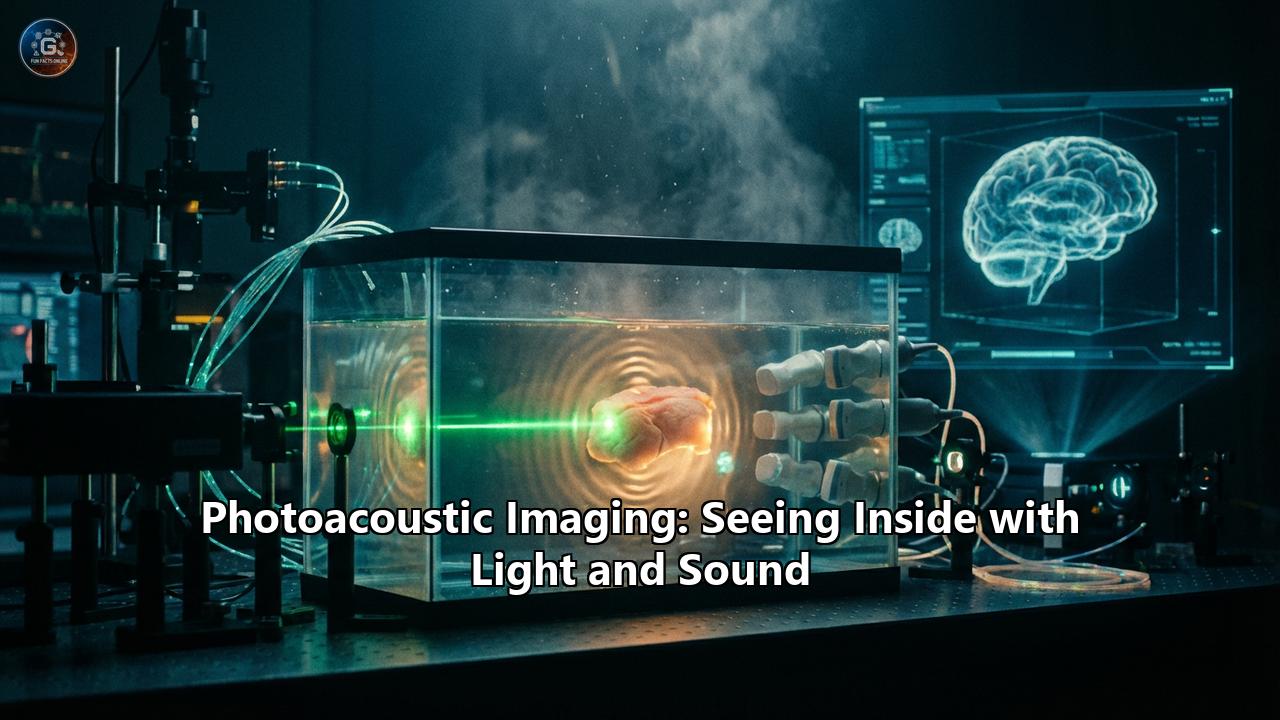
Imagine standing on a hillside during a summer storm. You see a flash of lightning illuminate the distant clouds, and seconds later, you hear the rolling boom of thunder. This delay and the intensity of the sound tell you exactly where the strike happened and how powerful it was. Now, imagine shrinking that process down to the microscopic level and using it to see inside the human body. This is the essence of Photoacoustic Imaging (PAI).
In the vast and rapidly evolving landscape of medical diagnostics, few technologies have bridged the gap between the "seeing" of light and the "hearing" of sound as effectively as PAI. Also known as optoacoustic imaging, this hybrid modality creates high-resolution, high-contrast images of biological tissues by listening to the sound of light.
While traditional imaging methods like X-ray, MRI, and Ultrasound each have their superpowers—and their kryptonites—PAI has emerged as a unique contender that combines the best of two worlds: the rich contrast of optical spectroscopy and the deep penetration of ultrasound. It is a technology that allows us to see not just the anatomy of the body, but its chemistry—to watch the brain think, to see a tumor feeding itself, and to map the intricate web of blood vessels without a single incision or a drop of radiation.
This comprehensive exploration will take you through the history, physics, engineering, and groundbreaking clinical applications of Photoacoustic Imaging. We will travel from Alexander Graham Bell’s 19th-century laboratory to the cutting-edge AI-enhanced scanners of 2026, revealing how this "lightning and thunder" technology is poised to revolutionize medicine.
Part I: The History – From the Photophone to the Nanosecond Laser
1.1 The 1880 Discovery: Alexander Graham Bell’s "Other" Invention
Most of the world knows Alexander Graham Bell as the father of the telephone. But in 1880, four years after patenting the telephone, Bell made a discovery he loved even more. He was experimenting with the transmission of sound using light beams—a device he called the Photophone.
Bell found that when he modulated a beam of sunlight and focused it onto a solid object (like a disc of selenium or a sheet of rubber), the object would emit sound waves. He had discovered the photoacoustic effect. He wrote, "I have heard articulate speech by sunlight! I have heard a ray of the sun laugh and cough and sing!"
Bell correctly deduced that the material was absorbing the flashing light, heating up, and expanding, then cooling down and contracting. This rapid expansion and contraction created pressure waves in the air—sound. Despite his enthusiasm, the technology was ahead of its time. The sun was not a stable enough light source, and human ears were not sensitive enough detectors for medical use. The photoacoustic effect remained a scientific curiosity, a dusty footnote in physics textbooks, for nearly a century.
1.2 The "Dark Ages" and the Laser Renaissance
For decades, the photoacoustic effect lay dormant. It wasn't until the invention of the laser in the 1960s that the field began to wake up. Unlike sunlight, lasers could deliver short, intense bursts of energy at specific wavelengths. Simultaneously, the development of sensitive ultrasound transducers meant we no longer had to rely on the naked ear to hear the "song" of the materials.
In the 1970s and 80s, researchers began using the effect for gas analysis and materials science (Photoacoustic Spectroscopy). But the true biomedical revolution began in the 1990s. Pioneers like Dr. Lihong Wang and others realized that biological tissues are essentially soft, watery bags of light-absorbing molecules. If you hit tissue with a laser pulse, the blood inside should "sing."
By the early 2000s, the first crude images of blood vessels were being produced. The field exploded. What started as benchtop physics experiments has now, in the mid-2020s, matured into sophisticated clinical machines capable of 3D real-time imaging.
Part II: The Physics – How Light Becomes Sound
To understand PAI, we must understand the journey of energy. The process can be broken down into three distinct acts: Absorption, Conversion, and Propagation.
2.1 Act One: Optical Absorption
It begins with a pulse of laser light. In medical imaging, we typically use "nanosecond lasers," which emit pulses that last only a few billionths of a second (usually 5 to 10 ns). This light enters the tissue.
Biological tissue is "turbid," meaning it scatters light. If you shine a flashlight through your hand, you see a red glow. The light bounces around (scattering) but some of it gets absorbed. The "colors" of the body—hemoglobin in blood, melanin in skin, lipids in fat, and water—absorb light at different wavelengths.
- Hemoglobin absorbs strongly in the visible and near-infrared spectrum.
- Melanin absorbs UV and visible light.
- Lipids have peaks in the near-infrared.
The magic of PAI is that we can tune the laser. If we want to see blood vessels, we use a wavelength (color) that blood likes to absorb (e.g., 532 nm or 1064 nm). If we want to see fat, we tune to a lipid peak (e.g., 1200 nm). The laser pulse dives into the tissue, scattering as it goes, until it hits a molecule of the target chromophore.
2.2 Act Two: Thermoelastic Expansion (The "Pop")
When the target molecule absorbs the photon, that energy has to go somewhere. It is converted instantly into heat. This causes a local temperature rise. It is crucial to note that this rise is infinitesimal—often less than a fraction of a degree Celsius. The patient feels nothing; the tissue is not burned.
However, because the laser pulse is so short (nanoseconds), the heat is generated faster than it can diffuse away. This is a condition known as Thermal Confinement.
Simultaneously, the heat causes the molecule to expand. Because the expansion happens so quickly, the surrounding tissue doesn't have time to move out of the way to accommodate the change in volume. This creates a sudden build-up of pressure. This condition is known as Stress Confinement.
The result is a tiny, localized explosion of pressure. The tissue "pops" at the molecular level.
2.3 Act Three: Acoustic Propagation
This pressure spike launches a mechanical wave outward in all directions. This is an ultrasound wave.
This is the brilliant trick of PAI: We send in light (which has high contrast but scatters easily) and we get out sound (which travels through tissue in straight lines with very little scattering).
Pure optical imaging (like microscopy) gets blurry a millimeter deep because light scatters. Pure ultrasound relies on mechanical properties (hardness/density) and has poor contrast for soft tissues. PAI uses the light to choose the target and the sound to locate it. We can "hear" the optical absorption from centimeters deep within the body.
Part III: Instrumentation – The Engineering Behind the Magic
A photoacoustic system is a marriage of advanced photonics and ultrasonics. Let’s dissect the anatomy of a PAI scanner.
3.1 The Excitation Source: The Laser
The heart of the system is the laser.
- Nd:YAG Lasers: The workhorses. They are powerful and can be frequency-doubled to produce green light (good for superficial blood vessels) or used in the infrared.
- OPO (Optical Parametric Oscillators): These are tunable lasers. They allow the operator to dial in specific wavelengths, effectively creating "color" photoacoustic images to distinguish between oxygenated and deoxygenated blood.
- Laser Diodes & LEDs: The "Game Changers" of the 2020s. Historically, PAI systems were cart-sized because of the massive lasers. Recent years have seen the rise of high-power LED arrays and laser diodes. While less powerful than big lasers, they are cheap, compact, and fast, enabling handheld, battery-operated PAI probes (like the AcousticX system).
3.2 The Ears: Ultrasound Transducers
The "ears" of the system are piezoelectric transducers, similar to those in standard fetal ultrasound wands. They convert the incoming sound waves back into electrical signals.
- Linear Arrays: Good for 2D cross-sectional images (like a slice of bread).
- Hemispherical Arrays: Used in tomography (PACT) to capture 3D images from all angles at once.
- Optical Ultrasound Detectors: A 2024-2026 breakthrough. Instead of piezo-crystals, some systems use micro-ring resonators or Fabry-Perot interferometers—tiny optical sensors that detect the vibration of the tissue surface with extreme sensitivity, even without touching the skin.
3.3 The Brain: Image Reconstruction & AI
Once the signals are captured, a computer must figure out where the sound came from. This is an inverse problem.
- Back-Projection: The classic algorithm. The computer "draws circles" from every detector based on the time delay, and where the circles intersect is the source of the sound.
- Deep Learning Reconstruction: The modern era. As of 2025/2026, AI has taken over. Neural networks (like U-Net and GANs) can reconstruct high-quality images from sparse data (fewer laser shots), allowing for faster scanning and less data processing. AI also helps "denoise" the image, filtering out reflections and artifacts to leave a crystal-clear picture of the vasculature.
Part IV: Modalities – One Concept, Many Forms
Photoacoustic imaging isn't just one machine; it's a family of techniques tailored for different scales.
4.1 Photoacoustic Microscopy (PAM)
PAM is the "histology without a slice" tool. It focuses the light tightly to a tiny point and raster-scans across the tissue.
- OR-PAM (Optical Resolution): Focuses light to a diffraction-limited spot. It provides incredible resolution (down to individual capillaries or even cells) but can only see about 1mm deep (ballistic regime). It’s used for dermatology and eye imaging.
- AR-PAM (Acoustic Resolution): Focuses the sound rather than the light. It has lower resolution (tens of microns) but can see deeper (several millimeters).
4.2 Photoacoustic Tomography (PAT / PACT)
PACT is the "scanner" version. It illuminates a large volume of tissue at once (a "shower" of light) and uses an array of transducers to capture the waves. It is used for breast imaging, brain mapping, and whole-body small animal imaging.
- 2026 Update: The RUS-PAT (Rotational Ultrasound + PAT) system developed by Caltech/USC represents the pinnacle of this, rotating sensors to create vivid 3D color maps of whole organs in under a minute.
4.3 Photoacoustic Endoscopy (PAE)
Miniaturized probes that go inside the body. These can be threaded into blood vessels (IVPA - Intravascular Photoacoustics) to look at arterial plaque from the inside out, or into the GI tract to look for early esophageal cancer.
4.4 Non-Contact and Remote Sensing (PARS)
One of the historical limitations of ultrasound is the need for "coupling"—that cold, sticky gel or water bath required to get sound from the body to the detector. Air kills sound waves.
However, Photoacoustic Remote Sensing (PARS) and dPARS (deep PARS) have solved this. They use a second laser beam to "read" the vibrations of the tissue surface optically. No gel, no contact. This is revolutionary for ophthalmology (no touching the eye) and burn imaging (too painful to touch).
Part V: The Palette of Life – Contrast Agents
Radiologists love contrast. PAI offers the most diverse palette of any imaging modality.
5.1 Endogenous Contrast: The Body’s Own Ink
The biggest advantage of PAI is that we often don't need to inject anything. The body is full of natural absorbers.
- Hemoglobin: The superstar. PAI is the only modality that can directly measure Oxygen Saturation (sO2) at high resolution without dyes. Oxy-hemoglobin is red; deoxy-hemoglobin is purple-blue. PAI sees the difference clearly. This allows for functional imaging—detecting where oxygen is being consumed (metabolism).
- Melanin: The primary absorber in skin and hair follicles. PAI is the gold standard for imaging melanoma depth.
- Lipids: Fat has a unique signature around 1200nm. PAI can map arterial plaque (which is fatty) inside blood vessels.
- DNA/RNA: In the UV range, cell nuclei absorb light. UV-PAM can virtually "stain" a biopsy slide without any chemicals, providing instant histology in the operating room.
5.2 Exogenous Contrast: The Nanotech Revolution
When natural contrast isn't enough, scientists turn to engineering.
- Gold Nanoparticles: Gold nanorods and cages can be tuned to absorb any wavelength of light. They absorb light thousands of times more efficiently than dye. They can be coated with antibodies to stick specifically to tumor cells.
- Organic Dyes: Indocyanine Green (ICG) and Methylene Blue are FDA-approved dyes used in clinics. PAI can track them with extreme precision.
- Switchable Probes: These are "smart" molecules that only turn on (become absorbing) when they encounter a specific enzyme or pH level. They can light up only when a cancer cell is active.
Part VI: Clinical Applications – The New Eyes of Medicine
We have arrived at the most critical question: What can this technology actually do for patients? As of 2026, the clinical translation of PAI is accelerating rapidly.
6.1 Oncology: Catching the Killer Early
Breast Cancer: The Radiation-Free Alternative
Mammograms are painful and use X-rays (ionizing radiation). They also struggle with "dense breasts" (common in younger women), where tumors hide behind fibrous tissue.
PAI excels here. Tumors are metabolic engines; they are hungry for oxygen. They grow a messy network of chaotic blood vessels (angiogenesis) to feed themselves. PAI sees this "vascular chaos" and the low oxygen saturation (hypoxia) typical of tumors.
- Recent Success: The SBH-PACT (Single-Breath-Hold) scanners can now image a whole breast in 15 seconds, revealing tumors without compression or radiation. A 2026 study showed PAI could differentiate benign cysts from malignant tumors with over 90% accuracy, potentially saving millions of women from unnecessary biopsies.
Melanoma: Measuring the Depth
The survival rate of skin cancer depends almost entirely on how deep it has grown (Breslow thickness). Visual inspection is a guess; biopsy is invasive. PAI can "see" the melanin of the tumor and measure its bottom boundary in 3D with micrometer precision, non-invasively, before the surgeon even picks up a scalpel.
Prostate and Thyroid
Transrectal PAI probes are being tested to distinguish aggressive prostate cancer from slow-growing types, something standard ultrasound struggles to do. Similarly, PAI can determine if a thyroid nodule is just a fluid sac or a vascularized solid mass.
6.2 Neurology: Watching the Brain at Work
The brain is a glutton for oxygen. When you move your finger, the motor cortex in your brain demands more blood.
fMRI (functional MRI) can see this, but it is slow, expensive, and loud. PAI can perform functional neuroimaging on the open cortex (intraoperative) or through the skull (in mice and infants).
- Stroke: PAI can instantly visualize the "penumbra"—the area of the brain starved of oxygen during a stroke—helping doctors decide on treatment windows.
- Neonatal Imaging: In 2024, researchers successfully used PAI through the fontanelle (soft spot) of infants to monitor brain health in the NICU without moving the fragile baby to an MRI machine.
6.3 Cardiology: The Vulnerable Plaque Hunter
Heart attacks often occur when a "vulnerable plaque" (a fatty deposit inside an artery) ruptures. Standard angiograms show the narrowing of the vessel, but they don't show what the plaque is made of.
Intravascular Photoacoustics (IVPA) involves a tiny catheter with a laser fiber inside. It can distinguish between stable calcified plaque (hard) and dangerous lipid-rich plaque (soft and likely to burst). This could revolutionize preventive cardiology.
6.4 Dermatology & Plastic Surgery
Beyond cancer, PAI is used to map skin aging (collagen levels), inflammatory diseases like psoriasis (increased blood flow), and port-wine stains.
- Reconstructive Surgery: A 2025/2026 breakthrough application involves breast reconstruction using fat grafting. Surgeons use PAI to monitor the blood vessel growth (neovascularization) into the grafted fat to ensure the tissue survives. If the graft doesn't get blood, it dies (necrosis). PAI provides an early warning system.
6.5 Rheumatology: Arthritis Detection
Arthritis involves inflammation of the joint lining (synovium). This inflammation brings extra blood and lowers oxygen levels. A 2024 UCL study introduced a handheld PAI scanner that can image all 20 finger joints in a few minutes. It detects "synovial hypoxia"—an early sign of arthritis that appears long before bone damage is visible on X-rays. This allows for treatment to start years earlier, preventing deformity.
Part VII: The Future Horizon (2026 and Beyond)
The field is moving fast. Here is what is on the drawing board.
7.1 Theranostics: See and Treat
Why just see the tumor if you can kill it with the same light? Theranostics combines therapy and diagnostics. Since PAI uses lasers, we can crank up the power slightly (within safety limits) or use nanoparticles that heat up intensely. We can use the low-energy pulse to find the tumor, and then a high-energy pulse to cook it (photothermal therapy) or release a drug carried by the nanoparticle.
7.2 The "Stethoscope of the Future"
The trend toward miniaturization is unstoppable. With the advent of affordable laser diodes and AI processing on chips, we are moving toward pocket-sized PAI devices. Imagine a primary care doctor placing a small probe on your neck and instantly seeing the oxygenation of your carotid artery or the depth of a suspicious mole, with the image displayed on their smartphone.
7.3 Multi-Modal Titans: OCPAM and RUS-PAT
Hybrid systems are becoming the norm.
- OCPAM (Optical Coherence Photoacoustic Microscopy): Combines OCT (which sees tissue scattering structure) with PAI (which sees molecular absorption). A 2026 study in Light: Science & Applications showed this technique could image cancer organoids in 3D, revealing how drugs affect tumor metabolism in real-time.
Conclusion: The Symphony of Light and Sound
Photoacoustic Imaging is no longer a scientific curiosity. It is a mature, robust, and rapidly expanding field that addresses some of the most fundamental limitations of modern medicine. By converting the silent absorption of light into the audible language of ultrasound, it gives physicians a new sense—a way to see the functional and molecular engines of life deep within the body.
From the 15-second breast scan that requires no radiation to the handheld probe that detects arthritis before it hurts, PAI is making the invisible visible. As AI refines the images and laser diodes drive down the cost, we are approaching a future where "listening to the light" will be as routine as listening to a heartbeat. The thunder that Alexander Graham Bell heard in 1880 has finally arrived, and it is reshaping the landscape of healthcare.
Reference:
- https://pmc.ncbi.nlm.nih.gov/articles/PMC8033250/
- https://www.ucl.ac.uk/news/2024/sep/medical-imaging-breakthrough-could-transform-cancer-and-arthritis-diagnosis
- https://www.sciencedaily.com/releases/2026/02/260204121550.htm
- https://repository.aus.edu/server/api/core/bitstreams/169421b9-f466-4ce4-86d4-8e2d7957b45e/content
- https://pmc.ncbi.nlm.nih.gov/articles/PMC4311576/
- https://www.researchgate.net/publication/382907717_Recent_Advances_in_Photoacoustic_Imaging_Current_Status_and_Future_Perspectives
- https://www.repository.cam.ac.uk/items/510acf17-a42d-4e03-a2b2-35d42f821b19
- https://www.mdpi.com/2072-666X/15/8/1007
- http://sirji.in/read-blog/44305_photoacoustic-imaging-market-outlook-2025-2033-innovation-driving-early-disease.html
- https://validate.perfdrive.com/?ssa=88d65826-875f-a332-6487-52def9cbd979&ssb=21971279138&ssc=https%3A%2F%2Fopg.optica.org&ssi=fe4802b6-d3hy-6006-7d95-d67cefca521c&ssk=botmanager_support@radware.com&ssm=93521867242442796137649880890723&ssn=d5c8adeaed163413673c577857bbe61739f8f65eb604-57a0-69ae-c43be5&sso=cbfb1ae-cbdf-77af9969938741e2eb8b4234ed53274567844f644282c79d&ssp=80230687971770362353177031614260762&ssq=41098898043602409270980435544278002362256&ssr=MTgwLjE4OC4xNzQuMjg=&sst=python-requests%2F2.32.3&ssv=&ssw=