
It happened in a moment of distraction, or perhaps one of intense concentration. The year was somewhere around 350 BCE, a time when the Roman Republic was still a regional power fighting its neighbors and Alexander the Great had not yet been born. On a shoreline fringed with dark pines, likely somewhere along the southern rim of the Baltic Sea, a boatbuilder was at work.
The air was thick with the acrid, pungent scent of heated pine tar. The vessel before him was a masterpiece of Iron Age engineering—a war canoe, sleek and predatory, built not with iron nails but with the tension of lime bast cords and the strength of wooden planks sewn together. It was a living thing, flexible and fast, designed to cut through the chop of the Baltic waves. But it leaked. All boats leaked. And so, the builder held a glob of warm, viscous pitch in his hand, searching for the gap in the stitching, the tiny void where the water might force its way in.
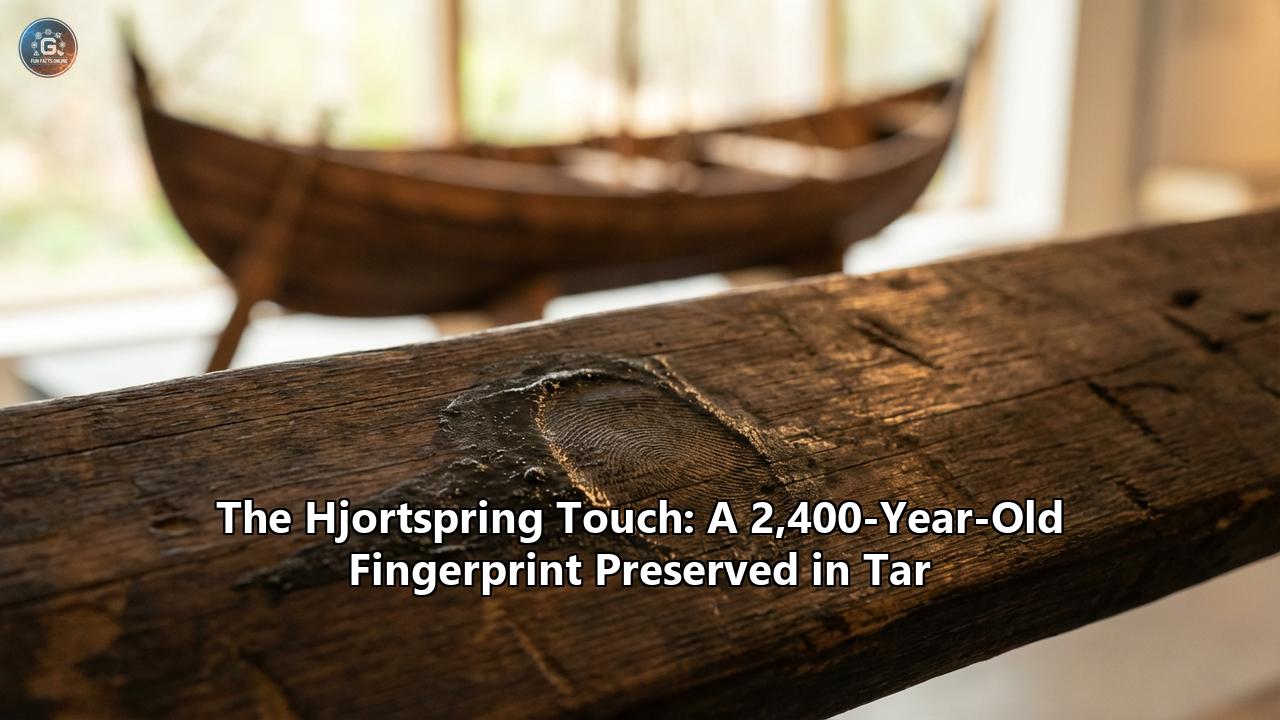
He found the spot. He pressed the sticky black substance into the seam, smoothing it down to seal the wood against the sea. In that split second, the ridges of his fingertip pressed into the cooling tar. The loop, the whorl, the microscopic valleys of his skin were captured with perfect fidelity. He pulled his hand away, perhaps wiping the excess onto his tunic, and moved on to the next seam. He thought nothing of it. It was a mundane action, one of thousands performed that day.
He could not have known that he had just signed his work. He could not have known that the boat would carry warriors to their doom. He could not have known that it would be captured, smashed, and sunk into a sacred bog as an offering to angry gods. And he certainly could not have known that twenty-four centuries later, long after his bones had turned to dust and his people had vanished into the mists of prehistory, a team of scientists in a brightly lit laboratory would peer at that tiny smudge of black resin and see him.
This is the story of the Hjortspring boat, the oldest plank-built vessel in Scandinavia, and the ghostly fingerprint that has reached out from the Iron Age to touch the present day.
Part I: The Bog’s Embrace
To understand the fingerprint, one must first understand the vault that kept it safe: the peat bog. The landscape of Denmark and Northern Europe is dotted with these watery archives. To the uninitiated, a bog is merely a swamp—treacherous, smelling of decay, a wasteland to be drained and farmed. But to the archaeologist, the bog is a miracle.
Sphagnum moss, the architect of the bog, creates a chemical environment that is hostile to bacteria but friendly to organic matter. As the moss grows and dies, it releases sphagnan, a complex sugar that tans protein like leather and acidifies the water. It strips the calcium from bones, leaving them rubbery, but it preserves skin, hair, wool, wood, and—crucially for our story—resin, with astonishing clarity. The bog halts the clock. It creates a low-oxygen tomb where the ordinary rules of decay do not apply.
The First DiscoveryThe story of the Hjortspring boat’s resurrection began in the late 19th century, a time of national awakening in Denmark. Peat cutters working in the Hjortspring Mose (Hjortspring Bog) on the island of Als began to find oddities in the black earth. A spearhead here, a wooden plank there. The locals knew the bog held secrets; folklore spoke of ancient battles and buried treasures, but for decades these finds were treated as curiosities, often discarded or kept on mantels.
It wasn't until the 1920s that the true scale of the site was revealed. The National Museum of Denmark dispatched Gustav Rosenberg, a meticulous and patient excavator, to investigate. What Rosenberg found would redefine the history of Northern Europe.
He did not find a Viking ship. This was something far older, far more primitive, and yet paradoxically more complex. He found a vessel that looked like a giant canoe, nearly 20 meters long, with strange, beak-like prow and stern that curved upwards and outwards, resembling the runners of a sled or the antlers of a stag.
But Rosenberg’s excavation was a nightmare of fragility. The wood had been in the bog for over two millennia. It had the consistency of wet cardboard. If it dried out, it would crumble to dust. If he touched it too roughly, it would dissolve. With the patience of a saint, Rosenberg and his team excavated the boat bit by bit, using water jets and paraffin wax to stabilize the timber.
They found more than just a boat. The bog was a mass grave of weaponry. Surrounding the vessel were thousands of artifacts: 169 spearheads, 50 shields, swords of the Celtic La Tène style, and chainmail coats. It was an entire army’s equipment, ritually destroyed and cast into the water.
The Conservation ParadoxWhen the boat was finally lifted and brought to Copenhagen, it underwent a massive conservation effort. In the early 20th century, the standard method for preserving waterlogged wood was to impregnate it with alum and other chemicals to replace the water and harden the structure. This saved the boat. The Hjortspring boat stands today in the National Museum, a skeletal, haunting beauty.
However, this conservation came at a cost. The chemicals used to save the wood contaminated it for future analysis. Radiocarbon dating, which would be invented decades later, is notoriously difficult on artifacts soaked in 1920s preservatives. The chemicals mask the original carbon signature. For a century, the boat sat in the museum, a silent enigma. We knew what it was—a war boat from the Pre-Roman Iron Age. We knew where it was found. But we didn't know exactly when it was built, or where it came from.
The wood was lime (linden), which grows in Denmark, but the specific design had no local parallel. Was it a local vessel? A raider from Sweden? A trader from the German coast? The boat kept its secrets, encased in its chemical shell.
Until the boxes were found.
Part II: The Cold Case Reopened
Archaeology is rarely about the Indiana Jones moment of lifting a golden idol. More often, it is about the dusty box on the bottom shelf of a storage room.
In the early 2020s, a team of researchers from Lund University in Sweden and the National Museum of Denmark, led by archaeologist Mikael Fauvelle, decided to take another look at the Hjortspring boat. They were driven by new questions and new technologies. They wanted to know the provenance of the boat. Where was the timber felled? Who were the people who built it?
They knew they couldn't test the main hull of the boat due to the alum conservation. But they hoped that perhaps, just perhaps, some fragments had been overlooked by the conservators of the 1920s.
They went into the museum's deep archives. There, tucked away in storage, were boxes containing the "leftovers" of Rosenberg’s excavation. These were the bits and pieces deemed too small or insignificant to be part of the main reconstruction. Fragments of cordage (rope), loose chips of wood, and lumps of the black, tar-like substance used to caulk the seams.
To the naked eye, these lumps looked like ancient chewing gum or clumps of dried mud. But to the researchers, they were gold. These fragments had not been treated with alum. They were chemically pure, exactly as they had been when they were pulled from the bog a hundred years earlier.
The Golden ThreadThe first breakthrough was the cordage. The Hjortspring boat is a "sewn" boat. In the Iron Age, before the widespread use of iron nails for shipbuilding in the north, planks were stitched together. Builders would drill holes along the edges of the wooden strakes and thread rope through them, pulling the planks tight against each other.
The rope found in the boxes was made of lime bast—the fibrous inner bark of the lime tree. It is a material that requires immense labor to produce. The bark must be stripped, soaked (retted) in water for months to rot away the soft tissue, and then the remaining fibers are twisted into strong, flexible cord.
Because these rope fragments were untreated, the team could radiocarbon date them. The results came back with a precision that had eluded previous generations: the boat was built between 381 and 161 BCE. This confirmed it belonged to the Pre-Roman Iron Age, a time of significant social upheaval and migration in Europe.
But the rope was just the beginning. The team turned their attention to the black lumps of caulking.
Part III: The Fingerprint
The caulking of the Hjortspring boat was crucial. A sewn boat is flexible; it moves with the waves, twisting and bending. This makes it seaworthy, but it also makes it prone to leaking. The stitches loosen. The wood expands and contracts. To keep the water out, the builders packed the seams with a resinous paste.
The researchers placed these small, dark fragments under a high-resolution 3D microscope. They were looking for the chemical signature of the tar. They expected to see wood grain, perhaps impressions of the rope, or sand.
What they saw stopped them in their tracks.
On one small fragment of tar, barely the size of a coin, there was a pattern. It wasn't the random texture of wood or the weave of fabric. It was a series of curved, parallel ridges. It was a friction ridge impression. A fingerprint.
The clarity was startling. The tar, applied hot and viscous, had cooled rapidly, freezing the impression in plastic perpetuity. The ridges were distinct enough to be measured. The distance between the ridges suggested the finger belonged to an adult, though whether male or female was impossible to say.
The Human MomentIn archaeology, we often deal with the aggregate: "The Celts," "The Teutons," "The Iron Age People." We see their walls, their trash pits, their collective movements. We rarely see the individual.
This fingerprint shattered that distance. Suddenly, the Hjortspring boat wasn't just an artifact; it was a project worked on by a person with a name, a family, and a job to do.
The location of the print was telling. It was in the caulking—the sealant. This implies the person was likely applying the tar, pushing it into the gap between the planks. Was it the master builder? An apprentice? A warrior making a desperate repair on the beach before the raid?
The presence of the print suggests a bare hand. This detail alone evokes a sensory world. The tar would have been warm, sticky, smelling of pine forests. The air might have been cold—it was Scandinavia, after all—but the work required tactile precision that gloves (if they even used them for such tasks) would clumsy.
The researchers couldn't run the print through a police database. There are no files for Iron Age boatbuilders. But the print itself was a message: I was here. I made this.
Part IV: The Chemistry of Connection
While the fingerprint provided the emotional connection, the chemical analysis of that same tar provided the geographical one.
The team used gas chromatography-mass spectrometry (GC-MS) to analyze the molecular composition of the caulking. They discovered that it was made of pine tar (pine pitch) mixed with a little bit of animal fat (likely to keep it pliable, preventing it from cracking in the cold water).
This was a bombshell.
In 350 BCE, Denmark did not have pine forests. The landscape of the Pre-Roman Iron Age in Denmark was dominated by deciduous trees: oak, lime, hazel, and alder. Pine trees had retreated north and east thousands of years earlier as the climate warmed after the Ice Age. They would not return to Denmark in significant numbers until modern forestry plantations planted them.
If the boat was caulked with pine tar, the tar—or the boat itself—had to come from somewhere else.
The Baltic ConnectionThe nearest source of abundant pine forests in 350 BCE was the Scandinavian peninsula (modern Sweden and Norway) or the southern coast of the Baltic Sea (modern Poland, Lithuania, Latvia, Estonia).
This evidence strongly supported a theory that had been debated for decades: The Hjortspring boat was not a local vessel. It was an invader.
The construction style also hinted at this. The specific way the planks were cleaved and the sewing technique had parallels in later boat finds from the eastern Baltic. The boat was likely built in a region where pine was king, perhaps the archipelagoes of Sweden or the coasts of the eastern Baltic, and then sailed or paddled hundreds of kilometers to the island of Als.
This changes the narrative of the Hjortspring find completely. It wasn't a local dispute between neighbors. It was a long-distance amphibious operation. It was a raid.
Part V: The Anatomy of a War Machine
To understand the raid, we must look at the vehicle that made it possible. The Hjortspring boat was the Viking longship’s great-grandfather, but it was a very different beast.
It was 19 meters long and 2 meters wide, weighing only about 530 kilograms (roughly 1,100 lbs). This is incredibly light for a vessel of its size. For comparison, a modern replica can be lifted and carried by its crew. This was a crucial design feature. It was amphibious. It could be paddled fast, beached on a shallow shore, and if necessary, carried over land to bypass rapids or cross a narrow isthmus.
The Sewing TechniqueThe hull was made of lime wood planks. Unlike the later "clinker" technique (where planks overlap and are riveted), the Hjortspring planks were laid edge-to-edge (lapstrake in a primitive form) and sewn.
The builders used lime bast cord for the stitching. They carved raised cleats onto the inner surface of the planks. The cord was threaded through holes in these cleats and the plank edges, locking the structure together. The resulting hull was not a rigid shell. It was a flexible skin.
In the choppy, short waves of the Baltic, a rigid boat takes a beating. A flexible boat "snakes" over the waves. It rides the water. It would have felt alive under the feet of the crew.
The PaddlesThere were no oarlocks. The boat was propelled by paddles, not oars. This is a significant distinction. Oars provide more leverage and power, but paddles allow for silence and instant maneuverability. A crew of 20 paddlers can stop the boat instantly, spin it on a dime, or back it up without missing a beat.
The paddles found with the boat were of different sizes, suggesting they were tailored to the specific position of the paddler in the hull or the height of the gunwale. There was also a steering oar at both ends, meaning the boat was "double-ended." It didn't need to turn around to reverse course; the crew just had to turn on their benches and paddle the other way.
This was a tactical vessel. It was designed for speed, stealth, and beach landings. It was the perfect craft for a surprise attack.
Part VI: The Day of the Raid
Based on the forensic evidence of the boat, the weapons, and the fingerprint, we can reconstruct the events of that fateful day in the 4th century BCE.
It is late summer or early autumn. The Baltic Sea is calm, but the air is crisp. A fleet of three or four boats glides silently toward the coast of Als. We know there must have been more than one boat because the number of weapons found in the bog (enough for 80-100 men) exceeds the capacity of the single Hjortspring vessel (about 20-22 men).
The invaders are not local. They have traveled far, perhaps from the Swedish coast, paddling for days, camping on islands, navigating by the stars and the coastline. They are hardened men. Their hands are calloused from the paddle shafts. They wear woolen tunics and trousers, leather shoes, and perhaps cloaks of skin.
Among them is the man who left his fingerprint in the tar. Maybe he is one of the older warriors, a veteran who knows how to fix a leak. Maybe he applied the patch during a rest stop the night before, heating the pine pitch over a small fire, pressing it into a seam that had worked loose during the crossing.
They approach the shore of Als. They are looking for cattle, slaves, or perhaps territorial dominance. The Iron Age was a time of tribal friction; land was wealth, and reputation was currency.
The BattleThey beach the boats and storm inland. But something goes wrong. The element of surprise is lost. The locals—the people of Als—are waiting.
We don't know the details of the battle. Was it a skirmish on the beach? An ambush in the forest? A siege of a local stronghold?
What we know is the outcome. The invaders were obliterated.
The sheer volume of weaponry found in the bog tells a story of total defeat. The locals didn't just repel the raid; they captured the entire force. They took the shields, the long Celtic-style swords, the lances, the spears, and the chainmail. And they took the boats.
The AftermathIn the ancient world, victory was not just due to martial skill; it was a gift from the gods. And the gods demanded a return on their investment.
The victors of Als gathered the spoils of war. They took the enemy's prized boat—the vehicle of their aggression—and dragged it to the edge of the Hjortspring bog. The bog was a sacred place, a liminal space between the world of men and the underworld.
They systematically destroyed the equipment. They bent the swords. They smashed the shields. They broke the spear shafts. This was a ritual "killing" of the weapons, ensuring they could never be used again, neither in this world nor by the spirits of the dead.
Then came the boat. They didn't just sink it; they dismantled parts of it. They likely slashed the sewing, broke the ribs. They filled it with stones and pushed it into the dark, peaty water.
As the boat sank, the fingerprint sank with it. The pine tar, hardened by the cold water, was buried in the anaerobic mud. The moss grew over it. The centuries passed. The warriors were forgotten. The tribe of the victors vanished or assimilated. The Roman Empire rose and fell. The Vikings came and went. Kings and Queens ruled Denmark. World wars swept across Europe.
And all the while, the fingerprint waited.
Part VII: Life in the Iron Age
The fingerprint invites us to look closer at the world these people inhabited. The Pre-Roman Iron Age (500 BCE – 1 CE) in Scandinavia is often overshadowed by the later Viking Age, but it was a dynamic, sophisticated era.
The SocietyIt was a stratified society. The presence of chainmail in the Hjortspring find is significant. Chainmail was high technology, likely imported from the Celtic tribes of Central Europe. Its presence suggests that the leaders of the raiding party were wealthy chieftains with international connections. They weren't just farmers with pitchforks; they were a warrior aristocracy.
They lived in longhouses—large, wooden buildings that housed both humans and cattle. The warmth of the animals helped heat the house in winter. They grew barley, wheat, and oats. They kept sheep, pigs, and cows.
The CraftsmanshipThe boat itself is a testament to their woodworking skills. Without saws (they used axes and adzes), they cleaved majestic lime trees into thin, wide planks. They understood the properties of wood intimately—how it split, how it bent, how it rotted.
The sewing of the boat required thousands of meters of cordage. Producing this lime bast rope was a massive industrial effort, likely involving the entire community—women, children, and the elderly stripping and twisting bark for weeks.
The fingerprint in the tar reminds us that their technology was organic. They used what nature provided: wood, bone, leather, bark, resin, fat. They were masters of chemistry in their own right, knowing exactly how to mix pine pitch and tallow to create a waterproof seal that would last for a voyage across the Baltic.
The ViolenceIt was also a violent world. The Hjortspring find is the earliest evidence of large-scale organized warfare in Scandinavia. This wasn't a duel between two champions; it was a clash of armies. The tactics involved shield walls, spear volleys, and close-quarters combat with swords.
The ritual destruction of the boat suggests a worldview where violence had a spiritual dimension. You didn't just kill your enemy; you obliterated his power. You sacrificed his tools to the bog to ensure he couldn't follow you.
Part VIII: The Science of Preservation
How does a fingerprint survive 2,400 years? The answer lies in the unique properties of pine tar and the bog environment.
The TarPine tar (or wood pitch) is a polymer. It is produced by the destructive distillation of pine wood. When heated, it flows like honey. When cooled, it becomes a hard, resinous solid, similar to plastic. It is hydrophobic (repels water) and antimicrobial.
When the ancient boatbuilder pressed his finger into the cooling tar, he created a mold. Because the tar hardened quickly, the impression was fixed.
The BogIf the boat had been left on a beach, the tar would have eventually cracked, weathered by UV light, or been eaten by bacteria. But in the bog, the environment is anaerobic (oxygen-free). Oxygen is the primary driver of decay. Without it, the bacteria and fungi that normally break down organic matter cannot function.
The water is also acidic. This preserves the tar perfectly. It essentially put the boat into a chemical stasis.
Modern ForensicsThe rediscovery of the fingerprint is a triumph of modern archaeological method. It shows the value of "legacy data." Museums are full of artifacts excavated 50, 100, or 200 years ago. Often, these artifacts hold secrets that the original excavators could not have imagined.
Gustav Rosenberg in 1922 didn't have a gas chromatograph. He didn't have high-resolution 3D scanners. He couldn't have known that the "useless" lumps of tar he boxed up would one day prove the boat's origin.
The scan of the fingerprint was done using micro-X-ray fluorescence or high-resolution photogrammetry. This allowed the researchers to create a topographic map of the finger ridges without risking damage to the fragile tar fragment.
They measured the ridge density. Men generally have coarser ridges (fewer ridges per centimeter) than women. The Hjortspring print falls in a range that could be an adult male or a robust female, but given the context of a war boat, a male builder or crew member is the statistical likelihood.
Part IX: The Anonymous Builder
Who was he? We will never know his name. We will never know his language—it was likely a Proto-Germanic dialect, the ancestor of modern Danish, Swedish, and English, but we have no written records from this time and place.
But we can imagine him.
He was likely a man of status. Boatbuilding was a specialized skill. In a world where the boat was the only way to travel long distances, the boatbuilder was as important as the smith who forged the swords.
He had rough hands. The tar he worked with would have stained his skin permanently. He smelled of smoke and pine.
He was part of a community that was preparing for war. He watched the young men sharpen their spears. He saw the provisions being loaded—dried meat, skins of water. He felt the tension in the village as the fleet prepared to launch.
Did he sail with them? It's possible. In tribal societies, craftsmen were often warriors too. If he was on the boat, he likely died on the shores of Als, his body left to the carrion birds or buried in a mass grave, while his masterpiece was sunk into the bog.
Or perhaps he stayed behind. Perhaps he was an old master, watching from the shore as his handiwork disappeared over the horizon, never to return. He would have waited for news. And when no one came back, he would have understood. The boat, and the fingerprint he left on it, was gone.
The Intimacy of TouchThere is something profoundly moving about a fingerprint. A sword is a tool of death. A gold necklace is a symbol of status. A pot is a vessel for food. But a fingerprint is the person.
It is an accidental monument. The builder didn't mean to leave it. It wasn't a signature for posterity. It was a mistake. A slip of the hand. And yet, it is the most powerful connection we have to him.
It forces us to bridge the time gap. We look at our own fingertips, at the whorls and loops that define us, and we realize that the biology of being human hasn't changed. The man in the Iron Age felt the cold just as we do. He felt the sticky heat of the tar. He felt fear, hope, and pride.
Part X: The Significance of the Find
The discovery of the Hjortspring fingerprint and the analysis of the tar have rewritten a chapter of European prehistory.
- Maritime Mobility: It proves that Iron Age societies were capable of complex, long-distance maritime operations. The Baltic was not a barrier; it was a highway.
- Trade and Ecology: It shows that resources (pine tar) were moving across ecological zones, or that people were moving from pine zones to non-pine zones.
- The Value of Archives: It demonstrates that the greatest discoveries aren't always in the ground; they are often in the basement of the museum, waiting for new technology to unlock them.
The Hjortspring boat is no longer just a "Danish" find. It is a Baltic find. It binds the history of Scandinavia together, showing a web of conflict and connection that spanned the sea.
Epilogue: Touching Time
In the quiet halls of the National Museum of Denmark, the Hjortspring boat hangs like a skeleton of a leviathan. It is fragile, light, almost ethereal. Visitors walk past it, marveling at its age.
But hidden away in the secure storage, inside a small, labeled box, sits a tiny lump of black pitch. On it is the mark of a man who lived 2,400 years ago.
He is gone. His people are gone. His gods are forgotten. Even the landscape has changed; the forests he knew are different, the coastlines have shifted. But his touch remains.
It serves as a reminder that history is not made by "forces" or "trends" or "eras." It is made by people. People who woke up in the morning, worked with their hands, fought for their lives, and occasionally, by sheer accident, left a mark that would outlast empires.
The Hjortspring touch is a greeting across the abyss of time. A silent, thumb-printed "I was here," preserved in the black blood of a pine tree, waiting for us to notice. And now that we have, the silence of the bog seems a little less empty. The ghost in the machine—or rather, the ghost in the boat—has finally been found.
Technical Appendix: The Reconstruction of the Event
- Date: ~350 BCE (Pre-Roman Iron Age).
- Location: Hjortspring Mose, Als, Denmark.
- Artifacts: 1 boat (originally likely 3-4), ~50 shields, ~169 spearheads, ~10 swords, chainmail fragments.
- Wood: Boat hull of Linden (Lime), paddles of Maple, Ash, and Oak.
- Caulking: Pine tar (Pinaceae family) mixed with animal fat.
- Fingerprint: Partial friction ridge impression, ridge width ~0.4-0.5mm, indicative of an adult.
- Conservation: Original boat (alum/glycerin), Archives (untreated).
This discovery stands as a testament to the power of interdisciplinary science—combining chemistry, archaeology, and forensics to breathe life into the distant past. It is a story not just of a boat, but of the hand that built it.
Reference:
- https://www.sciencedaily.com/releases/2026/02/260215225551.htm
- https://www.livescience.com/archaeology/fingerprint-of-ancient-seaborne-raider-found-on-scandinavias-oldest-plank-boat
- https://www.popsci.com/science/hjortspring-boat-builders-mystery-denmark/
- https://www.gu.se/en/news/researchers-uncover-clues-to-mysterious-origin-of-famous-hjortspring-boat
- https://archaeology.org/news/2025/12/12/new-thoughts-on-denmarks-ancient-hjortspring-boat/
- https://www.smithsonianmag.com/smart-news/the-mysterious-hjortspring-boat-that-sank-in-denmark-2400-years-ago-is-still-revealing-its-secrets-180987880/
- https://archaeologymag.com/2025/12/2000-year-old-hjortspring-boat-study/
- https://scitechdaily.com/a-2000-year-old-fingerprint-may-solve-mystery-of-scandinavias-oldest-wooden-boat/
- https://www.israelhayom.com/2026/01/05/ancient-fingerprint-solves-scandinavian-boat-mystery/
- https://www.lunduniversity.lu.se/article/fingerprint-ancient-seafarer-found-scandinavias-oldest-plank-boat
- https://www.zmescience.com/science/history-articles/scientists-find-alien-trees-and-one-fingerprint-on-ancient-warship-from-scandinavia/
- https://news.artnet.com/art-world/fingerprint-scandinavia-oldest-hjortspring-plank-boat-2730747
- https://www.ancient-origins.net/news-history-archaeology/hjortspring-boat-origin-00102379