
The dead of night in a modern metropolis is rarely silent. Among the distant hum of traffic and the hum of streetlights, there is often a distinct, metallic clatter echoing from a suburban alleyway. A heavy-duty, "animal-proof" trash receptacle, engineered by human minds to be impenetrable, is under siege. The assailants do not use brute force. Instead, they use a combination of persistent tactile exploration, collaborative effort, and a stunning degree of mechanical intuition. Within minutes, the complex bungee cords are bypassed, the latch is flipped, and the lid is popped open. The masked bandits—Procyon lotor, the common raccoon—have struck again.
To the frustrated homeowner, this is mere pestilence. To the evolutionary biologist and the cognitive ethologist, however, this scene is a magnificent display of higher-order problem-solving. It is a nightly masterclass in neuroplasticity and adaptation. But what drives this relentless, inventive curiosity? The answer lies not just in the raccoon’s unending quest for calories, but in a much more profound evolutionary mechanism: play.
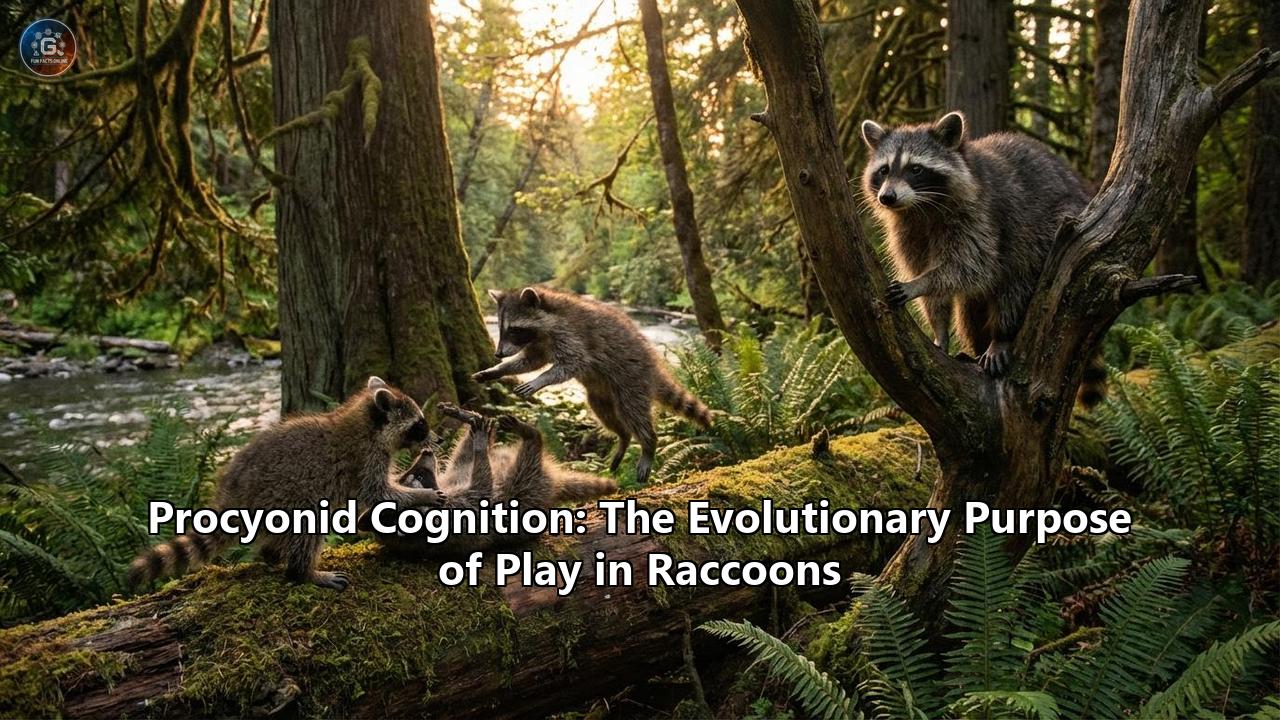
For the Procyonidae family, play is not a frivolous expenditure of surplus energy. It is the very crucible in which their extraordinary cognitive flexibility is forged. Through a continuous, tactile engagement with their environment, raccoons use play as an evolutionary simulator, mapping the physical rules of their world and preparing their highly dense, primate-like brains for the unpredictable challenges of the wild—and, increasingly, the urban jungle.
To understand the cognitive architecture of the raccoon, we must first look at the broader lineage from which they hail. The family Procyonidae, a New World offshoot of the order Carnivora, diverged from a common ancestor shared with canids (dogs) and ursids (bears) approximately 22.6 million years ago. Today, the family includes a fascinating array of adaptable, mostly nocturnal mammals, including the ringtail, the cacomistle, the coati, the arboreal kinkajou, and the elusive olinguito.
While they span a variety of habitats from the dense canopy of the Amazon rainforest to the arid canyons of the American Southwest, procyonids share several key traits. They are largely opportunistic omnivores, possessing a generalist physiology that allows them to pivot their diet based on seasonal availability. Unlike obligate carnivores, whose evolutionary path prioritized the swift, instinctual calculus of the hunt, procyonids evolved to forage. Foraging requires a different kind of intelligence—one based on spatial memory, patience, and the ability to extract hidden resources from complex environments.
The arboreal kinkajou, for instance, utilizes a prehensile tail and exceptional manual dexterity to extract nectar and ripe fruit from the high canopy. Coatis form complex social bands of females and young, utilizing collective intelligence to flush out invertebrates from the forest floor. But it is the raccoon that has taken the family’s predisposition for adaptability to its absolute zenith. Leaving the tropical and subtropical zones around 2.5 million years ago, the ancestors of the modern raccoon migrated north, facing the harsh, highly variable climates of North America. Surviving in these shifting environments required a brain capable of rapid learning and behavioral innovation.
For decades, the intelligence of raccoons was largely anecdotal, relegated to the folklore of Indigenous peoples—who aptly named them wica, or "little man," due to their human-like hands—and the frustrated tales of campers and city dwellers. However, modern evolutionary neuroscience has finally quantified the procyonid intellect, and the findings are nothing short of revolutionary.
The breakthrough came via the pioneering work of neuroscientist Dr. Suzana Herculano-Houzel, who developed a method to accurately count the number of neurons in animal brains by dissolving brain tissue into a "brain soup" and utilizing fluorescent tags. When her team applied this method to a variety of carnivores, they expected larger animals like brown bears to possess vastly more neurons than smaller animals. The results shattered these assumptions.
A brown bear, despite having a cerebral cortex ten times the size of a cat's, possesses roughly the same number of neurons—around 250 million. The raccoon, however, proved to be an astonishing outlier. Despite having a brain roughly the size of a cat's, the raccoon's cerebral cortex is densely packed with an average of 438 million neurons. When looking at the entire brain, raccoons boast neuron counts that rival those of small primates.
“If you gave me the numbers for a raccoon, I would tell you, ‘oh, what a cool primate brain!’” Herculano-Houzel noted. The entire raccoon brain appears to have undergone an evolutionary doubling of neurons relative to its size, resulting in a computing power per gram that vastly outstrips its carnivoran relatives.
A significant portion of this neural real estate is dedicated to the somatosensory cortex—the area of the brain responsible for processing tactile information. A raccoon’s front paws are hairless, highly sensitive, and packed with mechanoreceptors. In water, the pliable skin of their paws becomes even more sensitive, which is why raccoons are famously observed "washing" or dousing their food. This action is not driven by a desire for cleanliness; rather, it is an instinctual behavior (a fixed action pattern) that enhances their tactile vision. They are essentially "seeing" the microscopic textures of their environment through their hands, mapping the physical properties of objects with breathtaking precision.
But having a dense, primate-like brain and highly sensitive hands is only half of the evolutionary equation. The brain is an extraordinarily expensive organ to maintain, metabolically speaking. For such an organ to be evolutionary viable, it must be rigorously trained and calibrated to extract maximum value from the environment. This is where the biological imperative of play enters the narrative.
In the animal kingdom, play is notoriously difficult to strictly define, but cognitive ethologists generally agree on a few core criteria established by researcher Gordon Burghardt: play is not fully functional in the context in which it is expressed; it is spontaneous and rewarding; it differs from serious behavior in form or timing; it is performed repeatedly; and it occurs when an animal is relatively stress-free.
Historically, animal play was dismissed as a mechanism for burning off surplus energy or simply practicing motor skills for adulthood. While a wrestling match between raccoon siblings certainly hones the physical coordination required for fighting off predators, the surplus energy theory falls woefully short of explaining the sheer complexity of procyonid play.
Modern evolutionary theory posits a much more dynamic purpose: play is the mechanism by which highly intelligent animals build their cognitive maps and train for the unexpected. When a juvenile raccoon spends an hour methodically turning a shiny piece of discarded plastic over in its paws, biting it, dropping it in water, and tapping it against a rock, it is not just wasting time. It is conducting a rigorous scientific experiment.
This type of object play allows the raccoon to test the physical properties of its world. What breaks? What floats? What makes a sound that attracts attention? By voluntarily subjecting themselves to novel, low-risk situations, raccoons are building a vast mental database of cause-and-effect relationships.
Furthermore, play inherently reduces neophobia—the fear of new things. In a static environment, fear of the unknown is a survival mechanism; a strange object is likely dangerous. But for an opportunistic generalist expanding its range into highly variable and rapidly changing environments, neophobia is a death sentence. Play cultivates neophilia—a love for the novel. A playful raccoon approaches a newly designed, raccoon-proof latch not with terror, but with the focused, dopamine-driven curiosity of a puzzle-solver. The evolutionary purpose of play, therefore, is to generate a state of extreme cognitive flexibility, allowing the animal to adapt to environments its ancestors never encountered.
The link between a raccoon's playful manipulation of its environment and its higher-order cognitive abilities was put to the test in a fascinating 2017 study by zoologist Lauren Stanton and a team of researchers from the University of Wyoming and the USDA National Wildlife Research Center. They utilized a classic paradigm of animal intelligence: the Aesop’s Fable test.
Inspired by the ancient Greek tale in which a thirsty crow drops stones into a pitcher to raise the water level and drink, the test measures an animal's grasp of cause-and-effect and the principles of water displacement. Previously, only corvids (crows and rooks) and great apes had consistently passed this test.
The researchers presented eight captive raccoons with a clear cylinder containing water and a floating marshmallow, out of reach of their paws. Stones were provided nearby. Initially, the raccoons did not spontaneously drop the stones into the water. The researchers then trained the raccoons by balancing stones on the rim of the tube; when the raccoons accidentally knocked them in while playing and exploring, the water rose, and they earned a reward.
Following this incidental learning, two of the raccoons deduced the solution: they began actively picking up stones from the ground and dropping them into the tube to retrieve the marshmallow. They had successfully passed the Aesop's Fable test, proving that mammalian carnivores could grasp complex water displacement logic.
However, the most illuminating moment of the study came from a female raccoon who "failed" the test—but did so by displaying an astonishing level of innovative disruption. Instead of painstakingly dropping stones into the tube, she gripped the inner rim of the apparatus, rocked her body weight against it, and forcefully toppled the entire heavy, supposedly stabilized platform to claim her prize.
The researchers were stunned. The test had been specifically designed to prevent the tube from tipping, but this raccoon bypassed the intended rules entirely. As Stanton noted, the raccoons’ varied performances were not merely a reflection of a rigid cognitive limit, but rather a profound demonstration of their exploratory behavior and the unique build of their dexterous paws. They are not bound by a single, linear method of problem-solving. Through playful, destructive exploration, they find alternative, highly efficient solutions. In the wild, overturning a heavy log to instantly access a bounty of grubs is often a better caloric investment than painstakingly extracting them one by one. Their play teaches them to test the structural integrity of their world.
Nowhere is the evolutionary payoff of this playful cognition more evident than in the modern city. Urbanization has resulted in catastrophic habitat loss for countless species, driving many to the brink of extinction. Yet, for the raccoon, the city is not a wasteland; it is a limitless buffet of novel puzzles.
Dr. Suzanne MacDonald, a psychologist and animal behavior expert at York University, has spent years studying the cognitive divergence between urban and rural raccoons. Humans, she notes, are unwittingly directing the cognitive evolution of the urban raccoon, creating a localized population of "superpests" or, more accurately, brilliant synanthropes—wild animals that benefit from living near humans.
MacDonald hypothesized that the intense pressures and rich rewards of the urban environment were selecting for smarter, bolder animals. To test this, she designed a controlled experiment: a hanging bucket containing cat food, secured with a complex bungee cord system. She deployed these identical puzzle boxes in both rural wilderness areas and densely populated urban neighborhoods in Toronto, tracking the raccoons with infrared cameras.
The results were a stark demonstration of non-overlapping cognitive distributions. The rural raccoons approached the unfamiliar hanging bucket with caution. They sniffed it, attempted to get at the food from the bottom where the smell was strongest, and when that failed, they gave up and moved on. Their evolutionary programming in the wild dictates that if food is too difficult to obtain, wasting energy is a poor survival strategy.
The urban raccoons, however, exhibited entirely different behavioral software. They were unbothered by the novelty of the human-made object. They approached the bucket and immediately began manipulating the entire structure, climbing it, pulling at the bungee cords, and attempting to pry off the lid. They were incredibly persistent, with some individuals working continuously for hours. Every single urban raccoon in the study eventually solved the puzzle and accessed the food, whereas zero rural raccoons succeeded.
This extreme persistence and lack of fear are the direct byproducts of an environment where playful exploration is massively rewarded. Urban raccoons live in hyper-condensed territories, often overlapping with one another and tolerating social proximity that rural raccoons would fight to the death over. Because they are not constantly on the edge of starvation—thanks to the endless supply of human food waste—urban raccoons have the luxury of time. They can afford to engage in extended object play.
Furthermore, the very act of humans trying to thwart raccoons has initiated a localized cognitive arms race. When a city introduces a new "raccoon-proof" green bin with a rotary latch, they are essentially providing a standardized intelligence test to millions of raccoons. The raccoons that engage playfully with the new latch, manipulating it with their hypersensitive hands until it gives way, are the ones that secure a massive influx of high-fat, high-protein calories. They survive, breed, and pass on their bold, neophilic genetics and socially learned behaviors to their young. We are, as MacDonald observes, essentially building a smarter raccoon.
Recent histological studies further cement the relationship between problem-solving, environmental interaction, and brain structure. Research into the cytoarchitecture of raccoons profiled as "high-solvers" versus "low-solvers" in multi-access puzzle box tests revealed that high-solvers possess significantly more cells in the dentate gyrus of the hippocampus—a region critical for learning and spatial memory. This suggests that the raccoon brain is highly plastic; active, playful engagement with complex problems physically alters and enhances the cellular makeup of their learning centers.
When we observe a raccoon tumbling in the grass with its siblings, repeatedly dunking a shiny bottle cap in a puddle, or hanging upside down by its hind legs to systematically dismantle a bird feeder, we are witnessing the engine of evolution in real time. Play is the interface between the raccoon's dense, primate-like cerebral cortex and the physical world. It is a biological imperative that transforms a relatively small, generalist carnivore into an unstoppable force of adaptation.
The procyonid mind is a testament to the power of tactile curiosity. In a world increasingly paved over and dominated by human architecture, most species face a grim binary: retreat or perish. The raccoon, armed with hundreds of millions of neurons, unyielding paws, and a playful disposition that views our impenetrable fortresses as nothing more than an entertaining challenge, chose a third option. They decided to move in, figure out the locks, and conquer the new world we inadvertently built for them. Respecting their intelligence—and understanding the evolutionary playfulness that drives it—is not just key to mitigating our nightly suburban conflicts; it is a profound acknowledgment of one of nature's most brilliant and enduring survivors.
Reference:
- http://theevolvingnaturalist.com/from-little-man-to-rocket-a-mostly-natural-history-of-raccoons/
- https://en.wikipedia.org/wiki/Procyonidae
- https://en.wikipedia.org/wiki/List_of_procyonids
- https://en.wikipedia.org/wiki/Raccoon
- https://en.wikipedia.org/wiki/Kinkajou
- https://news.vanderbilt.edu/2017/09/07/brainiac-with-her-innovative-brain-soup-suzana-herculano-houzel-is-changing-neuroscience-one-species-at-a-time/
- https://www.snexplores.org/article/dog-wins-tally-nerve-cells-outer-wrinkles-brain
- https://onhumans.substack.com/p/is-the-human-brain-special-a-conversation
- https://www.suzanaherculanohouzel.com/uploads/1/1/5/3/115389475/jardimmesseder-2017-frontiers-carnivorans.pdf
- https://pubmed.ncbi.nlm.nih.gov/34076254/
- https://www.zmescience.com/ecology/animals-ecology/raccoon-water-displacement-432423/
- https://www.sciencedaily.com/releases/2017/09/170929125101.htm
- https://www.researchgate.net/publication/320109352_Adaptation_of_the_Aesop's_Fable_paradigm_for_use_with_raccoons_Procyon_lotor_considerations_for_future_application_in_non-avian_and_non-primate_species
- https://qz.com/1109505/raccoon-intelligence-includes-understanding-causality-proven-by-the-aesops-fable-test
- https://www.sci.news/biology/raccoons-aesops-crow-pitcher-puzzle-05292.html
- https://www.youtube.com/watch?v=zFlyAy97MrQ
- https://theexpertshow.com/blog/2018/3/8/more-about-raccoons-and-dr-suzanne-macdonald
- https://suzannemacdonald.ca/
- https://www.smithsonianmag.com/science-nature/when-it-comes-humans-and-wildlife-whos-bothering-whom-180969567/
- https://www.youtube.com/watch?v=FLwHKirq-SY