
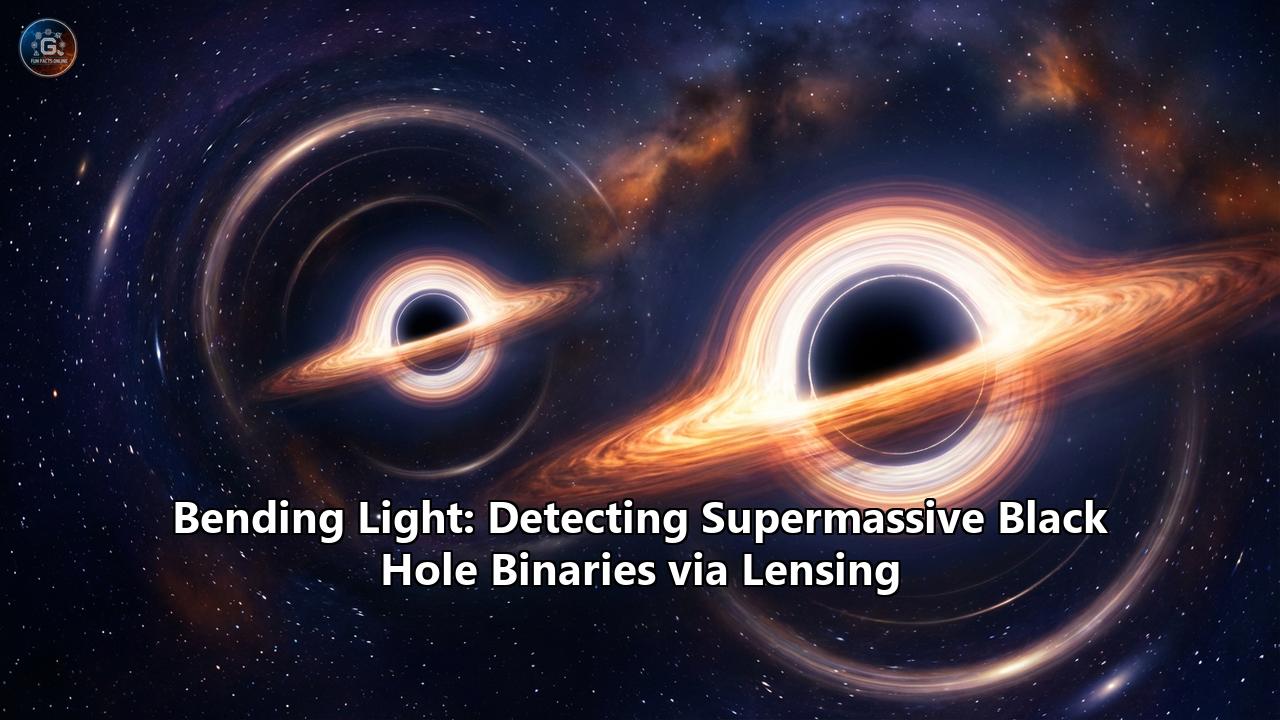
When we look up at the night sky, it is easy to imagine the cosmos as a static, serene tapestry. But behind the veil of this apparent stillness lies a universe defined by profound violence and majestic choreography. Among the most extreme events in the cosmos are the collisions of entire galaxies. When two galaxies merge, their central supermassive black holes—monsters weighing millions or even billions of times the mass of our Sun—sink toward the center of the newly formed galaxy, eventually engaging in a fateful gravitational waltz.
These pairs, known as supermassive black hole binaries (SMBHBs), represent a critical phase in the evolution of galaxies. For decades, astronomers have searched the heavens for these binary systems, knowing that they must exist in abundance. Yet, finding them has proven to be one of the most frustrating games of cosmic hide-and-seek. To find them, astrophysicists are turning to one of the most mind-bending predictions of Albert Einstein’s General Theory of Relativity: gravitational lensing. By watching how these invisible giants bend the light of their own glowing surroundings, we are finally learning to spot the unseeable.
To understand why detecting a supermassive black hole binary is so difficult, we must look at the scale of the cosmos. When galaxies collide, the friction between their stars and gas clouds strips the supermassive black holes of their orbital energy, causing them to spiral inward toward one another. Initially, this process is relatively rapid. But as the black holes draw closer—closing the distance to about one parsec (roughly 3.2 light-years)—the supply of surrounding stars and gas that can steal their orbital energy begins to deplete. According to classical physics, the inward spiral should stall, leaving the black holes orbiting each other indefinitely in a suspended state known as the "Final Parsec Problem."
However, we know that these binaries must eventually bridge this gap. If they did not, the universe would be littered with stalled binaries, and we would not observe the massive, singular black holes that anchor modern galaxies. We know that at extremely close ranges, they radiate away their remaining energy as gravitational waves—ripples in the fabric of spacetime—until they finally coalesce in a cataclysmic merger. But observing these binaries in their sub-parsec phase, right before they merge, is essentially impossible with traditional optics. A distance of a single parsec, viewed from millions or billions of light-years away, is too infinitesimally small for even our most powerful telescopes to resolve as two distinct objects. To the lens of a telescope, the binary appears as a single, indistinguishable point of light.
If we cannot resolve the black holes spatially, we must look for the fingerprints they leave on the light they emit. This is where gravitational lensing enters the frame.
In 1915, Albert Einstein published his General Theory of Relativity, proposing that gravity is not merely a force pulling objects together, but a warping of spacetime itself. Massive objects create deep wells in spacetime, and when light travels past these objects, it is forced to follow the curvature of that well. If a massive object passes directly between a distant light source and an observer on Earth, the gravity of the intervening object acts as a magnifying glass. It bends, focuses, and amplifies the light from the background source. For a single supermassive black hole, the alignment for strong gravitational lensing to occur has to be exquisitely precise, falling almost exactly along our line of sight.
But a supermassive black hole binary offers a far more dynamic environment. In many of these systems, at least one of the black holes is surrounded by a superheated disk of gas and dust known as an accretion disk, shining brilliantly as an active galactic nucleus (AGN) or quasar. If the binary system happens to be oriented nearly edge-on relative to our line of sight on Earth, a spectacular optical illusion occurs: gravitational self-lensing.
As the two black holes orbit one another, the foreground black hole periodically sweeps directly in front of the background black hole and its luminous accretion disk. When it does, the intense gravitational field of the foreground black hole acts as a sweeping magnifying glass. It bends the light from the background disk, creating a diamond-shaped structure of magnified light known as a caustic curve. As the binary system evolves and the black holes move, this caustic curve rotates and changes shape, sweeping across the background light and producing a dramatic, sharp spike in the system's overall brightness.
This self-lensing flare is a unique, undeniable heartbeat. It possesses distinct characteristics that allow astrophysicists to separate it from the random, erratic flickering typical of a standard, single feeding black hole.
First, a self-lensing flare is highly symmetric. The light ramps up sharply as the black hole perfectly aligns with its partner, and decreases just as smoothly as it moves away. Second, the magnification is generally achromatic, meaning the gravitational lens magnifies all wavelengths of light—optical, ultraviolet, X-ray—equally. This is a crucial diagnostic tool. If a quasar suddenly brightens because it swallowed a clump of gas, the temperature of the gas changes, altering the color of the emitted light. But gravity does not care about color; it bends all photons with equal geometry. Therefore, a perfectly achromatic flare is a smoking gun for self-lensing.
In addition to the symmetric spike, the extreme relativistic environment of the binary leaves other subtle signatures in the light curve. For instance, the event horizon and the photon ring of the background black hole cast a "relativistic shadow." Advanced models show that as the magnifying glass of the foreground black hole sweeps across this shadow, it can imprint a distinct dip or secondary feature onto the lensing flare. Furthermore, if both black holes possess their own miniature accretion disks (mini-disks), the system can exhibit partial eclipses. The physical matter of the foreground disk can temporarily block the background disk, creating a sudden dip in brightness accompanied by a razor-sharp lensing spike, further confirming the binary nature of the system.
Another relativistic phenomenon that dances in tandem with self-lensing is Doppler boosting. Because these black holes are orbiting each other at significant fractions of the speed of light, the light emitted by the accretion disk of the black hole moving toward Earth is blue-shifted and dramatically amplified, while the light from the black hole moving away is dimmed. This creates a smooth, sinusoidal wave in the overall brightness of the quasar over months or years. When you combine the smooth, rolling wave of the Doppler boost with the sudden, sharp, symmetric spike of a self-lensing event, you get a light curve that practically screams the existence of a binary system.
The theoretical models of self-lensing are elegant, but finding these cosmic needles in a sky full of haystacks requires immense patience and high-quality data. In recent years, however, astronomers have begun to uncover highly compelling candidates.
One of the most famous candidates was discovered mining the archives of NASA's Kepler Space Telescope. While Kepler was designed to hunt for exoplanets by staring unblinkingly at a single patch of sky to catch the tiny shadows of planets crossing their stars, it also inadvertently captured the light of distant quasars. Because Kepler took a picture every 30 minutes for years, it produced light curves of unprecedented quality. In this dataset, astronomers found a quasar, dubbed "Spikey" (formally J1918+4937), that exhibited a smooth undulating brightness punctuated by a prominent, sharp spike.
Mathematical modeling of Spikey's light curve suggested that the quasar harbors a milliparsec-separation supermassive black hole binary. The smooth variation was attributed to the orbital relativistic Doppler boost, while the sharp spike was beautifully explained by gravitational self-lensing. To verify this, astronomers turned to radio frequencies. High-resolution Very Long Baseline Interferometry (VLBI) images of J1918+4937 revealed a one-sided, wiggling jet of plasma extending outward. The morphological twisting of this radio jet perfectly aligns with the concept of a binary system, where the spin-orbit precession of the black holes causes the jet to wobble like a spinning top, strongly supporting the self-lensing binary interpretation.
Another tantalizing discovery occurred much closer to home in the Seyfert galaxy NGC 1566. Between the beginning of 2017 and early 2020, the All-Sky Automated Survey for SuperNovae (ASAS-SN) recorded a massive outburst from the center of the galaxy. The light curve of this outburst was steep, symmetric, and looked entirely different from the normal, random variations expected from an active galaxy. Detailed analysis revealed a characteristic timescale of 155 days for the event. Notably, while the continuous light and the broad-line emission from the fast-moving gas near the black hole varied, the narrow emission lines from gas further out remained completely undisturbed.
This specific pattern indicated that a massive object had passed directly between the inner broad-line region and the outer narrow-line region, acting as a gravitational lens. Astronomers calculated that the central supermassive black hole of NGC 1566 is being orbited by a secondary black hole weighing roughly 500,000 times the mass of the Sun. This smaller black hole, sitting at a distance of about 250 light-days from the primary, acted as a micro-lens, magnifying the inner accretion disk and providing striking evidence for a binary system with a mass ratio of about 10-to-1.
The power of self-lensing extends even to the most bizarre and rapid phenomena in the X-ray sky. Recently, X-ray observatories have detected Quasi-Periodic Eruptions (QPEs)—sharp, immense flares of X-rays lasting about an hour and repeating at regular intervals—in a few low-mass active galactic nuclei, such as GSN 069 and RX J1301.9+2747. While several theories have been proposed to explain QPEs, one compelling model suggests they are driven by gravitational self-lensing in an edge-on binary. In this scenario, the black holes are so close that they orbit each other in a matter of hours. Twice per orbit, each black hole gravitationally lenses the light from the accretion disk of the other, resulting in the rapid, clockwork flashes of X-rays we observe. If the orbit is slightly eccentric, it perfectly explains the specific timing and spacing of the flares. These systems are on the absolute brink of collision, with models suggesting they could merge within a mere 1,000 years.
As we transition from retrospective discoveries to forward-looking surveys, the hunt for self-lensing binaries is about to enter a golden age. The Vera C. Rubin Observatory, housing the Legacy Survey of Space and Time (LSST), is poised to revolutionize this field. Over a 10-year duration, the LSST will scan the entire southern sky every few nights, cataloging tens of millions of quasars. Given that many of these quasars are expected to host sub-parsec supermassive black hole binaries, the LSST is the ultimate net for catching self-lensing flares.
Because intrinsic quasar variability is messy—often described mathematically as a "damped random walk" (DRW) because it flickers unpredictably like a candle in the wind—finding a self-lensing flare is computationally challenging. Simple algorithms like the Lomb-Scargle periodogram, which look for basic repeating cycles, often fail because the massive spikes can be drowned out or confused by the quasar's natural stochastic noise. To solve this, astrophysicists are developing sophisticated "matched filters." By injecting simulated self-lensing flares into fake quasar light curves, researchers have proven that matched filters can successfully isolate the precise signal-to-noise ratio of a self-lensing flare, separating it entirely from the background noise.
Current models estimate that the LSST could detect tens to hundreds, and potentially up to thousands, of these self-lensing binary systems. The exact number will depend heavily on the orientation of the accretion disks relative to the binary orbits; if the disks are aligned with the orbit, the lensing signatures will be prominent and nearly achromatic, making them highly identifiable.
The identification of these systems through bending light is not just an end in itself; it is the crucial first step in the ultimate symphony of multi-messenger astronomy. Supermassive black hole binaries in tight sub-parsec orbits are the most powerful sources of low-frequency gravitational waves in the universe. While the light we see tells us about the environment and the optical mechanics of the binary, the gravitational waves tell us about the pure, fundamental physics of the black holes' masses and spacetime geometry.
Currently, global consortia utilizing Pulsar Timing Arrays (PTAs)—such as the NANOGrav collaboration—are listening to the collective "hum" of millions of supermassive black hole binaries merging across the universe. By monitoring the ultra-precise ticking of dead stars called pulsars, they can detect the minute stretching and squeezing of spacetime caused by this gravitational wave background. In the near future, next-generation radio telescopes like the Square Kilometre Array (SKA) will exponentially increase the sensitivity of these pulsar timing arrays. The holy grail of modern astrophysics is to use an optical survey like the LSST to spot the repeating, self-lensing flashes of a specific supermassive black hole binary, and then point the SKA at that exact coordinate to detect the individual gravitational waves emanating from that very same system.
Further down the line, the European Space Agency's Laser Interferometer Space Antenna (LISA) will launch into orbit. While ground-based gravitational wave detectors like LIGO are deaf to the ultra-low frequencies emitted by supermassive giants, LISA's massive, million-kilometer laser arms in space will be perfectly tuned to hear them. Discovering binaries via self-lensing today provides the exact targets that LISA will listen to tomorrow.
The bending of light has transformed from a theoretical curiosity of General Relativity into one of our most powerful navigational tools. By using black holes as magnifying glasses to look at other black holes, we are pulling back the curtain on the final, hidden acts of galactic evolution. We are watching the most destructive forces in nature perform an elegant, mathematically perfect waltz, broadcasting their inevitable doom through brilliant, symmetrical flashes of captured light. As our telescopes grow wider and our algorithms grow sharper, the invisible universe is finally coming into focus.
Reference:
- https://www.news9live.com/science/new-method-developed-to-hunt-binary-pairs-of-supermassive-black-holes-2932052
- https://www.semanticscholar.org/paper/A-self-lensing-binary-massive-black-hole-of-Ingram-Motta/b0cf98965d174c092fe6a2b5b6141f56a0fe754d
- https://academic.oup.com/mnras/article/495/4/4061/5835702
- https://arxiv.org/abs/2006.08441
- https://arxiv.org/abs/2512.08427
- https://www.semanticscholar.org/paper/73ffacc33ed70f64ba2fb7869f7a30ab47553af5
- https://www.utrgv.edu/cos/schools-and-departments/physics-and-astronomy/research/index.htm
- https://www.researchgate.net/publication/396575694_Gravitational_Wave_Detection_via_Advanced_Laser_Interferometry