
The Enigmatic Tale of the Fuegian Dog: A Lost Chapter in Domestication
In the windswept archipelago of Tierra del Fuego, at the southernmost tip of South America, a unique and mysterious canid once roamed alongside the Indigenous Yaghan and Selk'nam peoples. Known as the Fuegian dog, this creature was not a dog in the conventional sense, nor was it simply a wild animal. It was a domesticated fox, a testament to a fascinating and ultimately tragic relationship between humans and a now-extinct lineage of canids. Its story, pieced together from historical accounts, the oral traditions of the Fuegians, and modern scientific analysis, unravels a complex narrative of companionship, survival, and loss, leaving behind a legacy that continues to intrigue researchers today.
The Fuegian dog, also referred to as the Yaghan dog or Patagonian dog, vanished in the early 20th century, its extinction intertwined with the tragic fate of the Indigenous communities who lived with it. For centuries, this animal was an integral part of life in one of the world's harshest environments, a companion that offered more than just loyalty; it provided warmth, aided in hunting, and was a living thread in the cultural fabric of its people. But what exactly was this creature, and how did its unique bond with humans come to an end? The quest to answer these questions takes us back through the journals of early explorers, into the heart of Fuegian society, and deep into the genetic code of its last surviving remnants.
A Fox or a Dog? Unraveling a Zoological Puzzle
The true identity of the Fuegian dog has long been a subject of scientific debate. Early European explorers and missionaries provided the first written descriptions, often portraying it as a fox-like creature. French navigator Louis-Ferdinand Martial, who led a scientific expedition to Cape Horn in 1883, described it as "ugly, with long tawny hair and a sharp snout, it looks quite like a fox". Lucas Bridges, an Anglo-Argentine explorer and author who grew up among the Fuegians, offered a more evocative description, calling it "a stunted cross between an Alsatian police dog and a wolf". These varied accounts highlight the animal's ambiguous appearance, possessing traits of both wild and domestic canids.
For years, the prevailing theory was that the Fuegian dog was a domesticated form of the culpeo (Lycalopex culpaeus), a large, fox-like canid native to the western slopes of the Andes. The culpeo, while resembling a true fox, is genetically closer to wolves and jackals. This theory gained significant traction with a 2013 genetic study that analyzed hair samples from a taxidermied Fuegian dog specimen. The analysis revealed a much greater genetic similarity to the culpeo (97.57%) than to domestic dogs (Canis lupus familiaris) (88.93%). This groundbreaking research suggested an unusual case of canid domestication, one that occurred independently of the wolf domestication that gave rise to all modern dog breeds.
However, more recent scholarship has proposed a more nuanced understanding. A 2023 review of historical and scientific literature argued that there may have been two distinct types of canids among the Indigenous peoples of the region. The "Patagonian dog," associated with the inland Selk'nam people, was likely the domesticated culpeo. In contrast, the "Fuegian dog" of the coastal Yaghan people may have descended from an ancestral domestic dog population that arrived in the Americas via the Bering Strait. This theory is supported by some historical accounts that describe dogs of different sizes and colorations being used for different hunting purposes. One smaller, lighter-colored dog was used to hunt tuco-tucos (a type of rodent), while a larger, darker dog assisted in hunting guanacos.
Further complicating the picture is the idea that the Fuegian dog was not fully domesticated in the traditional sense. Some researchers propose that it existed in a state of semi-domestication, a "semi-tame companion" that formed a mutually beneficial partnership with humans. This would explain its often-described wild and independent nature. The debate continues, with other theories even suggesting a possible connection to the extinct canid Dusicyon avus, or a hybridization between domestic dogs and local canids. What is certain is that the Fuegian dog represents a unique chapter in the long and varied history of human-canid relationships.
A Creature of Contradictions: Appearance and Temperament
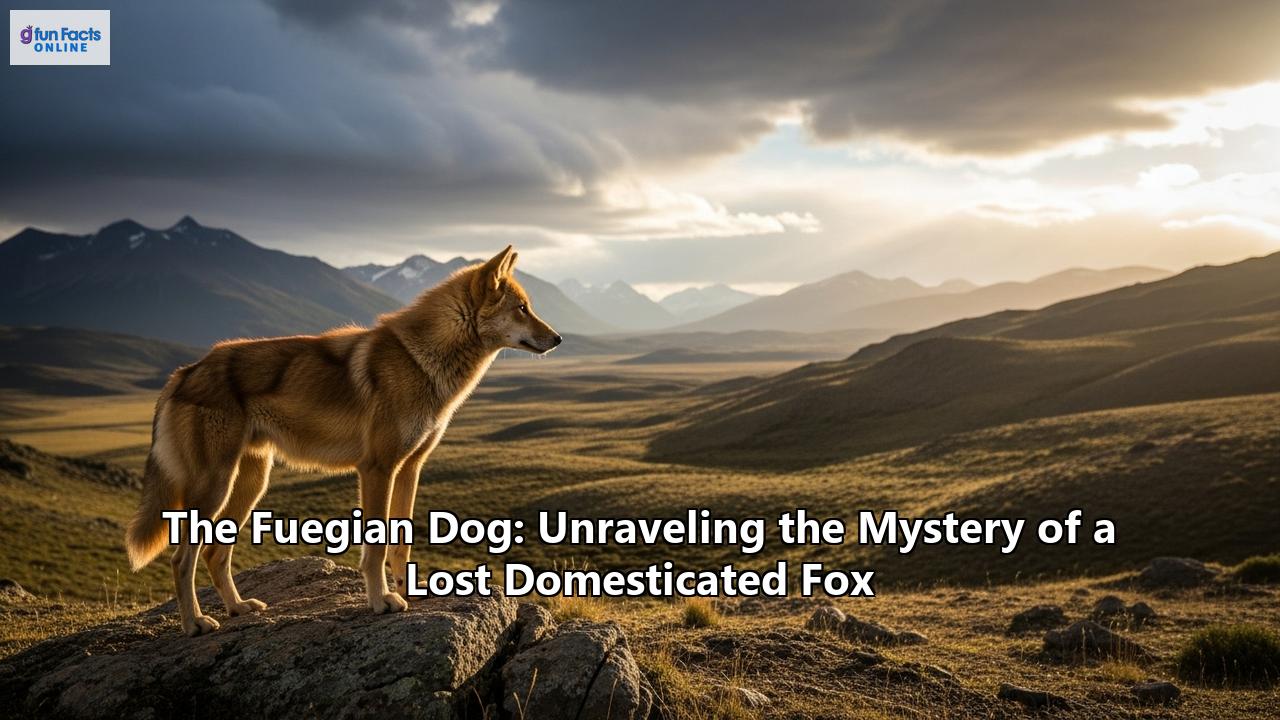
Surviving descriptions and the few remaining museum specimens paint a picture of a striking animal. The Fuegian dog had erect ears, a sharp snout, and a thick, bushy tail. Its coat was typically long and tawny, though some were entirely white. In terms of size, it was comparable to its wild ancestor, the culpeo, weighing between 5 and 13.5 kilograms (11 to 30 pounds), roughly the size of a Shetland Sheepdog. Gauchos in the region reportedly called them "maned dogs" due to their resemblance to the maned wolf.
The temperament of the Fuegian dog is a matter of some contradiction in historical records. On one hand, they were an integral part of the family unit. The Yaghan language, for instance, contains over 160 words and phrases related to the animal, suggesting its deep cultural significance. They were known to curl up with their human families, especially the children, in their crowded huts, providing a vital source of warmth in the harsh subpolar climate. This practice led to them being described as "heating furniture" for the Ona people.
On the other hand, the Fuegian dog was often described as being disloyal and not particularly protective of its owners. Julius Popper, an Argentine explorer involved in the Selk'nam genocide, wrote, "I never saw them, no matter how large their number, take an aggressive attitude or defend their masters when these were in danger". This aloofness and independent nature are often cited as evidence of its semi-wild state. Some accounts even portray them as aggressive and dangerous, particularly towards livestock introduced by European settlers. The Anglican missionary Thomas Bridges, for example, claimed in the 1880s that the dogs attacked his mission's goats. This alleged ferocity would later be used as a justification for their extermination.
A Working Partnership: The Role of the Fuegian Dog in Indigenous Society
The Fuegian dog was far more than a simple pet; it was a working partner essential for survival. Its keen hunting instincts were put to good use by the Yaghan and Selk'nam people. One of their primary roles was hunting otters. Charles Darwin, during his voyage on the Beagle in the 1830s, was told by a native boy how the dogs were used to catch these animals.
Remarkably, these canids were also employed in fishing. Accounts describe how the dogs would help corral schools of fish, driving them into nets set by their human companions. This level of cooperation in a semi-wild animal is a testament to the unique bond forged between the Fuegians and their canid partners.
The relationship was one of mutual benefit. The dogs received food and shelter, while the humans gained a valuable hunting assistant and a living blanket against the cold. This partnership model, where canids and people work together for survival, is seen in other Indigenous cultures, such as the use of sled dogs in the Arctic. The Fuegian dog was a crucial element in the ability of the Yaghan and Selk'nam to thrive in the challenging environment of Tierra del Fuego.
A Tragic End: The Extinction of a Species
The demise of the Fuegian dog is a story of cultural collapse and ecological disruption brought about by European colonization. The arrival of European settlers in the late 19th and early 20th centuries had a devastating impact on the Indigenous populations of Tierra del Fuego. Disease and the brutal Selk'nam genocide decimated their numbers, and with them, the unique culture that had sustained the Fuegian dog for centuries.
As European ranchers established themselves in the region, they introduced sheep and goats, which created a new source of conflict. The Fuegian dogs, with their innate hunting instincts, were accused of preying on this livestock. This led to them being hunted and killed by the settlers.
However, some accounts suggest a more complex and tragic reason for their final disappearance. When the Silesian missionary Martin Gusinde visited the remaining Yaghan people in 1919, he was surprised to find that the dogs were gone. He was told by the local people that they themselves had exterminated the animals because they had become "dangerous to men and cattle". It is theorized that this was a desperate act by the surviving Indigenous people to appease the European settlers and stop the violence being perpetrated against them, a last-ditch effort to save their own people by sacrificing their animal companions.
By the early 20th century, the Fuegian dog was extinct. Its disappearance marked the end of a unique evolutionary and cultural experiment, a partnership between humans and a domesticated fox that had endured for generations.
The Legacy of a Lost Canid
Today, the Fuegian dog exists only in a handful of taxidermied specimens in museums in Chile and Argentina, in the faded photographs and drawings of early explorers, and in the enduring mystery of its origins and demise. It stands as a powerful symbol of the profound connection that can exist between humans and the animal world, and of the devastating consequences of cultural and ecological disruption.
The story of the Fuegian dog continues to fascinate scientists and historians. Ongoing research using advanced genetic techniques on the few remaining specimens may yet provide more definitive answers about its exact taxonomic identity and its relationship to other canids. There is even speculation among some researchers about the possibility of "resurrecting" the Fuegian dog through retro-selection, breeding animals that carry similar genetic traits.
The tale of the Fuegian dog is a poignant reminder of a lost world. It is a story that speaks of the ingenuity of Indigenous peoples in adapting to their environment, of the complex and varied ways in which humans have interacted with other species, and of the irreplaceable loss that occurs when unique cultures and the animals they are intertwined with vanish from the Earth. The mystery of this domesticated fox from the "end of the world" serves as a compelling and cautionary tale, a chapter in the history of domestication that was brutally cut short, leaving us to wonder what might have been.
Reference:
- https://doglime.com/fuegian-dog/
- https://www.reddit.com/r/todayilearned/comments/1bimqc2/til_that_the_culpeo_a_south_american_fox_species/
- https://strangeanimalspodcast.blubrry.net/tag/fuegian-dog/
- https://en.wikipedia.org/wiki/Fuegian_dog
- https://www.wikiwand.com/en/articles/Fuegian_dog
- https://en.wikipedia.org/wiki/Culpeo
- https://www.researchgate.net/publication/372625045_Review_The_identity_of_Fuegian_and_Patagonian_dogs_among_indigenous_peoples_in_southernmost_South_America
- https://www.researchgate.net/publication/393670717_Foxes_as_pets_Case_study_of_the_Fuegian_Dog_and_its_relationship_to_extinct_Indigenous_cultures
- https://www.sciencenews.org/article/fuegian-dog-fox
- https://dogell.com/en/dog-breed/fuegian-dog
- https://www.youtube.com/watch?v=isR4BcEiTAo
- https://onlinefoxforum.wixsite.com/foxes/forum/unusual-foxes/the-resurrection-of-the-fuegian-dog
- https://www.reddit.com/r/Awwducational/comments/1hbso1n/the_culpeo_is_a_foxlike_canine_native_to_the_west/
- https://core.tdar.org/document/509957/the-origin-of-the-fuegian-dog-reassessment-of-taxonomic-identity-and-domestication-process-using-whole-genome-sequencing