
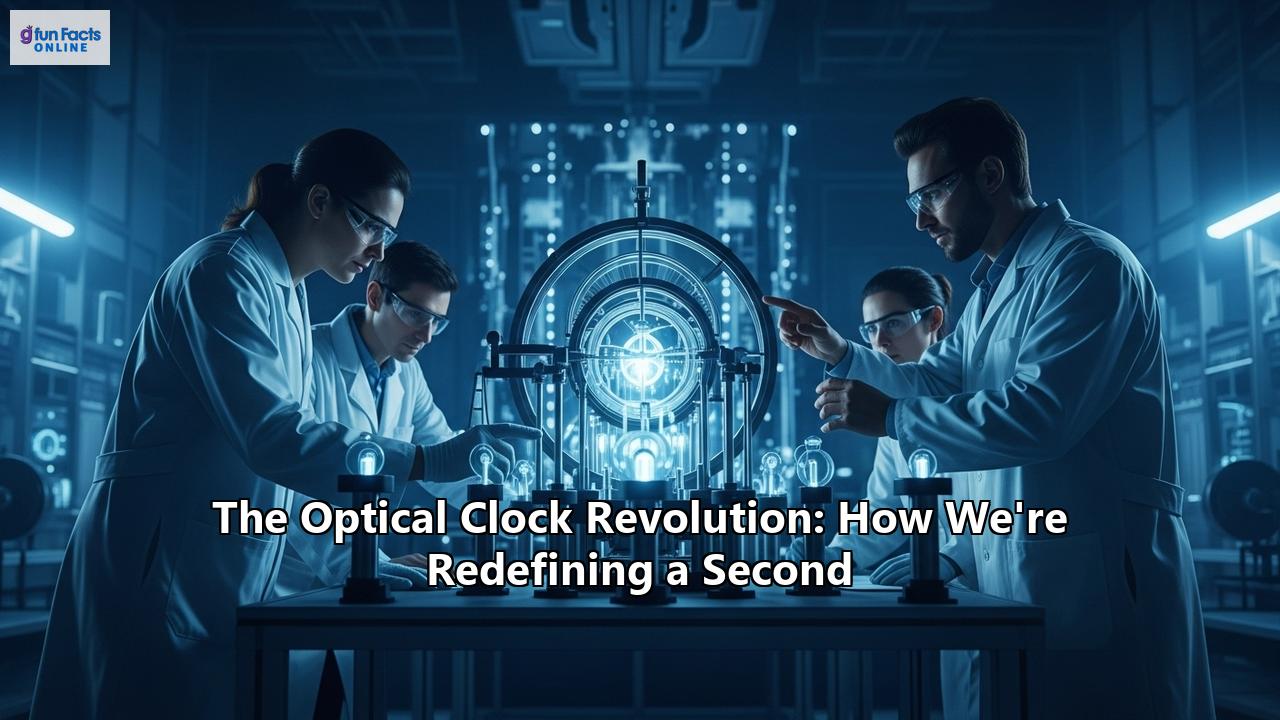
The Unceasing Tick-Tock: How the Optical Clock Revolution is Redefining Time Itself
Time, the invisible river that carries us from cradle to grave, has been a human obsession for millennia. We've measured its passage with the sun's shadow, the swing of a pendulum, and the hum of a quartz crystal. For the last half-century, the most precise "tick" in the world has been dictated by the unwavering oscillation of a caesium atom. This atomic pulse, a marvel of 20th-century physics, defines the very essence of a second. But a new era of timekeeping is dawning, one so profound it makes the caesium clock look like a grandfather clock in a quantum world. This is the age of the optical clock, a revolutionary technology that is poised not just to measure time with terrifying precision, but to unlock some of the deepest secrets of the universe and reshape our technological landscape.
These are not just better clocks; they are a new kind of scientific instrument. With a precision that would lose less than a second over the entire age of the universe, optical clocks are opening up a new frontier. They are becoming sensors of the infinitesimally small, tools for exploring the fabric of spacetime, and the foundation for a future where time is known with a certainty that was once the stuff of science fiction. The revolution is here, and it promises to redefine the second, and with it, our understanding of the cosmos.
From Sundials to Atoms: The Long Quest for a Perfect Second
Before we can appreciate the leap into the optical age, we must first understand the journey that brought us to the current definition of time. For most of human history, our measure of time was tied to the heavens. The rotation of the Earth on its axis gave us the day, which we dutifully subdivided. Ancient civilizations like the Egyptians and later the Greek astronomer Ptolemy divided the day and the circle into smaller and smaller parts, eventually giving us hours, minutes, and seconds. In 1874, the second was formally defined as 1/86,400 of a mean solar day.
However, physicists and astronomers knew this celestial clock was flawed. The Earth's rotation isn't perfectly uniform; it wobbles and gradually slows over centuries, with additional seasonal and irregular variations. This was not a stable foundation upon which to build modern science and technology. The search was on for a more constant pendulum. By the mid-20th century, a new candidate emerged from the burgeoning field of atomic physics.
The breakthrough came in 1955 when Louis Essen at the National Physical Laboratory (NPL) in the UK built the world's first practical caesium atomic clock. Scientists had discovered that the atoms of certain elements, when stimulated, transition between two distinct energy states, emitting or absorbing radiation at an incredibly stable and predictable frequency. The caesium-133 atom proved to be an ideal reference. Its "pendulum" was the natural, unperturbed frequency of the radiation corresponding to the transition between two hyperfine levels of its ground state.
This atomic tick was so reliable that in 1967, the 13th General Conference on Weights and Measures (CGPM) abandoned the astronomical definition and redefined the SI second based on the caesium atom. The new definition was precise: "the duration of 9,192,631,770 periods of the radiation corresponding to the transition between the two hyperfine levels of the ground state of the caesium-133 atom". This value was chosen to ensure continuity with the previous, astronomy-based second.
This ushered in the era of atomic time. This definition is realized today by a global network of primary frequency standards, most notably caesium fountain clocks. In a caesium fountain clock, a cloud of about 100,000 caesium atoms is first laser-cooled to temperatures near absolute zero, slowing their frantic motion. This chilled ball of atoms is then gently tossed upwards by lasers, like a fountain, through a microwave cavity. As the atoms rise and fall under gravity, their interaction time with the microwaves is extended, allowing for an extremely precise measurement of their resonant frequency. The best of these clocks, like the NIST-F2 in the United States, are accurate to within one second in over 100 million years.
The time signals from these elite clocks around the world are averaged to create International Atomic Time (TAI), a highly stable and continuous timescale. Our everyday civil time, Coordinated Universal Time (UTC), is based on TAI but is occasionally adjusted with "leap seconds" to keep it aligned with the Earth's slowing rotation. For over 50 years, this caesium-based system has been the bedrock of global timekeeping, underpinning everything from the internet and financial markets to GPS navigation. But science is relentless, and a clock that is 100 times more accurate is now on the horizon, ready to take the mantle.
A Faster Pendulum: The Principle of the Optical Clock
The fundamental principle behind the astonishing leap in precision offered by optical clocks is surprisingly simple: a faster pendulum can be a better pendulum. All clocks, from a simple sundial to a complex atomic clock, consist of three main parts: an oscillator (the "pendulum" that ticks at a regular interval), a counter to count the ticks, and a reference to keep the oscillator stable.
In a caesium clock, the oscillator is a microwave generator, and the reference is the natural resonance of caesium atoms, which "ticks" at a frequency of about 9.2 gigahertz (GHz), or 9.2 billion times per second. Optical clocks operate on the same basic principle but use a different type of atom or ion and a much, much faster oscillator. Instead of microwaves, they use laser light, which oscillates in the optical part of the electromagnetic spectrum.
The frequencies of visible light are around 100,000 times higher than microwave frequencies, on the order of hundreds of terahertz (THz), or hundreds of trillions of times per second. This much higher frequency is like having a ruler with far finer markings. By dividing the second into hundreds of trillions of discrete "ticks" instead of a mere 9.2 billion, an optical clock can achieve a much higher resolution and, consequently, greater precision and stability. Some of the most advanced optical clocks would lose just one second in 15 billion years, a timespan longer than the age of the universe.
However, harnessing these incredibly fast optical frequencies presented a monumental challenge. For decades, it was impossible to directly count the oscillations of light. Electronics were simply not fast enough. This "frequency chain" problem, bridging the vast gap between optical frequencies and countable microwave frequencies, required cumbersome and complex systems.
The game-changing breakthrough came in the late 1990s with the invention of the optical frequency comb. This device, for which Theodor W. Hänsch and John L. Hall were awarded part of the 2005 Nobel Prize in Physics, acts as a gearwork for light. A frequency comb is a specialized laser that emits a continuous train of ultra-short pulses of light, creating a spectrum that consists of hundreds of thousands of sharp, equally spaced frequencies—like the teeth of a comb. This comb acts as a ruler for light, providing a direct and precise link between the ultra-high frequencies of the optical clock's laser and the lower, electronically countable microwave frequencies. With the frequency comb, the final barrier to creating a practical optical clock was overcome, sparking a global race to build the most precise timekeepers in human history.
The Architects of Time: Trapped Ions and Optical Lattices
While the principle of using a faster, optical frequency is common to all optical clocks, scientists have developed two primary architectures for building them, each with its own strengths and set of preferred atomic candidates. The two main flavors are trapped-ion clocks and optical lattice clocks.
Trapped-Ion Clocks: The Quantum Ideal
A trapped-ion clock is perhaps the purest realization of an atomic clock, as it uses a single, isolated atom as its reference. To create one, scientists first take an atom, such as ytterbium (Yb+) or strontium (Sr+), and strip away one of its electrons. This gives the atom a net positive charge, turning it into an ion. Because it is charged, the ion can be trapped and held nearly motionless in a vacuum by oscillating electromagnetic fields. This "ion trap" effectively creates an electromagnetic cage, isolating the ion from almost all external perturbations, bringing it close to the spectroscopic ideal of an atom at rest in a perturbation-free environment.
Once trapped, the ion is cooled with precisely tuned lasers to a temperature near absolute zero, further reducing its motion. Another "clock" laser is then aimed at the ion, its frequency tuned to be as close as possible to one of the ion's specific optical transitions—an incredibly narrow and stable energy jump within the atom. By repeatedly probing the ion and using a feedback loop, the laser's frequency is "locked" to the ion's natural resonance. The fantastically stable frequency of this locked laser becomes the heart of the clock.
Because they offer such a pristine and well-controlled environment, trapped-ion clocks are leading the way in terms of accuracy. They are exceptionally resistant to disturbances like thermal radiation. However, a significant drawback is that they rely on a single atom. This means the signal is very weak, and it can take a long time—sometimes days or even weeks—to accumulate enough data to reach the highest levels of precision.
To overcome this, researchers at Germany's national metrology institute, the Physikalisch-Technische Bundesanstalt (PTB), have developed an innovative "ion crystal clock." This design traps multiple ions, often of different species, in a single trap where they form a crystalline structure. For example, they combine indium ions, which have excellent properties for clock accuracy, with ytterbium ions, which are used for efficient cooling of the entire crystal. This parallel approach drastically shortens the measurement time needed to achieve ultra-high accuracy. This new type of clock recently set a new accuracy record, demonstrating the immense potential of multi-ion systems.
Optical Lattice Clocks: The Power of Numbers
The second major type of optical clock, the optical lattice clock, takes a different approach. Instead of interrogating a single ion, it simultaneously measures the oscillations of many thousands of neutral atoms, such as strontium or ytterbium.
In a lattice clock, intersecting laser beams create a standing wave of light, which forms a kind of electromagnetic "egg carton." This web of light, known as an optical lattice, traps thousands of individual atoms, one in each "dimple" of the carton. This arrangement holds the atoms still, allowing their internal oscillations to be measured for a long time. The key advantage is that by averaging the measurements over all the atoms at once, scientists can achieve extremely high precision very quickly. This has made optical lattice clocks the most stable clocks in existence.
There is, however, a quantum mechanical catch. The powerful lasers used to create the lattice should, in theory, disturb the atoms' sensitive energy levels, shifting their resonant frequency and rendering them useless for timekeeping. The solution to this paradox is a clever trick known as the "magic wavelength." Scientists discovered that for certain atoms, like strontium, there exists a specific wavelength of laser light for the lattice where the perturbing effect on the two energy levels of the clock transition is exactly the same. The energy shifts cancel each other out, and the atom behaves as if the trapping lattice isn't even there. This "magic" allows the clock to benefit from trapping thousands of atoms without sacrificing accuracy.
Pioneering work at institutions like JILA, a joint institute of the National Institute of Standards and Technology (NIST) and the University of Colorado Boulder, has pushed strontium lattice clocks to the forefront of timekeeping. Researchers there have recently developed a clock with a total systematic uncertainty of just 8.1 x 10⁻¹⁹, one of the lowest ever reported. They achieved this by using shallower, gentler optical lattices to reduce errors caused by the trapping light and by atoms bumping into each other. Similarly, researchers at China's National Time Service Center (NTSC) have developed a strontium lattice clock with an uncertainty of 2×10⁻¹⁸, meeting the stringent requirements for a future redefinition of the second. These continuous advancements are solidifying the status of optical lattice clocks as leading candidates for the next generation of time standards.
A New Cosmic Toolkit: The Far-Reaching Applications of Optical Clocks
The incredible precision of optical clocks does more than just promise a more accurate way to tell time. It transforms these devices into powerful new sensors capable of probing the universe in ways previously unimaginable. From the vast expanse of space to the ground beneath our feet, optical clocks are set to revolutionize fundamental physics, navigation, and even our planet's geology.
Testing the Foundations of Physics
Albert Einstein's theory of general relativity, the bedrock of our modern understanding of gravity, predicts that massive objects warp the fabric of spacetime. A consequence of this is gravitational time dilation: time itself runs slower in a stronger gravitational field. A clock on the surface of the Earth will tick ever so slightly slower than an identical clock on a mountaintop or in orbit. This effect has been confirmed by experiments, but optical clocks are allowing scientists to test it with unprecedented rigor.
Recently, researchers at JILA used a strontium optical lattice clock to measure this time dilation across a height difference of just one millimeter within a single sample of ultracold atoms. They detected that the top of the atom cloud was ticking at a slightly different rate than the bottom, a direct observation of general relativity at a microscopic scale. This ability to measure such minuscule differences opens the door to using clocks to explore the fuzzy boundary where general relativity and quantum mechanics—the two pillars of modern physics—are expected to intersect.
Furthermore, optical clocks are becoming key tools in the hunt for some of the universe's greatest mysteries, including dark matter. While we can observe its gravitational effects on galaxies, dark matter has never been directly detected. Some theories propose that dark matter consists of ultralight fields or particles that interact very weakly with normal matter. These interactions could cause tiny, oscillating variations in the values of fundamental constants of nature, such as the fine-structure constant or the mass of the electron.
Because the frequency of an atomic clock transition is dependent on these fundamental constants, comparing two different types of optical clocks (for instance, a strontium lattice clock and an ytterbium ion clock) over long periods can search for these oscillations. If a dark matter field passed through the laboratory, it might affect the "tick rate" of the two clocks differently, creating a detectable signal. Networks of synchronized optical clocks, both on Earth and in space, could act as a global-scale telescope for dark matter, seeking out these elusive particles.
Relativistic Geodesy: Weighing the Earth with Time
The same sensitivity to gravity that allows optical clocks to test relativity can also be turned into a powerful new tool for Earth science. The concept, known as "relativistic geodesy" or "chronometric levelling," uses clocks to measure the Earth's gravitational potential.
Since a clock's tick rate is directly proportional to the local gravitational potential, comparing the frequencies of two highly accurate optical clocks can reveal the difference in their height, or more precisely, the difference in the gravitational potential between them. An accuracy of 1 part in 10¹⁸ corresponds to a height difference of about one centimeter.
By linking optical clocks across continents using optical fiber networks, scientists can create a network of sensors capable of mapping the Earth's geoid—the true, irregular shape of the planet defined by its gravity field—with centimeter-level precision. Transportable optical clocks are already being used to demonstrate this principle. A network of these clocks could monitor, in near real-time, the subtle changes in the Earth's crust caused by volcanic activity, the melting of ice sheets, or the depletion of underground aquifers. This could lead to better models for predicting earthquakes and volcanic eruptions and a deeper understanding of climate change's impact on our planet.
A More Precise Future: Navigation, Finance, and Communications
Beyond fundamental science, the optical clock revolution will have a tangible impact on technologies we use every day. Global Navigation Satellite Systems (GNSS) like GPS rely on a constellation of satellites, each carrying an atomic clock. A receiver on the ground determines its position by precisely measuring the time it takes for signals from multiple satellites to arrive. The accuracy of the system is fundamentally limited by the accuracy of the clocks.
Replacing the current microwave atomic clocks on satellites with more stable and accurate optical clocks could improve the precision of GPS by a factor of a thousand. This would lead to navigation systems with millimeter-level accuracy, enabling truly autonomous vehicles, safer drone operation, and more precise scientific monitoring. Furthermore, the development of compact, portable optical clocks could reduce our reliance on satellite signals altogether, making navigation systems less vulnerable to jamming or spoofing.
The world of finance and telecommunications will also be transformed. High-frequency trading relies on timestamping transactions with microsecond precision. More accurate clocks would allow for even faster and more secure financial systems. In telecommunications, the synchronization of high-speed networks, including future 5G and 6G systems, is critical for transferring vast amounts of data without error. Optical clock technology, especially as it is miniaturized into chip-scale devices, will provide a new level of timing stability, enabling more robust and efficient communication networks.
The Road to a New Second: International Consensus and Future Challenges
The evidence is overwhelming: optical clocks have surpassed the performance of the current caesium standard by about two orders of magnitude in both accuracy and stability. This has inevitably led the international metrology community to plan for a redefinition of the SI second for the first time in over 50 years.
The roadmap for this historic change is being managed by the International Bureau of Weights and Measures (BIPM) and its Consultative Committee for Time and Frequency (CCTF). The redefinition is tentatively planned for around 2030. However, before this can happen, several stringent conditions must be met.
First, multiple types of optical clocks, based on different atoms and architectures, must consistently demonstrate performance superior to caesium fountain clocks. Second, the frequency ratios between these different optical clocks must be measured with extreme accuracy to ensure they all agree. This requires a global effort to compare clocks located in different laboratories around the world. These comparisons are conducted using both dedicated optical fiber links, which offer the highest stability, and advanced satellite-based techniques. Recent large-scale international comparisons involving dozens of clocks across multiple continents have been a crucial step in building confidence in this new generation of standards.
Another key requirement is that optical clocks must be able to contribute reliably to the generation of International Atomic Time (TAI). In a landmark achievement, the UK's National Physical Laboratory (NPL) recently had its strontium optical lattice clock become the first in the UK to contribute to the official calibration of TAI, a vital step towards the redefinition.
Despite the incredible progress, significant challenges remain. Optical clock systems are still incredibly complex and delicate, often occupying entire laboratories. Making them more robust, autonomous, and even portable is a major focus of ongoing research. Scientists and engineers are working to miniaturize the components, from the lasers to the vacuum systems, with the ultimate goal of creating chip-scale optical clocks that could be integrated into everyday devices.
The Ticking Continues
The journey from tracking shadows to counting the oscillations of light within a single, chilled atom is a testament to humanity's unyielding curiosity and ingenuity. The optical clock is more than just the next chapter in the story of timekeeping; it represents a paradigm shift. We are on the cusp of redefining one of the fundamental units of science, a move that will provide a more stable foundation for all of modern measurement.
These remarkable instruments are pushing the boundaries of what we can measure, allowing us to perceive the subtle warping of spacetime on a human scale and to listen for the faint whispers of dark matter in the cosmos. They promise a future of more precise navigation, more secure communications, and a deeper understanding of our planet and the universe. The second, a unit of time we so often take for granted, is about to become more precise, more meaningful, and more powerful than ever before. The optical clock revolution is not just about keeping better time; it is about what we can do with that time. And the clock is ticking.
Reference:
- https://news.fnal.gov/2023/07/how-new-atomic-clocks-could-help-in-search-for-dark-matter-and-beyond/
- https://physicsworld.com/a/optical-clock-sets-new-constraints-on-dark-matter/
- https://agenda.infn.it/event/26098/contributions/132489/contribution.pdf
- https://physics.aps.org/articles/v13/s145
- https://journals.aps.org/prl/abstract/10.1103/PhysRevLett.129.241301
- https://science.nasa.gov/wp-content/uploads/2023/05/89_1c148a173e16cea01395f4ab95f009a4_NASA_Dark_matter_white_paper_4.pdf?emrc=070c97
- https://www.laserfocusworld.com/test-measurement/test-measurement/article/16558250/cryogenic-optical-lattice-clocks-will-enable-mapping-earths-gravity-via-general-relativity
- https://www.numberanalytics.com/blog/future-timekeeping-optical-clocks
- https://www.livescience.com/atomic-clock-confirms-einstein-predictions-about-time
- https://www.mdpi.com/journal/photonics/special_issues/AD5I7SG381
- https://www.iflscience.com/ultraprecise-atomic-clock-measures-general-relativity-effects-on-a-millimeter-scale-61341
- https://arxiv.org/abs/gr-qc/0608081
- https://www.numberanalytics.com/blog/ultimate-guide-optical-clocks-optical-physics
- https://science.nasa.gov/wp-content/uploads/2023/05/45_ff64cbf3fcf17410e55b7799a999f4cd_OatesChrisW.pdf?emrc=75325d
- https://meetingorganizer.copernicus.org/EGU2019/EGU2019-7401.pdf
- https://journals.aps.org/rmp/abstract/10.1103/RevModPhys.90.045005
- https://www.npl.co.uk/research/time-frequency/optical-atomic-clocks
- https://www.techno-science.net/en/news/atomic-clock-in-your-smartphone-and-gps-1000-times-more-precise-N26735.html
- https://www.sustainability-times.com/impact/end-of-gps-era-the-secret-rise-of-atomic-clocks-signals-a-military-grade-revolution-in-global-positioning-and-national-security/
- https://www.researchgate.net/publication/304822019_Relativistic_geodesy
- https://www.sciencefocus.com/future-technology/nuclear-clocks
- https://www.nist.gov/news-events/news/2024/07/worlds-most-accurate-and-precise-atomic-clock-pushes-new-frontiers-physics
- https://www.sciencedaily.com/releases/2020/04/200409100338.htm
- https://group.ntt/en/magazine/blog/innovating_disaster_forecasting/
- https://pmc.ncbi.nlm.nih.gov/articles/PMC10347235/
- https://www.qepnt.org/technologies/opticalatomicclocksaquantumleapinprecisiontiming/
- https://ken.ieice.org/ken/paper/20231214FcA6/eng/
- https://www.euramet.org/research-innovation/search-research-projects/details/project/accurate-timefrequency-comparison-and-dissemination-through-optical-telecommunication-networks
- https://www.npl.co.uk/news/npl-makes-history-with-first-uk-optical-clock
- https://www.optica.org/about/newsroom/news_releases/2024/september/researchers_simplify_design_of_optical_atomic_clocks_without_compromising_performance/