
For decades, the conversation around Attention Deficit Hyperactivity Disorder (ADHD) was dominated by a single molecule: dopamine. The prevailing narrative was simple—if your brain is a car, it’s running low on fuel. The solution? Fill the tank with stimulant medications like methylphenidate or amphetamines.
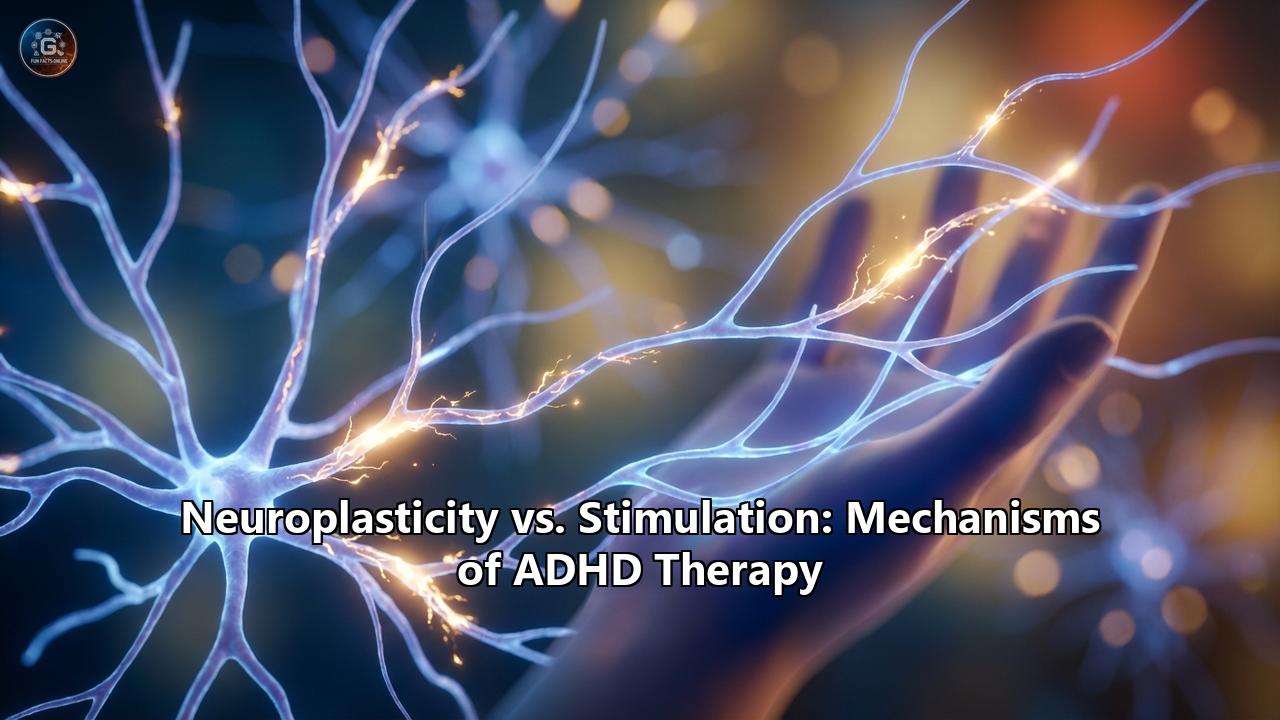
But modern neuroscience has popped the hood and revealed a far more complex engine. We now know that ADHD isn’t just a chemical deficit; it is a network disorder. It is a condition of connectivity, where the brain’s electrical highways—particularly those linking the impulse-control centers of the prefrontal cortex to the rest of the brain—are under-developed or inefficiently wired.
This realization has sparked a therapeutic civil war of sorts. On one side, we have the established titan: Chemical Stimulation (medication). On the other, a rising challenger: Electrical and Neuroplastic Therapies (TMS, tDCS, neurofeedback).
The question is no longer just "how do we treat symptoms?" It is "how do we change the brain?" To answer this, we must dive deep into the mechanisms of Neuroplasticity vs. Stimulation.
The Chemical Architect: How Medication Mimics Plasticity
To understand the new frontier, we must first respect the old guard. Stimulant medications are often misunderstood as merely "speeding up" a slow brain. In reality, their mechanism is far more elegant.
The "Noise" Filter
In an ADHD brain, neurons often fire with too much "background noise." Signals get lost in the static. Medications like methylphenidate (Ritalin) and amphetamines (Adderall) work by blocking the transporters that vacuum up dopamine and norepinephrine. This floods the synaptic cleft (the gap between neurons) with neurotransmitters.
Think of this not as adding fuel, but as turning up the signal strength on a radio. Suddenly, the message "focus on this spreadsheet" becomes louder than the static of "look at that bird outside."
The Neuroprotective Surprise
Critics often label medication as a "band-aid"—effective only as long as it is in your system. While true that the acute effects wear off in hours, recent research suggests a deeper, more permanent benefit.
Long-term studies indicate that stimulant medication may offer neuroprotective effects. By normalizing the chemical environment of the brain, medication allows networks to fire in a synchronized, rhythmic way. In neuroscience, "neurons that fire together, wire together" (Hebbian Learning). By artificially holding the brain in a focused state, medication may inadvertently help the brain practice being focused, potentially preserving grey matter volume in the prefrontal cortex that would otherwise atrophy from disuse.
However, medication is largely passive. It creates the conditions for focus, but it doesn't necessarily teach the brain how to focus without chemical assistance.
The Electrical Engineer: Non-Invasive Brain Stimulation (NIBS)
Enter the challengers: Transcranial Magnetic Stimulation (TMS) and Transcranial Direct Current Stimulation (tDCS). These therapies don't add chemicals to the system; they speak the brain's native language—electricity.
TMS: The Magnetic Mallet
Transcranial Magnetic Stimulation (TMS) uses a magnetic coil placed against the scalp to deliver magnetic pulses through the skull. These pulses induce small electrical currents in specific parts of the brain, typically the Dorsolateral Prefrontal Cortex (DLPFC)—the CEO of the brain responsible for planning and inhibition.
- Mechanism: TMS works through Long-Term Potentiation (LTP). High-frequency pulses (usually 10Hz or higher) excite the neurons, forcing them to fire repeatedly. This bombardment signals the brain that this pathway is important, triggering the release of Brain-Derived Neurotrophic Factor (BDNF).
- The Result: BDNF acts like fertilizer for the brain. It encourages the growth of new dendritic spines (connections between neurons), physically strengthening the "focus circuit."
tDCS: The Gentle Nudge
While TMS forces neurons to fire, Transcranial Direct Current Stimulation (tDCS) is more subtle. It applies a very weak, constant electrical current (usually 1-2 mA) to the scalp.
- Mechanism: tDCS doesn't cause firing; it changes the threshold for firing.
Anodal Stimulation (+): Lowers the threshold, making neurons more likely to fire when you try to focus.
Cathodal Stimulation (-): Raises the threshold, quieting down hyperactive areas.
- The "State-Dependent" Key: Because tDCS only "primes" the neurons, it is most effective when combined with active cognitive training. If you do a working memory task while receiving anodal tDCS, you are essentially effectively digging a deeper neurological groove than you would with the task alone.
The Showdown: "State" vs. "Trait" Changes
The core difference between these therapies lies in their goal: are we changing the state of the brain, or the traits of the brain?
The "State" Change (Medication)
Medication provides an immediate, powerful state change. A study comparing a single dose of methylphenidate against a single session of tDCS found that medication won by a landslide for immediate symptom relief. It instantly corrects the neurochemical deficit. However, when the drug leaves the system, the state reverts. It is like wearing glasses; you see perfectly while they are on, but your eyes haven't actually improved.
The "Trait" Change (Neuroplasticity)
Stimulation therapies play the long game. A single session of TMS or tDCS does very little. But over 20 to 30 sessions, the goal is to induce structural plasticity. By repeatedly forcing the "focus network" to activate, these therapies aim to physically thicken the neural connections.
This is akin to physical therapy. You don't go to the gym once and expect to be strong. You go repeatedly to tear down muscle fibers so they rebuild stronger. Stimulation therapies attempt to "build muscle" in the executive control centers of the brain. If successful, the benefits should persist long after the treatment stops—a true "rewiring."
The Third Way: Endogenous Neuroplasticity
We cannot ignore the most powerful neuroplastic tool available: the body itself. Research into "lifestyle neuroplasticity" is revealing mechanisms that rival clinical interventions.
The Irisin-BDNF Connection
New studies have highlighted a molecule called irisin, released by muscles during high-intensity exercise. Irisin crosses the blood-brain barrier and triggers the release of BDNF. This explains why exercise is often cited as a critical component of ADHD management. It isn't just about "burning off energy"; it is about chemically priming the brain for plasticity.
Neurofeedback: The Mirror
Neurofeedback is a distinct category that bridges the gap. It uses a brain-computer interface to show the patient their own brainwaves in real-time (e.g., a movie plays only when you suppress your "daydreaming" theta waves and boost your "focus" beta waves).
- Mechanism: Operant Conditioning.
- The Promise: Unlike passive medication or external electrical stimulation, neurofeedback forces the patient to learn how to self-regulate. It trains the driver, not just the car.
The Future: Combinatorial Psychiatry
The binary choice of "pills vs. pulses" is rapidly becoming obsolete. The future of ADHD therapy is combinatorial.
Imagine a protocol where a patient:
- Takes a low dose of a stimulant to normalize the chemical environment (lowering the "noise").
- Undergoes tDCS stimulation to "prime" the prefrontal cortex (sensitizing the neurons).
- Engages in computerized cognitive training during the stimulation (firing the specific circuits).
This "Swiss Army Knife" approach leverages the strengths of all mechanisms: the immediate clarity of chemistry, the priming capability of electricity, and the specificity of learning.
Conclusion: From Maintenance to Mastery
For the millions living with ADHD, the landscape of hope is expanding. We are moving away from a model of mere maintenance—keeping symptoms at bay day by day—toward a model of mastery and modification.
Whether through the precise magnetic pulses of TMS, the gentle current of tDCS, or the targeted chemistry of modern pharmaceuticals, the goal remains the same: to harness the brain's incredible ability to change itself. We are no longer just filling the tank; we are rebuilding the engine, one synapse at a time.
Reference:
- https://www.talkiatry.com/blog/stimulant-vs-nonstimulant-adhd-meds
- https://pmc.ncbi.nlm.nih.gov/articles/PMC11743978/
- https://pmc.ncbi.nlm.nih.gov/articles/PMC10970838/
- https://www.frontiersin.org/journals/molecular-neuroscience/articles/10.3389/fnmol.2022.997054/full
- https://en.wikipedia.org/wiki/Neurofeedback