
Introduction: A Shadow in the Land of Giants
One hundred and fifty million years ago, the sun set over a landscape that defies modern imagination. The ground shook with the rhythmic, thunderous footsteps of Diplodocus and Brachiosaurus, titans that stripped the canopy of ancient conifers. In the ferns below, the plated Stegosaurus swung its thagomizer in defense, while the terrifying roar of an Allosaurus echoed off the distant canyon walls. This was the Morrison Formation of the Late Jurassic, the "Serengeti of the Mesozoic," a world famous for its monsters.
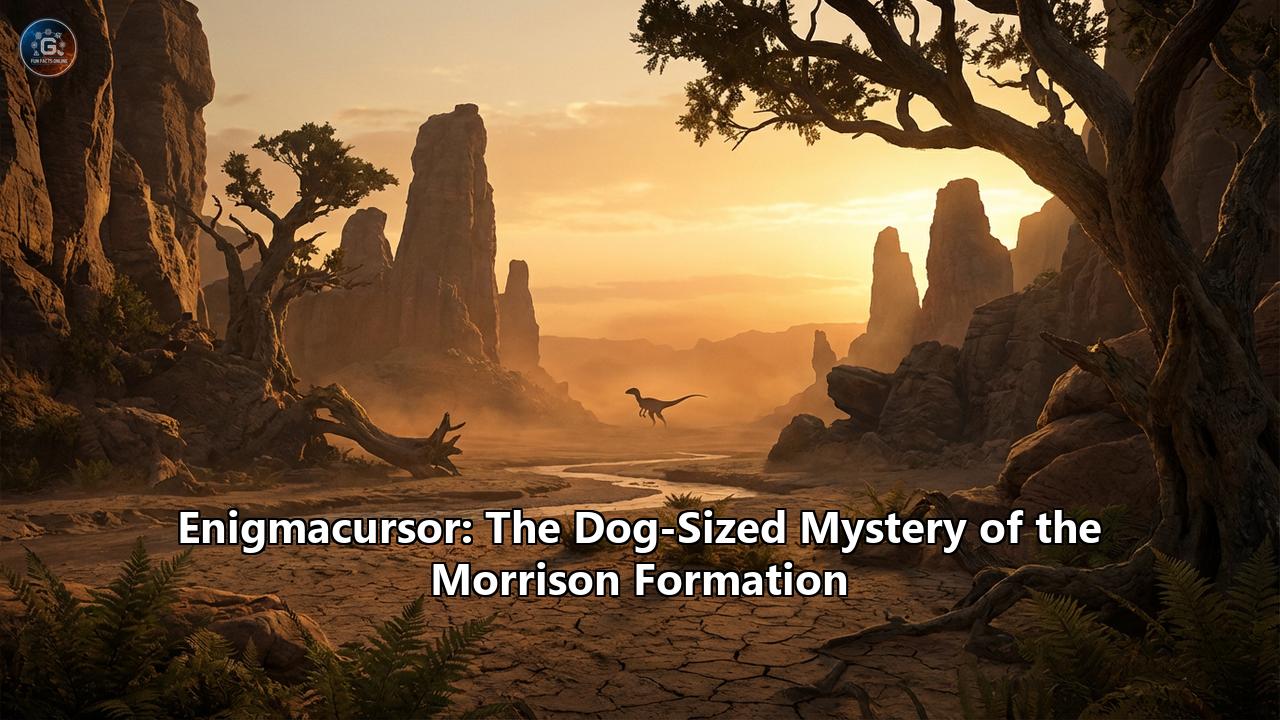
But look closer. darting between the pillar-like legs of a sauropod, a small, agile shape blurs past. It is no larger than a Labrador retriever, feathered in the dappled light of the floodplain, its large eyes scanning for danger. It pauses only for a heartbeat to nip at a cycad before vanishing into the undergrowth. For over a century, this creature was a ghost to science—a phantom hidden in the rock, misidentified, and overshadowed by the giants it lived alongside.
This is Enigmacursor, the "Dog-Sized Mystery" that has finally stepped out of the shadows.
In June 2025, paleontologists unveiled this remarkable new species, Enigmacursor mollyborthwickae, ending a 150-year-old cold case that had baffled scientists since the days of the Bone Wars. Its discovery does not just add a new name to the dinosaur roster; it fundamentally rewrites our understanding of the Jurassic ecosystem, proving that the world of giants was built on the backs of the small, the swift, and the unseen.
Part I: The Discovery – From Colorado Quarry to London Hall
The story of Enigmacursor begins not in a university lab, but in the dusty, sun-baked quarries of Moffat County, Colorado. The Morrison Formation is a vast geologic sequence stretching across the western United States, a graveyard of the Jurassic period that has yielded the most iconic dinosaurs in history.
In 2021, commercial paleontologists from "Dinosaurs of America, LLC" were excavating a site on private land. They were likely hoping for the usual prizes: the femur of a long-neck or the serrated tooth of a theropod. Instead, they found something delicate. Encased in the hardened mudstone was a partial skeleton of a small animal. It was a three-dimensionally preserved marvel—not flattened like roadkill as so many small fossils are, but retaining the volume and shape of the living creature.
The Case of Mistaken Identity
Initially, the fossil was put up for sale and advertised as Nanosaurus, a catch-all name often slapped on any small, herbivorous dinosaur found in the region. For decades, Nanosaurus had been a "wastebasket taxon"—a scientific dumping ground for small bones that didn't fit anywhere else. The dealers, following conventional wisdom, assumed this was just another specimen of that poorly understood genus.
The skeleton eventually caught the eye of the David Aaron art gallery in London, which then contacted experts at the Natural History Museum (NHM), London. Professor Susannah Maidment and Professor Paul Barrett, two of the world’s leading dinosaur experts, arrived to inspect the specimen.
What they saw stopped them in their tracks. The preservation was exquisite, far superior to the fragmentary scraps that defined Nanosaurus. As they looked closer at the femur and the vertebrae, they realized the anatomy didn't match. The muscle attachments were different. The proportions were wrong. This wasn't Nanosaurus. This was something entirely new.
Thanks to a generous donation from Molly Borthwick and her husband David, the museum acquired the specimen, saving it from disappearing into a private living room. In 2024, it arrived in London, and the real detective work began.
Part II: Anatomy of an Enigma
What exactly is Enigmacursor? The name itself is a clue. Enigma refers to the puzzling history of small Morrison dinosaurs, and cursor is Latin for "runner."
The "Dog-Sized" Dinosaur
When we think of dinosaurs, we think big. But Enigmacursor challenges that bias.
- Length: Approximately 1 meter (3.3 feet) from nose to tail.
- Height: About 50-60 centimeters (2 feet) at the hip.
- Build: Gracile and lightweight, roughly the size of a Collie or a Labrador, but much lighter in mass.
It was a neornithischian, a group of bird-hipped dinosaurs that includes the ancestors of the famous duck-billed hadrosaurs and the horned ceratopsians. However, Enigmacursor was a basal member of this lineage, lacking the elaborate frills or duck bills of its distant descendants.
Built for Speed
The skeletal analysis published in Royal Society Open Science reveals an animal built for survival in a hostile world. Its most defining feature is its legs. The hind limbs are elongated, particularly the lower leg bones, which is a classic adaptation for cursoriality (running).
In a world populated by Allosaurus (a 30-foot killing machine) and Ceratosaurus (a horned predator with blade-like teeth), Enigmacursor had only one defense: don't be there when the predator arrives. It would have been a nervous, twitchy animal, capable of explosive bursts of speed to dart into the dense fern prairies or vanish into the "gallery forests" lining the riverbanks.
The Juvenile Question
One of the most fascinating details found by Maidment and Barrett was in the spine. The neural arches—the top parts of the vertebrae that protect the spinal cord—were not fully fused to the centra (the body of the vertebrae). In modern reptiles and birds, this fusion happens as the animal matures. The lack of fusion suggests that the type specimen of Enigmacursor was not fully grown. It was likely a sub-adult, a "teenager" in dinosaur terms. This raises tantalizing questions: How big did adults get? Was this animal near its maximum size, or just hitting a growth spurt?
Part III: The "Nanosaurus" Problem – Solving a 150-Year-Old Puzzle
To understand why Enigmacursor is such a breakthrough, we must look back at the chaotic history of American paleontology.
The Bone Wars
In the late 19th century, two rival paleontologists, O.C. Marsh and E.D. Cope, waged a bitter feud known as the Bone Wars. They raced to name as many species as possible, often rushing descriptions based on fragmentary, inadequate fossils.
In 1877, Marsh named a small dinosaur Nanosaurus agilis based on a few scraps of bone found in Colorado. Over the next century, other small fossils were found and given different names: Othnielia, Drinker, Othnielosaurus.
Paleontologists spent decades arguing over these names. Were they all the same animal? Were they different genders of the same species? The fossils were mostly impressions in rock or shattered fragments, making comparison nearly impossible. The group became a taxonomic mess, a "black hole" of information.
*The Clarity of Enigmacursor---
The discovery of Enigmacursor provided the "Rosetta Stone" needed to decode this mess. Because the new specimen was preserved in three dimensions (not flattened), Maidment and Barrett could see the true shape of the bones.
They compared Enigmacursor to the original Nanosaurus fossils and realized they were distinct. More importantly, they concluded that the original Nanosaurus fossils were so poor that they were effectively useless for diagnosis—what scientists call nomen dubium (doubtful name).
Enigmacursor allows science to wipe the slate clean. It proves that there wasn't just one generic "small dinosaur" roaming the Jurassic. There was a diversity of them. It suggests that if we look closer at the "wastebasket" fossils in museums around the world, we might find even more distinct species hiding in plain sight.Part IV: The World of the Morrison Formation
To truly appreciate Enigmacursor, we must place it in its home. The Morrison Formation is often depicted as a lush jungle, but the reality was far more complex and harsh.
The Environment: A Jurassic Savanna
150 million years ago, western North America was a semi-arid basin. There were no flowering plants—no grass, no oaks, no roses. The ground was covered in ferns, cycads, and horsetails. Towering conifers (araucaria and pines) and ginkgo trees formed the canopy.
The climate was highly seasonal, with a wet season that brought monsoons and flooding rivers, followed by a brutal dry season. It was a landscape of extremes. Enigmacursor would have lived on the floodplains, navigating the open "fern savannas" and the denser forests near the waterways.
The Neighbors
Enigmacursor lived in the shadow of the most famous cast of characters in fossil history:- The Sauropods: Diplodocus, Apatosaurus, Camarasaurus, Brachiosaurus. These animals weighed as much as 50 to 80 tons. To Enigmacursor, they would have been like moving mountains, their footsteps capable of crushing the small runner instantly.
- The Armor-Bearers: Stegosaurus, with its dorsal plates and spiked tail, was a common sight.
- The Predators:
Allosaurus: The "lion" of the Jurassic, the apex predator.
Torvosaurus: A rarer, bulkier brute.
Ceratosaurus: A horned predator that likely prowled the waterways.
Ornitholestes: A smaller theropod, perhaps the most direct threat to a juvenile Enigmacursor.
Niche Partitioning
How did so many herbivores coexist? The giants, like Brachiosaurus, browsed the high tree tops. Diplodocus likely swept its neck low to clear vast swathes of ferns. Stegosaurus browsed mid-level bushes.
Enigmacursor occupied the "micro-niche." It was a selective browser, using its small beak and cheek teeth to nip at high-quality, low-growing vegetation that the giants trampled or ignored. It likely ate young fern fronds, cycad seeds, and perhaps insects or small invertebrates to supplement its diet (common in small ornithischians). It was the rabbit or the gazelle of its time—abundant, quick, and essential to the food web.Part V: Why Small Dinosaurs Matter
The media loves a T. rex or a Titanosaur. Museums build their halls around the biggest skeletons. But this "megafauna bias" skews our view of history.
In modern ecosystems, small animals vastly outnumber large ones. For every elephant, there are thousands of antelopes, rabbits, and rodents. The Jurassic should have been no different, yet our fossil record is dominated by giants.
The Taphonomic Bias
The reason for this is taphonomy—the science of how fossils form.
- Fragility: The bones of an animal like Enigmacursor are hollow and thin-walled. They snap easily and decompose quickly. The massive femur of a Brachiosaurus is virtually indestructible by comparison.
- Scavenging: A dead Enigmacursor is a bite-sized snack for a scavenger. A dead sauropod is a buffet that lasts for weeks, increasing the chance that bones get buried before they are destroyed.
- Hydrodynamics: In a flood (which formed much of the Morrison rock), small light bones are washed away, while heavy bones sink and are buried.
Professor Maidment noted during the reveal: "Smaller dinosaurs are often left behind, meaning there are probably many still in the ground. Enigmacursor shows that there's still plenty to discover in even this well-studied region."
Part VI: The Scientific Impact and Future Research
The publication of Enigmacursor mollyborthwickae is just the beginning.
phylogenetic ripples
The analysis placed Enigmacursor as a close relative of Yandusaurus, a small dinosaur from China. This suggests a pan-Laurasian distribution of these small runners. It implies that before the continents drifted too far apart, these small herbivores were migrating between what is now Asia and North America. It helps map the "superhighway" of dinosaur evolution in the Jurassic.
Growth Studies
Because the specimen is a juvenile, it offers a reference point for studying dinosaur growth rates (histology). By slicing a thin section of bone (if permitted in the future), scientists could count "growth rings" like a tree to see exactly how old this "teenager" was and how fast it was growing compared to its giant neighbors.
A Call to Action
This discovery is a wake-up call for commercial and academic paleontologists. It encourages field crews to stop ignoring the "small stuff." In the past, small, unrecognizable bones might have been discarded as "rubble" in the hunt for a Diplodocus skull. Now, every fragment is a potential new species.
Conclusion: The Little Runner That Could
For 150 million years, the bones of Enigmacursor lay in the dark, waiting. Above it, the world changed. The Jurassic gave way to the Cretaceous; the asteroid struck; mammals rose; and eventually, humans arrived to dig in the dirt.
The "Dog-Sized Mystery of the Morrison Formation" is no longer a mystery—it is a window. It invites us to look past the towering skeletons of the museum halls and focus on the shadows near the floor. It reminds us that the history of life is not just written by the victors or the giants, but by the small, the scrappy, and the swift.
Enigmacursor mollyborthwickae may have been small, but its legacy is enormous. It has cleaned up a century of scientific mess, linked continents, and breathed new life into the study of the Jurassic. The next time you picture the Morrison Formation, don't just see the earth-shaking Brachiosaurus. Picture the little Enigmacursor, darting through the ferns, a tiny, beating heart in a land of monsters.Quick Facts: Enigmacursor mollyborthwickae
- Name Meaning: "Molly Borthwick's Mysterious Runner"
- Period: Late Jurassic (approx. 150-145 million years ago)
- Location: Morrison Formation, Colorado, USA
- Classification: Ornithischia -> Neornithischia
- Diet: Herbivore (low browser)
- Size: ~1 meter long, ~5-10 kg weight (estimated)
- Key Feature: Elongated lower legs for high-speed running.
- Display: Natural History Museum, London (Earth Hall Mezzanine).
Reference:
- https://secretldn.com/new-dinosaur-enigmacursor-natural-history-museum-london/
- https://scitechdaily.com/paleontologists-unearth-new-species-of-mystery-dinosaur/
- https://en.wikipedia.org/wiki/Enigmacursor
- https://www.sci.news/paleontology/enigmacursor-mollyborthwickae-14021.html
- https://www.ctvnews.ca/sci-tech/article/new-dog-sized-dinosaur-species-discovered/
- https://www.nhm.ac.uk/discover/dino-directory/enigmacursor.html
- https://www.smithsonianmag.com/smart-news/enigmatic-dog-sized-dinosaur-reveals-a-new-species-that-scampered-around-jurassic-north-america-180986895/
- https://www.livescience.com/animals/dinosaurs/enigmatic-runner-dinosaur-from-colorado-helps-rewrite-understanding-of-several-jurassic-species
- https://thedinosaurs.org/dinosaurs/enigmacursor
- https://www.independent.co.uk/news/uk/home-news/dinosaur-natural-history-museum-enigmacursor-b2776485.html
- https://www.sciencing.com/1930610/new-fast-dinosaur-species-discovered-enigmacursor-mollyborthwickae-what-it-ate-herbivore/
- https://pubmed.ncbi.nlm.nih.gov/40568542/