
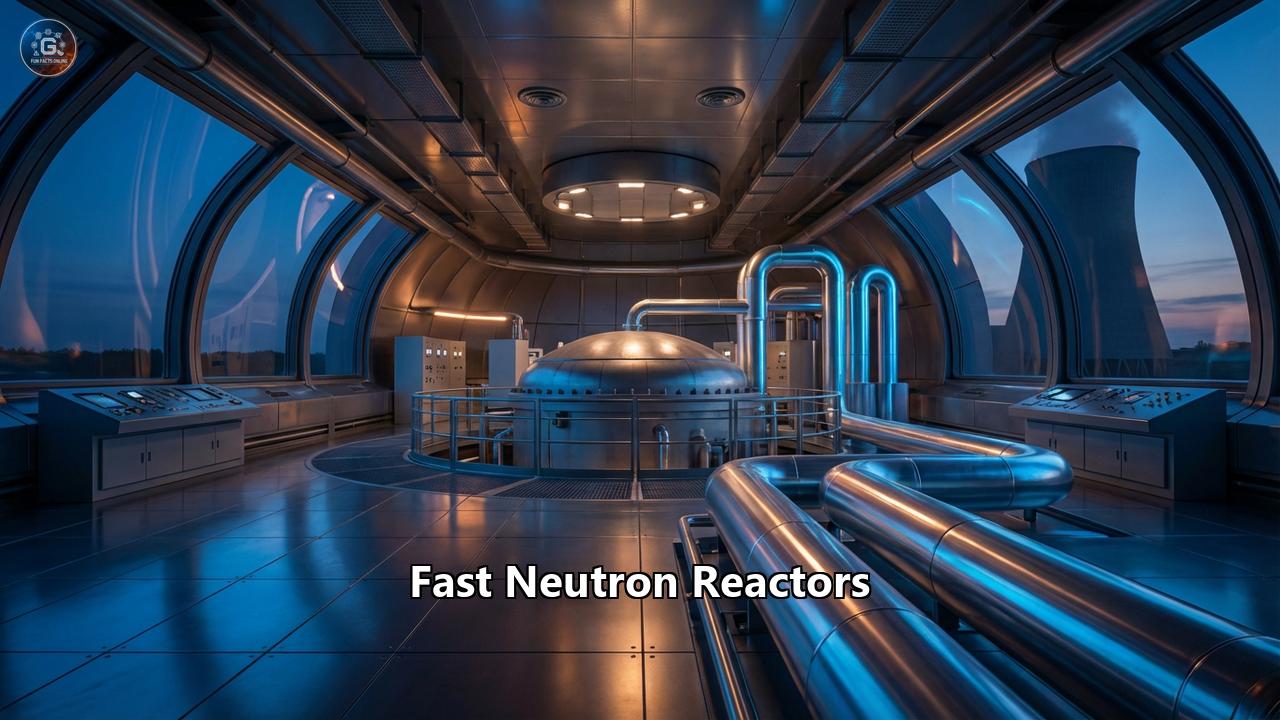
Part I: The Promise of Infinite Fire
In the vast, complex, and often contentious world of nuclear energy, there exists a machine that borders on magic. To the uninitiated, it sounds like a violation of the laws of thermodynamics: a power plant that produces more fuel than it consumes. It is the Fast Neutron Reactor (FNR), sometimes known as the "breeder" reactor. For seventy years, it has stood as the holy grail of nuclear engineering—a technology capable of turning nuclear waste into millennia of clean energy, ending the scarcity of uranium, and closing the fuel cycle forever.
Yet, despite this Promethean promise, the fast reactor remains a rare beast. Of the hundreds of nuclear power plants humming across the globe today, the vast majority are "thermal" reactors, burning only a tiny fraction of the energy locked inside uranium atoms. The fast reactor, by contrast, unlocks it all. It is a machine of extremes: it runs hotter, faster, and more intensely than its commercial cousins. It demands coolants that burn on contact with air or freeze into solid blocks of lead. It requires a mastery of physics and materials science that pushes the very boundaries of human capability.
To understand why nations are currently racing to build these machines—from the high deserts of Wyoming to the steppes of Russia and the coastlines of China—we must first descend into the atomic scale. We must understand the neutron.
The Neutron Spectrum: Thermal vs. Fast
The fundamental difference between a standard nuclear reactor (like the Pressurized Water Reactor, or PWR) and a Fast Neutron Reactor lies in the speed of the neutron.
When a uranium-235 atom splits (fissions), it ejects two or three neutrons. These neutrons are born "fast," traveling at speeds of around 14,000 kilometers per second, possessing kinetic energies in the range of 1 to 2 Mega-electron Volts (MeV). In a standard reactor, these speed demons are a problem. Uranium-235, the fissile isotope that powers most reactors, is terrible at catching fast neutrons. It is much more likely to split if the neutron is moving slowly—about 2.2 kilometers per second, or the speed of a comfortable walk for a gas molecule.
To slow these neutrons down, standard reactors use a "moderator," typically water or graphite. The neutrons bounce off the hydrogen atoms in the water, losing kinetic energy with each collision until they reach "thermal" equilibrium with the surrounding environment. Hence, "thermal reactors."
Fast reactors discard the moderator entirely. They keep the neutrons flying at their birth speeds. This decision changes everything.
The Probability Game: Cross-SectionsIn nuclear physics, the likelihood of a neutron interacting with a nucleus is called the "cross-section," measured in "barns" (as in, "hitting the broad side of a barn").
- In a Thermal Spectrum: The fission cross-section of U-235 is massive (hundreds of barns). It’s easy to split the atom.
- In a Fast Spectrum: The fission cross-section drops precipitously (to around 1 or 2 barns). It is much harder to split the atom.
To compensate for this low probability, fast reactors must be far denser. They require fuel enriched to 20% or more (compared to 3-5% in thermal reactors) and a core packed tightly with fissile material to ensure the neutrons hit something before escaping.
The Breeding MiracleWhy go through this trouble? The answer lies in the "fertile" isotope, Uranium-238. U-238 makes up 99.3% of natural uranium, but in thermal reactors, it is largely useless "trash" that eventually becomes nuclear waste.
In a fast neutron flux, however, U-238 behaves differently. When a fast neutron strikes U-238, it is often captured. The U-238 absorbs the neutron to become U-239, which quickly decays into Neptunium-239, and then into Plutonium-239.
Plutonium-239 is a distinct fissile fuel. In a properly designed fast reactor, for every U-235 or Pu-239 atom you destroy, you can convert more than one U-238 atom into new Plutonium-239. You are literally breeding fuel. This means a fast reactor can utilize nearly 100% of the energy in natural uranium, compared to the less than 1% utilization of thermal reactors.
This physics dictates the potential: A country with a fleet of fast reactors and a stockpile of depleted uranium (the waste tailing from enrichment plants) has achieved total energy independence for centuries.
Part II: Engineering the Beast
If the physics of fast reactors is elegant, the engineering is brutal. Because you cannot use water (which slows neutrons down), you need a coolant that does not moderate neutrons but still removes massive amounts of heat from a very small, power-dense core.
The Liquid Metal Choice
The solution has almost universally been liquid metal. It has excellent thermal conductivity and doesn't slow neutrons significantly. But which metal?
1. Sodium (The King of Coolants)Sodium is the standard bearer. It melts at 98°C (208°F) and boils at 883°C (1621°F).
- Pros: It stays liquid at atmospheric pressure. Unlike a PWR, which operates at 150 atmospheres of pressure (a massive explosion hazard), a sodium reactor vessel is not under high pressure. If you poke a hole in it, the coolant leaks out; it doesn't explode out. Sodium also conducts heat so well that the reactor can survive a pump failure just by natural convection.
- Cons: Sodium has a fiery temper. It burns spontaneously if it touches air and explodes violently if it touches water. This necessitates an "intermediate loop." You cannot send radioactive sodium directly to a steam generator (where water exists). You need a primary sodium loop (radioactive) heating a secondary sodium loop (non-radioactive), which then boils the water. This adds complexity and cost.
Favored by the Soviets for their "Alpha" class hunter-killer submarines.
- Pros: Lead is chemically inert. It doesn't burn. It also shields radiation superbly.
- Cons: It is incredibly heavy, requiring massive seismic supports. Worse, Lead-Bismuth melts at 123°C, but pure lead melts at 327°C. If the reactor cools down too much, the coolant freezes solid, turning the reactor into a useless multi-billion dollar paperweight. This happened to several Soviet submarines. Lead is also highly corrosive to steel at high temperatures, eating the reactor from the inside out unless specific oxygen controls are maintained.
The new contender. Chloride salts allow for a fast spectrum.
- Pros: Can operate at extremely high temperatures (700°C+), good for industrial heat. Fuel can be dissolved in the salt, eliminating fuel fabrication costs.
- Cons: Chemistry control is a nightmare. The salts are corrosive, and the fluid dynamics of a liquid fuel core are complex.
The Heart of the Machine: Fuel and Cladding
In a thermal reactor, fuel rods sit in the core for 3 to 4 years. In a fast reactor, the neutron flux is so intense—10 to 100 times higher—that it wreaks havoc on materials.
We measure radiation damage in "Displacements Per Atom" (dpa). In a standard reactor, the steel cladding might suffer 30-50 dpa over its life. In a fast reactor, it must withstand 150-200 dpa. Every atom in the steel structure is knocked out of its lattice position hundreds of times. This causes the steel to swell, become brittle, and warp. Developing "ferritic-martensitic" steels that can survive this atomic pummelling has been a 50-year struggle in materials science.
Part III: A History of Dreams and Disasters
The history of fast reactors is a dramatic saga of high hopes, crushing failures, and stubborn perseverance.
The Dawn: Clementine and EBR-I
The very first electricity ever generated by nuclear power came from a fast reactor. On December 20, 1951, in the Idaho desert, the Experimental Breeder Reactor-I (EBR-I) lit up four light bulbs. The pioneers—Walter Zinn and his team—chose fast reactors first because uranium was thought to be scarce. If they couldn't breed fuel, they believed the nuclear age would be over in a few decades.
Before EBR-I, there was Clementine at Los Alamos (1946), a tiny mercury-cooled fast reactor. It was the first to use plutonium fuel and the first to demonstrate the harsh reality of liquid metal: it failed due to cladding rupture and coolant corrosion.
The Meltdown Myth: Fermi 1
In the 1960s, a consortium of utilities built the Enrico Fermi Nuclear Generating Station near Detroit. It was a commercial prototype sodium-cooled breeder. In 1966, a piece of zirconium flow-guide (an add-on not even in the original design) broke loose and blocked the flow of sodium coolant to two fuel subassemblies. The fuel melted.
This incident was immortalized in the sensationalist book "We Almost Lost Detroit." In reality, the containment held, no one was injured, and the safety systems worked. However, it spooked the industry. Fermi 1 was repaired but eventually shut down, a victim of economics and public fear.
The French Crusade: Rapsodie, Phénix, and Superphénix
France, lacking oil and uranium, bet the farm on nuclear. They successfully operated Rapsodie and Phénix (a highly successful 250 MWe prototype). Emboldened, they built the leviathan: Superphénix.
Superphénix (1200 MWe) was the largest fast reactor ever built. It was a technological marvel and a political disaster.
- The Rocket Attack: In 1982, eco-terrorist Chaïm Nissim fired RPG-7 rocket grenades at the unfinished plant. The damage was superficial, but the symbolism was potent.
- The Sodium Leaks: The plant suffered from sodium leaks in its fuel storage drum (not the reactor itself) due to a steel grade error.
- The End: Despite solving its technical issues and reaching 90% availability by 1996, it was sacrificed on the altar of politics. The Jospin government shut it down in 1997 to appease Green coalition partners. It was a multi-billion dollar asset scrapped just as it began to work.
Japan’s Monju: The 20-Year Shutdown
Japan, also resource-poor, built Monju. In 1995, a thermometer probe broke due to vibration, causing a sodium leak. The sodium reacted with air and filled a room with caustic smoke. The leak was minor, but the operator (PNC) tried to cover up the extent of the damage, editing surveillance video. The scandal destroyed public trust. Monju sat idle for 20 years, consuming billions in maintenance, before being decommissioned without ever generating significant power.
The American Pivot: The IFR
While the world struggled with big commercial units, Argonne National Laboratory quietly perfected the technology with EBR-II. They developed "Integral Fast Reactor" (IFR) technology: metal fuel (uranium-zirconium alloy) rather than oxide fuel, and "pyroprocessing" (recycling fuel onsite using electro-refining).
In 1986, just months before Chernobyl, they ran a landmark safety test on EBR-II. They turned off the coolant pumps at full power and disabled the scram (shutdown) system. In a normal reactor, this is the apocalypse. In EBR-II, the reactor simply got hot, the fuel expanded, the neutron leakage increased, and the chain reaction shut itself down. The reactor saved itself.
Despite this triumph, the Clinton administration cancelled the IFR program in 1994, citing budget cuts and anti-proliferation concerns. It was a devastating blow to US nuclear capability that the country is only now trying to reverse.
Part IV: The Russian Fortress
While the West retreated, Russia pressed on. They viewed fast reactors not just as an experiment, but as a strategic necessity.
The BN Series- BN-600 (Beloyarsk): Operating since 1980. It is the workhorse of the fast reactor world. It has run reliably for over 40 years, proving that sodium handling can be mastered on an industrial scale.
- BN-800: Came online in 2016. It is currently the only large fast reactor in the world effectively burning MOX (Mixed Oxide) fuel derived from weapons-grade plutonium and reactor waste. It is the testbed for the closed fuel cycle.
Russia is currently building the BREST-OD-300 in Seversk. This is a Lead-Cooled Fast Reactor (LFR). It uses nitride fuel (denser than oxide) and an integral design where the steam generators are inside the reactor vessel. The goal is to eliminate the possibility of a "loss of coolant" accident entirely. As of early 2026, massive components have been installed, with operations targeted for the end of the decade.
Part V: The Renaissance (2020-2026)
We are currently living through a Fast Reactor Renaissance. The drivers are clear: the demand for carbon-free baseload power, the issue of nuclear waste storage, and geopolitical energy security.
1. USA: The TerraPower Natrium
Bill Gates’ company, TerraPower, realized that the complexity of previous fast reactors was their downfall. Their design, Natrium, decouples the nuclear island from the power island.
- The Battery Concept: The reactor runs at 100% power, heating a massive tank of molten salt (thermal storage). When the grid needs power (e.g., when the sun goes down), the salt tank drives the turbines. It can ramp up from 345 MWe to 500 MWe for hours.
- Status (2026): Construction is well underway in Kemmerer, Wyoming, at the site of a retiring coal plant. The non-nuclear structures are rising. The NRC review has been expedited, and the project is the flagship of the US attempt to reclaim nuclear leadership.
2. China: The Sprint (CFR-600)
China is moving with characteristic speed. The CFR-600 (China Fast Reactor) in Fujian is a sodium-cooled demonstration unit.
- Status: Unit 1 began low-power operations in mid-2023. Unit 2 is nearing completion as of 2026.
- The Strategy: China intends to move to the CFR-1000 (commercial scale) by 2030. They are scaling up reprocessing facilities to feed these beasts with plutonium separated from their thermal reactor fleet. The Pentagon has watched this closely, concerned about the potential for weapons-grade plutonium production, though China insists the purpose is civilian energy security.
3. India: The Thorium Dream (PFBR)
India has a unique three-stage nuclear program. They have limited uranium but massive thorium reserves.
- Stage 1: Pressurized Heavy Water Reactors (using natural uranium).
- Stage 2: Fast Breeder Reactors (using plutonium from Stage 1).
- Stage 3: Thorium Reactors (using U-233 bred in Stage 2).
The Prototype Fast Breeder Reactor (PFBR) at Kalpakkam has been "almost ready" for 15 years. However, as of 2026, reports indicate it is finally on the verge of commercial operation. India’s mastery of this technology is the bottleneck for unlocking their vast thorium wealth.
4. Moltex: The Stable Salt Solution
In Canada, Moltex Energy is developing the SSR-W (Stable Salt Reactor - Wasteburner). Unlike traditional Molten Salt Reactors (MSRs) where the radioactive fuel is pumped around pipes (a maintenance headache), the Moltex fuel sits in static tubes, like a normal reactor, but the fuel inside is liquid salt.
- The WATSS Process: They have validated a simplified recycling method to turn CANDU waste into SSR fuel. This promises to reduce Canada's nuclear waste stockpile significantly.
Part VI: The Fuel Cycle and The Waste Solution
The most compelling argument for FNRs is the "Closed Fuel Cycle."
In a standard "Open Cycle" (used by the US currently), fuel is used once. About 95% of the potential energy remains in the "waste," which remains radiotoxic for 300,000 years due to "minor actinides" (Americium, Curium, Neptunium).
In a "Closed Cycle" with Fast Reactors:
- Reprocessing: You chemically separate the uranium and plutonium from the fission products.
- Transmutation: You put the nasty long-lived actinides (Americium, etc.) into the Fast Reactor.
- The Burn: The high-energy neutrons split these actinides, turning them into short-lived fission products (Cesium, Strontium) that are radioactive for only 300 years.
Part VII: Technical Deep Dive – The Sodium Fire
To truly appreciate the FNR, one must respect the sodium.
Liquid sodium is a beautiful coolant. It looks like liquid mercury but flows like water. However, its affinity for oxygen is ferocious.
When sodium burns in air, it forms thick, white, caustic smoke (Sodium Oxide). If it sprays, it creates a "spray fire," which is highly destructive. If it pools, it creates a "pool fire," which cooks the concrete beneath it.
Engineering Defenses:- Inert Atmosphere: The reactor vessel is topped with Argon gas, not air. All cells containing sodium pipes are filled with Nitrogen or Argon.
- Leak Before Break: Sodium pipes are made of high-quality stainless steel. They are designed to leak small amounts (which are detected by "spark plug" sensors) long before they burst.
- The Intermediate Loop: As mentioned, this isolates the radioactive core from the water steam cycle.
- Passive Decay Heat Removal: Modern designs (like Natrium and PRISM) use air drafts. Even if the pumps die, air flows naturally up a chimney outside the reactor vessel, cooling the sodium through the steel wall. It is walk-away safe.
Part VIII: The Economics and The Future
If Fast Reactors are so superior physically, why aren't they everywhere?
Money.Historically, FNRs cost 30% to 50% more to build than standard Light Water Reactors (LWRs). The intermediate sodium loop requires more pumps, more pipes, and more steel. The fuel, requiring higher enrichment or plutonium handling, is expensive to fabricate.
However, the equation is changing.
- Uranium Volatility: As the world builds more standard reactors, uranium demand rises. If uranium prices spike, the FNR (which needs almost no raw uranium) becomes competitive.
- Waste Costs: If you price in the cost of deep geological repositories for 100,000 years, the FNR (which destroys that waste) gains a massive credit.
- Modular Construction: New designs like Natrium utilize factory construction techniques to drive down capital costs.
The 21st century will likely see a "Two-Tier" nuclear system.
- Tier 1: Fleets of standard LWRs (and Small Modular Reactors) providing the bulk of power.
- Tier 2: A smaller fleet of Fast Reactors acting as the "waste management" and "fuel breeding" hub. They will take the waste from Tier 1, burn it, and generate electricity while closing the cycle.
Conclusion: The Inevitable Machine
The Fast Neutron Reactor is the machine that refuses to die. It was the first to light a bulb, and it may be the last one standing when the uranium mines run dry. It is a technology of harsh environments and unforgiving chemistry, but it offers a reward that no other energy source can match: the ability to power civilization for millennia using nothing but the "waste" we have already dug out of the ground.
As construction cranes swing over Wyoming, Fujian, and Seversk, the alchemist’s dream is once again becoming steel and concrete. The fast neutrons are returning.
Extended Technical Analysis: Coolant Chemistries
To provide a comprehensive understanding, we must detail the specific chemical behaviors that dictate FNR design.
Sodium (Na)
- Melting Point: 97.79°C
- Boiling Point: 882.9°C
- Density: ~0.85 g/cm³ (lighter than water)
- Reactivity: $2Na + 2H_2O \rightarrow 2NaOH + H_2$. This reaction produces hydrogen gas and heat. If the hydrogen mixes with air, it explodes. This is why Sodium-Water Steam Generators are the "Achilles Heel" of SFRs. Modern designs use double-walled tubes with helium leak detection between the walls to ensure water and sodium never meet.
Lead (Pb) and Lead-Bismuth Eutectic (LBE)
- Melting Point: 327.5°C (Pb) / 123.5°C (LBE)
- Boiling Point: 1749°C (Pb)
- Reactivity: Benign with water and air.
- Corrosion: Lead dissolves the protective oxide layer on steel. To prevent this, oxygen sensors and injection systems must keep the dissolved oxygen in the lead at a precise "Goldilocks" level: high enough to form a protective Magnetite ($Fe_3O_4$) layer on the steel, but low enough not to form Lead Oxide ($PbO$) sludge that clogs the coolant channels.
Gas (Helium)
- The GFR (Gas-Cooled Fast Reactor): Uses high-pressure Helium (60-80 bar).
- Pros: Helium is optically transparent (easy to inspect the core), chemically inert, and cannot become radioactive.
- Cons: It has low thermal inertia. If the compressors stop, the core heats up instantly. Safety relies on active backup systems or very complex passive convection loops. This remains the least developed of the Gen IV concepts (e.g., the pure concept ALLEGRO project in Europe).
Specific Reactor Profiles (2026 Snapshot)
TerraPower Natrium (USA)
- Output: 345 MWe (nominal), 500 MWe (peaking with storage).
- Fuel: HALEU (High Assay Low Enriched Uranium) - metallic alloy U-10Zr.
- Differentiation: The "Island" approach. The nuclear island (reactor) is seismic category 1. The turbine island is standard commercial grade. This dramatically lowers the cost of concrete and compliance. The molten nitrate salt storage acts as a buffer, preventing reactor transients from reaching the turbine and vice versa.
BN-800 (Russia)
- Output: 880 MWe.
- Core: Hybrid core. Originally started with uranium, now transitioned to full MOX loading.
- Significance: It proved the "burn" capability. It is effectively destroying weapons-grade plutonium from the Cold War stockpiles under the Plutonium Management and Disposition Agreement (though the agreement itself is politically suspended, the technical burning continues).
PFBR (India)
- Output: 500 MWe.
- Design: Pool-type sodium reactor.
- The Delay: The main vessel was warped during welding years ago. Then, the fuel handling mechanism—an incredibly complex robotic arm operating blindly under opaque sodium—suffered teething issues. The "dummy fuel" loading trials took years longer than expected. Its commissioning is a test of national patience and engineering resilience.
ARC-100 (Canada)
- Concept: A small (100 MWe) sodium reactor based strictly on the EBR-II legacy.
- Strategy: Simplicity. It is designed to be a "nuclear battery" for remote communities or mining operations. It operates for 20 years without refueling. The entire core is then removed and replaced.
The Material Science Frontier: Swelling and Creep
The ultimate limit of a Fast Reactor is the cladding.
When a neutron hits a steel atom, it creates a "frenkel pair" (a hole and an interstitial atom). At high temperatures, these defects migrate. The holes cluster together to form voids.
Void Swelling: Under fast neutron bombardment, standard 316 Stainless Steel can swell by 10% to 20% in volume. Imagine a fuel assembly growing 20% bigger inside a tightly packed core. It would jam and warp, making refueling impossible. The Solution: HT9 Steel and ODS (Oxide Dispersion Strengthened) alloys. These advanced materials have microstructures designed to "trap" the defects before they can form large voids. The development of these steels is the unsung hero of the fast reactor renaissance.Final Thoughts
The Fast Neutron Reactor represents the transition of nuclear power from a "hunter-gatherer" phase (hunting for scarce U-235) to an "agricultural" phase (farming energy from abundant U-238). It is the completion of the nuclear cycle. While the technical and economic hurdles are high, the logic of physics is undeniable. In a world hungry for dense, carbon-free energy, the Fast Reactor is not just an option; it is an inevitability waiting for its moment. That moment, it appears, has finally arrived.
Reference:
- https://srswatch.org/doe-belatedly-admits-in-stiffed-congress-on-plan-for-versatile-test-reactor-vtr-confirming-vtr-is-dead/
- https://www.energyconnects.com/news/utilities/2025/december/gates-backed-nuclear-developer-nears-construction-on-reactor/
- https://news.constructconnect.com/nuclear-regulatory-commission-to-expedite-review-of-terrapower-reactor-project
- https://chemindigest.com/prototype-fast-breeder-reactor-to-be-operative-by-the-end-of-2025/
- https://www.world-nuclear-news.org/articles/turbine-island-installation-work-under-way-at-brest-od-300
- https://rosatomnewsletter.com/rosatom_news/construction-sites-23/
- https://www.nucnet.org/news/over-1-000-tonnes-of-specialised-components-shipped-for-generation-iv-reactor-says-russia-8-2-2025
- https://debuglies.com/2025/09/27/russias-closed-fuel-cycle-nuclear-push-in-2025-technical-status-of-brest-od-300-uranium-market-signals-and-governance-implications/
- https://www.neimagazine.com/analysis/the-brest-fast-reactor/
- https://timesofindia.indiatimes.com/india/first-of-its-kind-prototype-breeder-reactor-to-be-commissioned-by-september-2026/articleshow/120426007.cms
- https://www.nucnet.org/news/design-documentation-for-bn-1200-generation-iv-reactor-to-be-submitted-2025-7-3-2024
- https://en.wikipedia.org/wiki/CFR-600
- https://www.worldnuclearreport.org/Construction-Start-of-Second-Fast-Reactor-in-China.html
- https://fissilematerials.org/blog/2023/12/china_started_operation_o.html
- https://www.pib.gov.in/PressReleasePage.aspx?PRID=2159290®=3&lang=2
- https://www.ans.org/news/2025-01-16/article-6690/wyoming-oks-construction-of-terrapowers-natrium-plant/
- https://www.moltexenergy.com/moltex-demonstrates-reactors-unique-capability-to-consume-nuclear-waste-and-close-the-fuel-cycle/
- https://www.neimagazine.com/news/uk-moltex-seeks-to-deploy-its-stable-salt-reactor-in-canada-6254922/
- https://en.wikipedia.org/wiki/Stable_salt_reactor
- https://www.moltexenergy.com/moltex-energy-achieves-breakthrough-in-nuclear-fuel-recycling-with-watss-technology/
- https://economictimes.indiatimes.com/industry/energy/power/prototype-fast-breeder-reactor-to-be-operational-by-end-of-2025-govt/articleshow/115977167.cms?from=mdr
- https://www.energycentral.com/energy-biz/post/doe-decides-build-versatile-test-reactor-inl-eyNnGzAgfHgwxU2
- https://www.world-nuclear-news.org/articles/meta-announces-landmark-agreements-for-new-nuclear
- https://fissilematerials.org/blog/2019/08/the_construction_of_the_b.html
- https://www.thehindu.com/news/national/indias-first-prototype-fast-breeder-reactor-to-be-commissioned-by-september-2026/article69467909.ece