
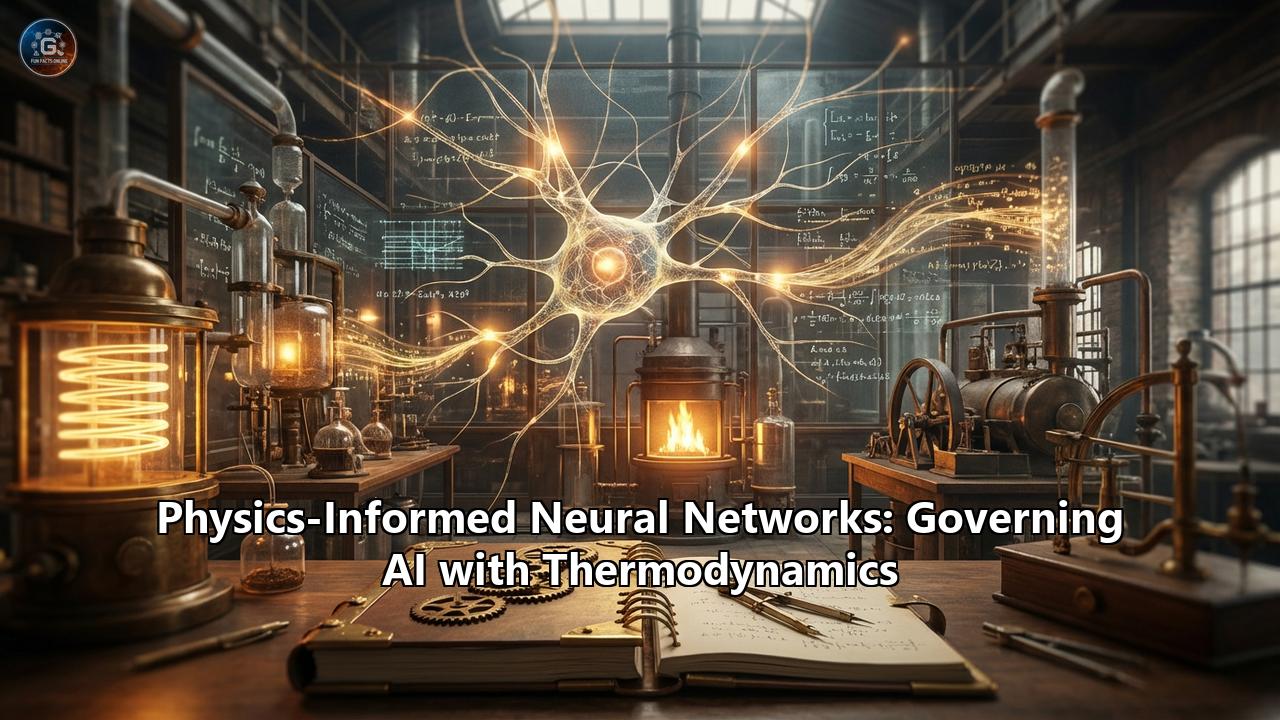
For decades, artificial intelligence has operated much like a brilliant but naive prodigy. Feed it enough data, and it can recognize a cat in a photograph, write poetry, or beat grandmasters at chess. However, when deployed into the rigorous realms of engineering, physics, and industrial manufacturing, traditional deep learning often stumbles in a way that is both spectacular and dangerous: it hallucinates physics. A standard neural network, ignorant of the fundamental laws of nature, might casually predict that water can flow uphill, that mass can spontaneously appear from nowhere, or that heat can seamlessly transfer from a freezing object to a boiling one.
This is the "Black Box" problem at its most perilous. In the physical world, predictions that violate the laws of physics are not just incorrect; they are catastrophic.
To bridge the chasm between data-driven machine learning and the immutable laws of reality, a revolutionary paradigm has emerged: Physics-Informed Neural Networks (PINNs). More specifically, as the field has matured, scientists have recognized that to truly govern AI, we must bind it to the universe's most unbreakable rules. This has given rise to the era of Thermodynamically Informed Neural Networks (THINNs). By hardcoding the First and Second Laws of Thermodynamics into the very architecture and loss functions of artificial intelligence, we are no longer just teaching machines to observe; we are teaching them the fundamental rules of existence.
This comprehensive exploration delves into the mechanics, mathematics, and profound implications of governing AI with thermodynamics. We will explore how these networks function, why they are essential for the future of computational science, and how they are already reshaping industries ranging from chemical engineering to renewable energy.
The Anatomy of a Physics-Informed Neural Network (PINN)
To understand how thermodynamics governs AI, we must first understand the vehicle of that governance: the Physics-Informed Neural Network. Introduced as a concept to bridge traditional numerical solvers and modern deep learning, a PINN is a universal function approximator that embeds the knowledge of physical laws—typically expressed as Partial Differential Equations (PDEs)—directly into its learning process.
The Flaw of Purely Data-Driven AI
A conventional Artificial Neural Network (ANN) operates solely on empirical data. You provide inputs (e.g., coordinates and time) and known outputs (e.g., temperature and pressure), and the network optimizes its internal weights to map the inputs to the outputs. The objective function, or "Loss Function," simply measures the difference between the AI’s prediction and the actual data (Data Loss).
The problem? Data is often sparse, noisy, or impossibly expensive to acquire. If an engineer wants to model heat distribution across a complex turbine engine, gathering millions of physical data points is unfeasible. Furthermore, when a standard ANN is asked to extrapolate beyond its training data, it fails blindly. It has learned the pattern, but not the reason behind the pattern.
The PINN Paradigm: Loss_Total = Loss_Data + Loss_Physics
PINNs disrupt this paradigm by fundamentally altering the AI’s objective. In a PINN, the loss function is mathematically augmented. The network must minimize not only the difference between its predictions and the training data but also the residual of the governing physical equations.
If we are modeling fluid dynamics, the network’s predictions are continuously fed into the Navier-Stokes equations. Because neural networks are inherently differentiable through a process called Automatic Differentiation (Autograd), we can easily compute the exact spatial and temporal derivatives of the AI’s output. If the AI predicts a flow field that violates the conservation of mass or momentum, the PDE residual spikes. The "Physics Loss" penalizes the network heavily, forcing the optimizer to adjust the weights until the prediction aligns with reality.
This dual-constraint system means that a PINN can achieve high-fidelity predictions with up to 100 times less data than a standard neural network. The prior knowledge of physical laws acts as the ultimate regularization agent, limiting the space of possible solutions to only those that are physically possible.
The Thermodynamic Imperative
While PINNs have seen immense success in fluid dynamics and solid mechanics, governing AI with Thermodynamics introduces a profound new layer of physical realism. Thermodynamics governs the transfer of energy and the evolution of systems toward equilibrium. It is the science of the possible.
There are two primary thermodynamic laws that AI must respect to generate physically realistic models:
- The First Law (Conservation of Energy): Energy cannot be created or destroyed, only transformed. A neural network predicting the performance of a chemical reactor must ensure that the total energy of the inputs strictly equals the total energy of the outputs plus any dissipated heat.
- The Second Law (Entropy): The total entropy of an isolated system can never decrease over time. Heat flows spontaneously only from hotter to colder bodies. Processes have a strict, irreversible directionality.
When conventional AI predicts phase behaviors in chemical mixtures or heat transfer in complex materials, it frequently violates the Second Law. It might suggest an unstable phase mixture that actually has a higher Gibbs free energy than a stable single-phase state—a thermodynamic impossibility.
By creating Thermodynamically Informed Neural Networks (THINNs), researchers constrain the AI to seek states that minimize Gibbs free energy and properly account for entropy generation. This ensures that the AI’s predictions are not just numerically accurate, but thermodynamically consistent.
Thermodynamically Informed Neural Networks (THINNs) in Action
How do we actually encode the laws of thermodynamics into a neural network? The execution requires a beautiful synergy of deep learning architecture and advanced theoretical physics. Recent breakthroughs have demonstrated several ways to embed thermodynamic consistency into AI.
1. Soft Constraints vs. Hard Constraints
Historically, thermodynamic consistency was taught to AI using "soft constraints." This involved adding a penalty term to the loss function—for example, penalizing the network if it violated the Gibbs-Duhem equation. While effective, this approach is imperfect. The network balances the data loss against the physics loss using weighting parameters. If the weights are slightly off, the network might still output a prediction that breaks thermodynamic laws by a small fraction.
The frontier of modern AI is the use of "hard constraints," where the neural network architecture itself guarantees thermodynamic consistency by design.
2. Gibbs Free Energy Graph Neural Networks (GE-GNNs)
A stunning example of hardcoded thermodynamic AI is the development of excess Gibbs free energy graph neural networks (GE-GNNs). Predicting the activity coefficients of binary chemical mixtures is notoriously difficult but essential for designing separation processes in chemical engineering.
Instead of asking the AI to predict the activity coefficients directly (which risks violating thermodynamic rules), researchers designed an architecture where the AI strictly predicts the molar excess Gibbs free energy—a fundamental thermodynamic property. Using the principles of automatic differentiation, the network then applies exact mathematical thermodynamic relations to derive the activity coefficients from the predicted Gibbs energy.
Because the architecture operates on fundamental thermodynamic derivations, the outputs are inherently consistent. There is no need for additional loss terms or penalty tuning. The AI cannot break the rules because the rules are the very mathematical pathways it uses to generate the output.
3. Fluctuations and Large Deviation Principles
In non-equilibrium thermodynamics, systems fluctuate. In 2026, state-of-the-art formulations of THINNs expanded to tackle these highly complex, fluctuating systems. By interpreting the loss function's penalization through the lens of thermodynamic fluctuation structures (characterized by large deviations principles), researchers realized that the AI’s penalty term should not be chosen heuristically. Instead, the network naturally penalizes mathematically improbable deviations based on real thermodynamic probabilities. This allows THINNs to act as a canonical framework for simulating fluctuating non-equilibrium thermodynamical systems, beautifully balancing modeling errors with fundamental physical truths.
Revolutionizing Real-World Engineering and Science
The theoretical elegance of Thermodynamically Informed Neural Networks translates into massive leaps in applied engineering, scientific discovery, and computational efficiency. By restricting the hypothesis space to only thermodynamically valid solutions, THINNs are solving problems that were previously computationally intractable.
Accelerating Heat Sink and Thermal Management Design
In modern electronics, thermal management is a critical bottleneck. Designing the optimal heat sink involves solving complex conjugate heat transfer equations over massive, multi-dimensional geometric spaces. Traditional computational fluid dynamics (CFD) simulations require highly refined spatial meshes and can take days or weeks to simulate a single design iteration.
By leveraging PINNs guided by thermodynamic heat-transfer laws, engineers can cover the entire design space in a single training session. Because the AI is mesh-free and solves the PDEs analytically via automatic differentiation, the inferencing speed is astronomical. Recent thermodynamic PINN models have demonstrated speedups of up to 1,000,000 times (10^6) compared to conventional CPU-ported numerical solutions. This allows for real-time optimization of microchip cooling, significantly reducing the energy consumption of data centers.
Designing Renewable Energy Systems in Extreme Environments
Thermodynamics-informed AI is also making a direct impact on the global transition to renewable energy. A recent application involved optimizing the design of flat-plate solar water heaters for the high-altitude, low-oxygen, high-radiation environments of the Andes.
Traditional simplified thermodynamic equations often fail to capture the severe non-linearities of heat loss and atmospheric variables in such unique geographical locations. Purely data-driven neural networks also fail because of the scarcity of physical data in the highlands.
By utilizing a PINN that fused fundamental thermodynamic balance equations directly with available climatic data, researchers created three interconnected neural networks. This model predicted the global collector efficiency, overall loss coefficients, and outlet fluid temperatures with unprecedented accuracy. It captured complex non-linear behaviors that analytical models missed while staying rigorously tethered to the thermodynamic realities of solar radiation and convective heat transfer. The result is a highly efficient, AI-optimized solar collector designed specifically for extreme topographies.
Phase Equilibrium and Compositional Modeling
In the oil and gas industry, as well as carbon capture and storage, predicting phase equilibrium is paramount. When complex mixtures of hydrocarbons and CO2 are subjected to varying pressures and temperatures, predicting whether they will remain a single-phase gas or separate into liquid and gas phases requires intense computational power.
Standard AI models frequently fail at these "two-phase flash calculations" because they do not understand stability analysis. A thermodynamic PINN, however, is trained to minimize the Gibbs free energy of the system, strictly obeying the Second Law of Thermodynamics. By incorporating enthalpy-entropy coupling and interphase mass balance constraints directly into the loss function, multistage hybrid models (like GNN-PINN frameworks) can predict vapor and liquid phase enthalpies and saturation pressures flawlessly, maintaining physical consistency even at highly sensitive equilibrium points.
Advancements in Pharmacology and Drug Discovery
Thermodynamics governs molecular interactions. In computational chemistry, accurately predicting the ionization constants (pKa values) of newly synthesized drugs is critical for understanding how a drug will behave in the human body. The euroSAMPL challenge recently pitted various AI and quantum chemistry models against one another to blindly predict these values.
The top-ranking submission was a thermodynamics-informed neural network model. By structuring the network to respect the physics of ionization—specifically, the fact that it is energetically more expensive to add a proton to a compound that already has multiple protons, forcing a strictly descending order of pKa values—the thermodynamically informed AI vastly outperformed both purely empirical machine learning models and expensive quantum chemistry simulations.
Physically Realistic Mixed Reality and Digital Twins
As we venture deeper into immersive technologies and the "metaverse," real-time physics simulation becomes a necessity. If a user interacts with a virtual deformable object, it must compress, sheer, and rebound in real-time. Traditional finite element analysis (FEA) is too slow for 60-frames-per-second virtual reality. Standard AI approximations often result in objects clipping through one another or generating phantom energy, breaking immersion.
Thermodynamics-informed neural networks are now being used to compute the dynamic response of non-linear and dissipative deformable objects in real-time. By ensuring thermodynamic consistency, these networks guarantee that virtual solids interacting with physical solids in mixed reality scenarios dissipate energy correctly, creating a flawless and physically realistic user experience. Furthermore, this acts as the foundation for Cognitive Digital Twins in manufacturing—virtual replicas of physical factories that run on thermodynamically constrained AI, capable of predicting equipment failure and optimizing energy use without ever suggesting physically impossible parameters.
The Mathematical Symphony of THINNs
To truly appreciate the power of Thermodynamically Informed Neural Networks, one must look under the hood at the mathematical architecture.
Consider a system governed by a generic partial differential equation, written as:
F(u; x, t) = 0
where u is the hidden state (e.g., temperature, velocity), x is the spatial coordinate, and t is time.
In a traditional numerical solver, the continuous space and time are discretized into a grid or mesh. The derivatives are approximated using finite differences. This suffers from the "curse of dimensionality"—as the geometric complexity increases, the number of grid points scales exponentially, bringing supercomputers to their knees.
A PINN bypasses the mesh entirely. The neural network u_θ(x, t) takes the continuous coordinates as inputs and outputs the predicted state. Because the network is composed of differentiable activation functions (like Tanh, Swish, or Softplus), we can use Autograd to compute the exact derivatives ∂u/∂t and ∂²u/∂x² with zero truncation error.
The Loss Function L is then formulated as:
L = W_data L_data + W_physics L_physics + W_ic/bc L_ic/bc
Where:
- L_data is the mean squared error between the predictions and any known experimental data.
- L_physics is the mean squared error of the residual of the thermodynamic PDE evaluated at a set of randomly sampled "collocation points" across the continuous domain.
- L_ic/bc enforces the Initial Conditions and Boundary Conditions.
- W represents dynamically updating weightings to balance the gradients during training.
When thermodynamics is explicitly introduced, the L_physics term expands to include constraints like energy conservation (dE/dt = Heat_in - Work_out) and entropy production (dS/dt ≥ 0). If the network attempts to update its weights in a direction that results in a negative entropy production rate for an isolated system, the L_physics term explodes, mathematically blocking the AI from venturing into that impossible parameter space.
The Thermodynamics of Computation: A Meta-Perspective
Governing AI with thermodynamics extends beyond the applications of the AI; it reaches into the very nature of computation itself. In the quest for Artificial General Intelligence (AGI), energy consumption is becoming the ultimate limiting factor. Training large language models and massive neural networks currently requires gigawatt-hours of electricity, dissipating massive amounts of heat.
Landauer’s Principle dictates that there is a minimum thermodynamic lower bound on the energy required to erase a bit of information. As our AI models scale, they are crashing into the physical limits of thermodynamics and heat dissipation on silicon chips.
Interestingly, Thermodynamically Informed Neural Networks offer a meta-solution. Because THINNs are dramatically more sample-efficient—learning the underlying laws of the system rather than memorizing billions of data points—they require vastly less data to train. Consequently, a PINN can often be trained on a single high-end GPU in a matter of hours to solve a problem that would take a massive cluster days to compute using traditional brute-force data methods or high-resolution CFD. By infusing AI with the laws of thermodynamics, we inherently make the AI more thermodynamically efficient to run.
Challenges, Limitations, and the Frontier
Despite the paradigm-shifting potential of PINNs and THINNs, they are not a magical panacea. Governing AI with physical laws introduces intense complexities in the optimization landscape.
1. The Stiff PDE Problem and Gradient Pathologies:When a neural network tries to minimize a multi-objective loss function (Data + Physics + Boundary Conditions), the gradients associated with the thermodynamic PDEs can become "stiff" or dominate the data gradients. The AI might perfectly satisfy the boundary conditions but completely fail to learn the interior physics, or vice versa. Advanced techniques like dynamically weighted loss functions, curriculum learning (solving the physics at low times/temperatures first and gradually increasing), and modified neural architectures (like Transformer-based PINNs) are required to navigate this jagged optimization landscape.
2. Computational Overhead During Training:While a fully trained PINN can infer solutions millions of times faster than a traditional solver, the training process itself can be computationally brutal. Calculating the second or third-order derivatives required for complex thermodynamic equations via Autograd is memory-intensive. However, because a trained THINN can be applied to different geometries and conditions without needing to be retrained from scratch (generalizability), the high upfront training cost is usually justified.
3. Discovering Unknown Physics:Perhaps the most exciting frontier is inverse modeling. In standard PINNs, the physicist gives the AI the thermodynamic equation. In inverse PINNs, we give the AI the data and ask it to discover* the missing terms in the thermodynamic equation. If an unknown material behaves strangely under extreme heat, a THINN can optimize its weights to not only predict the behavior but also output the precise differential coefficients that define the new material's unique thermodynamic signature. The AI becomes an active partner in scientific discovery.
The Synthesis of Machine Intelligence and Natural Law
The integration of thermodynamics into neural networks represents a profound maturation in the field of Artificial Intelligence. We are moving past the era of the "black box," where machines blindly mapped inputs to outputs without any comprehension of the reality they were modeling.
By governing AI with Physics-Informed Neural Networks—and specifically, by enforcing the unbreakable tenets of the First and Second Laws of Thermodynamics—we are grounding digital intelligence in the physical universe. We are creating models that can optimize aircraft aerodynamics, predict the behavior of quantum materials, design hyper-efficient renewable energy systems, and simulate mixed-reality worlds with a level of accuracy and safety that purely data-driven models could never achieve.
The future of AI is not just about big data; it is about smart data, constrained and guided by the very forces that shape the cosmos. Thermodynamically Informed Neural Networks ensure that as artificial intelligence grows increasingly powerful, it remains permanently anchored to the fundamental truths of nature. In teaching the machine the laws of thermodynamics, we have finally given AI a compass of physical reality.
Reference:
- https://www.cmm.uchile.cl/?p=64980
- https://arxiv.org/html/2509.19467v1
- https://repository.lsu.edu/cgi/viewcontent.cgi?article=6561&context=gradschool_theses
- https://en.wikipedia.org/wiki/Physics-informed_neural_networks
- https://www.youtube.com/watch?v=N74fkdG2vaI
- https://tyagi-bhaumik.medium.com/physics-informed-neural-networks-redefining-computational-science-f534c0f33f0f
- https://medium.com/@eugenio.andrieu_63440/cracking-complex-equations-with-ai-an-intro-to-pinns-9febe26c6f08
- https://www.mdpi.com/1996-1073/17/19/4978
- https://pmc.ncbi.nlm.nih.gov/articles/PMC11485056/
- https://arxiv.org/pdf/2407.18372
- https://arxiv.org/abs/2407.18372
- https://www.softserveinc.com/en-us/blog/exploring-the-potential-of-physics-informed-neural
- https://pubs.acs.org/doi/abs/10.1021/acs.iecr.5c02302
- https://arxiv.org/abs/2210.13414
- https://www.anl.gov/event/thermodynamicsinformed-neural-networks