
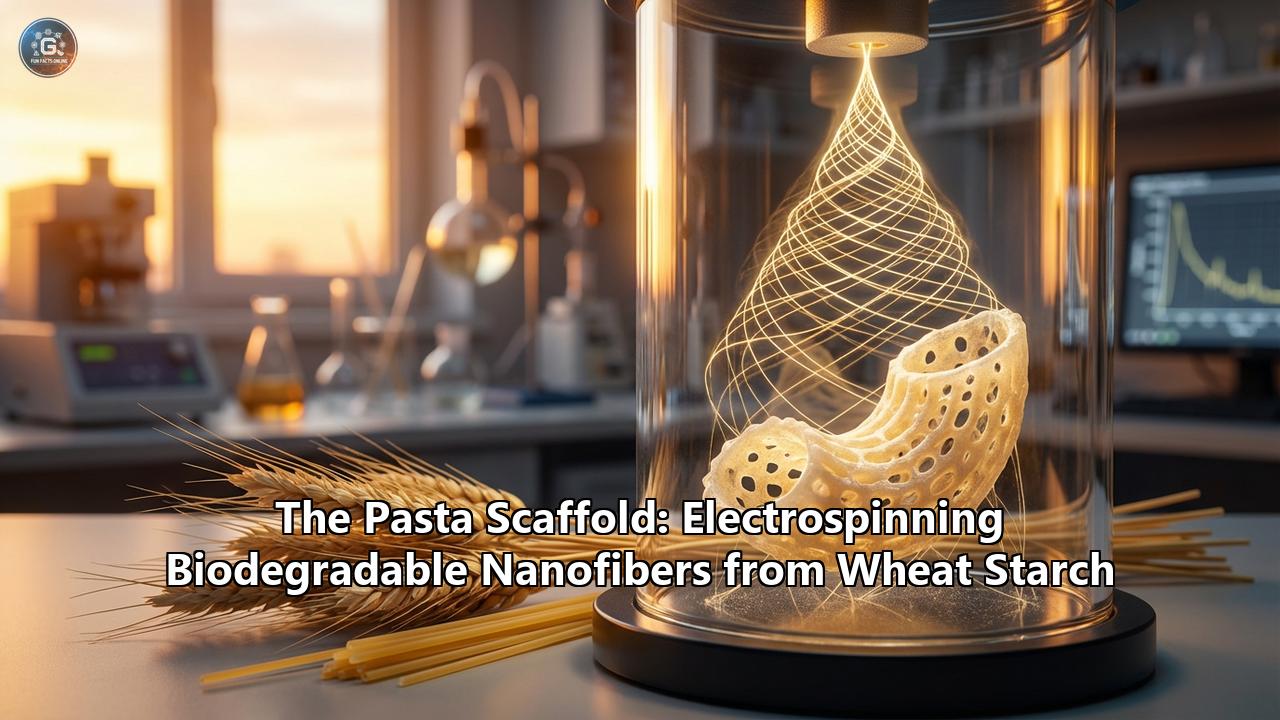
I. Introduction: The Spaghetti Junction of Biology and Engineering
In the high-stakes world of regenerative medicine, where scientists race to grow replacement organs and heal catastrophic wounds, the next great breakthrough isn't coming from a futuristic synthetic laboratory or a rare mineral mine. It is coming from the kitchen pantry.
For decades, the field of tissue engineering has been searching for the "Holy Grail" of scaffolding materials—a substance that is strong enough to support growing cells, porous enough to allow nutrients to flow, and, crucially, capable of disappearing without a trace once its job is done. Synthetic polymers like polycaprolactone (PCL) and polylactic acid (PLA) have dominated this space. They are reliable and easy to spin, but they lack the biological "soul" of natural materials. They are foreign bodies, and while they eventually degrade, they often leave behind acidic byproducts that can irritate delicate regenerating tissue.
Enter the humble wheat stalk. Specifically, the white flour that has been the staple of human civilization for millennia. In a convergence of culinary chemistry and advanced nanotechnology, researchers have developed a method to electrospin wheat starch into nanofibers—dubbed "nanopasta"—that are 200 times thinner than a human hair.
This is not a gimmick. This is the "Pasta Scaffold," a revolutionary approach that leverages the natural architecture of starch to create biodegradable mats that mimic the human extracellular matrix (ECM) with uncanny precision. These nanofibers offer a green, sustainable, and highly effective platform for growing bone, skin, and muscle, promising a future where the bandages we use don't just cover a wound—they actively help it rebuild, then vanish as if they were never there.
II. The Architecture of Life: Why Starch?
To understand why wheat starch is disrupting the field of biomedical engineering, one must first look at the molecular architecture of the material itself. Starch is not merely a source of calories; it is a complex, semi-crystalline biopolymer composed of two distinct polysaccharides: amylose and amylopectin.
1. The Amylose-Amylopectin BalanceAmylose consists of long, linear chains of glucose units, while amylopectin is highly branched. This duality is what gives starch its unique properties. In the culinary world, this balance determines whether rice is sticky or fluffy. In the world of electrospinning, it determines whether a material will form a stable fiber or collapse into a useless droplet.
Wheat starch is particularly interesting because of its specific amylose content (typically around 25-30%) and its ability to form strong hydrogen bonds. Recent comparative studies have shown that wheat starch, with its higher affinity for forming stable hydrogen bond networks compared to waxy corn starches, offers superior mechanical stability when processed into nanofibers. The linear amylose chains align during the spinning process, providing a structural "backbone" that gives the nanofiber its tensile strength, while the branched amylopectin adds flexibility and bulk.
2. Biocompatibility and BioresorbabilityThe human body is an expert at metabolizing starch. We possess enzymes like alpha-amylase that can break down the glycosidic bonds in starch molecules. This is a critical feature for a tissue scaffold. A permanent implant (like a titanium hip) is designed to stay forever. A scaffold, however, is a temporary support structure. It must exist only as long as the new tissue needs support. As cells proliferate and secrete their own natural collagen matrix, the starch scaffold should degrade at a matching rate.
Because the breakdown product of wheat starch is simply glucose—a primary fuel source for cells—the degradation process is not just non-toxic; it is potentially nutritive. Contrast this with synthetic polyesters, which degrade into acidic monomers that can lower the local pH and cause inflammation. The "Pasta Scaffold" is, quite literally, food for the regenerating tissue.
III. Electrospinning: Weaving the Nanoscale Web
To turn a pile of flour into a futuristic medical device, scientists employ a technique called electrospinning. It is a process that marries fluid dynamics with high-voltage physics to produce continuous fibers with diameters in the nanometer range.
1. The ProcessImagine a syringe filled with a thick, honey-like polymer solution. A high-voltage power supply is attached to the metal needle of the syringe, and a grounded collector plate is placed a few inches away. When the voltage is cranked up (often to 10,000 or 20,000 volts), the electric charge overcomes the surface tension of the liquid.
A jet of fluid erupts from the needle tip, whipping through the air in a chaotic, spiraling dance. As it flies, the solvent evaporates, and the polymer chain stretches and thins out. By the time it hits the collector plate, it is a dry, solid fiber. This process creates a non-woven mat that looks like a sheet of white paper to the naked eye but, under a microscope, resembles a dense, chaotic forest of vines—a structure that looks remarkably like the natural extracellular matrix (ECM) of human tissue.
2. The Challenge of "Natural" SpinningSynthetic plastics love to electrospin. They dissolve easily in volatile solvents and have long, entangled polymer chains that stabilize the fiber jet. Starch, however, is stubborn.
- Solubility: Native starch granules do not dissolve in cold water or common organic solvents. They must be "gelatinized" (cooked) or dissolved in harsh chemicals to break the granule structure.
- Crystallinity: The highly ordered crystalline structure of native starch fights against the formation of a smooth fluid jet.
- Beading: If the polymer chains aren't entangled enough, the jet breaks up into droplets (electrospraying) rather than forming a fiber. This results in a useless coating of starch beads instead of a fibrous mat.
Historically, researchers had to mix starch with synthetic polymers like PVA (polyvinyl alcohol) or PCL just to get it to spin. These were "composite" fibers, not pure starch. The starch was just a passenger; the synthetic polymer was the driver. The goal, however, has always been a pure starch fiber—a truly 100% natural scaffold.
IV. The "Nanopasta" Breakthrough
The turning point came with a study that reimagined the feedstock entirely. Instead of using expensive, purified laboratory-grade starch, researchers at University College London (UCL) asked a simple question: Can we spin pasta?
1. White Flour and Formic AcidThe team discovered that ordinary white flour—the kind used to make spaghetti or bread—could be dissolved directly in formic acid. Formic acid is a common organic solvent (naturally found in ant venom) that can disrupt the hydrogen bonding in starch granules, effectively "uncoiling" the long molecular chains without destroying them.
This "dope" (the technical term for the spinning solution) was then electrospun. The result was a mat of nanofibers with an average diameter of 372 nanometers. To put that in perspective, if a strand of angel hair pasta were the size of a giant redwood tree, these nanofibers would be the size of a garden hose.
2. Bypassing PurificationThe brilliance of the "Nanopasta" approach is its simplicity. Industrial starch production involves a massive amount of water and energy to separate the starch from the protein (gluten) and fiber in the wheat grain. By spinning the flour directly, the UCL team bypassed this entire environmentally costly step. The gluten proteins in the flour likely act as a co-polymer, helping to stabilize the jet and adding nitrogen-based nutrients to the final scaffold, further enhancing its biological value.
3. "Pasta Lunga" on the NanoscaleThe researchers playfully noted that this material technically qualifies as pasta lunga—long pasta. But unlike spaghetti, which is extruded, these fibers are drawn by electrostatic forces. The result is a high-porosity mesh with a massive surface area. A single gram of this material could have the surface area of a tennis court, providing ample space for millions of cells to anchor and grow.
V. Cellular Mechanics: How the Scaffold Talks to Cells
A scaffold is not just a passive waiting room for cells. It is an active instructor. The interaction between the "Pasta Scaffold" and a living cell is a complex dialogue of physical and chemical signals.
1. Mechanotransduction: Feeling the FloorCells have "hands" called integrins—transmembrane receptors that grab onto the surface they are sitting on. Through a process called mechanotransduction, cells can sense the stiffness and topography of their environment.
- Stiffness: Bone stem cells (osteoblasts) prefer a stiff surface; it signals them to deposit calcium and build bone. Soft tissue cells (fibroblasts) prefer a more pliable surface. By adjusting the cross-linking of the starch fibers (using heat or citric acid to bond the chains tighter), engineers can tune the stiffness of the "nanopasta" to tell stem cells what they should become.
- Topography: The nanometer scale of the fibers is crucial. If the fibers are too big (micrometers), the cell sees them as a flat surface. If they are nanoscale (like the 372 nm wheat fibers), the cell can wrap its membrane around them, bridging gaps and aligning itself along the fibers. This alignment is vital for tissues like muscle and tendon, which need to be oriented in a specific direction to function.
A major failure point in early tissue engineering was the "core necrosis" problem. If a scaffold is too dense, cells will grow on the outside, sealing it off. The cells in the middle then die of starvation because oxygen cannot diffuse through the outer layer.
The "Pasta Scaffold" excels here. The electrospinning process naturally creates a non-woven mesh with interconnected pores. This allows nutrient-rich fluids to soak through the entire thickness of the material, keeping the deep-tissue cells alive. Furthermore, because the starch is hydrophilic (water-loving), it wicks fluids instantly. Synthetic scaffolds are often hydrophobic (water-repelling) and require chemical treatments just to get them wet.
VI. Applications: From Bandages to Bones
The versatility of wheat starch nanofibers opens the door to a wide array of medical applications.
1. The Smart BandageChronic wounds, such as diabetic foot ulcers, are a silent epidemic. They stall in the inflammatory phase and refuse to heal. A "nanopasta" dressing offers a multi-pronged solution:
- Moisture Management: The high porosity allows the wound to "breathe" (vapor transmission) while the hydrophilic starch absorbs excess exudate (pus and fluid), preventing maceration of the surrounding skin.
- Barrier Function: The pore size is small enough to block bacteria from entering, but large enough to let oxygen in.
- Active Healing: As the starch degrades, it releases glucose, providing local energy for rapidly dividing skin cells.
Starch is an excellent carrier molecule. During the electrospinning process, drugs can be mixed directly into the flour/formic acid solution. Antibiotics, painkillers, or growth factors become trapped inside the nanofibers.
As the fiber slowly dissolves in the body, the drug is released. This "elution profile" can be tuned. A loose mesh might release its payload in a few hours (for immediate pain relief), while a tightly cross-linked mesh could release a growth factor over weeks (to guide bone regeneration).
3. Bone Regeneration ScaffoldsFor bone defects that are too large to heal on their own, doctors need a void filler. Wheat starch scaffolds, potentially reinforced with calcium phosphate minerals (the stuff bone is made of), can serve as this filler. The scaffold provides the initial structure. Osteoblasts migrate onto the starch fibers, lay down new mineralized bone, and digest the starch. In six months, the starch is gone, replaced entirely by the patient's own natural bone.
VII. Sustainability: The Green Revolution in Biofabrication
The "Pasta Scaffold" is not just a medical innovation; it is an environmental one. The field of medical disposables is a massive contributor to medical waste. Bandages, sutures, and implants are typically incinerated, releasing distinct pollutants.
1. The Life Cycle AdvantageLife Cycle Assessments (LCA) comparing starch-based polymers to fossil-fuel-based plastics (like polyethylene) generally show that starch has a lower carbon footprint in terms of fossil fuel depletion and greenhouse gas emissions. Wheat captures $CO_2$ from the atmosphere as it grows.
However, sustainability is nuanced. Critics point out that agricultural polymers use land and water (eutrophication potential from fertilizers). But the "Nanopasta" method mitigates this by allowing the use of lower-grade flours or agricultural byproducts that might not be suitable for food, or simply by being so efficient that the material yield is high.
2. Green ElectrospinningTraditional electrospinning often uses nasty solvents like hexafluoroisopropanol (HFIP) or trifluoroacetic acid (TFA)—chemicals that are toxic to humans and dangerous to dispose of. The move toward formic acid (which can be derived from biomass and breaks down easily) or even water-based spinning (though harder with pure starch) represents a significant step toward "Green Electrospinning."
The ability to use the entire flour component reduces the energy of purification. It moves the manufacturing process closer to the farm gate and further from the chemical plant.
VIII. Challenges and Future Perspectives
Despite the promise, we are not yet ready to see "spaghetti bandages" in the hospital aisle. Significant hurdles remain.
1. Mechanical Strength in Wet ConditionsStarch's greatest strength—its love of water—is also its weakness. When dry, a starch scaffold is stiff and brittle. When wet (as it will be in the body), it can become a soggy gel, losing its structural integrity too quickly.
Researchers are currently working on "cross-linking" methods—using citric acid or heat treatments to create chemical bridges between starch chains. This reinforces the "wet strength" of the fiber, ensuring it holds up for the days or weeks required for tissue formation.
2. Scaling UpElectrospinning is notoriously slow. A single needle produces a few milligrams of fiber per hour. To make enough bandages for a hospital, you need industrial setups with thousands of needles (multi-jet spinning) or "needleless" electrospinning (where fibers erupt from a rotating drum in a liquid bath). Scaling up starch processing is tricky because the solution viscosity must be maintained perfectly to avoid clogging thousands of tiny nozzles.
3. Regulatory PathEven though wheat flour is "Generally Recognized As Safe" (GRAS) for eating, injecting it or implanting it is a different regulatory beast. The FDA will require rigorous testing to ensure that trace proteins (gluten) do not trigger allergic reactions or immune rejection in sensitive individuals (celiac disease considerations). However, for topical wound dressings, the barrier to entry is lower.
IX. Conclusion: The Circle of Life
The concept of the "Pasta Scaffold" is poetic in its circularity. We grow wheat to sustain our bodies metabolically. Now, we are learning to use that same wheat to sustain our bodies structurally.
By looking back at one of our oldest materials—starch—and applying the newest tools of nanotechnology, we have created a material that is perfectly tuned to the needs of living tissue. It is strong yet degradable, complex yet simple, high-tech yet grown from the earth.
As research continues, the line between food and medicine will blur. The next time you look at a strand of spaghetti, you might not just see dinner. You might be looking at the future of bone grafts, skin repair, and the sustainable evolution of modern medicine. The "Pasta Scaffold" is here, and it is reshaping the very fabric of how we heal.
Reference:
- https://www.mdpi.com/2227-9717/12/10/2100
- https://www.researchgate.net/publication/342297344_Thermoplastic_starch_from_corn_and_wheat_a_comparative_study_based_on_amylose_content
- https://starchproduction.com/corn-starch-and-wheat-starch-knowledge/
- https://www.oreateai.com/blog/corn-starch-vs-wheat-starch-a-culinary-showdown/c3c5e5a9dfa68d41280ed7b7d82c27de
- https://scholars.unh.edu/urc/559/
- https://pmc.ncbi.nlm.nih.gov/articles/PMC5935783/
- https://www.nsmedicaldevices.com/analysis/the-medical-possibilities-of-sustainable-electrospinning/
- https://eureka.patsnap.com/report-electrospinning-with-natural-polymers-challenges-and-opportunities