
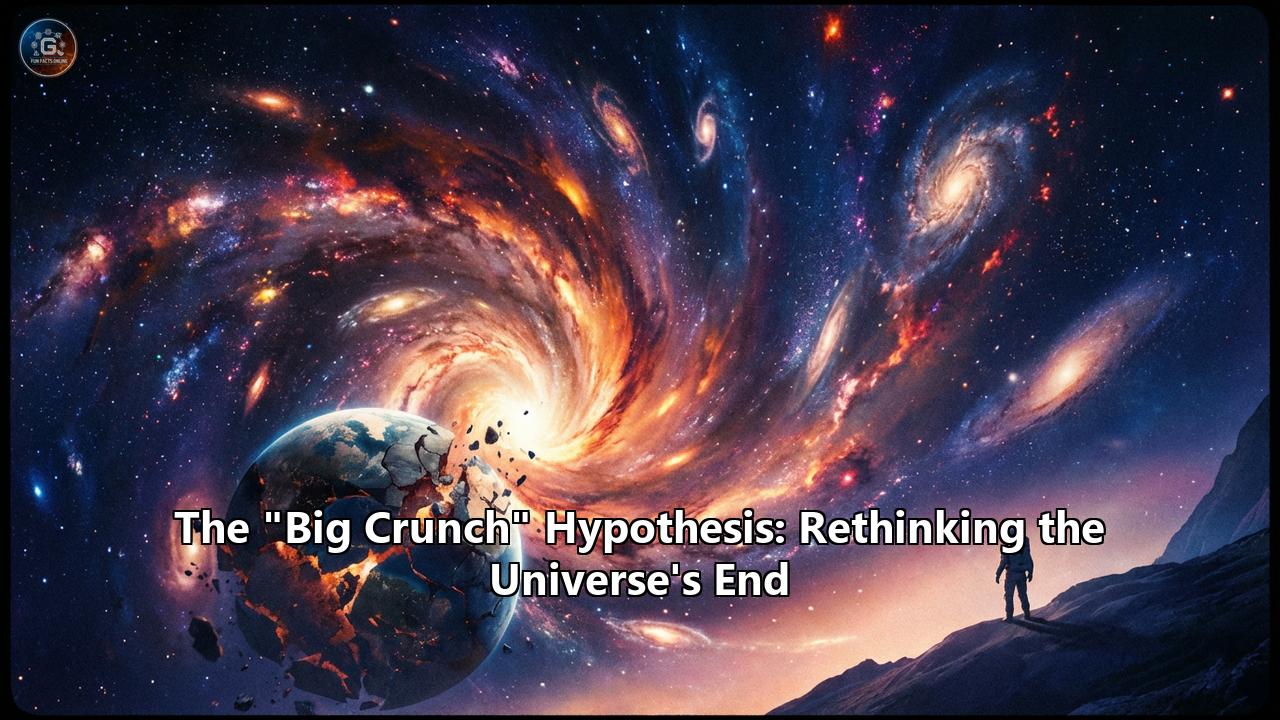
There is no question more profound, nor more terrifyingly majestic, than that of the end. Not the end of a life, a civilization, or even a planet, but the end of everything. For as long as humanity has understood that the universe had a beginning—a violent, creative eruption we call the Big Bang—we have wrestled with the inevitable corollary: Will it also have an end? And if so, what will that finale look like?
For decades, the most symmetrical, poetic, and theoretically robust answer to this question was the "Big Crunch." It is a hypothesis that paints a picture of a universe that breathes—an expanding lung that must eventually exhale, a ball thrown into the air that must eventually fall back to Earth. In this scenario, the cosmos does not fade away into a cold, eternal whimpers known as the "Heat Death" or "Big Freeze." Instead, it reverses course. It rushes back toward its origins, heating up, brightening, and crushing all matter, energy, space, and time back into the primordial fire from which it sprang.
The Big Crunch suggests that the universe is finite in duration but perhaps infinite in recurrence—a phoenix that burns itself to ash only to rise again. It is a concept that marries the physics of General Relativity with the ancient philosophical intuition of cycles. However, in the late 1990s, this theory suffered a near-fatal blow with the discovery of Dark Energy, a mysterious force driving the universe apart at an accelerating rate. For a quarter of a century, the Big Crunch was relegated to the dustbin of cosmic history, a beautiful idea killed by ugly data.
But science is never settled. In recent years, and particularly with observational data emerging in the mid-2020s, the Big Crunch has quietly returned to the conversation. New models of "dynamic" dark energy and theories of modified gravity have reopened the door to the possibility that our current expansion is not eternal. The universe may yet have a date with destiny, a rendezvous with a final, fiery collapse.
This article explores the rise, fall, and potential resurrection of the Big Crunch hypothesis. We will journey through the history of cosmological thought, delve into the titanic tug-of-war between gravity and expansion, and witness a second-by-second simulation of the universe’s final moments in a collapse scenario. We will ask whether the Big Crunch implies a "Big Bounce"—a heartbeat of eternity—and what it would mean for the legacy of existence itself.
Part I: The Architecture of Destiny
To understand the Big Crunch, we must first understand the engine that drives the universe: the relationship between matter, energy, and the geometry of space-time.
The Legacy of Friedmann and EinsteinIn 1915, Albert Einstein published the Theory of General Relativity, a framework that described gravity not as a force, but as the curvature of space and time caused by mass. When Einstein applied his equations to the universe as a whole, he encountered a problem. His math suggested that a universe filled with matter could not be static; the mutual gravitational pull of all the galaxies should cause the universe to collapse in on itself.
At the time, the prevailing scientific consensus was that the universe was static and eternal. Uncomfortable with the idea of a dynamic cosmos, Einstein introduced a "fudge factor" into his equations—the Cosmological Constant ($ \Lambda $) —a repulsive force designed to counteract gravity and hold the universe steady.
However, in 1922, a Russian mathematician named Alexander Friedmann took Einstein’s equations at face value. He realized that if you removed the artificial fix of the constant, the universe had to be moving. Friedmann derived a set of solutions—now known as the Friedmann Equations—that described three possible destinies for the universe, determined solely by the density of matter within it.
- The Open Universe: If the density of matter is low, gravity is too weak to stop the expansion. The universe expands forever, the stars burn out, and darkness wins.
- The Flat Universe: If the density is exactly at a specific "critical" limit, the expansion slows down forever but never quite stops. This is a knife-edge balance.
- The Closed Universe: If the density of matter is high—higher than the critical density—gravity will eventually win. The expansion will halt, reverse, and the universe will recollapse. This is the Big Crunch.
Friedmann’s work was initially ignored, but it was vindicated in 1929 when Edwin Hubble observed that distant galaxies were receding from us. The universe was expanding. Einstein abandoned his cosmological constant, calling it his "biggest blunder." The question then shifted from "Is the universe static?" to "Is the universe dense enough to Crunch?"
The Geometry of DoomThe Big Crunch is inextricably linked to the shape of space. In General Relativity, matter tells space how to curve.
- In an Open Universe, space is negatively curved, shaped like a saddle. Parallel lines eventually diverge.
- In a Flat Universe, space is uncurved, like a tabletop. Parallel lines remain parallel.
- In a Closed Universe—the home of the Big Crunch—space is positively curved, shaped like a sphere.
If you live in a closed universe and you travel in a straight line long enough, you will eventually return to your starting point, just as a plane flying around the Earth returns to the airport. In this geometry, the universe is finite in volume but has no edge. There is a limited amount of space, and as the universe contracts, that space literally shrinks.
For decades, astronomers tried to "weigh" the universe to see which geometry we lived in. They counted galaxies, estimated the mass of gas clouds, and searched for "Dark Matter"—the invisible scaffolding that holds galaxies together. If the total mass—visible plus dark—exceeded the "Critical Density" (roughly 5 hydrogen atoms per cubic meter), the Big Crunch was inevitable.
Part II: The Tug-of-War
The fate of the universe can be visualized as a ball thrown upward from the surface of the Earth.
- The throw: This is the Big Bang, the initial impulse of expansion.
- Gravity: This is the mass of the universe pulling everything back together.
If you throw the ball gently (low density), it goes up, slows down, stops, and falls back (Big Crunch). If you throw it with escape velocity (critical density), it travels forever, slowing down but never returning. If you throw it faster than escape velocity (low density), it shoots off into the void.
The Role of Dark MatterThroughout the 1970s and 80s, the case for the Big Crunch seemed plausible, though uncertain. Astronomers Vera Rubin and others confirmed the existence of Dark Matter, which added significantly to the universe's mass budget. While visible matter (stars, gas, us) accounts for less than 5% of the critical density, Dark Matter bumps that number up to about 27%.
This was a lot, but it wasn't enough. The universe appeared to be "under-dense," containing only about 30% of the matter needed to cause a Big Crunch. However, theorists argued that our measurements might be wrong, or that there was more hidden matter out there. Many physicists wanted the Big Crunch to be true. A Flat or Closed universe was aesthetically pleasing; it implied a sort of cosmic conservation. An Open universe that just drifted apart forever seemed wasteful, asymmetrical.
Then came 1998.
Part III: The Plot Twist—Dark Energy
In the late 1990s, two independent teams of astronomers set out to measure the deceleration of the universe. They used Type Ia supernovae—exploding white dwarf stars that shine with a consistent brightness—as "standard candles" to map the distance and speed of faraway galaxies. Their goal was to determine how much gravity was slowing down the expansion, and thus, how close we were to a Big Crunch scenario.
The results were a shock to the system. The universe wasn't slowing down at all. It was speeding up.
The expansion was accelerating. It was as if you threw a ball into the air, watched it slow down for a moment, and then suddenly saw it ignite a rocket engine and shoot into space faster and faster.
The Resurrection of the Cosmological ConstantTo explain this, physicists dusted off Einstein’s old "blunder." They postulated the existence of Dark Energy, a mysterious pressure permeating empty space that pushes galaxies apart. Unlike matter, which dilutes as space expands, Dark Energy appears to be a property of space itself. As the universe gets bigger, there is more space, and thus more Dark Energy, which causes faster expansion. This creates a runaway effect.
Current measurements (from the Planck satellite and others) indicate the universe is composed of:
- ~68% Dark Energy
- ~27% Dark Matter
- ~5% Normal Matter
With Dark Energy dominating the equation, the density of matter (32%) is overwhelmed by the repulsive force. The standard model of cosmology (Lambda-CDM) shifted to predict a Big Freeze. In this scenario, galaxies recede from one another faster than the speed of light (in terms of proper distance expansion), eventually leaving our local group of galaxies isolated in a dark, cold void. The Big Crunch seemed dead.
Part IV: The Return of the Crunch
"Science is the poetry of reality," Richard Dawkins once said, and poetry rarely follows a straight line. Just as the Big Crunch was being written out of textbooks, theoretical cracks began to appear in the "Big Freeze" consensus.
Is Dark Energy Constant?The assumption that the universe will expand forever rests on the idea that Dark Energy is the "Cosmological Constant"—a fixed value that never changes. But we don't know what Dark Energy actually is. It could be a field, a fluid, or a modification of gravity.
If Dark Energy is a dynamic field (often called Quintessence), it might change over time. It could decay. It could flip.
- Phantom Energy: If Dark Energy gets stronger over time, it leads to the Big Rip, tearing atoms apart.
- Decaying Dark Energy: If Dark Energy weakens or changes sign (becoming attractive rather than repulsive), the acceleration could stop.
In the mid-2020s, the Dark Energy Spectroscopic Instrument (DESI) released a colossal 3D map of the universe. The data hinted at something profound: Dark Energy might be evolving. The "equation of state" for Dark Energy (denoted as $ w $) appeared to be deviating from the constant value of -1.
If $ w $ rises above -1 and continues to evolve, or if the scalar field responsible for Dark Energy "rolls down" a potential hill and becomes negative, the repulsive force could turn into an attractive force. This is the "AdS Crunch" (Anti-de Sitter) scenario. Even a small negative cosmological constant would eventually overpower the expansion.
Theoretical physicists at institutions like Cornell and Princeton have calculated that if Dark Energy behaves this way, the reversal could happen surprisingly soon—cosmically speaking. Some models suggest the expansion could halt in as little as 10 to 20 billion years, transitioning into a contraction phase.
Suddenly, the Big Crunch is back on the table.
Part V: The Chronology of Collapse
Let us assume the Big Crunch hypothesis is correct. Let us simulate the end of the universe based on what physics tells us would happen if the expansion reversed. What would it look like? What would it feel like?
Phase 1: The Turnaround (T-minus 20 Billion Years)The first signs are subtle. For billions of years, astronomers have observed a "Redshift" in distant galaxies—their light stretched into longer, redder wavelengths as they move away.
As gravity begins to win the tug-of-war, the expansion slows to a halt. For a brief cosmic moment, the universe is static. Then, the contraction begins.
Slowly, the Redshift of distant galaxy clusters diminishes. Over millions of years, it turns into a Blueshift. Galaxies are moving toward us. The light from them is compressed, shifting into higher energies. At first, only the nearest superclusters seem to approach, but eventually, the entire sky begins to close in.
Phase 2: The Merging of Giants (T-minus 1 Billion Years)As the universe shrinks, the space between galaxies vanishes. The stately, isolated dance of spiral galaxies turns into a chaotic mosh pit.
Our own galaxy, the Milky Way, has likely already merged with Andromeda to form "Milkomeda." Now, this super-galaxy finds itself crowded by neighbors. The voids—the vast empty spaces between galactic filaments—collapse.
Collisions become constant. When galaxies collide, stars rarely hit each other, but the gas clouds smash together, triggering furious bursts of star formation. The universe lights up with the brilliance of newborn blue stars and exploding supernovae. The night sky is no longer black; it is a tapestry of overlapping galaxies, a kaleidoscope of violence.
Phase 3: The Rising Heat (T-minus 100 Million Years)This is where the Big Crunch distinguishes itself from a simple "reverse movie." Entropy—disorder—has been increasing since the Big Bang. You cannot put the egg back in the shell. The contracting universe retains all the heat and radiation generated over billions of years.
As space shrinks, that radiation is compressed. The Cosmic Microwave Background (CMB)—the faint afterglow of the Big Bang which is currently a chilly 2.7 Kelvin—begins to warm up.
It shifts from microwaves to infrared, then to visible light.
The sky begins to glow. At first, it is a dull red phosphorescence, barely visible. But as the universe contracts further, the background temperature rises to that of a warm summer day, then an oven.
There is no "night" anymore. The "dark" between the stars is glowing.
Phase 4: The Stellar Roast (T-minus 500,000 Years)This is the tipping point for life, if any remains.
Stars survive by shedding heat. The Sun generates energy in its core and radiates it into the cold vacuum of space. But in a Big Crunch, the vacuum is no longer cold.
When the background temperature of the universe exceeds the surface temperature of a star (thousands of degrees), the star can no longer radiate its heat away. Heat flows from hot to cold. If the sky is hotter than the star, heat flows into the star.
Stars begin to bake from the outside in. Their atmospheres superheat. They become unstable. Unable to release their internal energy, they likely explode or boil away. Planets are vaporized not by their own suns, but by the sky itself. The universe has become a cosmic furnace.
Phase 5: The Dissolution of Atoms (T-minus 3 Minutes)The universe is now smaller than our solar system. The temperature is billions of degrees. The intense radiation strips electrons from atomic nuclei. All matter becomes a plasma—a soup of charged particles.
We are back to the conditions of the first few minutes after the Big Bang, but in reverse.
Atomic nuclei are blasted apart by high-energy photons. Protons and neutrons dissolve into a quark-gluon plasma. The structures of matter—the legacy of 14 billion years of cosmic evolution—are erased.
Phase 6: The Final Singularity (Time Zero)Black holes, which have been gorging themselves on the dense matter soup, begin to merge. They coalesce into a single, monstrous super-black hole that encompasses the entire universe.
Space and time warp infinitely. The curvature of spacetime becomes so extreme that the concepts of "before" and "after" lose meaning.
The density becomes infinite. The temperature becomes infinite.
The universe crunches into a Singularity.
Physics as we know it breaks down. The screen goes black.
Part VI: The Big Bounce and Cyclic Universes
Is this the end? Or is it a new beginning?
The idea of a "one-and-done" universe, emerging from nothing and returning to nothing, is scientifically possible but philosophically unsatisfying. It raises the question: "Why did it happen just once?"
The Big Crunch offers a mechanism for resurrection: the Big Bounce.
Quantum Gravity to the RescueIn classical General Relativity, the singularity is a dead end. But quantum mechanics suggests that you cannot compress information to a literal point. At the Planck Scale (the smallest possible unit of space), quantum effects take over.
Theories like Loop Quantum Gravity suggest that space is "granular," made of tiny loops. When these loops are compressed to their limit, they cannot be crushed further. Instead, they repel. The force of gravity turns repulsive at extreme densities.
Imagine a spring being compressed. It resists, resists, resists—and then snaps back.
If this is true, the Big Crunch does not reach a singularity. It reaches a point of maximum density and then bounces outward, triggering a new Big Bang.
Penrose’s Conformal Cyclic Cosmology (CCC)Nobel laureate Sir Roger Penrose has proposed a different, mind-bending version of a cyclic universe that involves a "Crunch" of sorts, but without the contraction.
Penrose argues that in the extremely distant future of an expanding universe (Big Freeze), all matter will decay into radiation. Massless particles (photons) do not experience time or distance. To a photon, the size of the universe is irrelevant.
Through a mathematical transformation called "conformal rescaling," the infinite, cold end of one universe becomes mathematically identical to the hot, dense beginning of the next.
While not a traditional physical "crunch," it is a geometric crunch where the end is the beginning. Penrose claims we might even see "scars" in the Cosmic Microwave Background left by the collision of supermassive black holes from the previous eon.
The Steinhardt-Turok "Ekpyrotic" ModelAnother competitor is the Brane World scenario from String Theory. In this model, our universe is a 3-dimensional "brane" (membrane) floating in a higher-dimensional bulk.
Every few trillion years, our brane collides with a parallel brane. The collision releases massive energy, looking to us like a Big Bang. The branes bounce apart, expand, cool, and eventually slow down and are drawn back together for another collision.
Here, the "Crunch" is the collision of dimensions. The universe is eternal, but our specific epoch is just one cycle in an endless chain.
Part VII: Philosophical Implications
The hypothesis of the Big Crunch changes the narrative of existence.
The Meaning of ReturnIf the Big Freeze is true, the universe is a linear tragedy. It burns bright, fades, and dies forever. It is a story with a sad ending.
The Big Crunch (specifically the Big Bounce) turns the universe into a circle. It implies that life, consciousness, and matter are not flukes, but intrinsic features of an eternal system. We are the phoenix.
Nietzsche’s Eternal RecurrenceThis resonates with Friedrich Nietzsche’s concept of "Eternal Recurrence"—the idea that if time is infinite and matter is finite, every configuration of atoms must eventually repeat.
In a cyclic Big Crunch universe, will there be another "you" in the next cycle? Will you read this article again a trillion years from now?
Some physicists argue that quantum uncertainty prevents exact repetition. Each cycle would be slightly different—a variation on a theme rather than a rerunning of a tape.
The Value of the PresentConversely, if the Crunch is a "hard reset" that wipes out all information (no Bounce), it brings a different kind of solemnity. It means the universe is a temporary art installation. It exists for a time, beautiful and complex, and then is dismantled. Its value lies in its existence now, not in its permanence.
Conclusion: The Breathing Cosmos
The Big Crunch hypothesis is currently the underdog of cosmology, overshadowed by the evidence for dark energy and eternal expansion. The "smart money" is on the Big Freeze.
However, the history of science is a graveyard of absolute certainties. We have only known about Dark Energy for roughly 30 years—a blink of an eye in the history of astronomy. We do not know its nature. We do not know if it is stable.
The recent hints from DESI and other observatories that Dark Energy might be weakening serve as a humble reminder of our ignorance. The universe has surprised us before. It expanded when we thought it was static. It accelerated when we thought it was slowing. It may yet collapse when we think it is eternal.
The Big Crunch remains the most dramatic, violent, and paradoxically hopeful end-game for the cosmos. It promises that we will not fade away into the dark and cold. Instead, we will go out in a blaze of glory, returning our borrowed stardust to the cosmic fire, perhaps to seed a new heaven and a new earth.
Until the data proves otherwise, the Crunch waits in the shadows of the equations—a reminder that in the universe, what goes up might, just might, come down.
Reference:
- https://physicscommunication.ie/the-big-crunch/
- https://en.wikipedia.org/wiki/Big_Crunch
- https://www.youtube.com/watch?v=dAxA7aELbNA
- https://www.astronomy.com/science/the-beginning-to-the-end-of-the-universe-the-big-crunch-vs-the-big-freeze/
- https://www.zmescience.com/science/physics/big-crunch-ending/
- https://www.universetoday.com/articles/big-crunch
- https://www.discovermagazine.com/the-big-crunch-theory-is-revived-as-recent-data-shows-our-expanding-universe-47713
- https://www.sciencealert.com/physicists-predict-when-the-universe-will-end-in-a-reverse-big-bang
- https://science.howstuffworks.com/dictionary/astronomy-terms/big-crunch.htm
- https://www.parkes.atnf.csiro.au/people/sar049/eternal_life/universe/universe.html
- https://icjs.us/theoretical-astrophysics-research-on-how-the-big-crunch-builds-to-the-big-bounce-theory/
- https://www.worldatlas.com/space/the-big-crunch-51639.html
- https://news.cornell.edu/stories/2025/10/physicist-after-33-billon-years-universe-will-end-big-crunch
- https://www.physicsoftheuniverse.com/topics_bigbang_bigcrunch.html
- https://www.youtube.com/watch?v=Jl-iyuSw9KM
- https://scitechdaily.com/the-universe-will-end-in-a-big-crunch-physicists-warns/
- http://backreaction.blogspot.com/2022/02/will-big-bang-repeat.html
- https://www.popsci.com/science/universe-ends-big-crunch/