
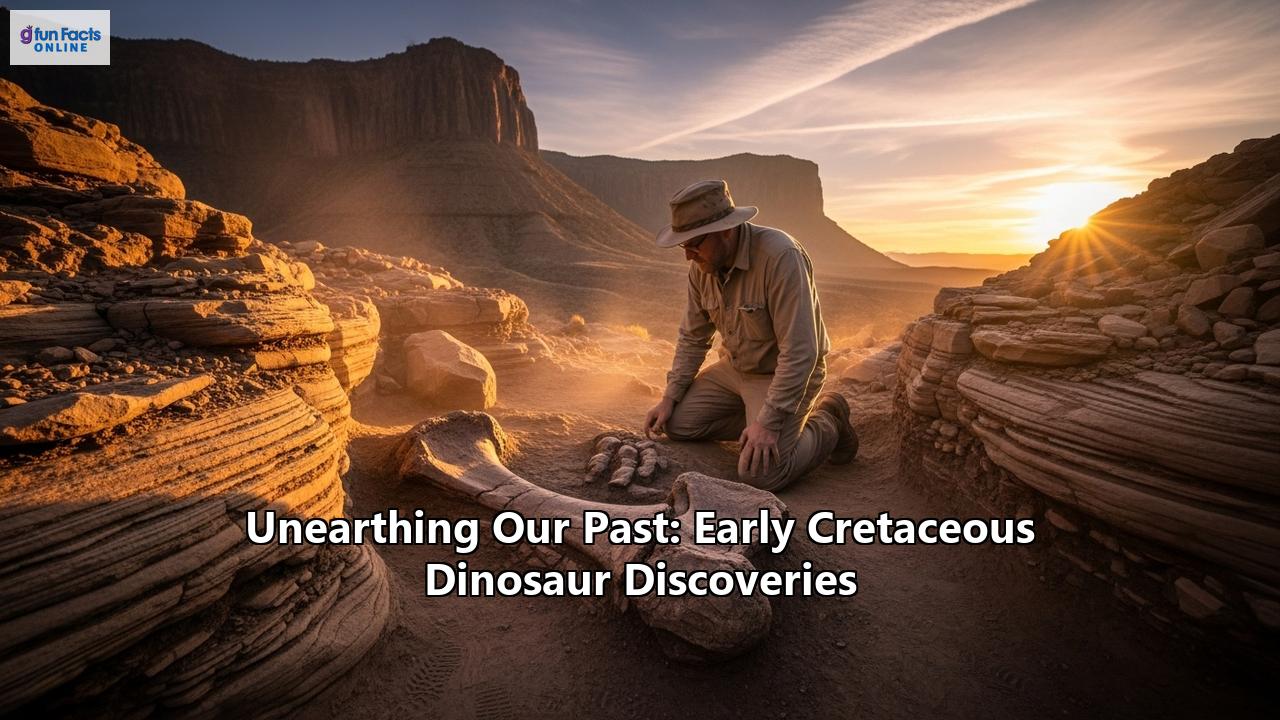
Unearthing Our Past: A Global Tour of Early Cretaceous Dinosaur Discoveries
The Early Cretaceous period, spanning from approximately 145 to 100.5 million years ago, was a time of immense change on our planet. The supercontinent of Pangaea continued its dramatic breakup, leading to the formation of new oceans and the isolation of continents. This geological dance set the stage for a remarkable diversification of life, particularly among the dinosaurs. It was an era where familiar giants from the Jurassic began to fade, replaced by a new and eclectic cast of characters that would dominate the prehistoric world. Recent discoveries from this period have unearthed a treasure trove of fossils, providing an unprecedented glimpse into the lives of these incredible creatures and the world they inhabited.
The climate of the Early Cretaceous was generally much warmer and more humid than today, with high sea levels creating vast shallow inland seas. This led to lush, tropical to subtropical environments extending far from the equator, with temperate forests reaching towards the poles. It was in this dynamic world that flowering plants first made their appearance, an evolutionary innovation that would forever change the face of the planet and the diets of its inhabitants.
A World of Feathered Dinosaurs: The Yixian Formation, China
Nowhere is the unique biodiversity of the Early Cretaceous more vividly preserved than in the Yixian Formation in northeastern China. Often referred to as a "dinosaur Pompeii," this remarkable fossil site, or Lagerstätte, is renowned for its exquisitely preserved fossils, thanks to periodic volcanic eruptions that buried entire ecosystems in fine ash and sediment. These catastrophic events created a perfect storm for fossilization, preserving not just bones but also soft tissues, feathers, and even the contents of stomachs.
The Yixian Formation has revolutionized our understanding of dinosaur evolution, particularly the link between dinosaurs and birds. It has yielded a stunning array of feathered dinosaurs, providing undeniable evidence that many theropods, the group of bipedal, mostly carnivorous dinosaurs that includes Tyrannosaurus rex, were covered in some form of plumage.
One of the most famous discoveries from Yixian is Sinosauropteryx, a small theropod whose fossil clearly shows a covering of downy, filamentous feathers. Another notable find is Yutyrannus, a large, early relative of T. rex, which was also covered in long, shaggy feathers, suggesting that even large tyrannosauroids sported a feathery coat. The Yixian Formation has also given us incredible insights into the early evolution of flight, with a multitude of primitive birds and bird-like dinosaurs like Confuciusornis and the four-winged Microraptor.
The paleoenvironment of the Yixian Formation was a temperate landscape of forests and lakes, with a mix of conifers, ginkgoes, and ferns. This ecosystem supported a diverse range of life, including early mammals, lizards, and a variety of fish. The exceptional preservation at Yixian allows paleontologists to reconstruct the intricate food webs of this ancient environment with remarkable detail.
Europe's Island Hoppers and Coastal Giants
During the Early Cretaceous, much of Europe was an archipelago of islands, creating unique evolutionary pressures that led to the development of distinct dinosaur faunas. One of the most important windows into this period is the Wealden Group of southern England, a series of rock strata that have been a hotbed of dinosaur discoveries for over two centuries.
The Wealden has yielded some of the first dinosaurs ever to be scientifically described, including the iconic Iguanodon. This large herbivore, with its distinctive thumb spike, was one of the most successful dinosaurs of its time, with related species found across the globe. The Wealden was also home to a diverse array of other herbivores, such as the smaller, agile Hypsilophodon and heavily armored ankylosaurs.
The predator guild of the Wealden was equally impressive. The fearsome Baryonyx, a large spinosaurid with a long, crocodile-like snout and a formidable claw on its thumb, likely prowled the riverbanks, preying on fish. Recent analysis of fossil teeth from the Wealden suggests an even greater diversity of predators than previously thought, including early tyrannosauroids and dromaeosaurids, the group of dinosaurs commonly known as "raptors."
Recent discoveries have continued to enrich our understanding of Europe's Early Cretaceous dinosaurs. In Spain, paleontologists recently unearthed the remains of a massive sauropod named Garumbatitan morellensis, a giant herbivore that lived around 122 million years ago. Also in Europe, a new species of sail-backed iguanodontian, Istiorachis macarthurae, was recently identified from fossils found on the Isle of Wight, England. This dinosaur sported a prominent sail along its back, which may have been used for display.
North America's Shifting Faunas
In North America, the Early Cretaceous was a time of transition. The familiar giants of the Late Jurassic, such as Allosaurus and the long-necked sauropods, began to decline, making way for new groups of dinosaurs. The fossil record from this period is not as complete as that of the Late Cretaceous, but discoveries in places like the Cloverly Formation in Wyoming and the Cedar Mountain Formation in Utah have revealed a fascinating and diverse fauna.
One of the most formidable predators of Early Cretaceous North America was Acrocanthosaurus, a large carnosaur with a distinctive row of tall spines along its back. It shared its environment with a variety of other theropods, including the iconic dromaeosaurid Deinonychus, a fierce predator with a large, sickle-shaped claw on each foot. The discovery of Deinonychus in the 1960s was instrumental in sparking the "dinosaur renaissance," a period of renewed interest and research into these animals that led to a more dynamic and active view of their biology.
Herbivores were also well-represented in Early Cretaceous North America. Ornithopods like Tenontosaurus were common, and armored dinosaurs like Sauropelta provided a formidable defense against predators. While the giant sauropods of the Jurassic were less common, some species, like Sauroposeidon, still roamed the landscape.
Gondwana's Southern Titans
The southern supercontinent of Gondwana, which included modern-day South America, Africa, Australia, and Antarctica, was also home to a unique assemblage of dinosaurs during the Early Cretaceous. As the continents continued to drift apart, the dinosaur faunas of Gondwana became increasingly distinct.
In Africa, fossil sites in Niger have revealed a diverse Early Cretaceous ecosystem. Here, the sail-backed spinosaurid Suchomimus, a relative of Europe's Baryonyx, hunted in the rivers, while the unusual iguanodontian Ouranosaurus, with its own prominent sail, browsed on the plains. Another notable African dinosaur from this period is Nigersaurus, a sauropod with a bizarre, wide-mouthed skull containing hundreds of tiny teeth. A nearly complete skeleton of the large predatory dinosaur Afrovenator was also discovered in the Sahara Desert, shedding light on the carnivores of Early Cretaceous Africa.
South America in the Early Cretaceous was a land of giants. This is where some of the largest land animals of all time, the titanosaurs, first rose to prominence. While the most famous titanosaurs are from the Late Cretaceous, their early ancestors laid the groundwork for their colossal size. The separation of Africa and South America during this time led to the development of unique and endemic dinosaur faunas on both continents.
A Glimpse into Dinosaur Society
Beyond the discovery of new species, paleontological research into the Early Cretaceous has also provided fascinating insights into the behavior of these animals. Evidence from a 190-million-year-old dinosaur nesting ground in Patagonia suggests that some of the earliest dinosaurs lived in herds. The discovery of a communal nesting site with skeletons of the sauropodomorph Mussaurus patagonicus grouped by age suggests a complex social structure, where adults may have cared for the young as a community. This herding behavior may have been a key factor in the success and widespread distribution of these long-necked herbivores.
A Legacy in Stone
The Early Cretaceous was a pivotal chapter in the story of the dinosaurs. The breakup of Pangaea and the rise of flowering plants created a world of new opportunities and challenges, driving the evolution of a dazzling array of new and bizarre forms. From the feathered dinosaurs of China to the island-hopping giants of Europe and the southern titans of Gondwana, the discoveries from this period continue to reshape our understanding of these magnificent creatures. Each new fossil unearthed is another piece in the puzzle of our planet's ancient past, a tangible link to a world that was both alien and strangely familiar. The ongoing work of paleontologists around the globe ensures that the unearthing of our past will continue to inspire and fascinate for generations to come.
Reference:
- https://www.smithsonianmag.com/smart-news/the-top-ten-dinosaur-discoveries-of-2024-180985656/
- https://scienceblog.com/rare-dinosaur-teeth-reveal-hidden-diversity-in-early-england/
- https://www.ebsco.com/research-starters/anatomy-and-physiology/afrovenator
- https://en.wikipedia.org/wiki/Cretaceous
- https://www.britannica.com/science/Cretaceous-Period/Terrestrial-life
- https://ucmp.berkeley.edu/mesozoic/cretaceous/cretlife.html
- https://thanksgivingpoint.org/flora-and-fauna-of-the-prehistoric-world/
- https://ontosight.ai/library/article/uncovering-the-secrets-of-the-yixian-formation-a-geological-wonder--6827e900b184a5cd46506003
- https://en.wikipedia.org/wiki/Yixian_Formation
- https://shop.minimuseum.com/blogs/cool-things/the-mystery-of-the-yixian-formation
- https://obscuredinosaurfacts.com/profile/2020/07/22/yixian.html
- https://www.pteros.com/environments/yixian-formation.html
- https://www.q-files.com/prehistoric/age-of-dinosaurs/cretaceous-europe
- https://en.wikipedia.org/wiki/List_of_European_dinosaurs
- https://en.wikipedia.org/wiki/Wealden_Group
- https://www.mydinosaurs.com/blog/european-dinosaurs-need-know/
- https://kesq.com/cnn-other/2025/08/22/new-dinosaur-species-with-striking-sail-like-back-discovered/
- https://www.nhm.ac.uk/discover/news/2025/august/new-sail-backed-dinosaur-species-unearthed-isle-of-wight.html
- https://www.nps.gov/subjects/fossils/cretaceous-dinosaurs.htm
- https://en.wikipedia.org/wiki/List_of_North_American_dinosaurs
- https://terpconnect.umd.edu/~gdouglas/harris/harris.htm
- https://en.wikipedia.org/wiki/List_of_African_dinosaurs
- http://www.dinosaurcollectorsitea.com/ECafrica.html
- https://www.esrf.fr/home/news/general/content-news/general/early-dinosaurs-were-sociable.html
- https://www.earth.com/news/social-behavior-helped-early-dinosaurs-thrive/
- https://scitechdaily.com/early-dinosaurs-were-social-and-lived-in-herds-may-have-been-key-to-their-success/