
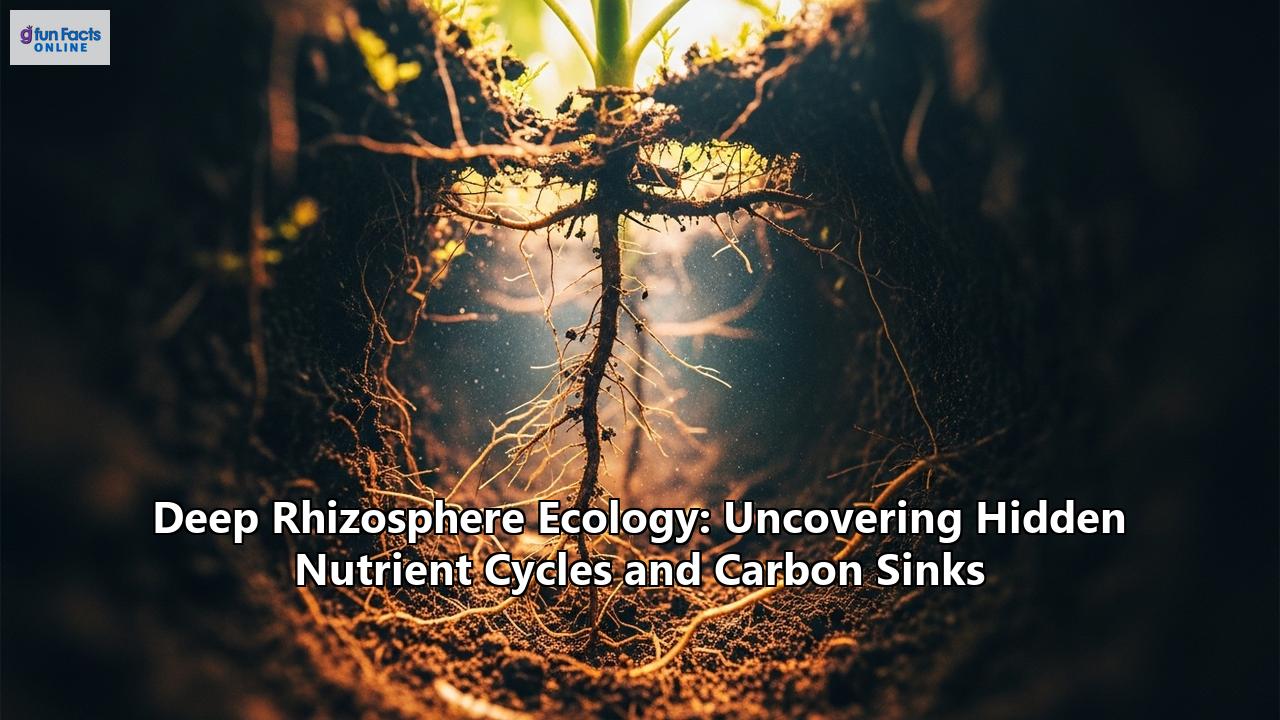
Beneath our feet, extending far beyond the familiar topsoil, lies a dynamic and critically important frontier of science: the deep rhizosphere. This hidden world, the zone of soil immediately surrounding plant roots that can plunge meters into the earth, is a hotbed of biological and chemical activity. It is a realm where plants, microbes, and geology intersect in a complex dance that governs nutrient cycles, stores vast amounts of carbon, and holds profound implications for our planet's health, particularly in the face of climate change. For decades, our focus has been on the surface, but a paradigm shift is underway as scientists dig deeper, uncovering a subterranean ecosystem more vibrant and vital than ever imagined.
The Unseen World: Beyond the Surface
Traditionally, soil science has concentrated on the top 30 centimeters of soil, where ecological processes are most apparent. However, this perspective is incomplete. In many ecosystems, from forests to grasslands, plant roots penetrate far deeper, sometimes reaching tens of meters into weathered bedrock. A recent study revealed that many plants develop a second, deeper layer of roots, often more than three feet underground, to access additional nourishment, a pattern previously unrecognized. These deep roots are not merely passive anchors; they are active agents that shape their environment, creating a unique "deep rhizosphere."
This deep environment is profoundly different from the surface. It is characterized by lower oxygen levels, higher soil density, and less availability of the easily accessible carbon and nutrients found in the topsoil's rich litter. Yet, life persists and even thrives. The total biomass of bacteria and fungi in these deep layers can be as high as in the topsoil, and they play a crucial role in biogeochemical processes. Understanding this deep frontier is essential, as it is pivotal to services like soil formation, water regulation, and, critically, the long-term sequestration of carbon.
A Web of Life: The Deep Microbial Ecosystem
The deep rhizosphere hosts a unique cast of microbial characters. While microbial biomass generally decreases with depth, the communities that exist are distinct and highly specialized. These are not simply stragglers from the surface but are ecosystems dominated by poorly known bacterial and archaeal taxa adapted to low-energy conditions. For instance, researchers have identified specific groups like Chloroflexi, Nitrospirae, and the candidate phylum Dormibacteraeota that are overrepresented in deep soil layers. Some of these microbes have evolved fascinating survival strategies, including the ability to enter dormancy or use atmospheric trace gases for energy.
A groundbreaking discovery identified a completely new phylum of microbe, CSP1-3, thriving at depths down to 70 feet in soils in both Iowa and China. Surprisingly, these microbes were not rare but dominant, in some cases making up over 50% of the microbial community. Genetic analysis revealed their ancestors were aquatic, and they have evolved over millions of years to adapt to this nutrient-poor environment, acting as "scavengers" that help purify water by consuming carbon and nitrogen that leaches from the surface. These deep microbes are central to the transformation of nutrients and the stability of soil organic carbon. In fact, a large fraction of the carbon stored in deep soils is composed of dead microbial cells, or "necromass," highlighting their critical role in creating a stable carbon sink.
The Hidden Pathways of Deep Nutrient Cycling
Plants send roots deep into the earth primarily to find water and nutrients that are scarce at the surface, especially during dry periods. This subterranean foraging has profound effects on the cycling of essential elements like nitrogen and phosphorus. The deep rhizosphere essentially extends the entire nutrient cycle meters below what is traditionally considered soil.
Nitrogen: Nitrogen is often the most limiting nutrient for plant growth. Research has shown that in the deep, weathered bedrock, biologically available nitrogen can be found in concentrations comparable to those in fertile topsoil, and it is primarily in organic forms. This nitrogen cycling is driven by an active rhizosphere, where plants release carbon-rich compounds (exudates) that fuel microbial activity. These microbes, in turn, transform nitrogen into forms that plants can absorb. Phosphorus and other nutrients: Plant roots can alter their chemistry at different depths to acquire necessary nutrients. For example, deeper roots might release low-carbon organic acids to unlock phosphorus bound to minerals, a different strategy than that used by shallower roots accessing organically-bound nutrients. Furthermore, agroforestry systems demonstrate how deep-rooted trees can "pump" nutrients from deep soil layers. Fungal partners, or mycorrhizae, associated with these roots are crucial, helping to solubilize and absorb nutrients from deep underground. These nutrients are then brought to the surface through the decomposition of leaf litter and shallow roots, enriching the topsoil for other plants. Deep roots also play a role in retrieving nutrients that have been leached from the surface, preventing their complete loss from the ecosystem.A Crucial Ally Against Climate Change: The Deep Carbon Sink
The soil holds at least twice as much carbon as the atmosphere, making it a critical reservoir in the global carbon cycle. While we have long understood the importance of topsoil in carbon storage, the deep soil is now being recognized as a massive and potentially more stable carbon sink. Up to 50% of a forest's soil organic carbon can be located below 20 cm, and this carbon tends to be much older and more resistant to change than surface carbon.
Deep roots are the primary conduit for getting this carbon underground. Plants contribute to this deep carbon pool in several ways:
- Root Biomass and Turnover: The physical substance of the roots themselves contains carbon. When deep roots die, their carbon has a much longer residence time because decomposition rates are slower in the harsher deep-soil environment.
- Rhizodeposition: Live roots constantly release carbon-containing compounds called exudates. This process, known as rhizodeposition, can account for 20% to 50% of a plant's total root production and feeds the deep microbial communities. This microbial activity is key to forming stable soil organic matter.
- Microbial Necromass: As mentioned, the bodies of dead microbes form a significant portion of deep soil carbon. This pathway, turning plant exudates into microbial bodies and then into stable soil carbon, is a vital and previously underestimated mechanism for long-term carbon storage.
The stability of this deep carbon is a key advantage. Unlike surface carbon, which is vulnerable to disturbances like fire, erosion, or even standard agricultural ploughing, deep carbon is better protected. Harsher conditions at depth, such as low oxygen, can prevent microbes from easily breaking down organic matter and releasing the carbon back into the atmosphere as CO2.
The Frontier of Discovery: Challenges and New Technologies
Studying an environment meters below the ground is inherently challenging. The sheer logistics of digging deep pits and collecting samples across large areas presents a significant hurdle. This difficulty is a primary reason why deep soils have remained a "black box" for so long.
However, a wave of new technologies is beginning to shed light on this hidden world.
- Advanced Imaging: Researchers are now using techniques like X-ray micro-computed tomography (CT) to create detailed 3D images of root systems and soil structure without excavation. Other advanced methods, such as combining laser ablation with spectroscopy, allow for detailed chemical analysis of the narrow rhizosphere from minuscule samples.
- Genetic and 'Omics' Tools: The discovery of genes that control root architecture, such as the EGT1 gene that influences root angle in wheat and barley, opens the door to breeding crops with steeper, deeper roots specifically designed for enhanced carbon sequestration. The discovery of the DRO1 gene has already made it possible to breed rice varieties with deeper roots that can better withstand drought.
- Sophisticated Monitoring and Modeling: Novel instruments like Vadose Zone Monitoring Systems can now be installed deep into bedrock to provide real-time data on moisture, water chemistry, and even reactive gases like CO2. This data, combined with artificial intelligence and machine learning, is helping to build more accurate models that can predict how carbon and nutrients are cycled in these deep systems.
The Future is Deep
The emerging field of deep rhizosphere ecology is reshaping our understanding of how terrestrial ecosystems function. The knowledge being unearthed has profound implications. For agriculture, breeding crops with deeper root systems could lead to more resilient plants that require less fertilizer and water, while simultaneously enriching the soil and storing more carbon. This offers a powerful tool for developing more sustainable farming practices.
For climate change mitigation, harnessing the power of the deep rhizosphere to sequester atmospheric carbon represents a vital natural solution. By understanding and promoting the processes that lock carbon deep in the soil for centuries, we can enhance the role of natural and agricultural lands in the fight against rising CO2 levels.
The journey into the deep rhizosphere has only just begun. It is a journey that requires an interdisciplinary approach, combining soil science, microbiology, plant physiology, and hydrology. As we continue to dig deeper, we are not just uncovering the secrets of the soil; we are gaining a more complete picture of life on Earth and finding new, nature-based pathways to a more sustainable future.
Reference:
- https://sustainability-directory.com/term/rhizosphere/
- https://www.researchgate.net/publication/225007952_Rhizosphere_Biophysics_biogeochemistry_and_ecological_relevance
- https://www.mdpi.com/2571-8789/8/4/105
- https://academic.oup.com/aob/article/118/4/621/2196536
- https://www.researchgate.net/publication/305039120_Understanding_deep_roots_and_their_functions_in_ecosystems_An_advocacy_for_more_unconventional_research
- https://rootbiome.tamu.edu/wp-content/uploads/sites/38/2015/06/2013-Maeght-deep-roots-matter-fpls-04-00299.pdf
- https://yaminapressler.com/Website/hidden/Soils+run+deep%2C+but+digging+isn't+always+easy
- https://botany.one/2016/10/deep-roots-functions-ecosystems/
- https://www.cabidigitallibrary.org/doi/10.1079/cabireviews.2024.0024
- https://www.biorxiv.org/content/10.1101/2024.01.08.574278v1.full-text
- https://www.nyu.edu/about/news-publications/news/2025/june/scientists-find-unexpected-deep-roots-in-plants.html
- https://www.frontiersin.org/journals/microbiology/articles/10.3389/fmicb.2021.674160/full
- https://www.researchgate.net/publication/338865927_Microbial_Life_Deep_Underfoot
- https://journals.asm.org/doi/abs/10.1128/mbio.03201-19
- https://msutoday.msu.edu/news/2025/msu-scientists-discover-new-microbes-in-earths-deep-soil
- https://cid-inc.com/blog/root-systems-role-in-ecosystems/
- https://www.researchgate.net/publication/377322433_Deep_rhizospheres_extend_the_nitrogen_cycle_meters_below_the_base_of_soil_into_weathered_bedrock
- https://pmc.ncbi.nlm.nih.gov/articles/PMC3321694/
- https://bg.copernicus.org/articles/17/5223/2020/bg-17-5223-2020.html
- https://krishinetra.com/Aug/002.pdf
- https://pmc.ncbi.nlm.nih.gov/articles/PMC3158691/
- https://www.earth.com/news/deeper-plant-roots-could-boost-soil-carbon-storage/
- https://news.ucsc.edu/2023/10/earth-energyshot/
- https://www.pnnl.gov/publications/new-tool-dig-rhizosphere
- https://alliancebioversityciat.org/stories/ai-deeper-roots-help-soil-store-carbon
- https://aca.pensoft.net/article/156623/
- https://alexandrewadoux.github.io/assets/pdf/Wadoux_et_al_2020.pdf
- https://www.mdpi.com/2571-8789/7/3/64
- https://www.frontiersin.org/research-topics/71149/outcomes-of-rhizosphere-6---rooting-for-earth-the-future-of-rhizosphere-research
- https://www.researchgate.net/profile/Kevin-Mccann-4/publication/46696964_Soil_Rhizosphere_Food_Webs_Their_Stability_and_Implications_for_Soil_Processes_in_Ecosystems/links/5f22b2bb299bf134049285ee/Soil-Rhizosphere-Food-Webs-Their-Stability-and-Implications-for-Soil-Processes-in-Ecosystems.pdf