
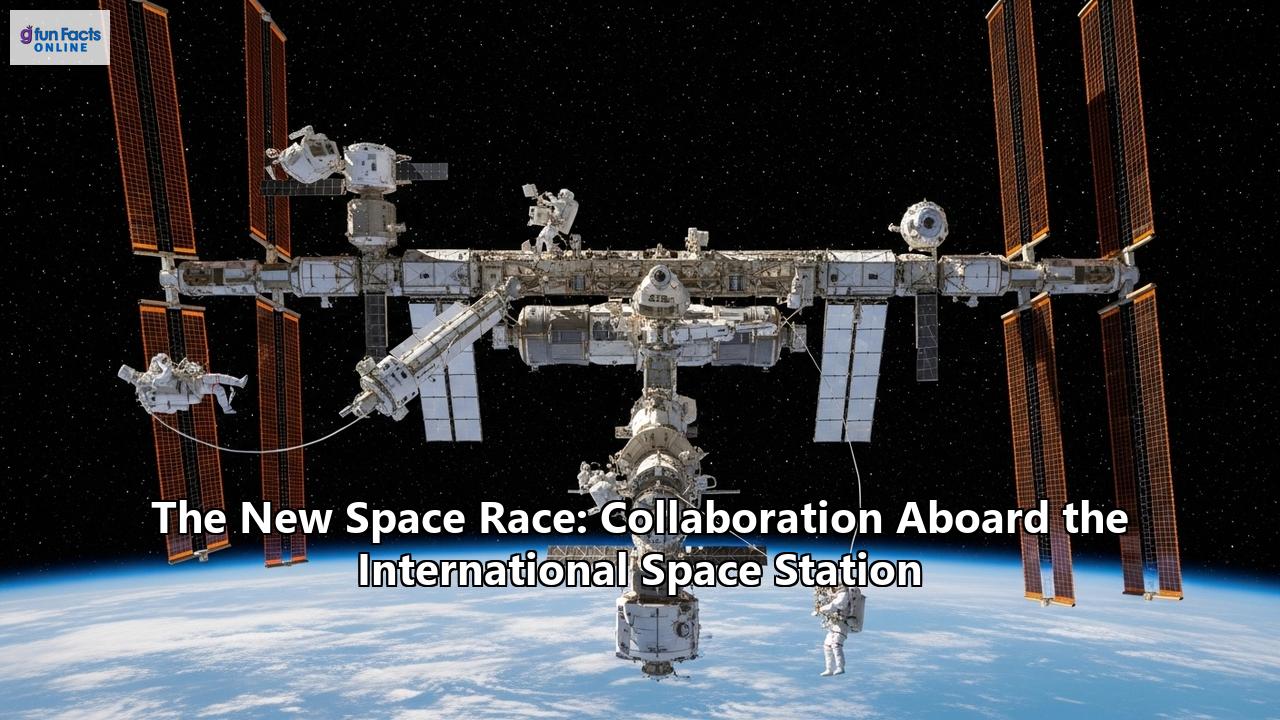
A New Space Race Forged in Orbit: The Enduring Collaboration Aboard the International Space Station
Orbiting 250 miles above a world of shifting alliances and terrestrial conflicts, the International Space Station (ISS) stands as a monumental testament to human ingenuity and, perhaps more remarkably, to our capacity for cooperation. For over two decades, this sprawling orbital laboratory, a joint project of the United States, Russia, Europe, Japan, and Canada, has been a beacon of peaceful partnership, a place where astronauts and cosmonauts have lived and worked side-by-side, their shared mission transcending the political divides below. But as a new, more complex space race heats up—this time involving not just superpowers but also private companies and ambitious emerging nations—and as geopolitical tensions on Earth reach a fever pitch, the very foundation of this unprecedented collaboration is being tested like never before. The story of the ISS in the 21st century is a tale of two competing narratives: one of a resilient, history-making partnership that continues to yield scientific breakthroughs, and another of a new, multipolar contest for dominance in the final frontier, a race that will define the future of humanity's place among the stars.From Cold War Rivals to Orbital Partners: The Genesis of the ISS
The seeds of the International Space Station were sown in the political thaw that followed the Cold War. The bitter space race between the United States and the Soviet Union, a decades-long struggle for technological and ideological supremacy, had given way to a new era of cautious optimism. With the dissolution of the USSR in 1991, the incentives for a purely competitive space race diminished. Instead, the immense cost and complexity of the next logical steps in space exploration—namely, a permanent human outpost in orbit—pushed the former adversaries toward an unlikely alliance.
This historic pivot from competition to cooperation did not happen overnight. It was built on a foundation of trust laid by precursor programs, most notably the Apollo-Soyuz Test Project in 1975, which saw the first-ever international spacecraft docking and a symbolic "handshake in space" that marked the beginning of the end of the Cold War in orbit. This spirit of détente was rekindled in the early 1990s. In 1993, with both the American "Space Station Freedom" and Russia's planned "Mir-2" station facing budgetary hurdles, U.S. Vice President Al Gore and Russian Prime Minister Viktor Chernomyrdin announced the groundbreaking decision to merge their programs.
This led to the Shuttle-Mir program, a crucial "Phase One" designed to build the operational and interpersonal trust necessary for a long-term partnership. Between 1994 and 1998, American Space Shuttles docked with the Russian Mir space station eleven times, allowing seven American astronauts to experience long-duration spaceflight alongside their Russian counterparts, accumulating nearly 1,000 days in space. This period was invaluable, giving NASA its first significant experience with long-duration missions since the Skylab program of the 1970s and providing both nations with the practical experience of working together in the unforgiving environment of space.
The success of the Shuttle-Mir program paved the way for the formal establishment of the International Space Station. On January 29, 1998, fifteen nations signed the International Space Station Intergovernmental Agreement (IGA), a treaty-level document that established the legal and cooperative framework for the design, development, operation, and utilization of a permanently inhabited civil space station for peaceful purposes. This complex agreement outlined ownership of the station's modules, rights to its resources and crew time, and the shared responsibilities for its maintenance and operation—a legal marvel as intricate as the station's engineering.
The station itself is a physical manifestation of this partnership. Divided into the Russian Orbital Segment (ROS) and the US Orbital Segment (USOS), its very architecture is a symbol of the interconnectedness of the partners. The ROS, operated by Roscosmos, provides the station's primary propulsion and attitude control, essentially keeping it in orbit and steering it away from space debris. The USOS, which includes contributions from NASA, the European Space Agency (ESA), the Japan Aerospace Exploration Agency (JAXA), and the Canadian Space Agency (CSA), provides most of the station's power and serves as its primary scientific hub. This interdependence was a conscious design choice, meant to bind the partnership together. On November 20, 1998, a Russian Proton rocket launched the first module, Zarya. Two weeks later, the Space Shuttle Endeavour delivered the American-made Unity node, and the two were joined, officially beginning the construction of humanity's shared home in space.
A Laboratory in the Heavens: The Fruits of Unprecedented Collaboration
The ISS is far more than a political symbol; it is the most advanced and unique laboratory ever built. For over two decades, its microgravity environment has allowed more than 3,000 experiments from 108 countries, leading to breakthroughs that are impossible to achieve on Earth. The station's primary mission is to conduct a wide range of scientific research, from astrobiology and astronomy to meteorology and physics, while also serving as a crucial testbed for the technologies and human endurance needed for future deep-space missions to the Moon and Mars.
The collaborative nature of the ISS has been a force multiplier for science, allowing for the pooling of resources, expertise, and crew time. This synergy has yielded remarkable discoveries with profound implications for life on Earth.
Medical Breakthroughs: The accelerated aging process observed in astronauts, including muscle atrophy and bone density loss, provides a unique model for studying diseases that affect the elderly on Earth. Research on the ISS has provided new insights into conditions like Alzheimer's, Parkinson's, cancer, and heart disease. For example, studying protein clusters in microgravity has aided Alzheimer's research, while observing the growth of endothelial cells, which are crucial for tumor formation, has advanced cancer studies. Italian researchers studying the 5-LOX enzyme, which regulates cell life expectancy, found it to be more active in space, providing a potential target for drugs to combat the weakening of the immune system. Technological and Materials Science Innovation: The station has been a hotbed for technological development. The German-Russian PKE experiment, one of the first on the ISS, has become one of its most successful, studying plasma crystals in microgravity and yielding over 100 scientific publications. Research into the behavior of "cool flames"—a form of combustion at much lower temperatures—was an unexpected discovery from the Flame Extinguishing Experiment (FLEX) and could lead to more efficient and less polluting engines on Earth. The development of amorphous metals, or bulk metallic glasses, has also been a significant achievement, with their unique atomic structure providing high strength and hardness for use in advanced manufacturing. A New View of Earth and the Cosmos: From its vantage point 250 miles up, the ISS provides an unparalleled platform for observing our planet. Instruments on board help track natural disasters like hurricanes and wildfires, monitor climate change, and study Earth's atmosphere, providing data that complements traditional remote-sensing satellites. Looking outward, the Alpha Magnetic Spectrometer (AMS-02), a massive particle physics detector, has collected data on over 100 billion cosmic particles, searching for evidence of dark matter and antimatter to help us understand the fundamental composition of the universe. A Stepping Stone to Deeper Space: The ISS is humanity's most important proving ground for long-duration spaceflight. The lessons learned about life support systems, water recycling (where 93% of water is reclaimed), growing food in space, and the psychological and physiological effects of living in microgravity are all essential for planning future crewed missions to the Moon and Mars under NASA's Artemis program and other international efforts.The New Space Race: A Crowded and Complicated Frontier
While the ISS represents a model of cooperation, the broader landscape of space exploration has become increasingly competitive. The "New Space Race" is a multipolar and multifaceted contest, fundamentally different from the two-horse race of the Cold War. It is characterized by a host of new actors, including private companies with immense resources and a growing number of spacefaring nations, each with its own ambitions. This race isn't just about planting flags; it's about establishing economic footholds, securing strategic advantages, and shaping the future of governance in the cosmos.
The Rise of Commercial Space: Perhaps the most significant shift has been the explosion of the private space industry. A few decades ago, space was the exclusive domain of governments, but today there are over 12,000 space-focused companies, profoundly changing the economics and accessibility of orbit. NASA has been a key catalyst in this shift, fostering a vibrant commercial market through programs like Commercial Cargo and Commercial Crew.Since the retirement of the Space Shuttle in 2011, NASA has relied on private companies to ferry supplies and, more recently, astronauts to the ISS. The Commercial Resupply Services (CRS) contracts, with a combined maximum value of $14 billion, have seen companies like SpaceX and Northrop Grumman become the station's lifeline, conducting dozens of cargo missions.
More transformational has been the Commercial Crew Program. In 2014, NASA awarded contracts to Boeing (up to $4.2 billion) and SpaceX (up to $2.6 billion) to develop independent American systems to transport astronauts to the ISS, ending years of sole reliance on Russia's Soyuz spacecraft. SpaceX began operational flights in 2020, and NASA has since extended its contract for a total of fourteen missions, valued at nearly $5 billion. This "space taxi" model, where NASA buys a service rather than owning and operating the hardware, has not only saved the agency money but has also kickstarted a new commercial human spaceflight industry.
This commercialization is now poised to define the post-ISS era. With the station's retirement planned for around 2030, NASA is actively funding the development of commercial space stations to ensure a continuous U.S. presence in low-Earth orbit. Several ambitious projects are underway:
- Axiom Station: Axiom Space is building the world's first commercial space station, with a unique business model that begins with attaching its own modules to the ISS starting in 2026, before detaching to become a free-flying outpost. The company already has a $1.26 billion contract to develop next-generation spacesuits for NASA and has conducted multiple private astronaut missions to the ISS, building a multi-faceted business around research, manufacturing, and space tourism.
- Orbital Reef: Led by Blue Origin and Sierra Space, Orbital Reef is envisioned as a "mixed-use business park" in space, providing services for commerce, research, and tourism. With partners including Boeing and Arizona State University, the project was awarded $130 million from NASA for initial development and aims to be operational by the end of the decade.
- Starlab: A joint venture between the American company Voyager Space and the European aerospace giant Airbus, Starlab is planned as a continuously crewed station dedicated to advanced research. The project received $160 million in initial NASA funding and is designed to be launched on a single SpaceX Starship flight around 2028.
This shift from a single, government-run outpost to multiple, commercially-operated destinations represents a fundamental paradigm shift in how humanity will live and work in space.
New National Ambitions: Beyond the commercial boom, a new cohort of nations is asserting its presence in space, challenging the long-held dominance of the U.S. and Russia.- China's Celestial Palace: Explicitly excluded from the ISS partnership by U.S. law, China has forged its own path, developing the impressive Tiangong space station. Operational since 2022, Tiangong is a modern, modular station that can host three astronauts for long-duration missions. While smaller than the ISS, China has ambitious plans for expansion and is actively marketing it as a platform for international collaboration, particularly for nations in the Global South. Pakistan, Egypt, and Bahrain are among the countries that have signed on for cooperative projects. This makes Tiangong a direct alternative to the Western-led model of space cooperation and a significant tool of geopolitical influence for Beijing.
- The Russia-China Lunar Alliance: In a clear counterpoint to the U.S.-led Artemis program, Russia and China have announced a "no-limits" partnership to build the International Lunar Research Station (ILRS). Their ambitious plans include constructing a permanent, nuclear-powered robotic base on the Moon's south pole by 2036, with the potential for human presence later. This alliance has already attracted over a dozen partners, including Venezuela, Pakistan, and South Africa, creating a distinct geopolitical bloc in the race back to the Moon.
- India's Ascent: India has emerged as a major space power, with stunning successes like its Chandrayaan-3 mission, which made it the first nation to land a craft near the Moon's south pole. Looking ahead, the Indian Space Research Organisation (ISRO) is planning its own space station, the Bharatiya Antariksh Station (BAS), with the first module scheduled for launch in 2028 and completion by 2035. The five-module station will support long-duration missions and serve as a stepping stone for India's plans to send an astronaut to the Moon by 2040.
- The UAE's Vision: The United Arab Emirates has rapidly become a significant player, investing heavily to diversify its economy and become a hub for space technology. Beyond its successful Mars mission, the UAE is a key partner in the U.S.-led Lunar Gateway project, where it will provide the Crew and Science Airlock module, securing a permanent seat on the program and a future trip to the Moon for one of its astronauts.
A Partnership Under Strain: Geopolitics in Orbit
The ISS has long been hailed as a sanctuary from terrestrial politics, an example of "science diplomacy" where shared goals can bridge divides. However, the unprovoked Russian invasion of Ukraine in 2022 has subjected this ideal to its most severe test. The conflict has not broken the partnership, but it has caused deep and lasting damage.
In the wake of sweeping Western sanctions designed to degrade Russia's aerospace and defense industries, the former head of Roscosmos, Dmitry Rogozin, unleashed a torrent of threats on social media. He repeatedly threatened to withdraw from the ISS partnership and suggested that without Russian propulsion, the 500-ton station could come crashing down on the U.S. or Europe. "If you block cooperation with us, who will save the ISS from an uncontrolled de-orbit?" he tweeted, a thinly veiled reference to Russia's critical role in station navigation.
These threats, while largely dismissed by NASA and other partners as inflammatory rhetoric, highlighted the station's delicate interdependencies. Rogozin also announced Russia would halt the sale of rocket engines to the U.S. and would no longer cooperate with Germany on scientific experiments aboard the Russian segment. In a particularly blatant move, Russian cosmonauts posed for photographs aboard the ISS holding the flags of Russian-backed separatist regions in Ukraine, prompting a rare and sharp public rebuke from NASA and ESA for using the station for political propaganda.
Despite the vitriol, day-to-day professional cooperation in orbit has, by necessity, continued. NASA has consistently stated that its professional relationship with Roscosmos continues to ensure the safety of the crew and the station. Astronauts and cosmonauts continue to live, work, and conduct spacewalks together. However, the trust that underpinned the partnership has been eroded. Russia has announced its intention to leave the ISS sometime after 2024 to build its own station, and while it recently extended its participation to 2028, the long-term future of the historic partnership is bleak. In a sign of the changing times, NASA has begun testing the use of Northrop Grumman's Cygnus cargo craft to perform orbital re-boosts, a crucial step in preparing for a future where Russian propulsion is no longer guaranteed.
The Future: Two Paths Diverging in the Cosmos
As humanity looks beyond low-Earth orbit, two distinct visions for the future of space collaboration are emerging, creating a new geopolitical chessboard in the heavens.
On one side are the Artemis Accords, a U.S.-led, non-binding set of principles for peaceful and responsible space exploration. Rooted in the Outer Space Treaty of 1967, the Accords emphasize transparency, interoperability, the release of scientific data, and the establishment of "safety zones" to prevent interference in lunar activities. Dozens of nations, from established space powers like Japan, Canada, and the members of ESA to emerging players like India, Brazil, and the UAE, have signed on, forming a broad coalition for the next era of exploration.
On the other side is the China-Russia ILRS initiative. This partnership presents a direct alternative to the U.S.-led framework, built on a vision of a more multipolar world order. While they also speak of peaceful exploration, their approach is seen by some as more exclusive and state-centric, and their rejection of the Artemis Accords has been framed as a stand against a perceived American-centric model of space governance.
This divergence sets the stage for a new kind of space race—one that is not just about technological firsts, but about competing norms, standards, and spheres of influence. The choice of which framework to join will have long-term strategic implications for nations around the world.
The Enduring Legacy of Collaboration
The International Space Station, now in the twilight of its operational life, is destined to be de-orbited and guided to a controlled splashdown in a remote part of the Pacific Ocean around 2031. Yet its legacy will endure far beyond its fiery reentry. It will be remembered not only for the scientific knowledge it unlocked but for the profound lesson it taught humanity: that even in a world of conflict, collaboration on a grand scale is possible. It proved that nations could set aside their differences to achieve a common goal that was bigger than any single one of them.
The new space race is more crowded, more commercial, and more complicated than the last. It is a landscape of fierce competition and diverging alliances, where the once-unified frontier is fracturing along geopolitical lines. Yet, the spirit of the ISS—the quiet, professional cooperation that continues 250 miles up, day in and day out, even as storms rage below—offers a glimmer of hope. It is a reminder that our shared destiny in the cosmos may ultimately depend not on who wins the race, but on how we choose to run it together. The next chapter of human space exploration is being written now, in the laboratories of private companies, in the mission controls of new spacefaring nations, and in the enduring, if strained, partnership aboard the International Space Station. The final frontier remains a place of both rivalry and fellowship, a reflection of the best and most challenging aspects of our own humanity.
Reference:
- https://www.google.com/search?q=time+in+%D0%94%D0%BE%D0%B1%D1%80%D0%BE%D0%B2%D0%B5%D0%BB%D0%B8%D1%87%D0%BA%D1%96%D0%B2%D1%81%D1%8C%D0%BA%D0%B8%D0%B9+%D1%80%D0%B0%D0%B9%D0%BE%D0%BD,+UA
- https://sciencebusiness.net/news/nasa-plays-down-russias-threat-halt-international-space-station-cooperation
- https://english.elpais.com/science-tech/2022-02-26/how-the-crew-of-the-international-space-station-could-become-unlikely-collateral-victims-of-the-conflict-in-ukraine.html
- https://www.engadget.com/what-economic-sanctions-mean-for-russias-space-program-170003960.html
- https://payloadspace.com/russia-announces-plans-to-leave-iss-partnership/
- https://www.space.com/russia-threatens-leave-international-space-station-program-rogozin
- https://www.pbs.org/newshour/science/space-station-largely-isolated-from-tensions-over-ukraine
- https://www.smithsonianmag.com/smart-news/sanctions-on-russia-reach-outer-space-180979679/
- https://sciencebusiness.net/news/ukraine-war-disrupting-east-west-cooperation-space
- https://www.space.com/roscosmos-rogozin-russia-iss-space-sanctions
- https://www.sciencealert.com/despite-threatening-twitter-thread-from-rogozin-nasa-states-international-space-station-cooperation-will-continue
- https://pacificspacecenter.com/2022/03/17/iss-tensions/
- https://www.astronomy.com/space-exploration/russian-invasion-of-ukraine-and-resulting-u-s-sanctions-threaten-the-future-of-the-international-space-station/
- https://www.space.com/russia-ukraine-nasa-response-iss-operations
- https://time.com/6174331/rogozin-threatens-space-station/
- https://www.space.com/nasa-condemns-russia-cosmonauts-anti-ukraine-propaganda
- https://www.newsweek.com/russian-space-agency-head-suggests-sanctions-may-lead-iss-plummeting-1682474
- https://www.voanews.com/a/russian-space-agency-chief-threatens-to-end-cooperation-over-western-sanctions/6470688.html
- https://www.space.com/russia-war-ukraine-damage-international-spaceflight-cooperation