
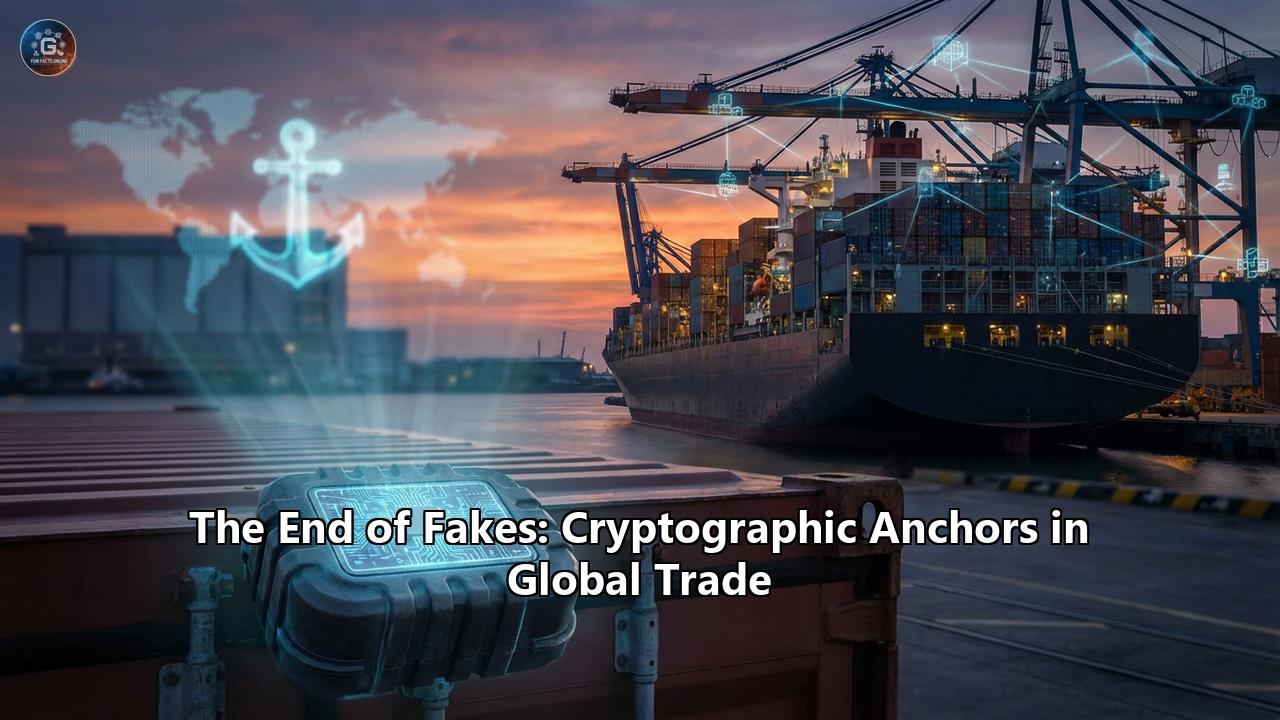
In the shadow of the global economy, a second, darker market thrives. It is a market where brake pads are made of compressed grass, life-saving malaria medication is nothing but chalk, and "vintage" Pinot Noir is a mix of cheap ethanol and food coloring. This is the counterfeit economy, a sprawling, multi-trillion-dollar beast that has, for centuries, played a cat-and-mouse game with legitimacy.
For most of history, trust in trade was local. You knew the blacksmith; you knew the farmer. But as trade lanes stretched from the Silk Road to the container ports of Shenzhen and Rotterdam, that personal link severed. We replaced it with proxies: wax seals, watermarks, holograms, and serial numbers. And one by one, the counterfeiters broke them all.
Today, however, we stand on the precipice of a technological shift so profound it promises to do what thousands of years of laws and stamps could not: physically bind the digital truth to the material world. We are entering the era of the Cryptographic Anchor.
This is not just about better barcodes or smarter stickers. It is about the fusion of material science, quantum physics, and blockchain technology to create objects that cannot be cloned, forged, or denied. It is the story of how a grain of sand, a strand of DNA, or a flicker of light is rewriting the rules of global trade.
Part I: The $4.5 Trillion Shadow
To understand the solution, one must first grasp the terrifying scale of the problem. The Organization for Economic Co-operation and Development (OECD) and other watchdogs estimate the trade in counterfeit and pirated goods to be worth between $600 billion and $4.5 trillion annually. To put that in perspective, if the counterfeit economy were a country, its GDP would rival that of Germany.
But the dollar figure is the least efficient metric of the damage. The true cost is measured in the erosion of reality.
- In Medicine: The World Health Organization estimates that 10% of medical products in developing countries are substandard or falsified. In parts of Africa, that number climbs to 70% for anti-malarials. These fakes don't just fail to cure; they actively kill, and worse, they breed drug-resistant superbugs by introducing sub-therapeutic doses of active ingredients into the population.
- In Industry: A counterfeit bolt in an aircraft engine or a fake microchip in a missile defense system isn't a financial loss; it is a catastrophic failure waiting to happen. In 2018, the U.S. military discovered a widespread infiltration of counterfeit electronics in its supply chain, raising alarms about national security vulnerabilities.
- In Luxury: While often dismissed as a "victimless crime," the fake handbag trade funds organized crime rings, human trafficking, and terror groups. The "Super Fake" industry in Guangzhou has become so sophisticated that even seasoned authenticators often cannot tell the difference between a $15,000 Hermès Birkin and its $200 doppelgänger without dismantling the bag.
Economist George Akerlof won a Nobel Prize for describing the "Market for Lemons"—a scenario where the buyer’s inability to distinguish between high-quality goods (peaches) and low-quality goods (lemons) drives the high-quality sellers out of the market. Counterfeiting is the ultimate realization of Akerlof’s nightmare. When you can no longer trust that the extra money you pay guarantees safety or quality, the entire market collapses into a race to the bottom.
Part II: The Birth of the Crypto Anchor
The fundamental flaw in all previous anti-counterfeit technologies—from the coin "reeding" introduced by Isaac Newton to the holograms on your credit card—is that they are extrinsic. They are added to the product. If a hologram can be made by a legitimate factory, it can be made by an illegitimate one. If a QR code can be printed, it can be photocopied.
The Cryptographic Anchor (or "crypto-anchor") changes this paradigm. It is a mechanism that links a unique, uncloneable physical property of an object to a digital record (usually on a blockchain).
IBM researchers, pioneers in this field, define it as a "digital fingerprint" for physical goods. Just as you cannot easily replicate a human fingerprint because of its random, chaotic formation, a crypto anchor relies on entropy—randomness introduced during manufacturing that is mathematically impossible to reproduce, even by the original manufacturer.
The anchor serves two functions:
- Authentication: "Is this the object you claim it is?"
- Provenance: "Where has this object been?"
The magic happens when this physical entropy is digitized and stored on a blockchain. The blockchain provides the immutable history (the "who, what, where"), while the anchor provides the physical proof (the "this is it"). Without the anchor, a blockchain supply chain is just a "Garbage In, Garbage Out" system; you could have a perfect digital record of a fake handbag. The anchor bridges the air gap between the atom and the bit.
Part III: The Hardware of Truth
How do you fingerprint a diamond, a pill, or a sneaker? The technology stack is diverse, relying on the cutting edge of physics and biology.
1. The Silicon Fingerprint: PUFs
At the heart of many electronic crypto anchors is the Physically Unclonable Function (PUF).
When a silicon chip is manufactured, microscopic variations occur in the manufacturing process—slight differences in the thickness of the silicon wafer or the doping concentration. These variations are usually considered defects, but PUF technology treats them as features.
- SRAM PUFs: When a Static Random-Access Memory (SRAM) cell powers up, it naturally settles into a state of 1 or 0. Which way it settles depends on these microscopic physical variations. A chip with thousands of SRAM cells will produce a random string of 1s and 0s upon startup. This string is unique to that specific chip. It is a fingerprint born from the chaos of quantum mechanics during fabrication.
- Arbiter PUFs: These measure the time delay of an electrical signal racing through the chip. Because of atomic-level differences in wire pathways, the signal will arrive at slightly different times on different chips.
The beauty of a PUF is that you don't need to store a secret key on the device (which can be stolen). The device is the key. To clone it, you would need to place individual atoms in the exact same arrangement—a feat currently impossible.
2. The Optical Fingerprint: Dust Identity
For non-electronic goods, we turn to Diamond Dust.
A startup called Dust Identity (born from MIT research) uses microscopic diamonds to tag objects. They spray a fine coating of polymer containing engineered nanodiamonds onto an item—say, an aerospace component or a luxury watch.
- The Randomness: As the diamonds land, they settle in random orientations and positions.
- The Lock: A scanner reads this distribution. The diamonds fluoresce and reflect light in a way that creates a complex, 3D optical signature.
- The Math: The number of possible combinations is astronomical ($10^{230}$). Even if you had the same diamonds and the same spray gun, you could never recreate the exact same scatter pattern.
This "Dust" can be applied to the head of a screw, the label of a sneaker, or the circuit board of a fighter jet. Once scanned and logged, any attempt to scrape it off or tamper with it destroys the pattern, signaling fraud.
3. The Biological Fingerprint: DNA Tagging
Applied DNA Sciences takes the concept to the molecular level. They use synthetic DNA sequences—short strands of genetic code—to tag materials.- Application: This DNA can be misted onto cotton fibers before they are woven into shirts, or mixed into the ink used to print pharmaceutical labels.
- Verification: Field inspectors can use portable PCR (Polymerase Chain Reaction) devices to test the product. If the DNA matches the specific "botanical SigNature" encrypted in the company’s database, it’s genuine.
This is particularly powerful for raw materials. You can't put a microchip in a vat of olive oil or a bale of cotton, but you can dope them with safe, edible DNA markers that survive the manufacturing process.
4. The Digital Witness: p-Chip
For extreme durability, the p-Chip offers a different approach. It is a semiconductor light-activated microtransponder, the size of a grain of salt. Unlike RFID, which requires bulky antennas, the p-Chip is powered by light (laser) and transmits its ID via radio frequency.
- Durability: It can survive temperatures from -200°C to +500°C, extreme pressure, and chemical baths.
- Use Case: It is being used to tag everything from insect specimens in museums to industrial tools in harsh environments. Because it is so small, it can be embedded inside products, not just on the packaging.
Part IV: The Digital Ledger (The Blockchain Connection)
Having a physical fingerprint is useless if you don't have a secure place to store the record. This is where Blockchain enters the equation.
In a traditional supply chain, data is siloed. The manufacturer has a database, the shipper has a spreadsheet, and the retailer has an inventory system. These siloes are opaque. A counterfeiter exploits these gaps by injecting fake paperwork or swapping goods during transit.
Blockchain creates a Shared Truth.
- The Genesis Block: When a luxury watch is made, its crypto anchor (e.g., a Dust Identity tag) is scanned. This scan creates a digital token (a "Digital Twin") on the blockchain.
- The Chain of Custody: As the watch moves from factory to courier to warehouse, each custodian scans the anchor. The blockchain records the time, location, and identity of the handler.
- Smart Contracts: These are self-executing code on the blockchain. A smart contract could say: "If the watch is not scanned at the customs port by Date X, flag it as stolen." or "Release payment to the supplier only when the retailer confirms the crypto anchor scan matches the Genesis block."
Part V: Sector Revolution
The application of cryptographic anchors is reshaping major global industries.
Pharmaceuticals: The Pill that Talks
The U.S. Drug Supply Chain Security Act (DSCSA) and the EU Falsified Medicines Directive (FMD) have mandated strict track-and-trace systems. But they largely rely on 2D DataMatrix codes (like QR codes) on boxes.
Crypto anchors are going deeper. Edible crypto-anchors are in development—micro-patterns printed directly onto pills using magnesium and silicon (safe to ingest). A patient could take a photo of the pill with a smartphone app before swallowing. The app analyzes the micro-texture of the pill, verifies it against the blockchain record, and confirms it’s not a dud.
This is a shift from "Trust the Pharmacy" to "Trust the Pill."
Food & Agriculture: From Farm to Fork
Walmart pioneered food traceability using blockchain (Hyperledger Fabric) to track pork in China and mangoes in the US. By integrating crypto anchors (like DNA mist on leafy greens or ruggedized p-Chips on crates), the time to trace the source of a salmonella outbreak dropped from 7 days to 2.2 seconds.In the high-value wine market, bottles are being tagged with NFC chips with rolling encryption. Every time you tap the bottle with your phone, the chip generates a new, one-time-use code. If a counterfeiter tries to clone the chip, they will only copy an old code, which the backend system will instantly reject.
Automotive & Aerospace: The Safety Critical
In the automotive aftermarket, counterfeit parts are a silent plague. A fake airbag that deploys 0.1 seconds too late is fatal.
Crypto anchors are allowing manufacturers to create a "Digital Thread" for parts. A brake caliper can be stamped with a 3D micro-structure during casting. When a mechanic installs it, they scan it. The car's onboard computer could theoretically refuse to recognize a part that doesn't have a valid cryptographic signature, preventing the vehicle from operating with unsafe components—a concept known as "The Internet of Trusted Things."
Part VI: The Cat and Mouse Game (The Arms Race)
History teaches us that every security measure eventually falls. Are crypto anchors invincible? No.
The Cloning Threat:While PUFs are theoretically unclonable, researchers have developed Machine Learning Modeling Attacks. By querying a PUF thousands of times (sending it "challenges" and recording the "responses"), an attacker can train an AI model to predict how the PUF will behave. If the AI becomes accurate enough, the attacker can create a software clone of the hardware chip.
- The Counter-Move: XOR PUFs and Double Arbiter PUFs introduce non-linearity, making the AI's job exponentially harder. It is an arms race between the complexity of the silicon chaos and the pattern-recognition power of AI.
If a bottle of vintage wine has a perfect crypto-anchor on the label, but the wine inside has been siphoned out and replaced with vinegar, the anchor is lying.
- The Counter-Move: Tamper-Evident Anchors. New designs integrate the anchor into the seal. Graphene-based printed electronics can detect if a paper seal has been torn, even if re-glued. The electrical resistance of the seal changes permanently upon tearing, updating the digital twin to "Void."
As 3D printing resolution improves, could counterfeiters simply "print" the micro-textures used by optical anchors?
- The Counter-Move: We are moving toward Internal Features. 3D printing can copy the surface, but it struggles to replicate internal density variations or sub-surface refractive layers that can be seen only with terahertz scanners or X-ray inspection.
Part VII: The Human Element and Ethics
As we blanket the world in trackable, verifiable sensors, we run headlong into privacy and ethical concerns.
The "Shirt that Spies":If a luxury jacket has a woven-in RFID crypto anchor that screams "I am authentic" to any scanner nearby, it also screams "Here is a person wearing a $5,000 jacket" to thieves or advertisers.
- Privacy-Enhancing Technologies (PETs) are being developed where the anchor remains silent until "unlocked" by the owner, or uses Zero-Knowledge Proofs to verify authenticity without revealing the owner's identity or location.
If a tractor or an iPhone requires a cryptographically signed spare part to function, it kills the third-party repair market. Manufacturers could use "safety" as a Trojan horse to monopolize repairs, forcing consumers to pay premium prices for "verified" screws and screens. This tension between security and monopoly is currently playing out in courts worldwide.
Consumer Apathy:The biggest hurdle might not be technology, but laziness. Will a consumer actually take their phone out to scan a QR code or a diamond dust tag? Early data suggests "Scanning Fatigue." Most people assume that if it's on a shelf at a reputable store, it's real. The "End of Fakes" relies on an engaged public. If nobody verifies, the anchor is just expensive decoration.
Part VIII: The Future (2035 and Beyond)
Where does this lead?
1. Quantum-Physical Binding:As quantum computers threaten to break the math behind current digital signatures (RSA/ECC), the next generation of anchors will use Post-Quantum Cryptography (PQC). More radically, we may see Quantum Anchors—devices that use the quantum states of atoms (entanglement) as the identifier. This would be truly unbreakable, as measuring the state would destroy it, preventing any cloning attempt (the No-Cloning Theorem).
2. Smart Dust:We are moving from "Passive Anchors" (which wait to be scanned) to "Active Motes." Imagine dust-sized computers with sensors that don't just say "I am a vaccine," but "I am a vaccine, and I have never exceeded 8°C." This merges the Cold Chain with Authentication, ensuring not just authenticity, but viability.
3. The Internet of Goods:In the future, search engines won't just crawl websites; they will crawl the physical world. You could Google "Where is my specific pair of sneakers?" and the blockchain, queried via the mesh network of scanners in the world, would locate its unique crypto-anchor. The distinction between the digital inventory and the physical warehouse will vanish.
Conclusion
The "End of Fakes" is a bold promise. As long as there is value, there will be fraud. However, cryptographic anchors are shifting the economics of counterfeiting. They are raising the cost of forgery from "buying a printer" to "building a semiconductor fab" or "solving quantum equations."
We are moving from an economy based on reputation ("I trust this brand") to an economy based on verification ("I can prove this math"). In a world fracturing under the weight of misinformation and deepfakes, the ability to anchor truth to a physical object may be the most valuable commodity of all. Global trade is upgrading its operating system, and for the counterfeiters, the update might just be fatal.
Reference:
- https://bamboorose.com/blog/compliance-traceability-transparency-retail-supply-chain/
- https://www.ukrise.org/wp-content/uploads/2023/07/Attacking_Arbiter_PUFs_Using_Various_Modeling_Attack_Algorithms_A_Comparative_Study.pdf
- https://www.proquest.com/openview/b5bb960094ab4aab6202dbce7c0cf8c6/1?pq-origsite=gscholar&cbl=2026366&diss=y
- https://hyperglade.com/blog/traceability-in-supply-chain-why-it-matters/
- https://dspace.mit.edu/bitstream/handle/1721.1/71611/ccs_attack_puf.pdf?sequence=1&isAllowed=y
- https://medium.com/@thomasarnosander/protecting-privacy-in-the-supply-chain-data-protection-in-logistics-8ebe96d486c6
- https://www.semanticscholar.org/paper/Modeling-attacks-on-physical-unclonable-functions-R%C3%BChrmair-Sehnke/a88b3be9b2db0319f8880e60a131b3060dba1eb7
- https://www.allthingssupplychain.com/data-privacy-and-security-in-supply-chain-management-systems/
- https://www.cio.com/article/4115117/3-steps-to-prepare-for-a-post-quantum-cryptography-world.html
- https://www.3dnatives.com/en/3d-printing-help-in-the-fight-against-counterfeit-goods-201220224/