
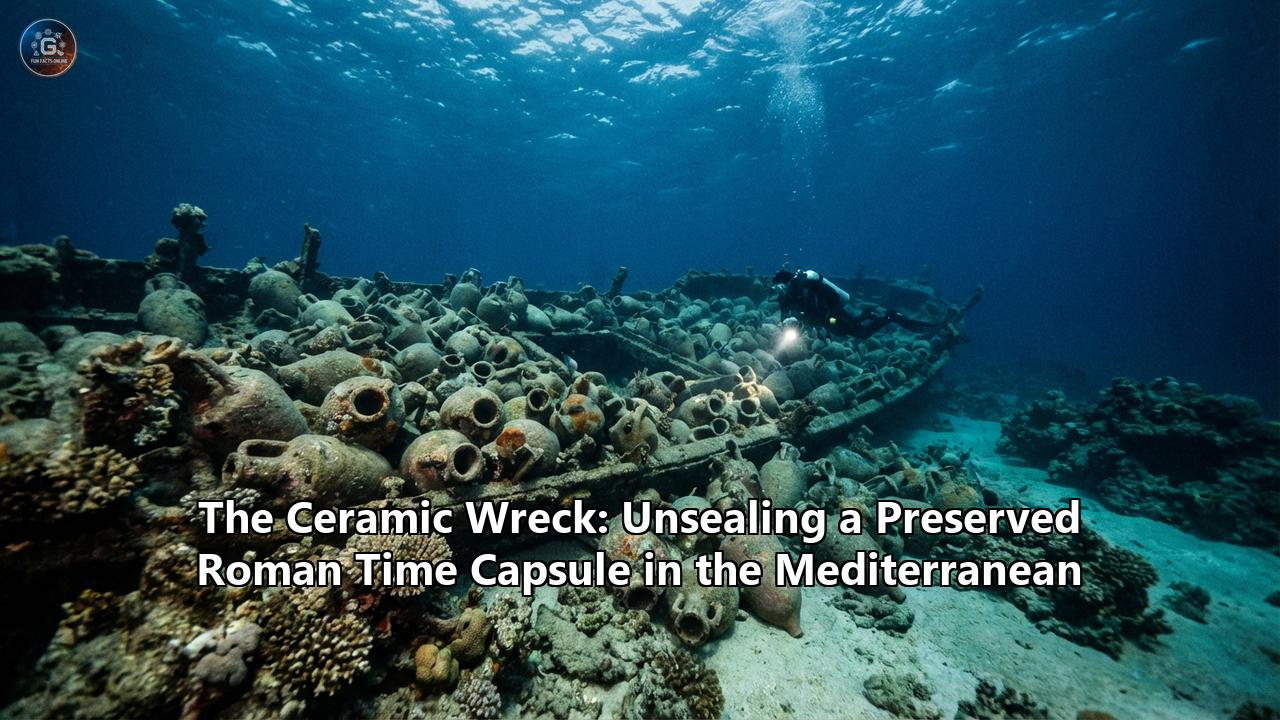
The cobalt blue of the Mediterranean has always been a keeper of secrets, a liquid archive that swallows history and holds it in a suspended, silent embrace. For two millennia, off the sun-drenched coast of Adrasan, Turkey, a Roman merchant ship lay sleeping in the deep, its wooden ribs settling into the seabed, its mission interrupted by a storm that history has long forgotten. It was a ghost ship, a phantom of the ancient world, until a team of divers, guided by the hum of modern technology and the instinct of seasoned archaeologists, descended into the twilight zone.
What they found was not just a shipwreck; it was a miracle of preservation. It was a time capsule so perfect, so meticulously sealed, that it defied the destructive logic of the sea. They called it "The Ceramic Wreck," a name that belies the true majesty of the discovery. This was not merely a pile of broken pots; it was a floating warehouse of the 1st century BC, a snapshot of a booming global economy, frozen in the instant of its destruction.
This is the story of that ship, its cargo, and the extraordinary efforts to bring its secrets back to the surface. It is a journey that takes us from the bustling kilns of ancient Antioch to the high-tech conservation labs of modern Turkey, revealing the "Heritage for the Future" project that is rewriting the history books of the Mediterranean.
Part I: The Discovery in the Deep
The Mediterranean coast of Turkey, known as the Turquoise Coast, is a graveyard of ships. For thousands of years, this stretch of sea was the superhighway of the ancient world, the connector between the grain fields of Egypt, the marble quarries of the Aegean, and the insatiable markets of Rome. But the sea is cruel, and for every ship that made its fortune, countless others were claimed by the jagged rocks and sudden squalls of the Lycian shore.
In the summer of 2024, under the aegis of the Turkish Ministry of Culture and Tourism’s ambitious "Heritage for the Future" (Geleceğe Miras) project, a team of underwater archaeologists led by Dokuz Eylül University began a systematic survey of the coastline. Their goal was not just to find shipwrecks—hundreds were already known—but to find the shipwreck, a vessel that could serve as a Rosetta Stone for understanding Roman maritime logistics.
They found it off Adrasan.
The first indication was a shadowy anomaly on the sonar, a rigid, unnatural shape rising from the chaotic topography of the seabed at a depth of roughly 50 meters (160 feet). It was deep enough to have been protected from the looting and anchor damage that plagues shallower sites, yet accessible enough for technical diving operations.
When the first divers descended, breaking through the thermocline where the water turns icy and clear, they were met with a sight that stopped their breath. Most ancient shipwrecks are tumuli—mounds of amphorae cemented together by marine growth, the wood long gone. But this wreck was different. It was a "plate wreck," a rare and distinct category of shipwreck. Instead of the usual bulky wine jars, the seabed was paved with thousands of red tiles.
As the divers swam closer, their lights cutting through the gloom, the "tiles" resolved into stacks. Perfectly aligned, teetering columns of plates, bowls, and cups. They were not scattered; they were stacked, just as the stevedores had placed them two thousand years ago. It was a scene of eerie domesticity interrupted by catastrophe.
But the true shock came when a diver gently fanned away the silt from one of the stacks. The ceramic was not covered in the hard, concrete-like crust of marine organisms (concretion) that typically encases underwater artifacts. Instead, it was coated in a soft, grey sludge. Underneath that sludge, the ceramic gleamed with a vibrant, lipstick-red gloss.
The diver realized with a jolt that he was looking at Eastern Sigillata A—the finest tableware of the late Hellenistic world—and it looked brand new. The crew of the doomed ship had packed their fragile cargo in raw clay, a brilliant ancient shock-absorber that had inadvertently acted as a hermetic seal against the ocean.
Part II: The Red Gold of Antioch
To understand the significance of the Ceramic Wreck, one must understand its cargo. The ship was not carrying gold or statues; it was carrying something arguably more important for the historian: consumer goods.
The red plates found at Adrasan are known as Eastern Sigillata A (ESA). In the 1st century BC, this was the Tupperware of the elite, the Wedgewood of the aspiring middle class. Produced in the region of Antioch (modern-day Antakya, near the Turkish-Syrian border), ESA was a revolution in ceramic technology.
Before ESA, fine pottery was often black-glazed, imitating the tarnished look of silver. But around 150 BC, fashions changed. The Roman world developed a taste for gold and bronze plate. For those who couldn't afford solid gold dining sets—which was almost everyone—ESA was the answer. The potters of Antioch discovered a way to fire local clay to a deep, rich red and coat it with a slip that, when fired, sintered into a glossy, almost metallic sheen. It looked like polished copper or bronze. It was beautiful, durable, and, crucially, stackable.
The Adrasan ship was a floating factory outlet for this ware. The archaeologists estimate the ship carried thousands of pieces. The standardization is staggering. There are not random assortments of pots; there are hundreds of identical plates of "Form 4," hundreds of bowls of "Form 22." This speaks to a level of industrial production that rivals the modern era. These were not made by a lone potter at a wheel; they were mass-produced in manufactories, ordered in bulk by merchants, and shipped across the sea to grace the tables of Roman citizens in Italy, Spain, and Gaul.
The sheer volume of ESA on the Adrasan wreck forces a recalibration of our economic models. It suggests that the trade in ceramics was not just a "space filler" on grain ships, as was often thought, but a primary trade in itself. This ship was likely chartered specifically to move this high-value tableware from the kilns of the East to the hungry markets of the West.
Part III: The Clay Cocoon – An Ancient Engineering Marvel
The most headline-grabbing aspect of the Adrasan discovery is the preservation method. In the chaotic world of underwater archaeology, finding organic packing material is rare. Usually, crates rot, ropes disintegrate, and straw washes away.
At Adrasan, the Roman stevedores used raw clay.
This was a stroke of genius. Ceramics are heavy and brittle. If you stack a hundred plates on top of each other in a wooden hull pitching in a storm, the bottom plates will crack under the weight and vibration. Straw or sawdust compresses and loses its bounce. But raw, unbaked clay is different. It is malleable, allowing it to be molded between each plate to create a custom fit. It dries hard enough to prevent shifting but remains soft enough to absorb shock.
When the ship sank, this clay packing saved the cargo twice. First, it cushioned the impact as the ship hit the seafloor. Second, and more miraculously, as the wooden crates rotted away, the clay did not dissolve. In the low-energy, silt-heavy environment of the deep seafloor, the clay packing turned into a mud seal. It created an anaerobic (oxygen-free) cocoon around each plate.
Barnacles, shipworms, and coral polyps need a hard substrate to latch onto. They cannot colonize soft mud. Therefore, the clay prevented the marine life from encrusting the ceramics. When the archaeologists remove the clay today, 2,000 years later, the red slip underneath is as bright as the day it came out of the kiln. There is no need for the months of acid baths and mechanical cleaning that usually accompany underwater finds. The Adrasan ceramics are ready for the museum shelf the moment they break the surface.
This "clay cocoon" offers a rare window into the logistics of ancient trade. It shows us that Roman merchants were sophisticated risk managers. They invested heavily in packaging technology to ensure their goods arrived intact. It implies a professional class of packers and stevedores, a logistical chain as complex as any Amazon fulfillment center today.
Part IV: The Ship and the Shift
While the cargo steals the spotlight, the ship itself is a silent witness to a technological revolution. The 1st century BC was a transition period in Mediterranean shipbuilding.
For centuries, Greeks and Phoenicians had built ships using a "shell-first" method. They would carve planks and join them edge-to-edge with elaborate mortise-and-tenon joints (wooden tabs fitted into slots and locked with pegs). It was like building a giant, watertight cabinet. Frames were added later for reinforcement. This made for incredibly strong, durable hulls, but it was slow and labor-intensive.
By the late Roman period, shipbuilders would shift to "skeleton-first" construction—setting up the keel and ribs first and nailing planks to them—which was faster and cheaper but less robust.
The Adrasan ship likely sits right on this cusp. Preliminary surveys of the hull remnants suggest it is a classic example of the mortise-and-tenon tradition. The hull planks are locked together with thousands of oak tenons, creating a shell so rigid it didn't need heavy internal framing. This immense strength is likely why the hull remains coherent even after the trauma of sinking.
The size of the vessel is also significant. Based on the spread of the cargo, the ship is estimated to be between 20 and 25 meters long. This was a medium-sized merchantman, the workhorse of the Mediterranean. It was not one of the giant grain freighters that fed Rome, but a nimble, privately-owned vessel that could navigate smaller harbors and trade networks.
Part V: The "Heritage for the Future" Project
The excavation of the Adrasan wreck is the crown jewel of a massive new initiative by the Republic of Turkey. In 2024, Minister of Culture and Tourism Mehmet Nuri Ersoy announced the "Heritage for the Future" (Geleceğe Miras) project. This is a billion-lira investment designed to accelerate archaeological work across Anatolia.
The philosophy of the project is a shift from "rescue archaeology" (digging only when a site is threatened by construction) to "systematic heritage management." For underwater archaeology, this means moving beyond the famous wrecks like Uluburun (Bronze Age) and focusing on mapping the entire maritime history of the Turkish coast.
The Adrasan excavation employs cutting-edge technology. The team uses Remotely Operated Vehicles (ROVs) to map the site in 3D before a single diver touches the bottom. Photogrammetry software stitches thousands of high-resolution photos together to create a millimeter-accurate digital model of the wreck. This allows researchers to "excavate" the site virtually, testing different strategies for lifting the fragile ceramic stacks without disturbing the hull structure.
The project also emphasizes in situ preservation. Not every artifact needs to be raised. The goal is to create an underwater museum. The vision is that, in the near future, tourists won't just look at these plates behind glass in a museum in Antalya; they will be able to take a submarine or a glass-bottom boat—or dive if they are qualified—to see the "Ceramic Sink" exactly as it lies on the ocean floor.
Part VI: A Window into Roman Life
Why do we care so much about a ship full of plates? Because objects are the fossils of behavior. The Adrasan wreck allows us to reconstruct the dinner parties of the Roman world.
Imagine a Roman merchant in Gaul or a wealthy landowner in Spain. They want to impress their guests. They cannot serve wine in rough, local pottery. They need the "good stuff." They order a set of Eastern Sigillata A. When that crate arrives, packed in Antioch clay, it is a connection to the civilized center of the world. It is a status symbol.
The Adrasan ship was carrying the physical components of "Romanization." Being Roman wasn't just about speaking Latin or paying taxes; it was about dining like a Roman. It was about eating from a red-slipped plate, drinking wine from a specific shape of cup, using fish sauce (garum) poured from a specific shape of amphora. This ship was carrying the "Roman lifestyle" in crates.
The fact that the cargo is so uniform suggests the rise of a consumer culture. This wasn't a commission for a king; it was bulk goods for a market. It speaks to a middle class with disposable income and a desire to emulate the aristocracy.
Part VII: The Future of the Past
As the excavation continues through 2025 and 2026, the artifacts raised from the Adrasan wreck are being transferred to the Regional Restoration and Conservation Laboratory in Antalya. Here, the next phase of the miracle occurs.
Even though the clay preserved the ceramics beautifully, they have still been submerged in saltwater for 2,000 years. The salt has penetrated the microscopic pores of the pottery. If the plates were simply dried out, the salt would crystallize and shatter the ceramic from the inside out.
Conservators must place the artifacts in desalination baths—tanks of fresh water that are chemically monitored and changed regularly for months or even years. Slowly, by the process of osmosis, the salt is drawn out. Only then can the clay coating be fully removed and the object stabilized for display.
The ultimate destination for these finds is the planned Mediterranean Underwater Archaeology Museum in the Kemer Idyros region. This museum aims to be the largest of its kind in the world, a facility dedicated entirely to the maritime heritage of Anatolia. The Adrasan "Ceramic Wreck" will be its centerpiece—a room where visitors can walk through a reconstruction of the ship's hold, surrounded by the very stacks of red plates that were destined for Roman tables two millennia ago.
Conclusion: The Unbroken Chain
The "Ceramic Wreck" of Adrasan is more than just a archaeological site; it is a poignant reminder of the continuity of human endeavor. We look at those stacked plates and we recognize the intent. We recognize the careful packing, the business transaction, the hope of profit, and the risk of the journey.
The storm that sank the ship two thousand years ago was a tragedy for the crew and a financial disaster for the merchant. But for us, it was a gift. It sealed a moment in time, wrapping it in clay and darkness, waiting for the moment when we would have the technology and the curiosity to open it again.
In unsealing this time capsule, we are not just finding pots; we are finding the people who made them, the people who shipped them, and the people who were waiting for them. We are unearthing the vibrant, dangerous, and interconnected world of the Roman Mediterranean, one red plate at a time.
Reference:
- https://archaeologymag.com/2025/07/2000-year-old-shipwreck-discovered-off-turkish-coast/
- https://www.biblicalarchaeology.org/daily/archaeology-today/two-thousand-year-old-shipwreck-discovered-off-turkish-coast/
- https://nuttersworld.com/roman-era-shipwrecks-mediterranean/adrasan-plate-wreck/
- https://www.the-express.com/news/world-news/187480/shipwreck-turkey-adrasan-roman-era
- https://dialnet.unirioja.es/descarga/articulo/2799336.pdf
- https://en.wikipedia.org/wiki/Phoenician_joint
- https://www.youtube.com/watch?v=PDZOPsUlmW8
- https://www.heritagedaily.com/2025/07/preserved-shipwreck-contains-2000-year-old-ceramic-treasures/155535
- https://www.middleeastmonitor.com/20211125-turkeys-archaeological-underwater-excavations-unearth-255-artefacts-this-year-alone/