
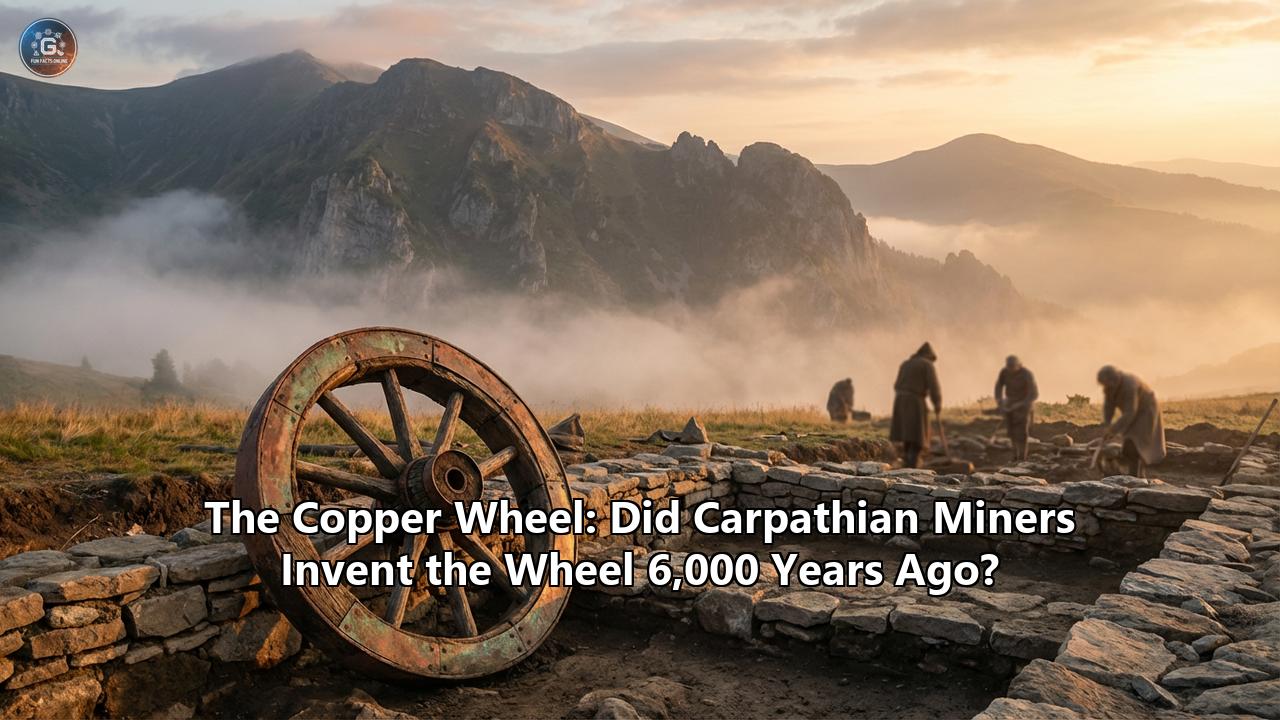
Introduction: The Mug, The Mine, and The Missing Link
For centuries, the story of human civilization has been taught with a distinct geographical bias. We look to the "Fertile Crescent" of Mesopotamia—the land between the Tigris and Euphrates—as the cradle of all significant innovation. It was there, we are told, that writing began, that cities first rose from the dust, and that humanity’s most iconic invention, the wheel, was born from the spinning tables of potters around 4000 B.C.
But history is rarely a straight line, and the earth is often reluctant to give up its secrets. In the shadowy, mineral-rich depths of the Carpathian Mountains, a different story has been waiting to be told—a story not of potters and clay, but of miners, sweat, and copper.
A groundbreaking study published in Royal Society Open Science by historian Richard Bulliet, aerospace engineer Kai James, and engineer Lee Alacoque has shattered the conventional timeline. Their research employs not just archaeological digging, but advanced "computational structural analysis"—essentially, digital forensic engineering—to propose a radical new theory: The wheel was not invented for pottery in the Middle East, but for mining in Eastern Europe, specifically by copper miners in the Carpathian Mountains around 3900 B.C.
This theory does not just shift a date or a location; it fundamentally changes our understanding of why we invent. It suggests that the wheel was not a stroke of artistic convenience for making bowls, but a desperate industrial necessity born from the claustrophobic, crushing weight of rock and ore.
To understand this revolution, we must travel back 6,000 years, to a lost civilization of "Old Europe," where the demand for the red metal—copper—forced humanity to reinvent the laws of motion.
Part I: The Lost World of Old Europe
Before we descend into the mines, we must understand the people who dug them. The history books often skip over the Balkans and Eastern Europe during the Copper Age (the Chalcolithic), focusing instead on Sumer and Egypt. Yet, between 5000 and 3000 B.C., this region was home to one of the most sophisticated and enigmatic civilizations in human history: the Cucuteni-Tripolye culture (and its related neighbors, like the Boleráz and Baden cultures).
The Mega-Sites of the Steppe
Long before the pyramids were sketched, the Cucuteni-Tripolye people were building "mega-sites"—proto-cities that defy our understanding of Neolithic life. Settlements like Talianki and Maidanetske in modern-day Ukraine housed up to 15,000, perhaps even 46,000 people. These were not mere villages; they were planned communities arranged in concentric ellipses, covering hundreds of hectares.
What makes this culture fascinating—and relevant to the invention of the wheel—is its industrial capacity. They were not just subsistence farmers; they were master craftsmen. Their pottery was exquisite, fired in advanced kilns that reached temperatures capable of transforming clay into ceramic approaching the hardness of stone. They wove complex textiles and, crucially, they were obsessed with metal.
The Copper Obsession
The "Copper Age" was named for a reason. For the first time, humans were not just reshaping stone (lithics) but transforming matter itself. Copper was the plastic of prehistory—malleable, recyclable, and prestigious. It was used for axes, chisels, awls, and heavy ornaments.
However, the Cucuteni-Tripolye and their neighbors in the Carpathian Basin faced a geographical problem. The rich alluvial plains where they farmed were poor in minerals. The copper they craved lay locked inside the volcanic spines of the Carpathian Mountains (spanning modern-day Romania, Serbia, and Slovakia).
To get the copper, they had to leave their sun-drenched plains and venture into the dark, vertical world of the mountains. It was here, at the intersection of geology and greed, that the pressure to invent became insurmountable.
Part II: The Problem of the Mine
Mining in 4000 B.C. was a nightmare of physical labor. There were no explosives, no steel drills, and no steam engines. There was only fire, water, antler picks, and stone hammers.
The "Energy Crisis" of the Copper Age
Early mining began with surface deposits—finding green malachite rocks in a stream. But as the surface supply dried up, miners had to chase the veins underground. We have evidence of these ancient mines at sites like Rudna Glava in Serbia and Ai Bunar in Bulgaria. These were not open pits; they were narrow, twisting shafts that followed the ore veins deep into the earth.
The study by Bulliet and his team highlights a critical constraint: The Environment.
A mine tunnel is a unique physical space. It is narrow, often barely wide enough for a human shoulders. It is uneven. And it is a one-way street.
Imagine you have hammered out 200 kilograms of copper ore at the end of a 50-meter tunnel. How do you get it out?
- Carrying it: A human can carry perhaps 20-30kg comfortably. This requires many trips, wasting immense energy.
- Dragging it: You can put it in a basket or a sledge. But friction is the enemy. Dragging a heavy sledge over rough rock floors is exhausting.
- Rollers: The classic solution for moving heavy objects (like the stones of Stonehenge) is the "free roller"—logs placed under a load. As you push the load, it rolls over the logs.
But there is a fatal flaw with free rollers in a mine. As the load moves forward, the logs are left behind. In an open field, you simply pick up the rear log and run it to the front. In a dark, narrow mine tunnel, with a heavy load blocking the way, you cannot get to the back to retrieve the rollers.
This was the "evolutionary bottleneck." The miners needed a way to keep the rollers under the load without having to constantly reset them. This specific problem, the researchers argue, is what forced the evolution of the wheel.
Part III: The Evolution of the Machine (The Science)
This is where the genius of the Royal Society Open Science study lies. Instead of guessing, the team applied Computational Structural Analysis—the same digital engineering used to design modern aircraft wings and bridges—to the primitive tools of the Copper Age.
They simulated the physics of moving heavy loads in a mine environment to see what design would be the most energy-efficient. Their algorithm essentially "evolved" the wheel through three logical steps, each solving a specific problem faced by those Carpathian miners.
Step 1: The Grooved Roller
The first innovation was simple but brilliant. If your heavy ore basket keeps sliding off the log rollers, or if the rollers keep wandering sideways into the tunnel walls, you have a problem.
The miners likely carved grooves into the rollers. They then modified the bottom of their ore baskets to have runners that fit into these grooves.
- The Benefit: The basket "locks" onto the roller. It doesn't slide off.
- The Result: A primitive track system. It’s still a roller system, but now it’s guided.
Step 2: The Unilateral Roller (The "Wheelset")
The study's computer models showed that as miners tried to reduce friction further, they would naturally cut away the wood in the middle of the roller, leaving the ends wide. Why?
- Clearance: A roller that is thick all the way across hits every bump and rock on the floor. If you thin out the middle (creating an axle) and leave the ends thick (creating wheels), the device can straddle rocks in the middle of the path.
- Weight: A solid log is heavy. A thinned-out log is lighter to carry back down the tunnel.
This led to the creation of the Wheelset.
Crucially, in a wheelset, the wheels and the axle are one solid piece of wood. They rotate together.
- The Engineering limit: A wheelset is terrible for turning corners. If you try to turn, the outer wheel needs to travel faster than the inner wheel. If they are fixed to the same axle, one must drag, creating friction.
- The Mining Advantage: In a mine shaft, you don't turn. You go straight in and straight out. The wheelset is the perfect, robust solution for a linear track.
Step 3: The Independent Wheel
It was only centuries later, when these carts were brought out of the mines and used on the winding paths of the surface world, that the final innovation occurred. The axle was fixed to the cart, and the wheels were made to rotate freely on the ends. This allowed for turning.
The computer algorithm proved that this sequence—Roller -> Grooved Roller -> Wheelset -> Independent Wheel—is the most physically plausible path of least resistance. It wasn't a "Eureka!" moment by a genius; it was centuries of miners shaving down logs to make their daily hell slightly more bearable.
Part IV: The Evidence in the Clay
A computer model is a theory. To make it history, you need physical proof. Wood rots. We have not found the original mine carts because they likely decayed into dust 5,000 years ago. But the Carpathian miners left us a ghost of their invention in an unlikely place: their dinner tables.
The Boleráz Drinking Mugs
Archaeologists excavating sites associated with the Boleráz culture (a sub-group of the Baden complex) in Slovakia and Hungary have found something peculiar: over 150 clay models of small, four-wheeled wagons.
These are not toys. They are drinking vessels.
Imagine a coffee mug, but square, and resting on four little clay wheels.
- Dating: These mugs date to approximately 3600 B.C.—centuries older than the classic wheeled chariots of Mesopotamia.
- Design: The mugs depict a rectangular box with four wheels. Crucially, the axles on these models go through the body of the cart, exactly like the "wheelset" design predicted by the computer models.
- The Connection: Why would a culture make drinking cups shaped like wagons? In the ancient world, you ritualize what is important to you. If your wealth, your copper, and your livelihood depend on these mining carts, they become sacred. Drinking from a "mine cart" might have been a way to toast the harvest of the earth.
The Ljubljana Marshes Wheel
The "smoking gun" of European wheel invention was discovered in 2002 near Ljubljana, Slovenia. Archaeologists pulled a wooden wheel and its axle from the mud of the marshes.
- The Object: It is an ash-wood wheel, 70cm in diameter, with a square hole in the center. The axle is oak.
- The Date: Radiocarbon dating places it between 3340 and 3030 B.C.
- The Significance: The square hole means the wheel was fixed to the axle. It rotated with the axle. It was a wheelset—exactly the type of technology the Bulliet study predicts would evolve from mine rollers. It is the oldest wooden wheel ever found, and it sits right in the backyard of the Carpathian copper mines.
Part V: The Rivals – Why Not Mesopotamia?
To accept the Carpathian Miner Theory, we must address the elephant in the room: Sumer.
For decades, textbooks have shown the "Standard of Ur" (c. 2500 B.C.) with its battle wagons and claimed Mesopotamia as the birthplace of the wheel.
The Potter’s Wheel Trap
The argument for Mesopotamia rests largely on the potter's wheel. We know the Sumerians used spinning tables to make ceramics around 3500-4000 B.C. The assumption was that someone looked at a potter's wheel, flipped it on its side, and put it on a cart.
However, Bulliet and his team argue this is mechanically unlikely.
- Physics: A potter's wheel is a heavy flywheel designed to store momentum. A vehicle wheel is a load-bearing structure designed to reduce friction. They solve different physics problems.
- Evolution: There is no "intermediate" stage in pottery. You either have a tournette (slow wheel) or a fast wheel. In mining, we can trace the slow, physical evolution from log to wheel.
The Northern Turkey Hypothesis
Another theory suggests the wheel arose in Northern Turkey (Pontic coast) around 3800 B.C. This is plausible, as it is close to the Caucasus and metal-rich areas. However, the density of archaeological evidence—specifically the sheer number of wagon models (the Boleráz mugs) and the specific environmental constraints of the Carpathian mines—makes the European theory more robust in explaining why it happened.
The Mesopotamians certainly adopted the wheel quickly. But it seems they may have imported the technology from the north, adapting it for their flat, muddy plains where the "independent wheel" (better for turning) eventually superseded the "wheelset."
Part VI: The Spread and the Legacy
Once the wheel escaped the dark tunnels of the Carpathians, it changed the world with terrifying speed.
From Mine to Steppe
The transition from a mine cart (pushed by humans) to a wagon (pulled by animals) likely happened when the technology met the Yamnaya culture of the Pontic-Caspian steppe. These were cattle herders.
- The Synergy: The miners had the wheel. The herders had the oxen.
- The Result: The Ox-Wagon. Suddenly, a house was no longer a fixed object. You could put your tent, your supplies, and your family on a wagon and follow the herds. The wheel turned the stationary Neolithic farmers into mobile Bronze Age nomads.
This mobility triggered the massive Indo-European migrations. The languages we speak today—English, Spanish, Hindi, Russian—are spread across the globe partly because 6,000 years ago, a copper miner needed an easier way to move a rock.
The Transformation of War
It took another thousand years for the solid wooden wheel of the miners to be lightened into the spoked wheel (invented by the Sintashta culture around 2000 B.C.). This allowed for the chariot, which transformed the wheel from a tool of industry into a tool of war. But the ancestor of the war chariot was not a warrior's dream; it was a miner's bucket.
Conclusion: The Wheel as a Child of Darkness
The study "Reconstructing the invention of the wheel" does more than just rearrange dates on a timeline. It humanizes the greatest invention of antiquity.
The wheel was not born in the airy workshops of Sumerian astronomers. It was born in the dark, sweating, claustrophobic tunnels of the Carpathian Mountains. It was born because human muscles were failing against the weight of the earth. It was born of grit, not just genius.
When we look at a modern car, a train, or even the watch on our wrist, we are looking at the great-grandchildren of a log that was shaved down by a copper miner who just wanted to get his work done a little faster. The Copper Wheel is a testament to the idea that the greatest leaps in human progress often come from the most grueling of human labors.
The mysterious drinking mugs of the Boleráz culture, once thought to be mere curiosities, now stand as monuments to this achievement—a toast raised by the ancients to the tool that moved the world.
Reference:
- https://www.youtube.com/watch?v=P2I3BJeI19U
- https://www.youtube.com/watch?v=hTmt6PUryT0
- https://www.thoughtco.com/the-invention-of-the-wheel-1992669
- https://www.kilncrafts.co.uk/blogs/news/history-of-the-pottery-wheel
- https://indiandefencereview.com/study-suggests-wheel-invented-carpathians-mining-carts-challenging-previous-theories/
- https://www.livescience.com/archaeology/1st-wheel-was-invented-6-000-years-ago-in-the-carpathian-mountains-modeling-study-suggests
- https://www.lavanguardia.com/mediterranean/20241023/10045521/first-wheel-invented-miners-carpathian-mountains-europe-axle-age-neolithic-copper-archaeology.html
- https://www.researchgate.net/publication/385170619_Reconstructing_the_invention_of_the_wheel_using_computational_structural_analysis_and_design
- https://kids.kiddle.co/Cucuteni%E2%80%93Trypillia_culture