
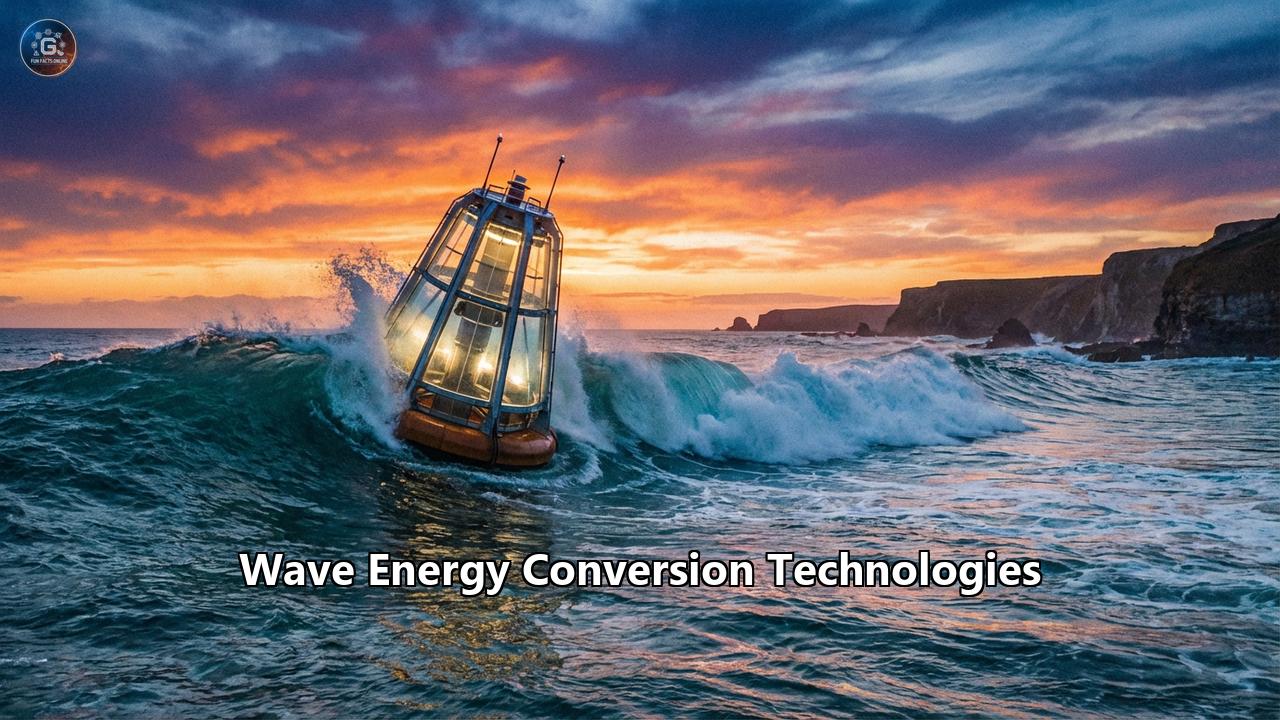
The ocean is a restless, titanic force, a vast reservoir of kinetic and potential energy that has pounded against the coastlines of our planet for billions of years. While humanity has successfully harnessed the wind and the sun—turning the gentle breeze and the warming ray into the electrons that power our digital lives—the ocean remains the "sleeping giant" of the renewable energy family. Wave energy, the extraction of power from the surface motion of ocean waves, represents one of the most technically challenging yet promising frontiers in the global quest for a carbon-neutral future.
Unlike the sun, which sleeps at night, or the wind, which can be fickle and intermittent, ocean waves offer a dense, persistent, and highly predictable source of power. It is estimated that the theoretically available energy in ocean waves worldwide stands between 2,000 and 4,000 terawatt-hours (TWh) per year—enough to cover a substantial portion of global electricity demand. Yet, despite this colossal potential, wave energy conversion (WEC) technologies have not yet reached the commercial maturity of solar photovoltaics or wind turbines. We are currently witnessing a pivotal moment in history, a "Cambrian explosion" of engineering designs where hundreds of different concepts are vying for dominance, each attempting to solve the riddle of how to survive the ocean’s fury while efficiently harvesting its power.
To understand where this industry is going, we must dive deep into the mechanics, the economics, the environmental impacts, and the sheer engineering audacity required to plug the ocean into the grid.
The Physics of the Blue Pulse: How Waves Carry Energy
Before dissecting the machines, one must understand the fuel. Ocean waves are not merely moving water; they are energy moving through water. They are generated primarily by the wind blowing across the surface of the sea. As the wind rubs against the water, friction transfers energy, creating ripples that grow into chops, and eventually into fully developed swells.
The amount of energy a wave carries is determined by its height (amplitude) and its period (the time between two crests). Crucially, the power of a wave is proportional to the square of its height. A wave that is two meters high contains four times the energy of a wave that is one meter high. This exponential relationship is both a blessing and a curse: it means that during storms, the available energy skyrockets, potentially overloading or destroying equipment designed for calmer conditions.
Furthermore, waves have the highest energy density of all renewable sources. Solar panels might capture 1 kilowatt per square meter on a sunny day. A wind turbine might intercept a few kilowatts per square meter of swept area. But a powerful ocean wavefront can deliver anywhere from 20 to 70 kilowatts per meter of crest length. A single kilometer of coastline in a high-energy environment like the Atlantic coast of Ireland or the Pacific Northwest of the United States receives hundreds of megawatts of power continuously.
The Zoo of Technologies: Classifying Wave Energy Converters
Unlike the wind industry, which has converged on the three-bladed horizontal axis turbine as the standard design, the wave energy sector is still fractured. There is no "standard" wave machine. Instead, we have a diverse zoo of devices, each looking and acting radically different. They are generally categorized by how they interact with the water and where they are located.
1. Oscillating Water Columns (OWC)
The Oscillating Water Column is perhaps the most intellectually elegant of all wave energy concepts. It mimics the action of a blowhole. Structurally, an OWC consists of a hollow chamber that is partially submerged. The bottom is open to the ocean, and the top is sealed but for a small vent containing an air turbine.
As a wave approaches and enters the chamber, the internal water level rises. This acts like a piston, compressing the air trapped above it and forcing it out through the vent at high velocity. When the wave recedes, the water level drops, creating a vacuum that sucks air back into the chamber.
The genius of the OWC lies in its removal of moving mechanical parts from the water. The only moving part is the turbine, which sits high and dry above the waterline. However, the airflow changes direction every few seconds (out, then in). To handle this, engineers use a self-rectifying turbine, most commonly the Wells Turbine, invented in the 1970s. The blades of a Wells turbine look like teardrops and are symmetrical; they spin in the same direction regardless of whether the air is flowing in or out.
- Notable Examples: The Mutriku Wave Energy Plant in the Basque Country of Spain is a breakwater-integrated OWC that has been operating since 2011, providing a rare example of long-term grid connection. Another is OceanEnergy in Ireland, which has developed the OE35, a massive floating steel hull OWC designed for deep-water deployment.
2. Point Absorbers
If you have ever watched a buoy bobbing up and down in the harbor, you have seen the principle of a point absorber. These devices are usually floating structures that absorb energy from all directions (hence "point" absorber). They are generally small compared to the wavelength of the waves they ride.
The most common design involves a floating buoy connected to a submerged seabed foundation or a submerged reaction body. As the wave passes, the buoy heaves (moves up and down). This relative motion between the moving float and the fixed base is used to drive a linear generator or a hydraulic pump.
The challenge here is "tuning." Just as a child on a swing needs to be pushed at the right moment to go higher, a point absorber needs to move in resonance with the incoming waves to maximize energy capture. If the device is out of sync, it rides the wave like a cork without extracting much power. Modern companies use advanced control systems to "trick" the buoy into reacting as if it were much larger, artificially inducing resonance to multiply the power output.
- Notable Examples: CorPower Ocean, a Swedish company, is a leader in this space. Their "C4" buoy uses a unique pre-tensioned mooring system and "WaveSpring" phase control technology inspired by the pumping principles of the human heart, allowing it to oscillate in resonance with the waves and survive storms by "detuning" itself. Carnegie Clean Energy in Australia developed the CETO system, a submerged point absorber that sits completely underwater, safe from surface storms, driven by the pressure differences of passing waves.
3. Attenuators
Attenuators are the "snakes" of the sea. These are long, multi-segment floating structures that are oriented parallel to the direction of the wave travel. As the wave runs along the length of the machine, the varying heights of the water cause the joints between the segments to flex.
Imagine a train floating on water. As the engine rides a crest, the carriage behind it might be in a trough. This difference in height forces the coupling between them to bend. Hydraulic rams located inside these joints resist this bending, pumping high-pressure fluid through motors to generate electricity.
- Notable Examples: The most famous attenuator was the Pelamis, a pioneer project in Portugal that, despite its eventual financial failure in 2014, proved that wave energy could be pumped into the grid. The legacy of Pelamis lives on in newer designs that seek to reduce the complexity and maintenance costs of the many articulated joints.
4. Oscillating Wave Surge Converters (OWSC)
While point absorbers focus on the up-and-down (heave) motion, surge converters exploit the horizontal back-and-forth movement of water particles found in shallower coastal waters.
These devices typically look like large paddles or flaps hinged to the seafloor. As a wave approaches the shore, the water particles rush forward (surge) and then pull back. This pushes the flap like a pendulum. The movement of the flap pumps hydraulic fluid to a generator.
- Notable Examples: The Oyster by Aquamarine Power was a massive flap installed off the Orkney Islands. A more modern iteration is the WaveRoller by Finnish company AW-Energy. The WaveRoller sits on the seabed and sways with the bottom currents and surge, a prime example of a device designed to operate invisibly from the shore.
5. Overtopping Devices
These devices function like a floating hydroelectric dam. They use large "arms" or reflectors to funnel waves toward a central ramp. The momentum of the wave drives the water up the ramp and into a reservoir that sits above the surrounding sea level.
Once the water is trapped in the reservoir, it has potential energy. It is then released back into the sea through low-head hydro turbines, generating power just like a conventional river dam.
- Notable Examples: The Wave Dragon is a Danish concept that has seen extensive prototype testing. It is enormous, requiring a heavy structure to hold the weight of the water reservoir, which has historically made the capital costs challenging.
6. Rotating Mass
These devices are completely enclosed hulls with no external moving parts. Inside the hull, there is a heavy weight or a gyroscope. As the hull rocks and rolls with the waves, the internal mass swings or precesses. This internal movement drives a generator. The advantage is survivability: with no external paddles or hinges exposed to saltwater and barnacles, the maintenance is theoretically lower.
- Notable Examples: The Wello Penguin from Finland is an asymmetrical hull that gyrates in the waves. The movement spins a massive internal flywheel, generating continuous power without any metal parts touching the sea.
The Heart of the Machine: Power Take-Off (PTO) Systems
Regardless of the external shape, every wave energy converter needs a "heart"—the Power Take-Off (PTO) system that converts the mechanical motion into electricity.
- Hydraulic Systems: These are the most common for high-force, slow-motion devices (like flaps or huge buoys). The wave motion pumps oil at high pressure. This oil is smoothed out by accumulators (pressure tanks) and then drives a hydraulic motor connected to a generator. Hydraulics are robust and good at handling the chaotic nature of waves, but they can be leaky and inefficient.
- Direct Drive Electrical: In this setup, the moving part of the device carries magnets and the fixed part carries copper coils (or vice versa). The wave motion directly induces electricity. This eliminates the need for hydraulic fluids and hoses, reducing maintenance, but requires massive, custom-built generators to handle the slow oscillating speeds.
- Pneumatic (Air): Used in OWCs. The compressibility of air acts as a natural gearbox, allowing a slow ocean wave to drive a fast-spinning air turbine.
The Engineering Nightmare: Survival vs. Efficiency
The fundamental paradox of wave energy engineering is this: To generate power, you must catch the wave; to survive, you must dodge it.
A wind turbine can pitch its blades to let a hurricane blow through without damage. A solar panel can just sit there. But a wave energy device is physically coupled to the medium. When a "100-year storm" hits (which, thanks to climate change, now happens far more often), the forces involved are astronomical. Water is 800 times denser than air. A breaking wave hitting a steel structure is like a truck slamming into a wall.
Early prototypes, like the Oceanlinx in Australia or early deployments off Scotland, were often torn apart by the very energy they sought to harvest. This led to a design philosophy shift. Modern devices, like CorPower’s buoys, have "storm modes" where they de-tune or lock down, becoming transparent to the waves to ensure survival. The goal is no longer just maximum efficiency; it is survivable efficiency.
Economic Realities: The Valley of Death
The biggest barrier to wave energy today is not physics, but finance. The Levelized Cost of Energy (LCOE)—the average cost to produce a megawatt-hour of electricity over the plant's life—remains high for wave energy, estimated between $300 and $600 per MWh for pilot projects. Compare this to offshore wind (around $80/MWh) or solar (under $40/MWh).
Wave energy is currently in the "Valley of Death." It is too expensive for commercial banks to finance because it’s unproven, but it requires too much capital ($10M - $50M per prototype) for typical venture capitalists or university grants.
However, the trajectory is changing. As designs converge and supply chains mature, costs are falling. The European Union and the UK government have introduced "Contracts for Difference" (CfD) and revenue support specifically for tidal and wave energy, guaranteeing a high price for the electricity to encourage early adopters.
Environmental Impacts: Friend or Foe?
Wave energy is clean, but it is not without an environmental footprint.
- Marine Life: There are concerns that mooring lines could entangle whales, or that the noise of hydraulic pumps could disturb communication among dolphins. However, studies from the European Marine Energy Centre (EMEC) in Orkney have shown minimal negative interactions so far. In fact, wave farms often act as "de facto" marine protected areas (artificial reefs) where fishing is prohibited, allowing fish stocks to recover.
- Coastal Processes: Extracting energy from waves reduces the energy that hits the shore. While this could theoretically alter sediment transport or beach profiles, in many places this is a benefit. "Wave farms" could act as invisible breakwaters, protecting eroding coastlines from storm surges without the need for ugly concrete sea walls.
- Visual Impact: Most wave devices have a very low profile. Some, like the Oyster or submerged point absorbers, are completely invisible from the shore, preserving the pristine view of the coastline—a significant advantage over towering offshore wind turbines.
The Leaders of the Pack: Key Players in 2026
As we look at the landscape in the mid-2020s, several companies have separated themselves from the pack:
- Eco Wave Power (EWP): This Israeli company took a pragmatic approach. Instead of going deep offshore (which is expensive and dangerous), they attach their floaters to existing breakwaters and piers. The floaters move up and down, but the expensive generation equipment is located safely on land. They have successfully connected projects to the grid in Gibraltar and at the Port of Jaffa, and in 2025/2026 initiated their first US project at the Port of Los Angeles. Their "low-tech," low-cost strategy has allowed them to survive where high-tech giants failed.
- CorPower Ocean: Based in Sweden and Portugal, CorPower is arguably the leader in high-efficiency point absorbers. Their HiWave-5 demonstration project in northern Portugal proved that their fiberglass buoys could survive Atlantic storms while producing 5 times more energy per ton of device than previous generations.
- OceanEnergy: The Irish company’s OE35 is a testament to ship-building scale. By building a massive floating OWC, they leverage standard ship construction techniques, aiming for economies of scale rather than complex novelty.
The Future: The Blue Economy and Hybrid Parks
The future of wave energy likely does not lie in competing directly with wind or solar on the main grid immediately. Instead, it will likely find its foothold in the Blue Economy.
- Desalination: Reverse osmosis plants require high pressure, something wave energy hydraulics produce naturally. Wave-powered desalination buoys could provide fresh water to drought-stricken islands without using fossil fuels.
- Island Grids: For remote islands currently burning imported diesel at $0.50/kWh, wave energy is already cost-competitive.
- Hybrid Parks: The ultimate vision is the co-location of offshore wind and wave energy. They are complementary. Wind often creates the waves, but the swells persist long after the wind dies down. A combined park would produce a smoother, more reliable power output, sharing the same expensive subsea cables and maintenance vessels.
Conclusion
Wave energy is no longer a science project; it is a burgeoning industry entering its industrialization phase. The path has been littered with broken prototypes and bankrupt companies, but these failures were the necessary tuition fees for a new class of engineering.
We are standing on the edge of the ocean, watching the next great energy revolution roll in. It is a revolution of steel and software, of hydraulics and hydrodynamics, fighting a battle against the wildest environment on Earth. The waves will never stop crashing. If we can learn to ride them, we will unlock a power source as eternal as the tides and as deep as the sea itself. The sleeping giant is waking up.
Reference:
- https://www.youtube.com/watch?v=D-DQ0hnrDdY
- https://www.youtube.com/watch?v=e2TvA40EA7Q
- https://www.cityu.edu.hk/see_mer/wave-devices.htm
- https://pdfs.semanticscholar.org/6d3d/d861f4abd2eaf05bee3b02e6a4f0b62724a9.pdf
- https://grokipedia.com/page/Oscillating_water_column
- https://www.mdpi.com/2077-1312/12/2/342
- https://www.coastalwiki.org/wiki/Wave_energy_converters
- https://www.emec.org.uk/marine-energy/wave-devices/
- https://tethys-engineering.pnnl.gov/technology/point-absorber
- https://www.researchgate.net/figure/Working-principle-of-Attenuator-Pelamis-25_fig2_271949918
- https://www.wisdomlib.org/concept/oscillating-wave-surge-converters
- https://juniperpublishers.com/rapsci/pdf/RAPSCI.MS.ID.555593.pdf
- https://theliquidgrid.com/marine-clean-tech-briefs/wave-energy-converters/
- https://www.researchgate.net/figure/Principle-of-operation-of-Wave-Dragon-overtopping-device_fig11_262116355
- https://www.youtube.com/watch?v=uONkUgtac7A
- https://www.alternative-energy-tutorials.com/wave-energy/environmental-impact-of-wave-energy.html
- https://tethys.pnnl.gov/sites/default/files/publications/Li-et-al-2022_0.pdf