
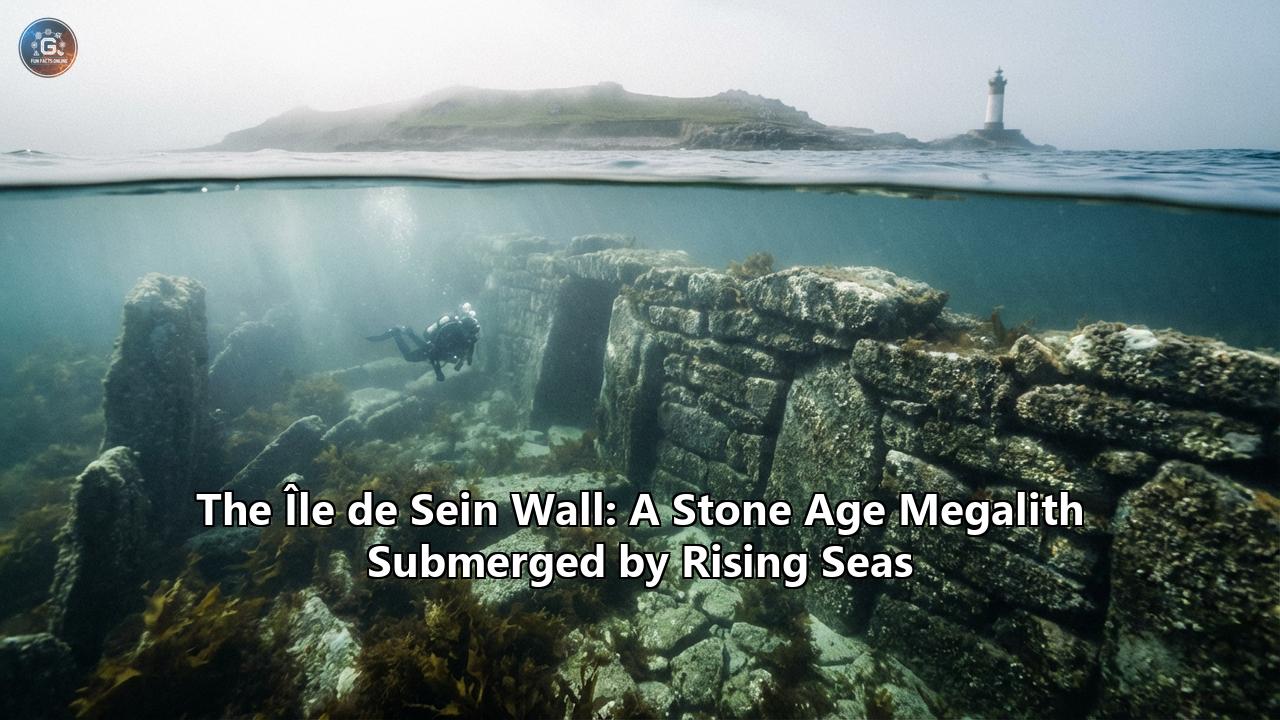
The Atlantic Ocean has long been a keeper of secrets. For millennia, its restless tides have swallowed coastlines, islands, and perhaps entire civilizations, hiding them beneath a shroud of cold, blue silence. But every so often, the sea gives something back.
In the turbulent waters off the western tip of Brittany, France, a discovery has emerged from the depths that challenges our understanding of human history. It is not a ship of gold or a lost palace, but something far more primal and profound: a massive stone wall, built by human hands 7,000 years ago, now resting in the twilight zone of the ocean floor.
This is the story of the Île de Sein Wall—a ghost from the Stone Age that refuses to remain buried.
Part I: The Anomaly in the Maps
The story begins not with a diver, but with a beam of light. In 2017, Yves Fouquet, a geologist with Ifremer (the French National Institute for Ocean Science), was meticulously analyzing bathymetric maps of the Breton coast. These maps were created using LIDAR (Light Detection and Ranging), a laser-based remote sensing technology that strips away the water to reveal the naked topography of the seabed.
The area Fouquet was studying, the Chaussée de Sein, is notorious among sailors. It is a chaotic, jagged extension of the Île de Sein, a place where currents rip at seven knots and the Atlantic swells shatter against submerged granite teeth. It is a place of shipwrecks, not settlements.
Yet, as Fouquet zoomed in on a sector known as Toul ar Fot, about a mile west of the island, he saw something that shouldn't exist. Amidst the chaotic, fractal shapes of natural granite formations, there was a line. A perfectly straight, unnatural line cutting across a submerged valley.
"Nature doesn't draw straight lines," the old adage goes. Geologists know this isn't entirely true—fault lines and dykes can be straight—but this feature was different. It was 120 meters (nearly 400 feet) long, distinctly raised from the seabed, and appeared to block a channel.
Fouquet remained skeptical. "At first, I didn't believe it too much," he later told reporters. "I thought they were artifacts of the LIDAR." He filed the anomaly away, a digital curiosity in a sea of data.
It would take five years for the truth to surface.
Part II: Into the Abyss
In May 2022, a team of divers from the Société d'Archéologie et de Mémoire Maritime (SAMM) was operating in the area. They were seasoned veterans, accustomed to the treacherous conditions of the Breton coast. They had finished a dive near the famous Ar-Men lighthouse and, realizing they had air left in their tanks, decided to investigate the anomaly Fouquet had noted years prior.
Descending into the green gloom, fighting the rip of the current, they reached the seabed at a depth of roughly nine meters (30 feet). What they found was breathless.
Looming out of the algae and silt was a wall.
It was not a random pile of rocks. It was a deliberate, engineered fortification. The structure, later designated TAF1, was composed of massive granite blocks stacked with intention. More shockingly, it was reinforced with upright stone slabs—megaliths—some standing nearly two meters tall. These "orthostats" acted as a skeleton for the wall, a technique that requires planning, immense physical strength, and social organization.
"It was undeniable," said Philippe Bodénes, president of SAMM. "We were looking at a man-made structure in a place where no man could breathe."
Over the next two years, between 2022 and 2024, the team conducted nearly 60 dives. They battled short windows of calm weather and fierce tides to document the site. They didn't just find one wall; they found a complex.
Part III: The Architecture of the Stone Age
The full scope of the discovery, published in the International Journal of Nautical Archaeology in late 2025, describes a landscape that was once a bustling center of human activity.
The main wall, TAF1, is the crown jewel.
- Dimensions: 120 meters long, approximately 20 meters wide at its base, and standing up to 2 meters high.
- Composition: It is built from local granite. The builders used a "double-facing" technique—two outer rows of large vertical stones (orthostats) with a core filled with smaller rubble and stones. This is a classic dry-stone walling technique, but applied on a monumental scale.
- The Monoliths: Divers counted over 60 distinct upright stones. These are not mere pebbles; they are multi-ton pillars that had to be quarried, transported, and levered into place.
Surrounding this main barrier, the divers found other structures:
- TAF2 and TAF3: Smaller walls and barriers that seem to work in concert with the main wall.
- YAG3C: A fascinating alignment of small monoliths, spaced about a meter apart, running for 50 meters. This looks less like a wall and more like a fence or a specific funneling mechanism.
The preservation is miraculous. For 7,000 years, storms have battered the Atlantic coast, yet these stones have held their ground, protected partly by the depth and partly by the sheer solidity of their construction.
Part IV: A Window into the Mesolithic-Neolithic Transition
Dating stone is difficult—granite cannot be radiocarbon dated. However, archaeologists can date the context. By analyzing the depth of the wall and reconstructing the history of sea-level rise, the team, led by archaeologist Yvan Pailler of the University of Western Brittany, pinpointed the construction window.
The wall was built between 5800 and 5300 BCE.
This date is explosive for two reasons:
- It predates the famous Carnac Stones. The vast alignments of Carnac, one of the wonders of the prehistoric world, were erected roughly 1,000 years after this wall. This means the tradition of moving massive stones in Brittany is far older than we thought.
- It straddles two worlds. This period marks the transition between the Mesolithic (hunter-gatherers) and the Neolithic (farmers).
For decades, the standard view of history was that hunter-gatherers were nomads who lived in small bands and built nothing permanent. The "heavy lifting" of civilization—monumental architecture, large settlements—was supposed to arrive with agriculture.
The Île de Sein wall shatters that assumption. It proves that the indigenous hunter-gatherer populations of Atlantic Europe were sedentary, sophisticated, and capable of massive communal labor projects long before the first wheat seed was sown in the region. They didn't need farms to build empires; they had the sea.
Part V: The Great Trap
Why build a 120-meter wall that is now underwater? The answer lies in the environment of the past.
Seven thousand years ago, the sea level was roughly 9 to 10 meters lower than it is today. The Île de Sein was not an island, but a prominent hill at the end of a long peninsula connected to the French mainland. The submerged plateau where the divers swam was, back then, a coastal plain—an intertidal zone that flooded at high tide and drained at low tide.
The leading theory is that TAF1 was a fishery or a fish weir.
Imagine the mechanism: The wall was built across a natural valley on the shoreline. At high tide, the ocean would flood over the wall, bringing with it schools of fish—bass, mackerel, mullet. As the tide receded, the water would drain away, but the wall would act as a barrier. The water would filter through the stones or a sluice gate, but the fish would be trapped behind it, thrashing in shallow pools, ready to be harvested by the basket-load.
This was not subsistence fishing; this was industrial-scale food production. A trap of this size could feed a large, permanent community. It suggests a society that was "farming" the ocean.
However, there is a darker, more poignant theory.
Part VI: The First Climate Refugees
While a fish trap is the most functional explanation, some researchers, including Pailler, have suggested a secondary or alternative purpose: defense.
During this period, the sea was rising. The glaciers of the last Ice Age were melting, and the ocean was encroaching on the land at a rate of several millimeters a year. To a person living on that ancient coast, the change would have been visible within a single lifetime. Elders would remember meadows that were now beaches; grandchildren would see those beaches become the sea.
Was this wall an attempt to hold back the rising tide? A prehistoric dyke meant to protect a precious lagoon or a low-lying settlement?
If so, it is a tragic monument. It represents a desperate, monumental effort to fight a losing battle against the changing climate. The ocean was relentless. Eventually, the waves breached the wall, the lagoon flooded, and the people were forced to retreat to higher ground—the ground that is now the Île de Sein.
Part VII: The Legend of Ys
It is impossible to discuss submerged walls in Brittany without invoking the City of Ys.
According to Breton folklore, Ys was a magnificent city built on the coast, protected from the sea by a massive golden dyke. It was ruled by the benevolent King Gradlon. But the city fell into debauchery, and his daughter, the princess Dahut, was tricked by the Devil into stealing the key to the sluice gates. She opened them, and the ocean rushed in, drowning the city in a single night. Only the King escaped.
For centuries, this was treated as a fairy tale—a moral fable about sin and punishment.
But the discovery of the Île de Sein wall forces us to look at the legend with new eyes. Myths often serve as the "archive" of pre-literate societies. They preserve the collective trauma of catastrophic events.
Is the legend of Ys a distorted memory of the submergence of these Neolithic landscapes?
"It is likely that the abandonment of a territory developed by a highly structured society has become deeply rooted in people's memories," the researchers wrote in their study.
The timeframe aligns. The drowning of the coastal plains wasn't a single wave, but a relentless encroachment that destroyed the "old world" of the ancestors. The image of a great wall failing to hold back the sea is not just a story; it is a historical reality that happened right there, at Toul ar Fot. The wall found by the divers is, in a very real sense, the physical skeleton of the myth of Ys.
Part VIII: A New Frontier
The discovery of the Île de Sein wall is likely just the beginning. The floor of the Atlantic shelf is a museum that has barely been visited.
"We have only explored a tiny fraction of what is down there," says Yves Fouquet. "The conditions are extreme, but the rewards are history-changing."
This wall forces a rewrite of European prehistory. It tells us that the Atlantic facade of Europe was home to powerful, innovative societies that utilized stone engineering earlier than we imagined. It bridges the gap between the nomadic past and the monumental future of the megalith builders.
Today, the wall sits silent in the gloom, colonised by kelp and sea stars. But it is no longer forgotten. It stands as a testament to human ingenuity—a voice from the deep reminding us that our battle with the rising seas is not new. We have fought the ocean before. We built walls. And the ocean won.
Key Takeaways from the Discovery
- Location: 120 meters long, submerged 9 meters deep off the Île de Sein, France.
- Age: Built ~7,000 years ago (5800-5300 BCE).
- Significance: Oldest known megalithic structure in the region; predates Carnac by millennia.
- Function: Likely a massive tidal fish trap, but possibly a sea defense system.
- Mythology: Provides a potential factual basis for the legend of the sunken City of Ys.
Reference:
- https://arkeonews.net/a-7800-year-old-massive-stone-wall-discovered-beneath-the-sea-off-the-coast-of-france/
- https://www.labrujulaverde.com/en/2025/12/the-oldest-and-deepest-stone-structures-in-europe-built-by-hunter-gatherers-7900-years-ago-found-submerged-off-the-coast-of-brittany/
- https://indiandefencereview.com/underwater-wall-dating-back-7000-years/
- https://www.ancient-origins.net/news-history-archaeology/underwater-wall-france-00102387
- https://archaeologymag.com/2025/12/ancient-undersea-wall-off-the-french-coast/
- https://www.ctvnews.ca/sci-tech/article/ancient-undersea-wall-found-off-french-coast/
- https://www.ancientpages.com/2025/12/12/7000-year-old-underwater-wall-french-coast-mythical-submerged-city-of-ys-been-found/
- https://www.liberation.fr/sciences/archeologie/au-debut-je-ny-croyais-pas-trop-vieux-de-7-000-ans-un-mur-geant-decouvert-au-large-de-lile-de-sein-20251211_ERPKZYRCUVHF7I236IQTFDCGAM/
- https://ground.news/article/a-giant-7-000-year-old-wall-discovered-off-the-island-of-sein
- https://thedebrief.org/7000-year-old-sunken-discovery-points-to-european-megalithic-construction-centuries-earlier-than-previously-thought/
- https://unidivers.fr/mur-sous-marin-ile-de-sein/
- https://uz.kursiv.media/en/2025-12-13/stone-age-wall-found-off-brittany-may-link-to-myth-of-a-sunken-city/
- https://www.heritagedaily.com/2025/12/network-of-submerged-stone-structures-rewrites-early-european-prehistory/156573
- https://archeologie.culture.gouv.fr/megalithes/en/sea-level-and-shoreline
- https://www.cambridge.org/core/journals/proceedings-of-the-prehistoric-society/article/abs/landscape-evolution-and-human-settlement-in-the-iroise-sea-brittany-france-during-the-neolithic-and-bronze-age/9C7D6824433ED556500651CAC519459E
- https://www.youtube.com/watch?v=l1EVgO5tZt4