
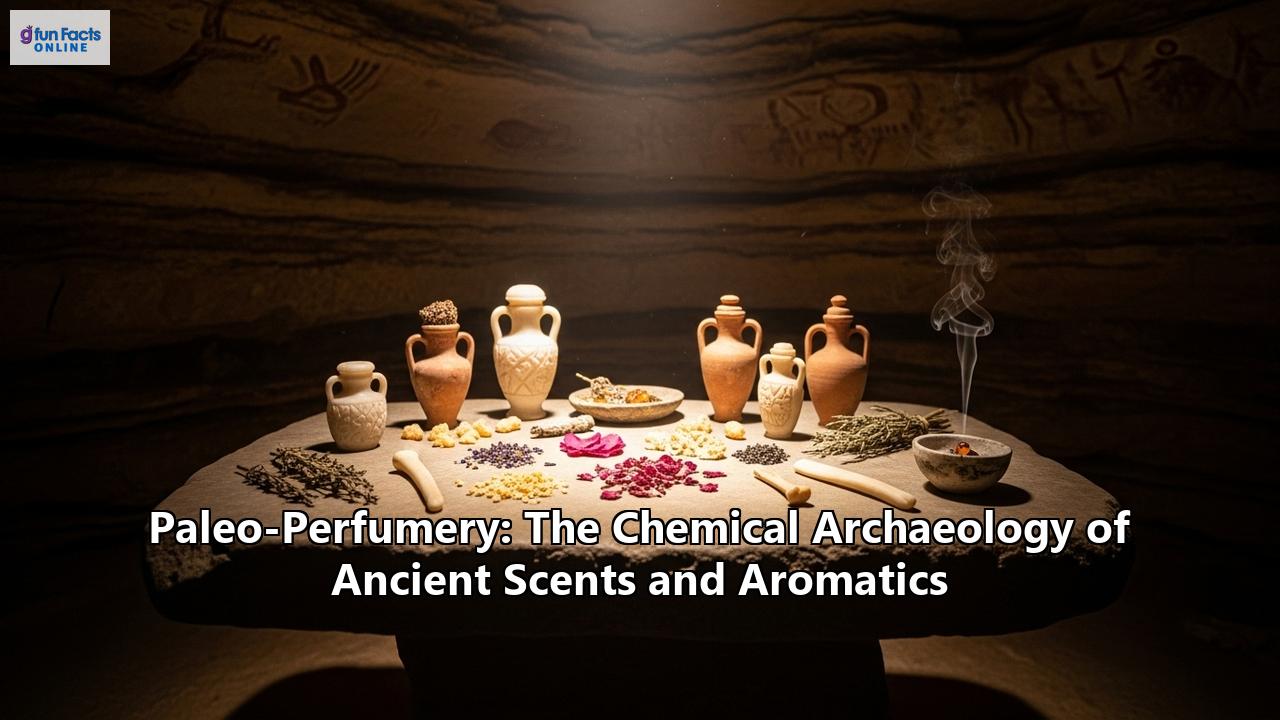
An aroma, potent and fleeting, is a ghost of the tangible world. It can evoke memories, stir emotions, and transport us across the chasm of time. But what if we could resurrect the very scents that filled the air of ancient civilizations? What if we could inhale the perfumes of pharaohs, the incense of Mesopotamian temples, or the fragrant oils that adorned Roman aristocrats? This is the tantalizing promise of paleo-perfumery, a burgeoning field where archaeology, chemistry, and history converge to decode and recreate the olfactory landscapes of the past. It is a journey that takes us from the dust of archaeological digs to the sterile precision of the modern laboratory, all in pursuit of the ephemeral essence of ancient life.
The quest to understand ancient scents is more than a frivolous indulgence in the odorous past. It is a profound exploration of ancient cultures, economies, and personal experiences. Fragrances were not mere luxuries; they were deeply embedded in the spiritual, political, and social fabric of antiquity. They were used to commune with the gods, to project power and status, to heal the sick, and to navigate the intimate rituals of life and death. To resurrect these scents is to gain a more visceral and multi-sensory understanding of our ancestors.
This burgeoning field of paleo-perfumery relies on the meticulous work of "chemical archaeologists" who employ an arsenal of advanced scientific techniques to coax secrets from the most unassuming of artifacts. Pottery shards, residue-caked unguentaria (perfume bottles), and even the mummified remains of the long-dead can hold the molecular ghosts of ancient aromatics. Through a combination of rigorous scientific analysis and dedicated historical and botanical research, these scent detectives are piecing together the fragrant puzzle of the past, one molecule at a time.
The Dawn of Perfumery: A Whiff of the Ancient World
The human love affair with fragrance is as old as civilization itself. The earliest evidence of perfume-making dates back over 4,000 years, with multiple ancient cultures independently developing sophisticated methods for capturing and blending scents.
In ancient Mesopotamia, the cradle of civilization, the world's first recorded chemist was a woman named Tapputi-Belatekallim. Her name and perfume-making techniques are immortalized on a cuneiform tablet from around 1200 BCE. Tapputi, an overseer of the Royal Palace, developed groundbreaking methods for scent extraction, including the use of solvents to create lighter, more enduring fragrances. Her recipes, fit for a king, included a complex blend of flowers, oil, calamus, cypress, myrrh, and balsam, which she distilled and filtered multiple times.
Ancient Egypt is perhaps the civilization most synonymous with the art of perfumery. For the Egyptians, scents were the sweat of the sun god, Ra, and were intrinsically linked to the divine. Hieroglyphics in tombs dating back to 3,000 BC depict the creation of perfumes, which were central to religious rituals. Priests, the first perfumers, would burn copious amounts of incense, believing the fragrant smoke carried their prayers to the heavens and pleased the deities.
The Egyptians' mastery of aromatics extended beyond the temple. Perfumes were integral to daily life, used for personal adornment, as a marker of high social standing, and for their perceived medicinal properties. The hot, dry climate of Egypt also made scented oils and balms essential for moisturizing and protecting the skin.
The Indus Valley Civilization, which flourished from 3300 to 1300 BCE, also has a rich history of perfumery. Archaeological excavations have unearthed terracotta distillation apparatus and oil containers carbon-dated to 3000 BCE. Early Hindu Ayurvedic texts, such as the Charaka Samhita and Sushruta Samhita, mention the distillation of ittar (attar), a natural perfume oil derived from botanical sources, primarily for the use of royalty and in religious ceremonies.
In ancient China, the use of fragrance took a different, though equally significant, form. The ancient Chinese primarily used scent in the form of incense, burning aromatic woods and resins to perfume their homes and clothing. People also carried sachets filled with dried aromatic materials. The Taoist belief that extracting a plant's fragrance liberated its soul imbued the act of scenting with deep spiritual meaning.
The art of perfumery was further refined by the ancient Greeks and Romans. The Greeks learned much from the Egyptians, expanding their aromatic repertoire with Mediterranean ingredients. Philosophers like Theophrastus documented the art and science of perfume making, analyzing the properties of various plants. For the Romans, perfume was an integral part of their lavish lifestyle. They used fragrant oils in their famous baths, scented their public spaces, and even had perfumed water flowing in fountains.
The Scent Sleuths: Unearthing the Chemistry of Ancient Perfumes
The work of a paleo-perfumer begins where that of a traditional archaeologist ends. Once an artifact believed to have contained a scented substance is unearthed, it is up to the chemical archaeologists to analyze its invisible contents. This is a formidable task, as organic molecules are notoriously fragile and degrade over time. However, with the advent of highly sensitive analytical techniques, it is now possible to identify the chemical fingerprints of ancient perfumes.
Gas Chromatography-Mass Spectrometry (GC-MS): The Molecular DetectiveOne of the most powerful tools in the paleo-perfumer's arsenal is gas chromatography-mass spectrometry (GC-MS). This technique is incredibly effective at separating and identifying the individual chemical components of a complex mixture. In the context of ancient perfume analysis, a tiny sample of residue from a pottery shard or unguentarium is dissolved in a solvent and injected into the gas chromatograph.
The sample is vaporized and carried by a gas through a long, thin tube called a capillary column. Different molecules travel through the column at different speeds depending on their chemical properties, such as their boiling point and their interaction with the column's coating. This separates the mixture into its individual components.
As each component exits the column, it enters the mass spectrometer, which acts like a molecular scale. The molecules are bombarded with electrons, causing them to break apart into charged fragments. The mass spectrometer then measures the mass-to-charge ratio of these fragments, creating a unique "mass spectrum" for each component. By comparing these mass spectra to a library of known compounds, scientists can identify the specific molecules present in the original residue.
GC-MS has been instrumental in identifying the ingredients of many ancient perfumes. For example, analysis of residues from Roman-era unguentaria has revealed the use of plant-based oils as a base, although the volatile aroma compounds are often more difficult to detect.
Paleoproteomics: Identifying the Building Blocks of LifeWhile GC-MS is excellent for identifying smaller organic molecules, it is not as well-suited for analyzing large biomolecules like proteins. This is where paleoproteomics, the study of ancient proteins, comes in. Proteins are the building blocks of life and can provide a wealth of information about the past. In the context of paleo-perfumery, proteomic analysis can identify the types of animal fats or plant oils that were used as a base for ancient perfumes.
Like DNA, the sequence of amino acids in a protein is genetically determined, allowing scientists to identify the specific plant or animal source of the protein. This is particularly useful for ancient perfumes, as many were made with a base of animal fat, such as goose fat in ancient Egypt.
The process of analyzing ancient proteins is complex. First, the proteins must be extracted from the artifact, a delicate procedure that aims to minimize contamination. Then, the proteins are broken down into smaller, more manageable pieces called peptides using an enzyme. These peptides are then analyzed using mass spectrometry, and their sequences are compared to protein databases to identify the original protein and its source.
The field of paleoproteomics has already yielded significant insights. For instance, proteomic analysis of pottery residues has revealed the specific ingredients used in ancient cuisine, such as the use of deer meat, salmon, and chestnut flour in prehistoric pottery. While its application to perfumery is still emerging, it holds immense potential for revealing the precise composition of the fatty bases used in ancient unguents.
Challenges in a Degrading WorldThe analysis of ancient organic residues is fraught with challenges. The most significant of these is the degradation of organic molecules over time. Exposure to water, oxygen, and microorganisms can alter or destroy the very molecules that scientists are trying to identify. This makes it incredibly difficult to obtain a complete picture of an ancient perfume's composition.
Another major challenge is contamination. Ancient artifacts are often contaminated with organic material from their burial environment, as well as from handling by archaeologists and museum curators. Distinguishing between endogenous (original) molecules and contaminants is a critical and often difficult step in the analytical process.
Furthermore, the original ingredients themselves can pose a challenge. Many ancient recipes call for ingredients that are now extinct, or whose chemical properties have changed over time due to evolution and different growing conditions. This makes it difficult to find modern equivalents for use in recreations.
Whispers from the Past: Case Studies in Paleo-Perfumery
Despite the challenges, paleo-perfumers have had remarkable success in identifying and even recreating the scents of the ancient world. Several key discoveries have provided tantalizing glimpses into the olfactory landscapes of the past.
The Perfumes of the PharaohsAncient Egypt, with its elaborate burial rituals and well-preserved tombs, has been a treasure trove for paleo-perfumers. When Howard Carter opened the tomb of Tutankhamun in 1922, he found over 3,000 unguent jars, some still containing their original contents. Analysis of one of these unguents in 1926 revealed a base of neutral animal fat and a resin or balsam. More recent analysis suggests that the primary fragrant component was spikenard, a rare and expensive aromatic plant native to the Himalayas. The scent of spikenard is complex and profound, a mixture of sweet, spicy, and musky notes with an earthy undertone.
Another famous ancient Egyptian fragrance is Kyphi, a compound incense that was burned in temples to honor the gods. Recipes for Kyphi are inscribed on the walls of the temples at Edfu and Philae. While the exact recipe varies, it typically included a blend of 16 ingredients, such as myrrh, frankincense, honey, wine, raisins, juniper, and cinnamon. The creation of Kyphi was a lengthy and ritualistic process, taking 12 days to complete, a number that symbolized the 12 days Isis spent gathering the scattered pieces of her murdered husband, Osiris. Researchers like Dora Goldsmith, an Egyptologist specializing in the archaeology of smell, have recreated Kyphi based on these ancient recipes.
The Mendesian perfume, named after the ancient Egyptian city of Mendes, was another highly prized fragrance. Often referred to as "The Egyptian," it was so popular that its fame spread throughout the Greco-Roman world. While no Egyptian recipe for the Mendesian survives, Graeco-Roman texts describe its ingredients as myrrh, cassia, and resin in a base of balanos oil. Researchers Dora Goldsmith and Sean Coughlin have collaborated to recreate the Mendesian, using experimental archaeology to test different interpretations of the ancient recipes. Their work resulted in a fragrance with a spicy base note of myrrh and cinnamon and a sweet undertone, a scent that remained stable for at least two years, a quality for which Egyptian perfumes were renowned.
The 4,000-Year-Old Perfumery of CyprusOne of the most significant discoveries in the history of paleo-perfumery was the excavation of a massive perfumery on the island of Cyprus. Located at Pyrgos-Mavroraki, the 43,000-square-foot factory dates back to the early Bronze Age, around 2000 BCE, making it the oldest known large-scale perfume production center in the world.
The site revealed a sophisticated industrial complex, with at least 60 distilling stills, mixing bowls, funnels, and perfume bottles. The perfumery was part of a larger industrial area that also included an olive press, which produced the olive oil that served as the base for the perfumes.
Residue analysis of the pottery fragments from Pyrgos-Mavroraki has identified the scents of lavender, bay, rosemary, pine, and coriander. This discovery provides a fascinating insight into the perfumery of the Bronze Age Mediterranean and demonstrates that the aromatics favored by our ancestors are not so different from those we enjoy today.
Tapputi's Royal Mesopotamian FragranceIn a remarkable feat of experimental archaeology, a team of Turkish scientists and perfume experts successfully recreated a 3,200-year-old Mesopotamian perfume based on the cuneiform tablet that describes the work of Tapputi. The team, from Turkey's Smell Academy and Scent Culture Association, spent three years meticulously translating the Akkadian text and experimenting with Tapputi's methods.
The tablets revealed not only the ingredients Tapputi used—a blend of flowers, oil, calamus, cyperus, myrrh, and balsam—but also her advanced techniques for distillation and filtration. The inscriptions even suggest a ritualistic aspect to her work, noting that she worked under a full moon. The successful recreation of Tapputi's fragrance is a testament to the power of interdisciplinary collaboration and a direct link to the olfactory world of ancient Mesopotamia.
Roman Aromas: From Patchouli to FenugreekThe Romans' love of perfume is well-documented in historical texts, and recent archaeological discoveries are providing chemical confirmation of their fragrant habits. In a Roman tomb in Carmona, Spain, archaeologists discovered a 2,000-year-old perfume in a sealed quartz unguentarium. Chemical analysis of the solid residue revealed a base of vegetable oil, likely olive oil, and the unmistakable scent of patchouli, an essential oil derived from a plant of Indian origin. This discovery is significant as patchouli was not thought to have been commonly used in the Roman era, suggesting that the owner of the tomb was a person of high social status.
In Turkey, a project was launched to recreate a fragrance based on the ancient fenugreek-based perfume "telinum." The recreated perfume was sold in Turkey, France, and Italy, offering a modern audience a chance to experience a scent that may have once been enjoyed by figures like Julius Caesar.
The Ancient Aromatic Palette: A Global Cornucopia of Scents
The perfumes of the ancient world were a testament to the vast trade networks that connected distant civilizations. The most prized ingredients were often exotic and expensive, traveling thousands of miles by land and sea to reach the workshops of ancient perfumers.
The Incense Route: A River of ResinThe Incense Trade Route was a network of land and sea routes that linked the Mediterranean world with the southern Arabian Peninsula, the source of two of the most precious aromatic resins: frankincense and myrrh. This trade flourished from the 3rd century BCE to the 2nd century CE and was made possible by the domestication of the dromedary camel.
Caravans of camels, laden with frankincense, myrrh, and other luxury goods, would travel from the Dhofar region of modern-day Oman, through Yemen and Saudi Arabia, to ports on the Mediterranean like Gaza. From there, the precious resins were shipped to Egypt, Greece, and Rome. The kingdoms that controlled this trade, such as the Nabataeans with their capital at Petra, grew immensely wealthy.
The Ingredients of Ancient PerfumesThe palettes of ancient perfumers were rich and varied, drawing from a wide range of natural sources.
- Resins: Frankincense and myrrh were the undisputed kings of the ancient aromatic world. Their rich, complex scents were used in incense, perfumes, and embalming fluids. Other important resins included pine resin and balsam.
- Flowers: A bouquet of floral scents filled the perfumes of antiquity. Roses, jasmine, lilies, and violets were popular in the Roman world. The ancient Egyptians, despite their love of the native blue lotus, often used imported flowers in their most prestigious perfumes.
- Spices: The spice trade brought a wealth of aromatic ingredients to ancient perfumers. Cinnamon and cassia, with their warm, sweet scents, were used in the Mendesian perfume and Kyphi. Cardamom was another popular spice, used in the Egyptian perfume Susinum.
- Woods: The fragrant heartwood of trees like sandalwood and cedar was highly prized. Sandalwood was a key ingredient in Ayurvedic perfumery in India, while the Cedar of Lebanon was considered the most precious of all aromatics in Mesopotamia.
- Herbs and Roots: A variety of herbs and roots were also used to add complexity to ancient perfumes. Calamus, a type of sweet flag, was used by Tapputi in Mesopotamia. The Minoans used herbs like marjoram, fennel, and dill in their fragrances. Spikenard, a root from the Himalayas, was the key ingredient in the perfume found in Tutankhamun's tomb.
- Animal Products: While less common, some animal products were used in ancient perfumery. Animal fats, such as goose fat, were used as a base for unguents. Musk, a secretion from the musk deer, was used in some Chinese fragrances.
The Art and Science of Re-creation: A Dialogue with the Past
The process of recreating an ancient perfume is a delicate dance between scientific analysis and historical interpretation. It is a field where the certainties of chemistry meet the ambiguities of ancient texts.
The Experimental ArchaeologistsResearchers like Dora Goldsmith and Sean Coughlin are at the forefront of this field, using experimental archaeology to bring ancient scents back to life. Their work is not simply about following a recipe; it is about understanding the chemical processes behind it. They meticulously research ancient texts, from Egyptian hieroglyphs to Greek medical treatises, to understand the methods of ancient perfumers.
The project "Alchemies of Scent," led by Sean Coughlin, is a five-year interdisciplinary effort to reconstruct the practices of Greco-Egyptian perfumery. The team, which includes historians, Egyptologists, philologists, and organic chemists, is experimentally replicating the recipes for five ancient perfumes. Through these experiments, they aim to understand how the quest to manipulate plant essences influenced the development of science and medicine.
Debates and ChallengesThe recreation of ancient perfumes is not without its debates and challenges. Ancient texts are often vague or incomplete, leaving modern researchers to fill in the gaps. The identification of ancient botanical ingredients can also be contentious. For example, in the recipe for the Mendesian perfume, the identity of "balanos oil" is debated, with some scholars believing it to be from the Moringa tree and others from the desert date.
To address these ambiguities, researchers often have to test multiple interpretations of a recipe. The Alchemies of Scent project, for instance, treats each recreation as a scientific experiment, documenting different variations to understand the underlying chemical processes.
The ethical implications of recreating ancient scents are also a consideration. Is it possible to truly know what an ancient perfume smelled like, or are we simply creating a modern interpretation? Researchers in this field are careful to frame their work as a reconstruction, an attempt to understand ancient processes rather than a definitive reproduction of a lost scent.
Sensory Archaeology and the Smellscapes of the Past
The study of ancient scents has given rise to a new subfield of archaeology: sensory archaeology. This approach seeks to understand the past through all the senses, moving beyond the traditional focus on the visual. By reconstructing the "smellscapes" of ancient cities, archaeologists can gain a more holistic understanding of ancient life.
An ancient city would have been a complex tapestry of smells, a mixture of the pleasant and the putrid. The aroma of baking bread and sizzling street food would have mingled with the stench of open sewers and animal waste. The air in a Roman city, for example, would have been thick with the smells of charcoal fires, dampness, and food processing.
The study of these smellscapes reveals much about ancient societies. The presence of foul odors can provide insights into sanitation and public health. The deliberate use of pleasant scents, such as the sprinkling of rose-water in Roman theaters, tells us about cultural values and the desire to create a more agreeable environment.
By mapping the sources of different smells in an ancient city, archaeologists can begin to understand how people navigated their world through their sense of smell. This approach challenges the traditional view of ancient cities as monumental but odorless, sterile spaces, and instead presents a more vibrant and visceral picture of the past.
The Future of Paleo-Perfumery: A Scented Tomorrow
The field of paleo-perfumery is still in its infancy, but it holds immense promise for the future of archaeology and our understanding of the past. As analytical techniques become even more sensitive, it may one day be possible to identify the faintest traces of ancient scents, opening up new avenues of research.
The increasing interest in sensory archaeology is also likely to lead to new and innovative ways of presenting the past to the public. Imagine walking through a museum exhibit and not only seeing the artifacts of ancient Egypt, but also smelling the Kyphi that was burned in its temples or the spikenard that was used to anoint its pharaohs. This kind of multi-sensory experience has the power to create a much deeper and more personal connection to the past.
The work of paleo-perfumers is a reminder that the past is not a silent, colorless, or odorless place. It was a world of vibrant sensory experiences, a world where the scent of a flower or the smoke of incense could hold profound meaning. By resurrecting the lost scents of antiquity, we are not only satisfying our curiosity; we are adding a new and vital dimension to our understanding of the human story. The ghosts of ancient aromas are all around us, waiting to be awakened, and the dedicated scent sleuths of paleo-perfumery are leading the way in this fragrant and fascinating quest.
Reference:
- https://www.google.com/search?q=time+in+Rome,+IT
- https://brownhistory.substack.com/p/attar-the-fragrance-of-south-asia
- https://archive.cyprus-mail.com/2005/02/24/ancient-perfumery-found-in-pyrgos/
- https://researchers.mq.edu.au/en/publications/sensory-archaeologies-a-vindolanda-smellscape
- https://www.google.com/search?q=time+in+%CE%94%CE%AE%CE%BC%CE%BF%CF%82+%CE%9B%CE%B5%CF%85%CE%BA%CF%89%CF%83%CE%AF%CE%B1%CF%82,+CY
- https://ijcrt.org/papers/IJCRT2111056.pdf
- https://www.pyrgos-mavroraki.eu/perfumes
- https://www.perfume24x7.com/blogs/perfume-fashion/what-is-the-history-of-perfume
- https://en.wikipedia.org/wiki/History_of_perfume
- https://www.scentsplit.com/a/blog/history-of-perfumes-part-1-1
- https://www.scmp.com/magazines/post-magazine/short-reads/article/3249749/history-fragrances-china-incense-and-scented-sachets-persian-rosewater-20th-centurys-cheap-mass
- https://pubmed.ncbi.nlm.nih.gov/21029705/
- https://www.hausofgloi.com/blogs/haus-herald/perfume-traditions-in-china
- https://futuristscents.com/2019/08/29/cleopatras-perfume-recovered/
- https://www.mdpi.com/2571-9408/8/5/170
- https://news.artnet.com/art-world/smells-in-the-ancient-world-2117196
- https://www.scentopia-singapore.com/deciphering-and-recreating-ancient-perfume-recipes.html
- https://philpeople.org/profiles/sean-coughlin?app=%22%3ENoah
- https://www.scentopia-singapore.com/unearthing-ancient-fragrances.html
- https://english.elpais.com/culture/2022-07-27/dora-goldsmith-the-egyptologist-who-reconstructs-the-worlds-oldest-perfumes.html
- https://www.researchgate.net/publication/291754091_Making_senses_of_the_past_Toward_a_sensory_archaeology
- https://www.alchemiesofscent.org/
- https://www.tiktok.com/@sleeplesscents/video/7199698923299245358
- https://www.journals.uchicago.edu/doi/10.1086/715345
- http://carmelperfume.blogspot.com/2009/03/four-thousand-year-old-perfumery.html
- https://www.perfumerflavorist.com/fragrance/ingredients/news/21870155/4000-year-old-perfumes-found
- https://historicargumentsindia.quora.com/History-of-perfumes-in-ancient-India
- https://www.ancientworldmagazine.com/articles/recreating-past-through-scent-interview-historical-perfumes-chronicles/
- https://www.scentopia-singapore.com/history-of-perfumery-in-asia.html
- https://beautinow.com/origins-history-of-perfume/perfume-in-ancient-china/
- https://www.researchgate.net/publication/391714087_Compositional_Analysis_of_Greco-Roman_Unguentaria_Residues_from_the_Michael_C_Carlos_Museum
- https://www.avcr.cz/en/media/.content/Files/press-releases/FLU_perfumes.docx
- https://www.alchemiesofscent.org/sean-coughlin
- https://www.cambridge.org/core/journals/journal-of-roman-archaeology/article/abs/smellscape-of-a-pompeian-neighborhood/655E3495726C4CE2F0890AB584AB341B
- https://www.fu-berlin.de/en/featured-stories/research/2021/smellscapes-of-ancient-egypt/index.html
- https://www.alchemiesofscent.org/replications
- https://www.avcr.cz/en/news-archive/Perfumes-from-the-days-of-Cleopatra-might-be-re-created/
- https://bmcr.brynmawr.edu/2015/2015.09.51/
- https://www.researchgate.net/publication/362112065_Smellscape_of_a_Pompeian_neighborhood
- https://www.pyrgos-mavroraki.eu/about
- https://www.researchgate.net/publication/371984593_Characterization_of_residues_found_within_some_Roman_unguentaria_glass_artefacts_preliminary_results_of_a_multi-disciplinary_approach