
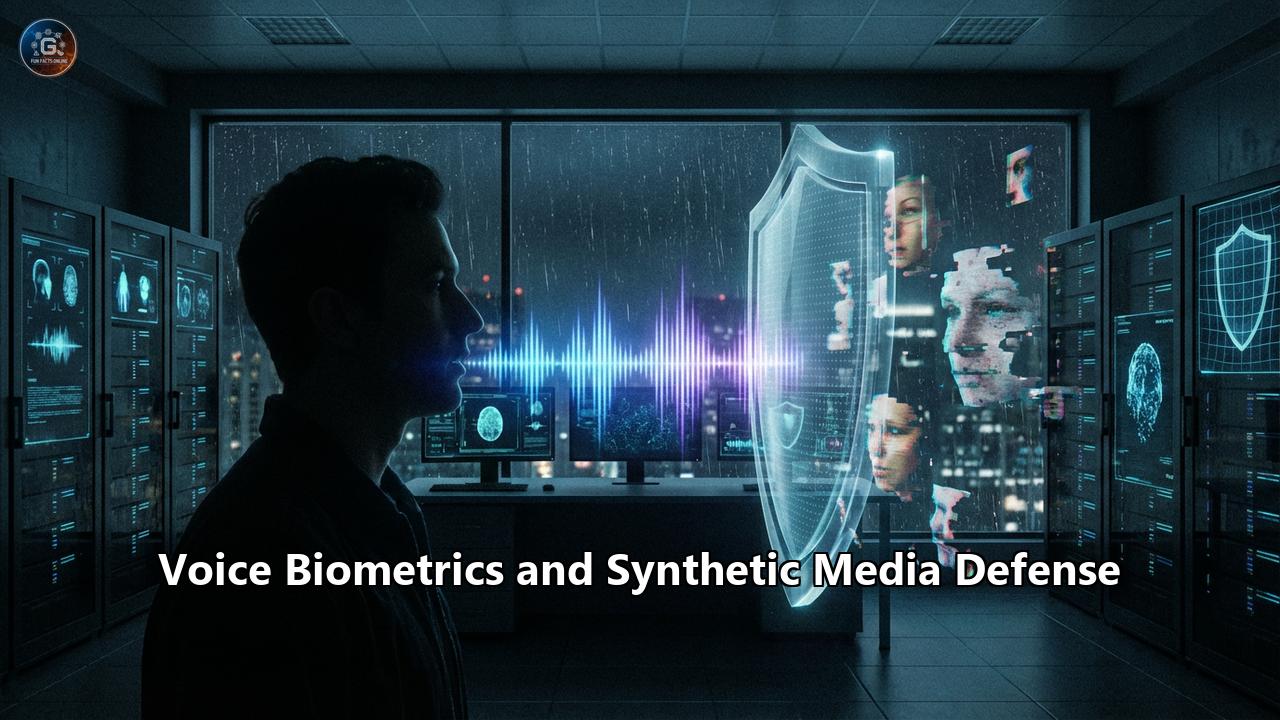
Voice biometrics and the rising tide of synthetic media defense represent one of the most critical security frontiers of our decade. As we transition into an era where "hearing is no longer believing," the immutable characteristics of the human voice are being challenged by generative AI capable of cloning a speaker with just three seconds of audio. This shift forces a complete reimagining of trust, authentication, and digital identity.
The following comprehensive guide explores the technical, legal, and operational landscape of this battleground.
Part I: The Fundamentals of Voice Biometrics
To understand the threat, one must first understand the fortress. Voice biometrics, also known as voice verification or speaker recognition, relies on the biological premise that a person's voice is as unique as their fingerprint.
1. The Anatomy of a Voiceprint
Unlike a password, which is a secret you know, a voiceprint is something you are. When a user enrolls in a voice biometric system, they are not recording a simple audio file that gets compared like two MP3s. Instead, the system analyzes the "spectro-temporal" features of the voice.
- Physiological Components: The shape of the larynx, the length of the vocal tract, the size of the nasal cavity, and the movement of the jaw and tongue all contribute to the sound. These physical traits determine the "timbre" or color of the voice.
- Behavioral Components: These include the rhythm of speech, accent, intonation, pronunciation speed, and idiosyncrasies in how specific phonemes are shaped.
2. The Mathematical Engine: From MFCCs to Deep Neural Networks
The conversion of raw audio into a secure biometric template involves complex signal processing.
- Mel-Frequency Cepstral Coefficients (MFCCs): For decades, this was the gold standard. It involves breaking the audio into short frames (e.g., 20 milliseconds), applying a Fourier transform to analyze frequencies, and mapping them to the "Mel scale," which mimics how the human ear perceives sound pitch.
- i-Vectors and x-Vectors: Modern systems use vector embeddings. An "i-vector" (identity vector) compresses the speaker's information into a low-dimensional fixed-length array. More recently, "x-vectors" derived from Deep Neural Networks (DNNs) have become the state-of-the-art, offering superior resistance to noise and channel variability (e.g., the difference between speaking into a high-end mic vs. a smartphone on speakerphone).
Part II: The Rise of Synthetic Media and the Threat Landscape
The security of voice biometrics was largely unquestioned until the explosion of Generative Adversarial Networks (GANs) and Transformer models. We have moved from "text-to-speech" (TTS) that sounded robotic to "voice cloning" that captures the very soul of a speaker's cadence.
1. The Mechanics of Attack
- Replay Attacks: The oldest and simplest form. An attacker records the victim's voice (perhaps from a phone call or a social media video) and simply plays it back to the authentication sensor.
- Voice Synthesis (Text-to-Speech): Early TTS systems required hours of clean studio data to build a model. Today, "Zero-Shot" voice conversion models can generate a convincing clone from a 3-second sample found on TikTok or YouTube.
- Voice Conversion (VC): This is distinct from TTS. In Voice Conversion, the attacker speaks into a microphone, and the AI modifies the timbre and pitch in real-time to match the target victim. This allows for real-time fraud on phone calls, enabling the attacker to react dynamically to the victim’s questions.
2. Case Studies in Failure
The theoretical threat has already become a financial reality.
- The $25 Million Hong Kong Deception (2024): A finance worker at a multinational firm in Hong Kong was invited to a video conference call with the company’s CFO and several other colleagues. The worker was suspicious of the initial email but relaxed upon seeing the faces and hearing the voices of people he knew. In reality, everyone on the call except the victim was a deepfake. The worker was manipulated into transferring $25.6 million to fraudulent accounts. This case shattered the illusion that "live" video and audio interactions were proof of presence.
- The Biden Robocall Incident (2024): Prior to the New Hampshire primary, thousands of voters received a call from what sounded exactly like President Joe Biden, using his signature "malarkey" catchphrase, urging them not to vote. This wasn't just a political prank; it was a demonstration of how easily democratic processes could be disrupted by synthetic audio. The call was traced to a magician using a simple AI tool, highlighting the low barrier to entry.
3. The "Liar's Dividend"
A psychological side effect of these technologies is the "Liar's Dividend." As the public becomes aware that any audio can be faked, bad actors can plausibly deny legitimate incriminating evidence. A CEO caught on tape making a racist remark or engaging in insider trading can simply claim, "That wasn't me; it was AI," and a significant portion of the public will believe them. This erosion of objective truth is perhaps more damaging than the fraud itself.
Part III: The Defense Arsenal
Defense against synthetic media is an "arms race." As generation models get better, detection models must evolve. The defense strategy is currently tri-modal: Liveness Detection, Watermarking, and Provenance.
1. Liveness Detection: The Gatekeeper
Liveness detection answers the question: Is this audio coming from a live human vocal tract right now, or is it a recording/synthesis?
- Active Liveness:
Challenge-Response: The system asks the user to say a random phrase (e.g., "Purple Dinosaur") displayed on the screen. This prevents simple replay attacks but is vulnerable to real-time voice conversion tools that can read text.
Prompted Emotion: Newer systems ask the user to "say the password in a happy tone" or "whisper the passphrase." Current AI models struggle to switch emotions or vocal styles instantly without latency.
- Passive Liveness (The Invisible Shield):
Spectral Analysis: Real human speech has "micro-tremors" and breath sounds that result from the physical air pressure moving through vocal cords. Synthetic speech, generated by mathematical models, often lacks these sub-perceptual imperfections. It is often "too perfect" or contains specific high-frequency artifacts (often above 8kHz) left by the vocoder (the part of the AI that generates the waveform).
Channel Characteristics: When a voice is played through a loudspeaker (replay attack), the speaker adds its own resonance, and the room adds reverb. Passive detection algorithms look for these "box" effects that indicate the audio is being played at a device rather than spoken into it.
Phoneme-Viseme Mismatch: In video-based voice authentication, the system checks if the lip movements (visemes) perfectly match the sounds (phonemes). Deepfakes often have slight desynchronizations that are imperceptible to humans but glaring to algorithms.
2. Audio Watermarking: The Supply Chain Defense
If we cannot detect the fake, we must certify the real.
- Imperceptible Watermarking: Companies like Resemble AI and others have developed neural watermarking (e.g., "PerTh"). This involves embedding a data signal into the audio that human ears cannot hear (masked by louder frequencies, a phenomenon known as "auditory masking") but that persists even if the audio is compressed, cropped, or recorded over a phone line.
- Fragile vs. Robust Watermarks:
Robust watermarks are designed to survive compression (like MP3 encoding) to prove copyright ownership.
Fragile watermarks are designed to break if the file is tampered with. For security, a fragile watermark is useful: if the watermark is broken, the system knows the audio has been manipulated.
3. Blockchain and Provenance
The concept of "Glass-to-Glass" provenance suggests we need a chain of custody for media from the moment it hits the camera/microphone lens to the moment it is consumed.
- C2PA and Content Credentials: The Coalition for Content Provenance and Authenticity (C2PA) creates open technical standards for certifying the source of media. In a voice context, a microphone with a specialized cryptographic chip could sign the audio metadata at the hardware level. This "signed" audio is then hashed and stored on a ledger (like a blockchain). If the audio is deepfaked later, the hash won't match the original, and the "content credential" will show the file as unverified.
Part IV: Regulatory and Legal Frameworks
The technology does not exist in a vacuum. Governments are scrambling to regulate the collection of voice data and the creation of synthetic voices.
1. The United States: A Patchwork of Privacy
- Illinois BIPA (Biometric Information Privacy Act): This is the strictest biometric law in the U.S. It requires explicit written consent before collecting biometric identifiers (including voiceprints) and allows private citizens to sue companies for violations. Crucially, recent court rulings suggest that each time a company scans a worker's or customer's voice without consent, it counts as a separate violation, leading to potentially ruinous liability for non-compliant firms.
- CCPA/CPRA (California): Classifies biometric data as "sensitive personal information." Californians have the right to know if their voice data is being collected, the right to delete it, and the right to opt-out of its sale.
- FCC Robocall Ruling: Following the Biden deepfake incident, the FCC issued a declaratory ruling that AI-generated voices in robocalls are "artificial" under the Telephone Consumer Protection Act (TCPA), making them illegal to use without express consent.
2. The European Union: The AI Act and GDPR
- GDPR: Voice data is "special category data" (Article 9). Processing it requires a higher threshold of justification (usually explicit consent).
- The AI Act: This groundbreaking legislation categorizes AI systems by risk.
Unacceptable Risk: Real-time remote biometric identification in public spaces by law enforcement is largely banned.
High Risk: Biometric systems used for critical infrastructure, employment, or border control must undergo strict conformity assessments.
Transparency Risk: Deepfakes and synthetic media must be clearly labeled as artificially manipulated. Users interacting with an AI chatbot (voicebot) must be informed they are talking to a machine.
3. China: The PIPL and Deep Synthesis Provisions
China has moved aggressively to regulate deepfakes.
- Deep Synthesis Provisions (2023): Service providers that offer "deep synthesis" (deepfake) capabilities must add watermarks to the content, verifying the source. They must also verify the real identity of users creating the content.
- PIPL (Personal Information Protection Law): Similar to GDPR, it places strict requirements on data handlers and requires a specific security assessment before transferring voice data cross-border.
Part V: Industry Applications and Vulnerabilities
Different sectors face unique risks and are adopting voice biometrics at different speeds.
1. Financial Services (The Frontline)
Banks were the early adopters. "My voice is my password" became a common phrase for telephone banking.
- The Threat: Account Takeover (ATO). Fraudsters use cloned voices to bypass the "knowledge-based authentication" (like mother's maiden name) by simply asking the call center agent to reset it, sounding exactly like the account holder.
- The Defense: Banks are moving to "passive background authentication." Instead of asking the user to say a phrase, the system listens to the natural conversation with the agent. It scores the voice for a match and simultaneously runs an anti-fraud check for deepfake artifacts. If the score is low, it triggers a step-up authentication (like an OTP sent to a mobile app).
2. Healthcare (Privacy vs. Efficiency)
Doctors spend nearly 50% of their time on Electronic Health Records (EHR). Voice dictation is a savior, but it opens privacy holes.
- Use Case: Ambient listening tools (like Nuance's DAX) record the doctor-patient conversation and automatically generate clinical notes.
- Risk: If a malicious actor injects a fake voice command into the recording stream, they could alter a prescription or diagnosis.
- Defense: Healthcare systems are adopting "speaker diarization" (identifying who spoke when) combined with biometric verification to ensure that only the authorized physician can finalize a medical order via voice.
3. Automotive (The Cockpit)
Cars are becoming rolling computers.
- Use Case: Unlocking the car and starting the engine with voice commands. Personalizing seat, mirror, and climate settings based on who is speaking.
- Risk: A thief could play a recording of the owner's voice to unlock the car (a "replay attack").
- Defense: Automotive systems rely heavily on multi-modal fusion. They combine voice biometrics with facial recognition (via a driver monitoring camera) and lip-movement synchronization. The car won't start unless the voice matches and the lips are moving in sync with the password.
Part VI: The Future: Quantum, Ethics, and the Human Element
1. The Quantum Threat
Current encryption standards (RSA, ECC) used to protect biometric templates are vulnerable to future quantum computers (Shor's algorithm). If a hacker steals an encrypted database of voiceprints today, they can store it ("harvest now, decrypt later") and crack it when quantum computers become viable.
- Solution: The industry is migrating to Post-Quantum Cryptography (PQC), such as lattice-based cryptography, to encrypt biometric templates. Additionally, "cancelable biometrics" are being developed—if your voiceprint is stolen, the algorithm can generate a new hash from your voice that doesn't match the old stolen one, effectively "resetting" your biometric password.
2. Ethical AI Development
Companies like ElevenLabs are implementing "Ethics by Design."
- Safeguards: To clone a voice on their platform, you must read a specific, randomly generated prompt using your real voice to prove you are present and consenting. They also ban the cloning of famous voices without permission.
3. The Human Firewall
Ultimately, technology cannot solve everything. The "Grandparent Scam"—where a senior receives a frantic call from a grandchild (voice-cloned) begging for bail money—exploits fear, not just technology.
- Defense: We must train people to have "safe words" with family members. If a loved one calls claiming an emergency, ask for the safe word. If they can't give it, hang up and call them back on their known number.
Conclusion
Voice biometrics offers a future of seamless, password-less interaction, but it exists in a precarious balance with the destructive potential of synthetic media. The defense of our digital voices will not be won by a single technology, but by a layered ecosystem: robust liveness algorithms, invisible watermarking, immutable provenance ledgers, and a vigilant, educated public. As the line between real and synthetic blurs, the ability to prove who is speaking becomes not just a security feature, but a fundamental pillar of truth in society.
Reference:
- https://www.getclarity.ai/ai-deepfake-blog/25m-deepfake-ceo-scam-shakes-hong-kong-firm
- https://www.forbes.com/sites/zacharyfolk/2024/02/23/magician-created-ai-generated-biden-robocall-in-new-hampshire-for-democratic-consultant-report-says/
- https://www.resemble.ai/watermarker/
- https://www.resemble.ai/neural-speech-watermarker/
- https://voicebot.ai/2023/02/02/resemble-ai-creates-synthetic-audio-watermark-to-tag-deepfake-speech/
- https://www.resemble.ai/audio-watermarking-techniques-applications/