
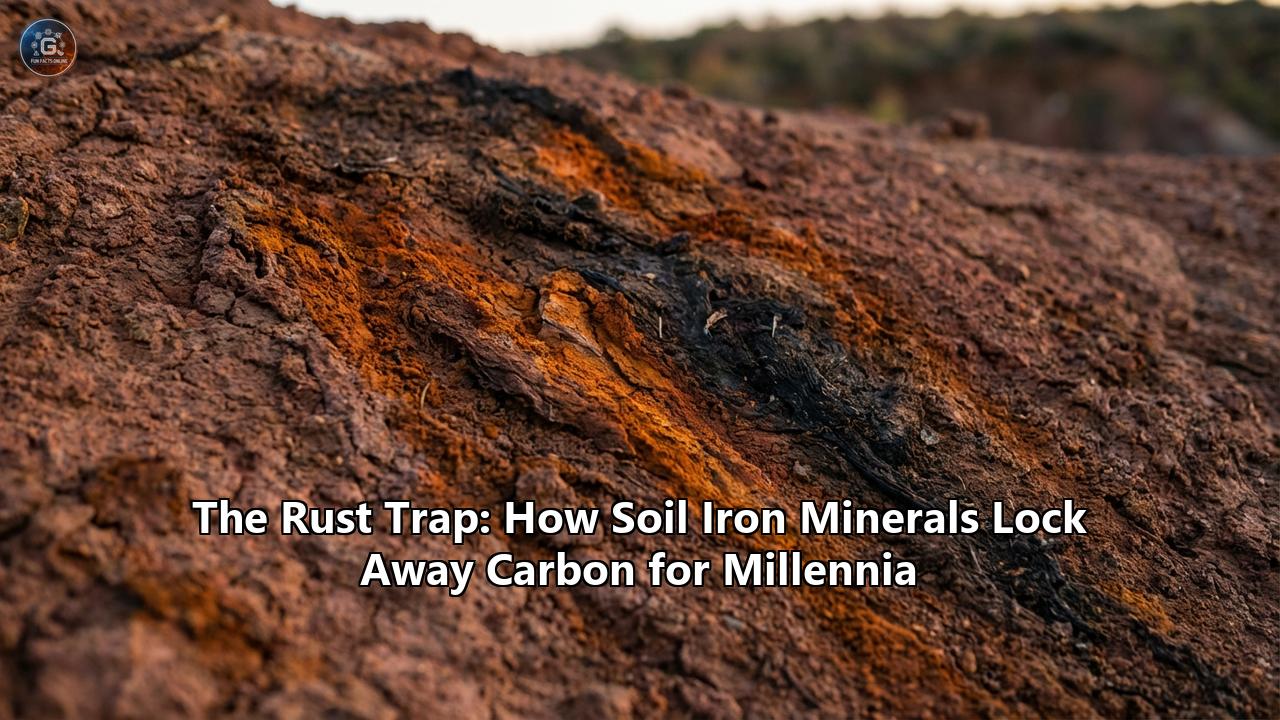
The ground beneath our feet is often viewed as a passive stage for life—a dark, inert matrix where roots anchor and worms burrow. But zoom in to the nanometer scale, and this static view dissolves into a frantic, high-stakes chemical marketplace. Here, amidst the chaos of decaying leaves and microbial feeding frenzies, a silent struggle plays out that will determine the future of our planet’s climate. At the center of this struggle is a common, often overlooked element: iron. specifically, the reddish-brown minerals we commonly know as rust.
For decades, scientists have known that soil is the Earth’s second-largest carbon sink, holding more carbon than the atmosphere and all the world’s vegetation combined—roughly 2,500 billion tons. Yet, the mechanism behind this storage has been a subject of intense debate. Why does some organic matter break down in days, while other bits persist for millennia, effectively locked away from the atmosphere?
The answer, it turns out, lies in "The Rust Trap."
Recent breakthroughs, including a landmark study from Northwestern University in late 2025, have revolutionized our understanding of how iron minerals—particularly a reactive form called ferrihydrite—act as a "carbon vault." These minerals do not merely coat soil particles; they possess a complex, nanoscale architecture that traps organic carbon using a multi-pronged chemical strategy. This discovery has shattered old paradigms of soil science, shifting our view from "humus" as a stable substance to "mineral-associated organic matter" (MAOM) as a dynamic, protected state.
This article explores the deep science, the sweeping history, and the future technology of the Rust Trap. It is a story that spans from the peat bogs of the Arctic to the red clays of the Amazon, and from 19th-century German laboratories to modern Silicon Valley startups trying to reverse climate change by spreading rock dust.
Part I: The Nanoscale Vault
To understand how a mineral can lock away carbon for thousands of years, we must first abandon the idea of soil as a simple mixture of sand, silt, and clay. At the molecular level, soil is an aqueous environment, a thin film of water coating mineral surfaces where ions and molecules drift and collide.
The "Sticky" Mineral: Ferrihydrite
Iron oxides come in many forms in the soil. There is hematite, the stable, crystalline mineral that gives tropical soils their deep red hue. There is goethite, often yellowish-brown and common in temperate regions. But the true superstar of carbon sequestration is ferrihydrite.
Ferrihydrite is a "short-range ordered" (SRO) mineral. Unlike hematite, which has a perfect, repeating crystal lattice extending in all directions, ferrihydrite is poorly crystalline. It forms tiny, chaotic nanoparticles with a massive surface area relative to its volume. It is often described as "metastable"—it forms quickly when iron is released from weathering rocks or microbial activity, but it wants to eventually turn into more stable forms like goethite.
For years, scientists assumed that positively charged minerals simply attracted negatively charged organic molecules—a basic electrostatic attraction, like a balloon sticking to a wall. While true, this bond is weak and easily broken. The 2025 Northwestern study led by Ludmilla Aristilde revealed something far more sophisticated.
The Nanoscale Mosaic
Using advanced atomic force microscopy and molecular modeling, researchers discovered that ferrihydrite’s surface is not a uniform positive charge. Instead, it is a nanoscale mosaic of positive and negative patches. This heterogeneity allows the mineral to interact with a staggering diversity of organic molecules.
- Ligand Exchange (The Anchor): This is the strongest bond. An organic molecule (like a carboxylic acid from decaying plant matter) swaps a hydroxyl group on the iron surface for one of its own oxygen atoms. This forms a direct, covalent bond between the carbon-structure and the iron metal. It’s not just sticking; it’s chemically welding the carbon to the rock.
- Hydrogen Bonding: The mosaic surface allows for multiple hydrogen bonds to form, acting like "molecular velcro" that stabilizes larger, more complex organic structures that might not fit a single binding site.
- Co-precipitation (The Tomb): Perhaps the most powerful mechanism is co-precipitation. When dissolved iron and dissolved organic carbon meet in the soil solution, they can precipitate out of the liquid together. The iron mineral forms around the organic matter, encasing it like a fly in amber. Inside these "organo-mineral aggregates," the carbon is physically inaccessible to the enzymes of hungry microbes.
The "Onion" Layering Effect
Recent imaging has shown that these interactions create a layered architecture. The inner layer of carbon is tightly bound directly to the mineral surface via strong ligand exchange—this is the "hard core" that can last for millennia. On top of this, other organic molecules attach via weaker forces, creating a "soft shell."
This "Zonal Model" of organo-mineral interactions, proposed by researchers like Markus Kleber, suggests that the iron mineral acts as a nucleus. It stabilizes the first layer of carbon, which then stabilizes the next. This explains why soils with high reactive iron content often hold significantly more carbon than their texture alone would predict.
Part II: The Global Geography of Rust
The Rust Trap is not evenly distributed. Its effectiveness depends on geology, climate, and the specific history of the land. By touring the world’s major soil biomes, we can see the Rust Trap in its various guises—and the different threats it faces.
1. The Red Earths: Tropical Rainforests (Oxisols and Ultisols)
In the Amazon and the Congo Basin, the soils are ancient and highly weathered. Most soluble minerals washed away millions of years ago, leaving behind insoluble residues: iron and aluminum oxides. This is why tropical soils are famous for their vibrant red and yellow colors.
In these Oxisols and Ultisols, the "Rust Trap" is the primary reason any fertility exists at all. The clay minerals (like kaolinite) in these regions have very low chemical activity. It is the iron oxides that provide the surface area to hold onto organic matter and nutrients.
- The Iron Nodule Phenomenon: In some tropical soils, alternating wet and dry seasons cause iron to concentrate into hard nodules or "plinthite." These nodules can physically encapsulate organic carbon, locking it away for geological timescales. However, if these forests are cleared and the soil dries out completely, these iron minerals can harden irreversibly into ironstone, making the land unfarmable—a process that traps carbon but destroys the ecosystem.
2. The Frozen Vault: Boreal Forests and Podzols
Move north to the boreal forests of Canada, Scandinavia, and Russia, and you find "Podzols." These soils are characterized by a striking visual profile: a bleached, grey layer of sand on top, and a dark, reddish-brown layer beneath it.
This profile is the result of a natural chemical extraction. Acidic water from pine needles leaches iron and organic matter from the surface, carrying them downward. deeper in the soil, the chemistry changes, and the iron and carbon precipitate out together, forming that dark, rusty subsoil layer.
- The Fungal Connection: In these forests, ectomycorrhizal fungi play a crucial role. They mine the soil for nitrogen, often attacking mineral surfaces to release nutrients. Recent research from Sweden shows that these fungi can actually deposit carbon onto iron minerals as they grow and die, feeding the "mineral trap" deep underground where it is safe from forest fires.
3. The Waterlogged Trap: Peatlands and Wetlands
Peatlands are the heavyweights of soil carbon, storing twice as much carbon as all the world’s forests. Here, the preservation mechanism is usually attributed to the lack of oxygen—microbes just can't work fast enough in the water.
However, iron plays a secret, dangerous role here. In the "transition zones" of peatlands, iron minerals bind with dissolved organic carbon, preventing it from leaching away. This is the "Rusty Sink."
- The Threat of Reduction: The danger in wetlands is that iron is "redox sensitive." In the presence of oxygen (rust), it is solid and holds carbon tight. But if conditions become too anoxic (oxygen-free) and specific bacteria like Geobacter or Shewanella wake up, they can "breathe" the iron oxides instead of oxygen. This process, called reductive dissolution, dissolves the solid iron mineral into liquid ferrous iron (Fe2+). When the mineral jail cell dissolves, the carbon prisoner is released. This can lead to sudden pulses of methane and CO2—a "carbon bomb" triggered by changes in the water table.
4. The Blue Carbon Coast: Mangroves
Mangroves accumulate massive amounts of carbon in their soils. Recent studies from the Amazon coast have shown that a significant portion of this "blue carbon" is actually iron-bound. The daily tides create a dynamic reactor where fresh iron is supplied from rivers, and the fluctuating water levels create cycles of rust formation. However, converting mangroves to shrimp farms or pastures disrupts this cycle, often draining the soil and causing the oxidation of iron-sulfides (pyrite), which creates sulfuric acid—literally burning the soil's organic matter away.
Part III: From Humus to Minerals – A History of Ideas
To truly appreciate the "Rust Trap," we must understand the intellectual journey soil science has taken. For two centuries, we looked for the wrong thing.
The Humus Theory (1790s–1990s)
In the late 18th century, German agronomist Albrecht Thaer popularized the "Humus Theory." The idea was intuitive: plant matter decays into a dark, stable, gelatinous substance called "humus." Scientists believed humus was a specific class of unique chemical compounds—humic acids, fulvic acids, and humin—that were large, complex, and inherently resistant to decay (recalcitrant).
Generations of scientists, including the Nobel Prize winner Selman Waksman in the early 20th century, spent their careers extracting these substances using strong alkalis (like lye). They classified them by color and solubility, assuming that "building soil health" meant creating these specific, recalcitrant molecules.
The Paradigm Shift (2000s–Present)
The crack in the theory appeared when modern technology (like spectroscopy and synchrotrons) allowed scientists to look at soil without extracting it first. What they found was shocking: Humic substances don't exist in nature. They were artifacts created by the harsh chemical extraction process in the lab.
In nature, soil organic matter is just a continuum of plant and microbial debris in various stages of decay. There is no magical, indestructible "humus" molecule.
This led to the Soil Continuum Model and the concept of Mineral-Associated Organic Matter (MAOM).
- The New Rule: Carbon doesn't persist because it is chemically unique or "hard to eat." It persists because it is protected.
- Sugars and proteins—highly edible substances that should vanish in hours—can last for centuries if they are chemically bonded to an iron mineral or trapped inside a soil aggregate.
- This shift, championed by scientists like John Lehmann, Markus Kleber, and Francesca Cotrufo, completely changed our focus. We stopped trying to breed "super-plants" with tough residues and started looking at the mineral matrix—the capacity of the soil bucket itself.
Part IV: Threats to the Vault
The realization that soil carbon is "protected" rather than "permanent" is both empowering and terrifying. It means the "Rust Trap" is not a safe deposit box; it is a bank vault that can be robbed if the security conditions change.
1. The Redox Seesaw
Iron minerals are chemically fickle. They react to the availability of electrons.
- The Permafrost Thaw: As the Arctic warms, permafrost soils that have been frozen for millennia are thawing. If they thaw into a waterlogged slush, the environment becomes anoxic. Iron-reducing bacteria will thrive, dissolving the ancient iron oxide bonds and releasing carbon that has been trapped since the Ice Age. This turns a carbon sink into a methane source.
- The Agricultural Flood: In rice paddies or flooded fields, the same process occurs. While wet conditions generally slow decomposition, the specific dissolution of iron minerals can release a pulse of previously stable carbon and phosphate.
2. The Acidification Problem
The bond between carbon and iron is pH-dependent. In general, slightly acidic to neutral conditions favor strong bonding. However, extreme acidification (often caused by excessive nitrogen fertilizer use) can alter surface charges. If the pH drops too low, aluminum becomes soluble and toxic, potentially interfering with iron-carbon bonds. Conversely, liming soils to raise pH changes the surface charge of iron minerals, which can temporarily release carbon before new equilibriums are established.
3. Root Exudate Priming
Plants are not passive observers. To access nutrients like phosphorus (which often binds to iron just like carbon does), plants release organic acids (like oxalate and citrate). These acids are designed to attack iron minerals.
- The "Rusty Trade": Plants trade carbon (sugar) to microbes or release acids to dissolve rust and grab the phosphorus trapped inside. In doing so, they inadvertently unlock the "old" carbon trapped in that rust. This is called the "Priming Effect." As CO2 levels rise, plants may pump more exudates into the soil, potentially accelerating the weathering of these minerals and destabilizing the carbon vault.
Part V: Unlocking the Trap – Practical Management
If we understand the "Rust Trap," we can manage it. Farmers and land managers are moving beyond generic "soil health" to targeted mineral management.
1. Clay Delving and Modification
In places like Australia, where farmers struggle with sandy soils that hold no water or carbon, a practice called "clay delving" or "clay spreading" is gaining traction. Huge plows dig up to a meter deep to bring iron-rich subsoil clay to the surface.
- The Science: This isn't just about texture. By mixing iron-coated clay into the sandy topsoil, farmers are literally adding "binding sites" to the soil. They are increasing the soil's saturation deficit—creating empty seats in the stadium for carbon to sit in. Studies show this can double or triple the carbon sequestration rate compared to standard practices.
2. Iron Slag Amendments
The steel industry produces massive amounts of "slag"—a calcium and iron-rich byproduct. Historically treated as waste, it is now being re-evaluated as a high-tech soil amendment.
- Silicate Fertilizers: In rice paddies, applying iron silicate slag provides electron acceptors. The iron in the slag intercepts the electrons that would otherwise generate methane, significantly reducing greenhouse gas emissions. Simultaneously, the iron weathers to form new ferrihydrite surfaces, creating fresh traps for soil carbon.
3. Strategic Tillage and Water Management
- No-Till: Tillage breaks up soil aggregates. It physically smashes the "house" where carbon is hiding. By adopting no-till, farmers allow the fungal hyphae and iron cements to rebuild the nanoscale architecture of the soil.
- Water Control: Managing the "redox" state is crucial. Avoid keeping soils waterlogged and warm for extended periods unless necessary (like in rice), and ensure adequate drainage in cropping systems to prevent the reductive dissolution of the iron trap.
Part VI: Future Tech & Geoengineering
The "Rust Trap" has caught the eye of Silicon Valley and the burgeoning carbon removal market. We are moving from passive management to active engineering.
Enhanced Rock Weathering (ERW)
Startups like UNDO and Eion are scaling up "Enhanced Rock Weathering." They grind up basalt—a volcanic rock rich in iron, magnesium, and calcium—and spread it on farmland.
- The Process: As the basalt weathers, it captures CO2 directly from the air to form bicarbonates (which wash into the ocean—a separate sequestration pathway). But importantly, the iron in the basalt remains in the soil, forming new iron oxides (ferrihydrite and goethite).
- Double Duty: This means ERW is a double-barreled carbon gun: it captures carbon chemically via weathering and creates new mineral surface area to trap organic carbon produced by the crops.
Engineered Enzymes and Microbes
A startup called FabricNano is taking it a step further. They are engineering enzymes (carbonic anhydrase) and immobilizing them on rock particles to speed up the weathering process from decades to years.
- Loam Bio focuses on the biological side. They coat seeds with specific microbial fungi. These microbes are selected for their ability to produce "sticky" residues (melanin and chitin) and to specifically associate with soil minerals. They are essentially deploying microscopic construction crews to build the "Rust Trap" faster and more efficiently than native microbes might.
Iron "Fertilization" on Land?
We have heard of iron fertilization in the oceans to stimulate algae. Some researchers are now proposing "terrestrial iron fertilization"—using chelated iron or iron-rich industrial byproducts to specifically target carbon-poor soils. The goal is to artificially increase the "MAOM capacity" of a field. If a soil has plenty of carbon input (crop residue) but nowhere to store it (sandy soil), adding reactive iron is like building a new warehouse.
Conclusion: The Rusty Key
The "Rust Trap" redefines our relationship with the ground. Soil is not just dirt; it is a vast, battery-like matrix of charged particles holding onto the energy of ancient suns (in the form of carbon).
Iron minerals are the guardians of this vault. They are the reason that carbon can persist for millennia, bridging the gap between the rapid biological cycle of life and the slow geological cycle of rock.
As we face the climate crisis, the Rust Trap offers a rare glimmer of hope. It is a natural mechanism that is scalable, proven by millions of years of Earth history, and compatible with agriculture. But it requires a new level of sophistication in how we treat the land. We cannot just dump compost and hope for the best. We must nurture the mineral matrix—managing pH, moisture, and physical disturbance to keep the vault door locked.
From the red dust of the outback to the high-tech labs of ag-tech startups, the humble rust particle has become one of the most important materials on Earth. The future of our atmosphere may well depend on how well we understand the trap beneath our feet.
Reference:
- https://www.researchgate.net/publication/222420758_Historical_evolution_of_soil_organic_matter_concepts_and_their_relationships_with_the_fertility_and_sustainability_of_cropping_systems
- https://tmg.hu/en/the-mitosis-of-humus-and-the-reanalysis-of-soil-organic-matter/
- https://www.esa.org/esa/wp-content/uploads/2012/12/carbonsequestrationinsoils.pdf
- https://www.regreener.earth/blog/the-5-best-enhanced-rock-weathering-carbon-credit-projects-of-2026
- https://un-do.com/enhanced-weathering/
- https://carbonherald.com/fabricnano-is-revolutionizing-enhanced-rock-weathering-with-enzymes/
- https://carboncapturemagazine.com/articles/veolia-uses-enzymes-in-world-first-trial-to-remove-co2-with-enhanced-rock-weathering