
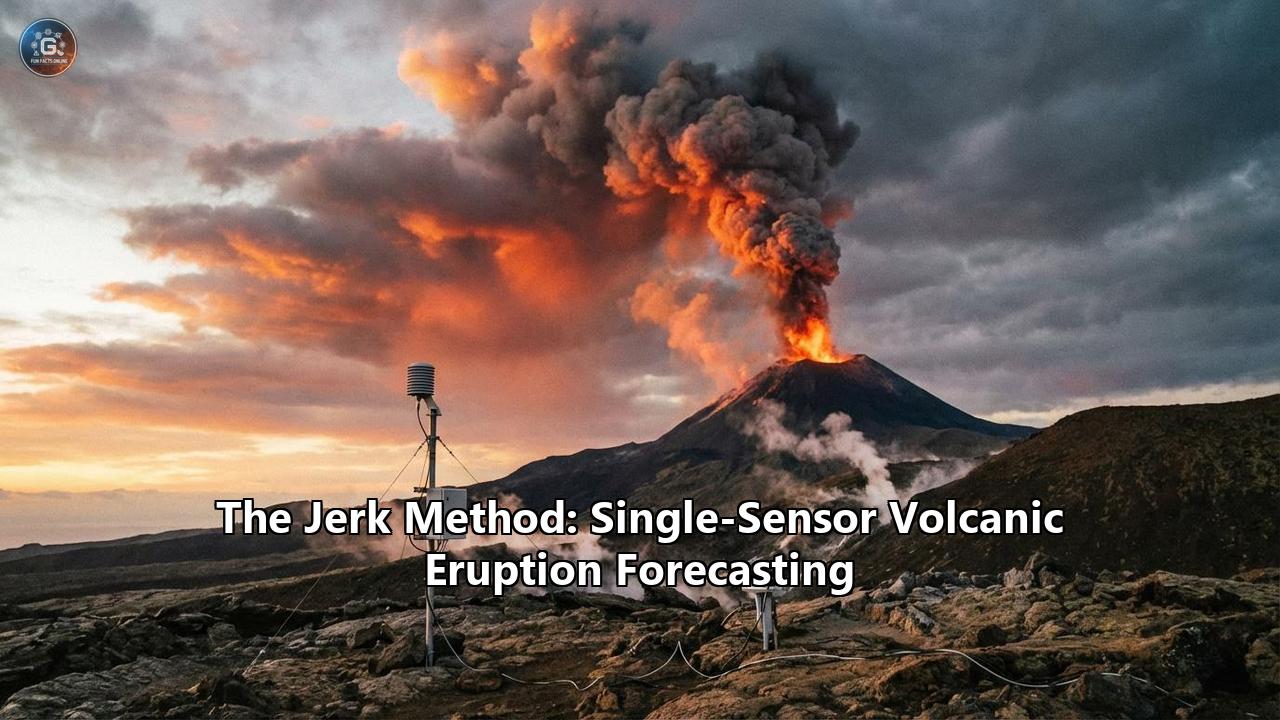
The shadow of an active volcano is a place of breathtaking beauty and latent peril. For generations, millions of people living near the world’s most restless peaks have relied on a complex, often imperfect science to warn them of impending doom. Historically, forecasting a volcanic eruption has required heavily funded observatories, massive arrays of sensitive equipment, and a healthy dose of statistical guesswork. Hazard scientists have spent decades trying to decode the erratic seismic whispers of the Earth, frequently racing against the clock to issue warnings before magma violently breaches the surface.
But what if the key to predicting an eruption didn't require an army of sensors? What if a single, precisely tuned instrument could detect the faintest subterranean breath of a waking volcano hours before the first drop of lava appeared?
Welcome to the frontier of geophysical monitoring: the "Jerk" method. Developed by an international team of researchers from the Institut de Physique du Globe de Paris (IPGP) and the GFZ Helmholtz Centre for Geosciences, this deceptively simple, highly elegant technique is revolutionizing single-sensor volcanic eruption forecasting. By shifting the focus from traditional seismic metrics to a hyper-sensitive physical derivative known as "jerk," scientists have unlocked a real-time early warning system that is saving time, money, and potentially thousands of lives.
To truly appreciate the genius of this methodology, one must first understand the physics of movement. In classical mechanics, position describes where an object is. Velocity is the rate at which that position changes. Acceleration is the rate at which velocity changes.
But there is a third derivative of position: the jerk.
Jerk is the rate of change of acceleration. If you are sitting in a car that is smoothly accelerating, you are pushed back into your seat with a constant force. But if the driver suddenly stomps on the gas pedal or abruptly slams on the brakes, you feel a sudden, jarring lurch. That physical jolt is the jerk. It is a measurement of abrupt alteration in dynamics.
For decades, traditional volcanology and seismology have relied heavily on measuring velocity and acceleration. When magma rises from deep within the Earth's crust, it fractures rock, creates harmonic tremors, and deforms the ground. Seismometers and GPS stations pick up these changes, but often, the most obvious signals only manifest hours or even minutes before an eruption—sometimes too late for an effective evacuation.
The researchers behind the Jerk method realized that the ascent of magma is not a smooth, constant process. As magma forces its way upward, it exhibits "stick-slip" behavior. It pressurizes, stalls, violently fractures surrounding rock, and causes rapid gas bubble collapses. These microscopic, non-linear deformation processes create abrupt, transient shifts in the mechanical behavior of the volcano. They create a jerk.
The brilliance of the Jerk method lies in its sensitivity to these extraordinarily faint, ultra-low-frequency transients in horizontal ground motion and tilt. These signals are unimaginably small—on the order of a few nanometers per second cubed (nm/s³). To put that into perspective, it is a movement so subtle that it sits far below what conventional seismology would even classify as a micro-earthquake. Yet, by applying advanced data processing to continuous seismic recordings, scientists can isolate these tiny, rapid jolts within the magma chamber, effectively catching the volcano in the act of clearing its throat before it screams.
The theoretical elegance of the Jerk method is matched only by its stunning real-world success. Rather than relying on a sprawling, expensive network of multi-disciplinary sensors (which many developing nations cannot afford), the Jerk method requires only a single, very broadband seismometer.
However, detecting a signal of a few nanometers per second cubed on a dynamic, noisy planet is no small feat. The data processing involved is intensely rigorous. To isolate the jerk of ascending magma, the automated system must filter out background seismic noise, atmospheric pressure changes, and even correct for Earth tides—the literal gravitational pull of the moon and sun deforming the Earth's crust.
Once filtered, what remains is a clear, unambiguous signal of dynamic rock-fracturing and fracture-opening processes that immediately precede a magmatic intrusion. Unlike previous prediction approaches that were heavily probabilistic—meaning they searched for statistical correlations in massive dumps of historical data—the Jerk method is deterministic. It does not guess if an eruption is likely based on past trends; it directly measures the physical mechanism of magma physically breaking through the crust in real time.
No scientific theory is complete without a grueling trial by fire. For the Jerk method, that proving ground was the Piton de la Fournaise on La Réunion Island in the Indian Ocean.
Piton de la Fournaise is one of the most active volcanoes in the world, and heavily monitored by the OVPF-IPGP (Volcanological Observatory of Piton de la Fournaise). It serves as an ideal, almost laboratory-like environment for volcanologists. In April 2014, the research team—led by Dr. François Beauducel, alongside Dr. Philippe Jousset and colleagues—implemented the Jerk tool as a fully automated module within the observatory's WebObs system. They utilized data from a single seismological station belonging to the global Geoscope network, located 8 kilometers away from the volcano's summit.
The results of this ten-year operational run, later published in the prestigious journal Nature Communications, sent shockwaves through the geophysical community.
On June 20, 2014, just two months after the system was brought online, the automated Jerk module triggered its first alert. Exactly 1 hour and 2 minutes later, the eruption began.
Over the next decade, from 2014 to 2023, the volcano erupted 24 times. The single-sensor Jerk system successfully issued automated early warnings for an astounding 92% of those eruptions. The warning times provided by the system varied depending on the speed of the magma ascent, ranging from a few minutes up to 8.5 hours before the lava reached the surface.
Critics of early warning systems frequently point to the danger of "false positives." In hazard management, a false alarm can lead to unnecessary evacuations, economic disruption, panic, and a devastating loss of public trust (the "cry wolf" effect). During the ten-year test period at La Réunion, the Jerk method yielded a false positive rate of 14%—meaning an alert was triggered, but no eruption occurred.
However, volcanologists quickly realized these were not system errors. The Jerk signals detected during these "false alarms" were entirely real. They accurately identified deep magma intrusions and movements beneath the surface. The magma had simply stalled, losing its upward momentum before breaking through the surface. In other words, the tool performed exactly as designed, correctly identifying the hazardous subterranean fracturing, even if the volcano ultimately decided to hit the snooze button. In December 2025, during a seismic crisis characterized by very low deformations and gas anomalies, the system picked up a microscopic jerk signal of just 0.1 nm/s³, confirming to scientists that a deep magmatic intrusion had indeed taken place despite the lack of traditional surface warnings.
The implications of the Jerk method extend far beyond the shores of La Réunion Island. While Piton de la Fournaise is a highly instrumented volcano, the vast majority of the world's active volcanoes are not.
Across the Pacific Ring of Fire, Latin America, and Southeast Asia, millions of people live in the shadows of "under-monitored" volcanoes. Deploying dense networks of tiltmeters, gas flux monitors, GPS arrays, and dozens of seismometers is prohibitively expensive. Furthermore, the rugged terrain, extreme weather, and threat of vandalism or theft in remote areas make maintaining these vast networks a logistical nightmare.
The Jerk method offers a profound democratization of volcanic safety. Because it relies on the data processing of a single very broadband seismometer, it presents a highly cost-effective, easily maintainable alternative for poorly monitored volcanic regions. By extracting high-value, early-warning intelligence from minimal hardware, observatories operating on shoestring budgets can suddenly possess world-class forecasting capabilities.
The scientific community is already moving to expand the application of this breakthrough. The next major test for the Jerk method will take place in Italy, targeting Mount Etna. Through a collaborative project named "POS4dyke" involving the INGV (National Institute of Geophysics and Volcanology in Italy), researchers are deploying a new network of broadband seismometers from the Geophysical Instrumental Pool of Potsdam (GIPP) to see how the Jerk method adapts to the highly complex, continuously active plumbing of Europe's most famous volcano.
As machine learning algorithms and high-speed telemetry continue to advance, the integration of jerk analysis into global monitoring frameworks will become increasingly seamless. Modern seismometers can be paired with edge-computing devices to continuously calculate the third derivative of displacement on-site, instantly beaming automated alerts to local authorities the moment the subterranean rock begins to violently snap.
The development of the single-sensor Jerk method represents a paradigm shift in how humanity interacts with the restless Earth. It proves that the solution to one of hazard science's most difficult problems did not require building bigger, more expansive arrays of equipment, but rather looking deeper and more intelligently at the data we already had. By tuning our ears to the nanometer-scale jolts of fracturing rock, scientists have found a way to outpace the magma. The Earth will always be unpredictable, but thanks to the mathematics of the jerk, we are finally getting a life-saving head start.
Reference:
- https://scitechdaily.com/a-deceptively-simple-idea-could-revolutionize-volcanic-eruption-forecasting/
- http://www.sciencedaily.com/releases/2026/03/260315004411.htm
- https://www.preventionweb.net/news/jerk-promising-new-method-early-warning-volcanic-eruptions
- https://scienmag.com/jerk-new-tool-predicts-volcanic-eruptions-early/
- https://www.mdpi.com/1424-8220/23/12/5730
- https://www.semanticscholar.org/paper/Jerk%2C-a-promising-tool-for-early-warning-of-Beauducel-Roult/25dbac3427baa600a805d40aa337b2788893bbca
- https://www.gfz.de/en/press/news/details/jerk-eine-vielversprechende-neue-methode-zur-fruehwarnung-vor-vulkanausbruechen
- https://pubmed.ncbi.nlm.nih.gov/41408041/