
On February 13, 2023, deep beneath the surface of the Mediterranean Sea, something violently energetic tore through the silent darkness. It was not a whale, nor a submarine, nor any geological tremor. It was a single subatomic particle—a ghost—carrying an amount of energy so incomprehensible that it defied the standard catalogs of astrophysical violence.
For a fraction of a second, the abyss 3,500 meters off the coast of Sicily was illuminated by a cone of phantom blue light. This flash, known as Cherenkov radiation, was the death rattle of a secondary particle created by the collision of a cosmic neutrino with a water molecule.
This was not just any neutrino. It was KM3-230213A.
With an estimated energy of 220 Peta-electronvolts (PeV), this single particle carried nearly 30 times the energy of the most powerful record-holders previously detected by the famous IceCube observatory in Antarctica. To put this in perspective, 220 PeV is roughly the kinetic energy of a professional tennis ball served at 100 mph—packed into a subatomic point with almost no mass. In the world of particle physics, this is not a tennis ball; it is a nuclear warhead.
Its detection sent shockwaves through the global physics community, triggering a "Code Red" hunt across the electromagnetic spectrum. It challenged decades of data from the South Pole, hinted at "new physics" beyond the Standard Model, and officially marked the entry of a new titan in the field of neutrino astronomy: the KM3NeT observatory.
This is the story of that particle, the machine that caught it, and the terrifyingly powerful cosmic engine that fired it across the universe.
Part I: The Machine in the Deep
To catch a ghost, you must build a trap the size of a mountain.
Neutrinos are the "introverts" of the particle zoo. They have no electric charge and nearly zero mass. They are produced in the nuclear fusion of stars, in supernovae, and in the Big Bang itself. Trillions of them pass through your fingertip every second, oblivious to your existence. To a neutrino, the Earth is as transparent as a pane of glass. They can travel through a light-year of lead without hitting a single atom.
However, "rarely" is not "never." If you build a detector large enough—using a transparent medium like ice or water as your target—you can play the odds. Eventually, a neutrino will crash head-on into an atomic nucleus. When it does, it transforms into a charged particle (like a muon) that screams through the medium faster than light can travel in that medium. This sonic boom of light is what detectors look for.
For over a decade, the undisputed king of this hunt was IceCube, a cubic kilometer of sensors frozen into the Antarctic ice sheet. It had found PeV-scale neutrinos before—famous events nicknamed "Big Bird," "Bert," and "Ernie"—but they topped out around 6 to 10 PeV.
Enter KM3NeT (Cubic Kilometre Neutrino Telescope).
Unlike IceCube, which looks down through the frozen clarity of the South Pole, KM3NeT looks up through the liquid abyss of the Mediterranean. It is currently being constructed in two sites: ORCA (off France) for lower energies, and ARCA (Astroparticle Research with Cosmics in the Abyss) off the coast of Sicily, designed for the ultra-high-energy monsters.
The ARCA21 Configuration
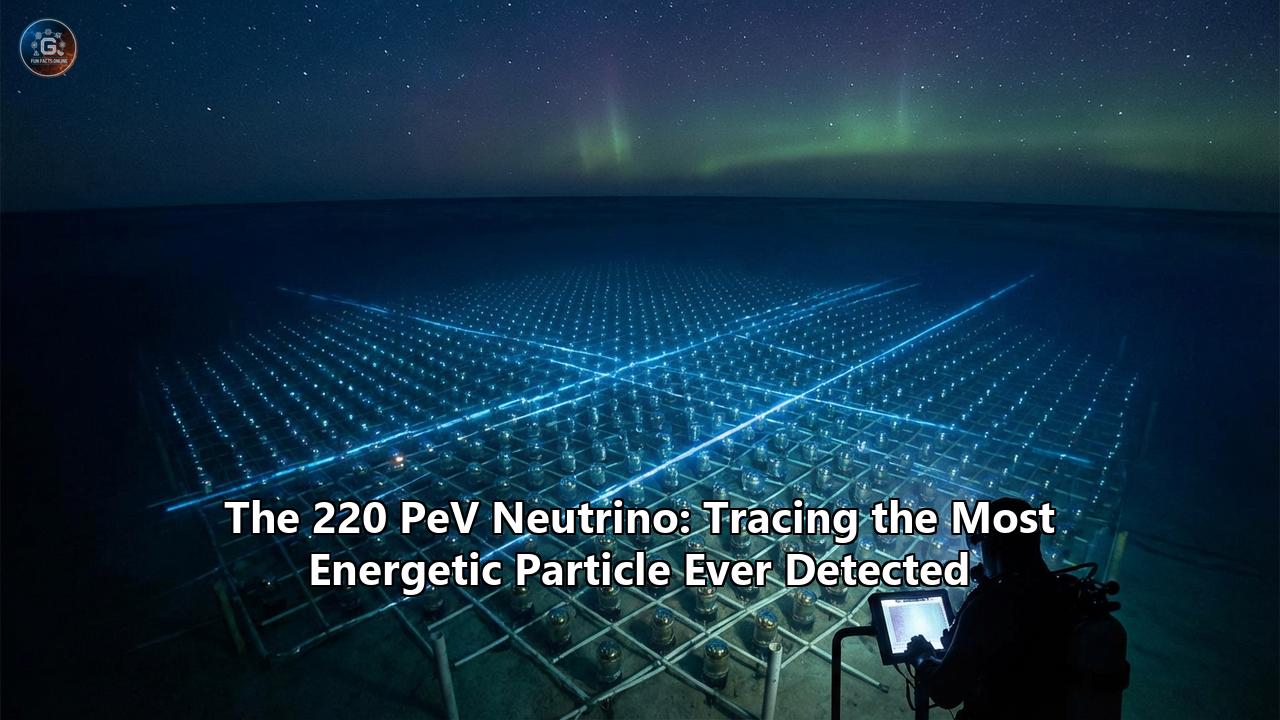
When the 220 PeV event occurred, ARCA was not even finished. It was operating in a partial configuration known as ARCA21—meaning only 21 of its planned 230 detection strings were active.
Each "string" is a vertical cable anchored to the sea floor, rising 700 meters into the black water like a reverse kelp forest. Attached to these strings are Digital Optical Modules (DOMs)—pressure-resistant glass spheres the size of beach balls. Inside each sphere is a honeycomb of 31 photomultiplier tubes, looking out into the dark like the compound eye of an insect.
The physics of water gave KM3NeT a secret weapon. While Antarctic ice is incredibly clear, it is old and pressurized, containing bubbles and dust layers that scatter light. Scattering makes images fuzzy; a sharp track of light becomes a glowing blob. Mediterranean seawater, however, has a much longer scattering length. Light travels in straighter lines. This allows KM3NeT to reconstruct the direction of an incoming particle with unprecedented angular resolution—less than 0.1 degrees in some cases.
On that Monday in February 2023, the ARCA21 detector was simply running its calibration and data-taking routines. The sea was calm; the background noise from bioluminescent plankton and Potassium-40 decay was within normal limits.
Then came the muon.
Part II: Anatomy of a Monster
The event KM3-230213A did not look like a typical neutrino interaction. It was a "through-going track."
When a high-energy "muon neutrino" hits the water (or the rock beneath the detector), it creates a muon. This muon is a heavier cousin of the electron, and because of its mass and speed, it can travel kilometers through rock and water.
The muon from this event entered the detector from the side, traveling nearly horizontally. It tore through the instrumented volume, lighting up one-third of the entire detector. Over 3,600 individual photomultipliers triggered in a synchronized cascade.
The Horizontal Signature
The geometry was the first clue that this was an astrophysical event.
- Atmospheric Muons: Cosmic rays hitting Earth's atmosphere constantly shower us with muons. But muons lose energy as they travel through matter. An atmospheric muon cannot penetrate the entire thickness of the Earth. Therefore, detectors look "down" (through the Earth) to find neutrinos.
- The Horizon: KM3-230213A arrived with a zenith angle of roughly 89.4 degrees—almost perfectly parallel to the sea floor. It had grazed the Earth's crust, traveling through hundreds of kilometers of rock and water before hitting the detector. No atmospheric muon could survive that journey. It had to be a neutrino that interacted close to the detector.
The Energy Calculation
Reconstructing the energy of such a particle is like estimating the speed of a jet by the window-rattling of a house it passes. The detector measures the amount of light deposited (dE/dx).
The muon was glowing with a ferocity ARCA had never seen. It was in a "continuous radiative regime," shedding energy via bremsstrahlung (braking radiation) and pair production at a rate that blinded the sensors.
The algorithms crunched the numbers:
- Muon Energy: ~120 PeV.
- Parent Neutrino Energy: Since the neutrino gives only about half its energy to the muon, the estimated energy of the neutrino was 220 PeV (with a statistical range of 110 to 790 PeV).
To understand the magnitude, compare it to the LHC (Large Hadron Collider) at CERN. The LHC smashes protons at 13.6 TeV (Tera-electronvolts). One PeV is 1,000 TeV. This single neutrino carried 16,000 times more energy than the most powerful collision humanity has ever created.
It was a messenger from a universe we can barely imagine—a place where entire stars are shredded and magnetic fields snap like cosmic rubber bands.
Part III: The Clash of Titans (IceCube vs. KM3NeT)
The publication of the KM3NeT result in Nature (February 2025) precipitated a crisis in the field. This crisis is affectionately known as the "Clash of the Titans."
The Problem: IceCube has been running for over a decade with a full cubic kilometer of ice. It has an effective area much larger than the partial ARCA21 detector. If the universe is filled with 220 PeV neutrinos, IceCube should have seen dozens of them by now.But it hasn't. IceCube's record tops out around 10 PeV.
When the KM3NeT team calculated the flux implied by this single event, it sat awkwardly above the "upper limits" set by IceCube. This tension—statistically quantified at between 2.9 and 3.6 sigma—suggests three possibilities, ranging from the mundane to the revolutionary.
Hypothesis 1: The Cosmic Fluke (Poisson Statistics)
It is possible that 220 PeV neutrinos are incredibly rare, and IceCube has just been unlucky, while KM3NeT got incredibly lucky. This is the "winning the lottery on your first ticket" scenario. While statistically unlikely (roughly a 0.3% chance), it cannot be ruled out.
Hypothesis 2: The Transient Source
IceCube integrates data over years to find a "diffuse flux" (a steady glow of neutrinos). But perhaps the universe isn't steady. Maybe KM3-230213A came from a transient event—a sudden explosion that lasted only minutes or hours. If ARCA was looking at the right spot at the right time, and IceCube was looking elsewhere (or the Earth was in the way), the discrepancy vanishes. This implies the neutrino didn't come from a steady "candle" but from a cosmic "flashbulb."
Hypothesis 3: New Physics
This is where the theorists get excited.
- Lorentz Invariance Violation: At such extreme energies, does the speed of light still hold as an absolute limit? Some theories suggest high-energy neutrinos might decay or interact differently.
- Dark Matter Decay: Some models propose that super-heavy Dark Matter particles (millions of times heavier than the Higgs boson) might decay directly into high-energy neutrinos. If so, this wasn't an astrophysical accelerator; it was the suicide of a Dark Matter particle in the halo of our galaxy.
Part IV: The Coordinates of Chaos
Where did it come from?
Because of seawater's superior optical properties, KM3NeT provided a precise coordinate for the event:
- Right Ascension (RA): 94.3°
- Declination (Dec): -7.8°
This points to a region of the sky in the constellations of Monoceros (The Unicorn) and Orion. It is a region rich in galactic history, near the galactic plane, but crucially, no obvious source was there.
The Multi-Messenger Silence
As soon as the alert went out (and later during the retrospective analysis), telescopes around the world swung to stare at RA 94.3°, Dec -7.8°.
- VERITAS (Gamma Ray Observatory): Looked for high-energy gamma rays. They found... nothing.
- Fermi-LAT (Space Telescope): Checked its archival data for a gamma-ray flare at that time. Nothing.
- Radio Telescopes: Listened for the radio afterglow of a relativistic jet. Silence.
This silence is disturbing. Standard physics says that any accelerator capable of producing a 220 PeV neutrino (through proton-proton or proton-photon collisions) must also produce gamma rays. The fact that we saw the neutrino but not the light suggests the source might be "opaque" to gamma rays.
Imagine a black hole wrapped in a thick cocoon of dust and gas. The protons accelerate inside, smash into the gas, and create neutrinos. The neutrinos, being ghosts, fly right through the cocoon. The gamma rays, however, are absorbed by the dust. We see the ghost, but the flashlight is hidden.
Part V: The Cosmogenic Candidate
There is one other suspect, and it is the "Holy Grail" of high-energy astrophysics: The Cosmogenic Neutrino (or GZK Neutrino).
In 1966, physicists Greisen, Zatsepin, and Kuzmin realized that the universe has a speed limit for cosmic rays. If a proton travels through the cosmos with enough energy (above $5 \times 10^{19}$ eV), it will eventually collide with a photon from the Cosmic Microwave Background (the heat left over from the Big Bang).
This collision destroys the cosmic ray but creates a byproduct: ultra-high-energy neutrinos.
For 50 years, physicists have been hunting for these "GZK neutrinos." They are the fingerprints of the most energetic particles in the universe interacting with the Big Bang's afterglow.
KM3-230213A fits the energy profile of a GZK neutrino perfectly. If this is true, it is the first direct evidence of the "GZK Cutoff" in action. It would prove that Ultra-High-Energy Cosmic Rays (UHECRs) are protons (not heavy iron nuclei) and that they are traveling across cosmological distances.
However, the "Flux Problem" returns. If this was a GZK neutrino, it implies a population of UHECRs so vast that current cosmic ray observatories (like the Pierre Auger Observatory) should have seen more of the parent protons. The single detection implies a GZK flux that is uncomfortably high—unless, again, we just got lucky.
Part VI: The Future of the Deep
The detection of KM3-230213A is a "Sputnik moment" for the KM3NeT project. It proved that the technology works, and it works better than anticipated.
Currently, KM3NeT is still expanding.
- ARCA will eventually grow to 230 strings (two blocks of 115).
- ORCA will continue to study neutrino oscillations.
As the detector grows, the "effective volume" will surpass IceCube. We are moving from an era of "fishing with a line" to "trawling with a net."
Furthermore, this event creates a mandate for IceCube-Gen2, a proposed expansion of the Antarctic detector that would increase its volume by a factor of ten. To resolve the tension between the North (Mediterranean) and the South (Antarctica), we need both eyes open.
Epilogue: The New Astronomy
For centuries, astronomy was the study of light. We looked at the universe through the photons that stars were kind enough to send us. But light is fragile; it is blocked by dust, absorbed by gas, and bent by gravity.
Neutrinos are different. They are the only particles that can travel from the edge of the visible universe, straight through the heart of a galaxy, through the core of the Earth, and into a detector without deviating. They bring us information from the "engines of creation"—the very centers of black holes and neutron star mergers—that light can never reveal.
The 220 PeV neutrino is a warning shot. It tells us that the universe is capable of violence on a scale we haven't fully modeled yet. It tells us that somewhere in the direction of the Unicorn constellation, something accelerated a proton to near light-speed, and the only evidence that arrived on Earth was a ghost trapped in a glass bead at the bottom of the sea.
The trap is set. The deep sea is listening. And the physicists are waiting for the next ghost to arrive.
Reference:
- https://www.researchgate.net/publication/395843652_Search_for_a_cosmic_point-like_neutrino_source_from_the_direction_of_the_ultra-high-energy_event_KM3-230213A
- https://scitechdaily.com/a-220-pev-neutrino-shatters-records-opening-a-new-window-into-the-cosmos/
- https://physicstoday.aip.org/news/record-setting-cosmic-neutrino-breaks-in-a-new-telescope
- https://arxiv.org/pdf/2507.21534
- https://sciencecast.org/casts/z2e5fmbvio8s
- https://arxiv.org/abs/2509.25422
- https://arxiv.org/pdf/2502.04508
- https://arxiv.org/html/2509.25422v1
- https://www.sciltp.com/journals/hihep/articles/2509001435
- https://www.researchgate.net/publication/396135629_Looking_for_the_gamma-Ray_cascades_of_the_KM3-230213A_neutrino_source
- https://www.km3net.org/km3-230213a/possible-origins/
- https://hackaday.com/2025/08/26/confirmation-of-record-220-pev-cosmic-neutrino-hit-on-earth/
- https://www.km3net.org/km-3230213a-full-page/
- https://media.sciltp.com/articles/2509001435/2509001435.pdf
- https://www.researchgate.net/publication/395542537_Extreme_High-Energy_Neutrinos_IceCube_vs_KM3NeT
- https://arxiv.org/html/2502.04508v2
- https://www.researchgate.net/publication/394355274_Recent_advances_on_multimessenger_astrophysics_Centaurus_A_GW_170817_and_KM3-230213A
- https://arxiv.org/html/2503.00097v2