
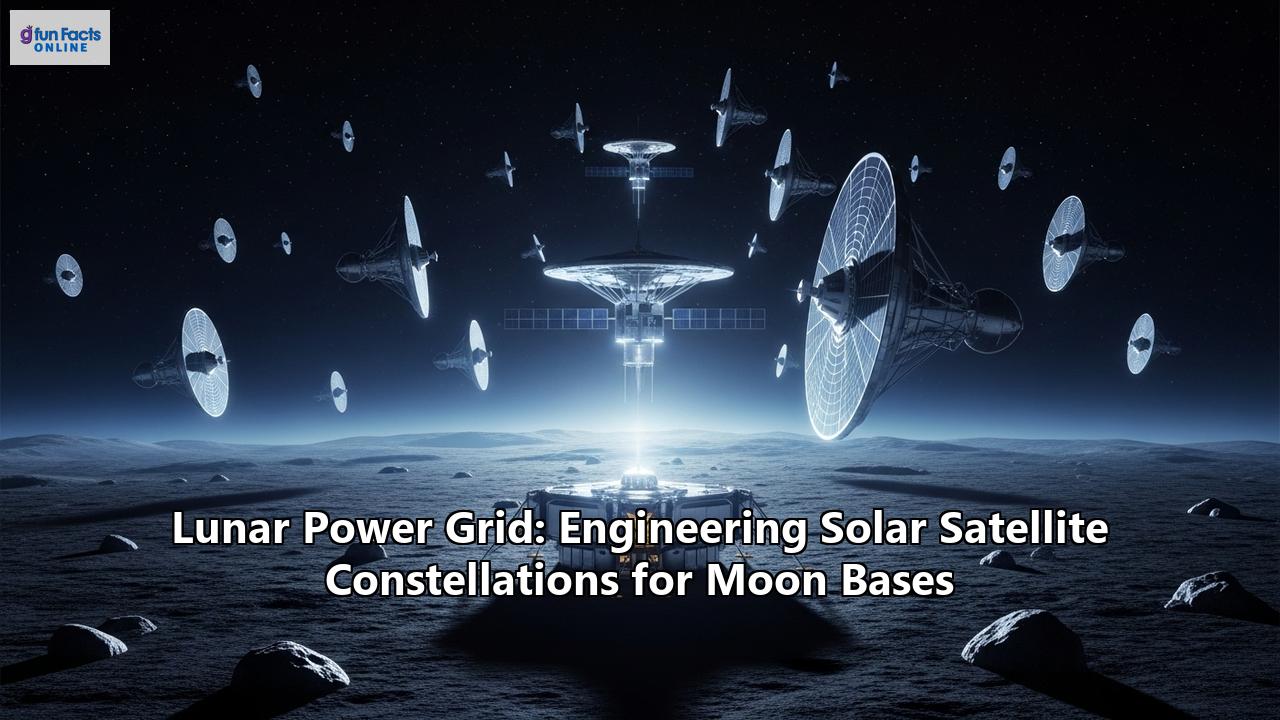
As humanity sets its sights on establishing a permanent foothold on the Moon, one of the most formidable challenges is not just getting there, but staying there. The success of future lunar bases, ambitious scientific outposts, and a burgeoning cislunar economy hinges on a single, critical element: a continuous, reliable power source. The Moon's long, frigid nights, lasting approximately 14 Earth days, render traditional surface solar panels insufficient for sustained operations. To overcome this fundamental obstacle, space agencies and private companies are engineering a revolutionary solution that sounds like it was lifted from the pages of science fiction: a lunar power grid energized by a constellation of orbiting solar satellites.
The Grand Design: A Power Grid in the Sky
The concept of a lunar power grid is a testament to human ingenuity. It involves placing a network of satellites in stable orbits around the Moon. These satellites, acting as orbital power plants, would be in near-constant sunlight, allowing them to continuously harvest solar energy. This power would then be beamed wirelessly to receiving stations on the lunar surface, providing uninterrupted energy to habitats, rovers, and industrial equipment, day or night.
The key to this architecture is Wireless Power Transmission (WPT). Two primary methods are being explored:
- Microwave Power Transmission (MPT): This involves converting solar energy into microwaves and beaming them to large receiving antennas on the ground called "rectennas." These rectennas would then convert the microwave energy back into usable electricity. This method is similar to how wireless communication signals are sent and received.
- Laser Power Transmission (LPT): An alternative approach uses high-intensity lasers to transmit power. The energy is beamed to specialized photovoltaic cells on the surface that are optimized to receive the laser's specific wavelength of light, converting it directly into electricity with high efficiency.
This space-based approach offers numerous advantages, including the ability to deliver power to permanently shadowed regions at the lunar poles, which are thought to be rich in water ice but see little to no direct sunlight.
The Trailblazers: Global Efforts to Light Up the Moon
The dream of a lunar power grid is being pursued by a global consortium of space agencies and pioneering commercial companies.
NASA's Artemis Program: As the driving force behind humanity's return to the Moon, NASA's Artemis program requires a robust power infrastructure to support its goals of a sustained lunar presence. The agency is actively developing technologies for lunar surface power and is exploring how a grid could evolve from small, local power sources to a full-scale industrial utility. The planned Lunar Gateway, a space station in orbit around the Moon, will itself be a hub for power and propulsion, serving as a key piece of the evolving infrastructure. The European Space Agency (ESA): ESA is at the forefront of space-based solar power research through its SOLARIS initiative. While initially focused on providing clean energy for Earth, the technologies are directly applicable to the Moon. One concept developed through an ESA program is the Greater Earth Lunar Power Station (GEO-LPS), a butterfly-shaped satellite designed to be placed at a Lagrange point between the Earth and Moon, from where it could continuously beam 23 megawatts of power to the lunar surface. Northrop Grumman: This aerospace giant is a major player, working on the U.S. Air Force Research Laboratory's Space Solar Power Incremental Demonstrations and Research (SSPIDR) project. A core innovation is the "sandwich tile," a lightweight panel that integrates photovoltaic cells, components for converting solar energy to a radio frequency (RF), and a phased array antenna to beam the power. Northrop Grumman is also exploring concepts for a lunar railroad, an ambitious infrastructure project that would rely on a robust power network to operate. Commercial Innovators: A host of startups are also racing to provide lunar power solutions.- Volta Space Technologies is developing a satellite network called LightGrid to beam power via lasers to rovers and other assets, helping them survive the brutal lunar night.
- Astrobotic has been funded by NASA to develop a large Vertical Solar Array Technology (VSAT-XL), a 34-meter-tall deployable tower designed to capture sunlight at the low angles present at the lunar poles.
- Blue Origin's "Blue Alchemist" project has demonstrated a method to produce solar cells directly from simulated lunar regolith, a technology that could drastically reduce the need to launch materials from Earth.
Overcoming a Hostile Environment
Building and operating a power grid on the Moon is an immense engineering challenge due to the harsh lunar environment.
- The Long, Dark Night: While orbiting satellites solve the problem of darkness, surface storage and backup systems will still be crucial for resilience. The 14-day lunar night is accompanied by a precipitous drop in temperature that can damage equipment.
- Extreme Temperatures: The lunar surface experiences temperature swings from over 120°C (250°F) in sunlight to below -155°C (-247°F) in darkness. Any hardware must be able to withstand this thermal cycling without failing.
- Abrasive Lunar Dust: Lunar regolith is a fine, sharp-edged dust that is electrostatically charged. It clings to everything and can infiltrate seals, jam mechanisms, and coat solar panels and electrical connectors, posing a significant threat to long-term operations.
- Radiation: The Moon has no protective atmosphere or magnetic field, exposing electronics to high levels of solar and cosmic radiation that can degrade or destroy them. All systems must be radiation-hardened.
- Challenging Lighting: Even in the "sunlit" polar regions, the Sun never rises more than a few degrees above the horizon. This creates areas of extreme contrast, with blinding glare next to deep, dark shadows, making landing, navigation, and extravehicular activities incredibly difficult.
An Ecosystem of Energy
A space-based solar grid will likely be the backbone of a larger, integrated power ecosystem that includes several other key technologies.
- Nuclear Fission: Compact nuclear reactors are a leading contender for providing steady, reliable power, regardless of sunlight. NASA has awarded contracts for the development of fission surface power systems that could generate tens of kilowatts, enough to power an early base camp and complement solar sources.
- Energy Storage: For times when beamed power might be interrupted or for mobile applications, advanced energy storage is vital.
Regenerative Fuel Cells (RFCs) can use surplus solar power to split water (potentially sourced from lunar ice) into hydrogen and oxygen. During the night, these elements are recombined in a fuel cell to produce electricity, with water as the only byproduct, creating a closed-loop system.
Advanced Batteries are also being developed to operate efficiently in the extreme cold of the lunar night.
- In-Situ Resource Utilization (ISRU): The ability to "live off the land" is paramount for sustainability. Research is underway to use lunar regolith to manufacture key components of a power system, such as solar cells, electrical wiring, and even bricks that can store thermal energy. This could dramatically reduce the immense cost and difficulty of launching everything from Earth.
The Dawn of a Cislunar Economy
The development of a lunar power grid is more than just an engineering project; it is a foundational step toward a sustainable human future in space. Abundant and reliable power is the ultimate enabler, unlocking the potential for long-duration scientific missions, large-scale resource extraction (like mining water ice), and the birth of commercial ventures like tourism and manufacturing. This infrastructure, born from a collaboration between government agencies and commercial visionaries, will be the powerhouse that drives the expansion of the human sphere from Earth to the Moon and, eventually, beyond. The science-fiction concept of beaming power through space is rapidly becoming a technological reality, promising to light our way back to the Moon, this time to stay.
Reference:
- https://newspaceeconomy.ca/2025/02/15/how-we-will-power-the-moon/
- https://www.quora.com/How-will-electricity-be-difficult-when-building-a-moon-base
- https://www.mdpi.com/2226-4310/10/11/919
- https://www.universetoday.com/articles/does-beaming-power-in-space-make-sense-at-the-moon
- https://filelist.tudelft.nl/News/2023/06_June/LR/27_LUMEN_JurySummary.pdf
- https://scispace.com/pdf/lunar-wireless-power-transfer-4uqul1j66n.pdf
- https://payloadspace.com/four-startups-race-to-make-space-based-power-a-reality/
- https://www.congress.gov/crs-product/IF11643
- https://newspaceeconomy.ca/2025/05/28/nasas-artemis-program-current-status-and-challenges-toward-a-sustainable-lunar-presence/
- https://ntrs.nasa.gov/api/citations/20230005406/downloads/Space%20Power%20Workshop%20Plenary%20Draft%204-10-2023.pdf
- https://www.rechargenews.com/energy-transition/solar-energy-beamed-to-earth-from-moon-made-butterfly-satellite-cost-competitive-space-chiefs-told/2-1-1488323?zephr_sso_ott=74hpgO
- https://room.eu.com/article/the-promise-of-solar-energy-for-sustainable-development-and-space-exploration
- https://www.esa.int/ESA_Multimedia/Images/2023/07/Lunar_solar_power_satellite
- https://afresearchlab.com/technology/space-power-beaming/
- https://spaceinsider.tech/2024/03/21/darpa-backs-northrop-grummans-vision-for-a-lunar-railroad/
- https://www.space.com/darpa-northrop-grumman-moon-railroad
- https://ispace-inc.com/news-en/?p=6455
- https://www.astrobotic.com/astrobotic-awarded-lunar-power-study-with-vsat-xl/
- https://www.leonarddavid.com/watts-new-a-moon-power-purchase-program/
- https://www.bbc.com/future/article/20240417-the-nuclear-reactors-that-could-power-moon-bases
- https://www.esa.int/Enabling_Support/Space_Engineering_Technology/Shaping_the_Future/Surviving_the_Lunar_Night_with_a_Regenerative_Fuel_Cell_System
- https://sci.esa.int/documents/33321/35974/1567255631493-130700-Schautz.pdf
- https://ntrs.nasa.gov/api/citations/20240013342/downloads/IECON%20Power%20Needs%20and%20Challenges%20M2M%20pdf.pdf
- https://www.universetoday.com/articles/nasa-has-a-plan-to-power-the-moon
- https://www.earth.com/news/astronauts-face-extreme-lighting-challenges-at-the-moons-south-pole/
- https://ntrs.nasa.gov/citations/20240011393
- https://aerospaceamerica.aiaa.org/intuitive-machines-lunar-south-pole-landing-attempt-highlights-challenges-for-artemis/
- https://www.moondaily.com/reports/Characterizing_visual_challenges_for_astronauts_at_the_Lunar_South_Pole_999.html
- https://tlpnetwork.com/news/policy-and-finance/nasa-awards-11-advance-lunar-power-and-tech-contracts
- https://ttu-ir.tdl.org/server/api/core/bitstreams/b4427b95-0ecb-43f8-bb4d-d7a502248ae6/content
- https://www.fastmarkets.com/insights/esa-lunar-regolith-solar-panels/
- https://www.youtube.com/watch?v=dGVqUFTcII0