
In the quiet, climate-controlled corridors of modern data centers and the frenetic trading floors of global financial hubs, a revolution is brewing—one that is invisible to the naked eye but fundamentally changes the physics of how we communicate. For over five decades, the internet has been built on strands of silica glass, a material so purified that it allows us to span oceans with pulses of light. We have optimized this glass to near-theoretical perfection. We have doped it, drawn it, and multiplexed signals through it until we hit hard physical limits. But for all its brilliance, glass has a flaw: it is slow.
Light traveling through standard optical fiber moves at roughly 200,000 kilometers per second—about 31% slower than it moves through a vacuum. For a casual internet user streaming a movie, this delay is imperceptible. But for the high-frequency trading algorithms fighting for nanoseconds, or for the sprawling AI clusters trying to synchronize a trillion parameters across thousands of GPUs, this "glass latency" has become an intolerable bottleneck.
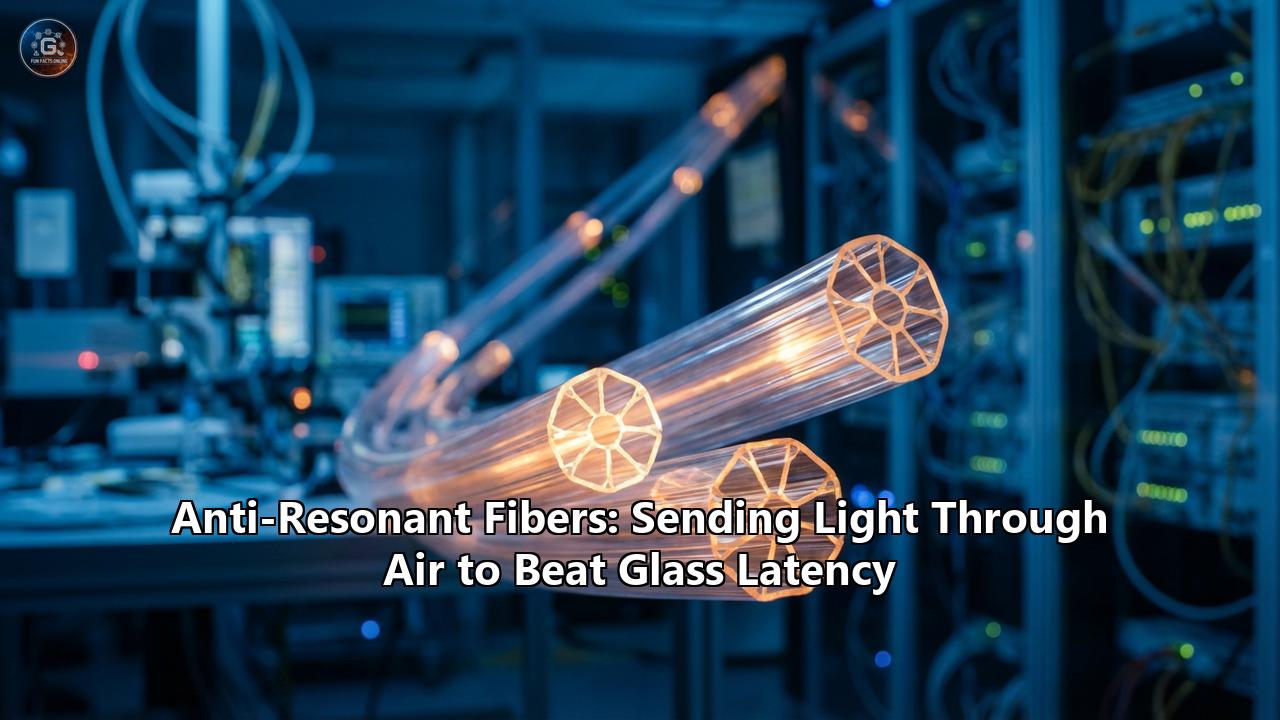
The solution lies in a radical rethinking of the medium itself. Instead of sending light through a solid core of glass, engineers are now sending it through nothing at all. Enter the Anti-Resonant Hollow Core Fiber (AR-HCF)—a technology that guides light through air, achieving 99.7% the speed of light in a vacuum, obliterating the nonlinearity limits of silica, and promising a new era of hyper-fast, ultra-low-latency connectivity. This is the story of how we learned to beat glass by embracing the void.
Part 1: The Glass Ceiling
To understand the magnitude of the hollow core revolution, we must first appreciate the incumbent: Standard Single-Mode Fiber (SMF).
The history of fiber optics is a triumph of materials science. In the mid-20th century, the idea of using light for communication was stifled by the poor quality of available glass. Light would lose 99% of its intensity after traveling just a few meters. It was Charles Kao in 1966 who theorized that if we could purify glass to remove water and metallic impurities, we could transmit light over kilometers. His prediction held true. By the 1970s, Corning had produced the first low-loss fibers, sparking the telecommunications boom.
Standard fiber works on the principle of Total Internal Reflection (TIR). It consists of a solid core (doped with germanium to increase its refractive index) surrounded by a cladding of pure silica (with a lower refractive index). When light tries to escape the core, the boundary acts like a perfect mirror, bouncing the light back in. It is an elegant, robust, and incredibly efficient system.
However, the refractive index ($n$) of silica is approximately 1.45. The speed of light in a medium ($v$) is defined by the speed of light in a vacuum ($c$) divided by the refractive index ($v = c/n$).
$$ v = \frac{300,000 \text{ km/s}}{1.45} \approx 206,896 \text{ km/s} $$
This means that for every kilometer of fiber, light takes about 4.9 microseconds to travel. In a vacuum (or air), it takes only 3.3 microseconds. That difference—1.6 microseconds per kilometer—is the "latency tax" we pay for using glass.
For decades, this tax was irrelevant. Switches, routers, and signal processing added far more delay than the fiber itself. But as electronics became faster, the fiber became the bottleneck. In a trans-Atlantic cable from New York to London (approx. 6,000 km), the glass adds roughly 10 milliseconds of round-trip delay purely due to the refractive index. In the world of High-Frequency Trading (HFT), where trades are executed in microseconds, 10 milliseconds is an eternity.
Furthermore, glass is a material. It interacts with light. Push too much power into a solid core, and the glass reacts nonlinearly. It distorts the signal (Self-Phase Modulation), mixes frequencies (Four-Wave Mixing), and eventually melts or shatters (Fiber Fuse). This imposes a "Shannon Limit" on how much information we can squeeze into a single strand of glass.
To break these limits, we needed a fiber where the light doesn't travel through glass. We needed a fiber with a core of air.
Part 2: Guiding Light in Nothing
The concept of a hollow fiber is intuitive but physically baffling. If the core is air ($n=1.0$) and the cladding is glass ($n=1.45$), Total Internal Reflection is impossible. TIR only works when light travels from a high-index medium to a low-index medium. If you shine a light down a simple glass tube, it will simply refract out through the walls and disappear.
For years, this problem seemed insurmountable. Then came the era of Microstructured Optical Fibers.
The Photonic Bandgap Era
In the 1990s, Philip Russell and his team at the University of Southampton pioneered the Photonic Crystal Fiber (PCF). Their early hollow-core designs, known as Photonic Bandgap Fibers (PBGFs), looked like a honeycomb. The cladding was a complex lattice of hundreds of tiny air holes arranged in a periodic crystal structure. This structure created a "forbidden zone" for light—a photonic bandgap. Light of certain frequencies physically could not exist in the periodic cladding, so it was trapped in the hollow core.
PBGFs were a scientific marvel. They proved light could be guided in air. However, they had significant limitations. The "honeycomb" surface was rough, leading to surface scattering loss. They had narrow bandwidths (only guiding specific colors of light), and they were notoriously difficult to manufacture. While they found niche uses, they could not compete with the low loss of solid fiber.
The Anti-Resonant Breakthrough
The true revolution came with a shift from "Bandgaps" to Anti-Resonance.
Imagine a Fabry-Perot interferometer—two parallel mirrors that trap light of certain wavelengths while letting others pass. Now, imagine wrapping those mirrors into a tube.
In an Anti-Resonant Hollow Core Fiber (AR-HCF), the cladding is not a complex crystal lattice. Instead, it consists of a single ring of thin glass capillaries (tubes) surrounding the central air core. These capillaries are often called "canes" or "tubes."
The guidance mechanism relies on the constructive and destructive interference of light within the thin glass walls of these capillaries. The wall thickness is tuned precisely so that light trying to leak out resonates within the glass wall and is reflected back into the core. It is, in essence, a "leaky" waveguide that has been engineered to be 99.99% reflective.
This design, often referred to as a "Revolver" fiber (because the cross-section looks like the cylinder of a revolver), changed the game.
- Broad Bandwidth: Unlike bandgap fibers, AR fibers can guide a massive range of wavelengths.
- Low Overlap: The light mode in the center barely touches the glass walls. Less than 0.01% of the light travels in the glass; 99.99% travels in the air.
- Simplicity: The structure is macroscopic and simpler to draw than the intricate honeycombs of the past.
Part 3: The Physics of the "Negative Curvature"
To truly minimize loss, engineers discovered they had to trick the light into staying away from the glass boundaries entirely. This led to the development of the Negative Curvature core boundary.
In a simple circular tube, the core boundary curves towards the light. This geometry encourages the light to couple into the cladding modes (leak out). However, in the "Revolver" design, the convex shape of the capillaries means the boundary facing the core curves away from the light. This negative curvature drastically reduces the spatial overlap between the fundamental mode of the light (the signal) and the lossy glass modes.
This concept evolved into the current state-of-the-art structure: the Nested Anti-Resonant Nodeless Fiber (NANF).
In a NANF design, you don't just have one ring of tubes. Inside each cladding tube, there is another smaller tube nested inside. This "tube-within-a-tube" design creates a double barrier. If any light manages to tunnel through the first layer of anti-resonant glass, it hits the second layer and is reflected back.
This "Inhibited Coupling" mechanism is so effective that the theoretical loss limits of these fibers are lower than solid silica. In solid fiber, light scatters off the molecules of the glass itself (Rayleigh Scattering). In a hollow core, there are no molecules to scatter off. The only loss comes from the roughness of the glass surfaces and the residual leakage.
As of 2025, researchers at the University of Southampton and companies like Lumenisity (now Microsoft) have demonstrated NANF fibers with losses approaching 0.174 dB/km—matching the very best solid fibers available, but with all the speed benefits of air.
Part 4: Why "Air" Changes Everything
The shift from glass to air brings four transformational advantages:
1. The Speed of Light (Latency)
This is the headline feature. By traveling in air ($n \approx 1.0003$), signals move at ~299,700 km/s.
- Latency Savings: ~1.54 microseconds per kilometer.
- Real World Impact: On a link between London and Frankfurt, this saves milliseconds. In a modern AI cluster, where GPUs are waiting for data from peers to complete a training step, this reduction in "tail latency" can boost the overall computational efficiency of a supercomputer by 10-20%.
2. Ultra-Low Nonlinearity
In solid fiber, high optical power causes the refractive index of the glass to change slightly (the Kerr Effect). This leads to signal distortion. It forces engineers to cap the amount of power (and thus data) they launch into a fiber.
Air has a nonlinearity coefficient nearly 1000 times lower than glass. You can blast high-power signals into a hollow core fiber without the signal distorting itself. This opens the door to using simpler, higher-power transceivers and potentially skipping complex error-correction processing, further reducing latency.
3. Low Dispersion
In solid glass, different colors of light travel at different speeds (Chromatic Dispersion). This spreads out data pulses over long distances. While hollow fibers still have waveguide dispersion, the material dispersion of air is negligible. This makes the fiber naturally suited for high-speed, wide-bandwidth transmission.
4. Thermal Stability
Glass expands and changes its index with temperature. Air is thermally stable. For applications like precision interferometry or quantum key distribution, where the phase of the light must remain perfectly stable, hollow core fibers offer a pristine environment insulated from the outside world's thermal fluctuations.
Part 5: The Fabrication Challenge
Making a NANF is an act of extreme artisanal precision. The process, known as Stack-and-Draw, is akin to making high-tech rock candy.
- The Stack: Engineers begin with high-purity silica tubes. They manually stack these capillaries into a larger glass jacket tube to create the macroscopic pattern of the fiber (the "preform"). This preform might be 2-3 centimeters wide.
- The Draw: The preform is placed at the top of a fiber draw tower—a multi-story vertical furnace. The tip is heated to ~2000°C until the glass softens and falls under gravity.
- The Pressure Game: As the fiber is pulled down into a hair-thin strand (125 microns wide), the internal structure must not collapse. This is the hardest part. If you just pull it, surface tension will turn your complex nested tubes into a solid blob.
Engineers attach precise pressure control lines to the different regions of the preform (the core, the cladding tubes, and the jacket).
They pressurize the internal tubes to keep them inflated against the crushing force of surface tension. The pressure must be controlled to within fractions of a Pascal while the fiber is being drawn at speeds of hundreds of meters per minute.
The result is a continuous strand of glass where the internal geometry—the nested tubes, the gaps, the wall thicknesses—is preserved at the sub-micron scale. A variation of just a few nanometers in wall thickness can ruin the anti-resonant effect.
Part 6: Splicing and The "Open Pipe" Problem
Once you have the fiber, how do you use it? You cannot simply weld a hollow tube to a solid block of glass without consequences.
1. The Mode Mismatch: The spot size of the light in a hollow core fiber is often larger than in standard SMF. If you butt-couple them, you lose light. 2. The Retro-Reflection: Glass-to-Air interfaces cause strong reflections (Fresnel reflection), which can destabilize lasers. 3. The Contamination: It’s a hollow pipe. If you leave the end open in a humid data center, moisture will enter, condensing on the thin glass webs and destroying the guidance. Dust is catastrophic.Solving this required a new suite of interconnect technologies.
- Thermally Expanded Core (TEC) splicing: Heating the solid fiber to expand its mode field to match the hollow fiber.
- Angled Cleaving: Cutting the fiber at an angle to prevent back-reflections.
- End-Caps: Fusing a tiny window of solid glass onto the end of the hollow fiber to seal it hermetically while allowing light to pass.
Modern commercial HCF cables now come "connectorized," with these problems solved at the factory, allowing network engineers to plug them in just like standard cables.
Part 7: The "Killer Apps" and Market Adoption
For years, HCF was a "solution looking for a problem." Standard fiber was cheap and "good enough." But the landscape of 2020-2030 changed that.
The Race to Zero (High-Frequency Trading)
The first adopters were the HFT firms. In a market where being second means losing money, the cost of the fiber is irrelevant compared to the speed advantage.
- Case Study: The route between the CME data center in Aurora, Illinois, and the NYSE data center in Mahwah, New Jersey. Microwave towers (which transmit through air) traditionally held the crown here. However, microwaves suffer from weather interference and limited bandwidth. HCF offers the reliability of a buried cable with the speed of a microwave.
- Firms like Drw and Jump Trading were early backers of HCF research.
The AI and Cloud Explosion (Data Centers)
This is where Microsoft changed the game. In December 2022, Microsoft acquired Lumenisity, the leading UK startup spun out of Southampton University.
Why? Not for trading stocks, but for training AI.
Modern AI models (like GPT-5 and beyond) are trained on "supercomputers" composed of tens of thousands of GPUs. These GPUs must constantly exchange parameters. If a GPU has to wait for data, it sits idle.
In a massive data center, the optical cables connecting these racks can be hundreds of meters long. HCF reduces the latency of these interconnects by 30-50%.
- Disaggregated Computing: HCF allows Microsoft to place memory and compute further apart without a performance penalty, enabling more flexible data center designs.
- Security: HCF is incredibly sensitive to tampering. Any attempt to "tap" the fiber disturbs the resonance and cuts the signal instantly, providing physical-layer security for government and military clouds.
Scientific and Industrial Lasers
Beyond data, HCF is revolutionizing laser delivery.
- Laser Surgery: Surgeons use CO2 lasers (mid-infrared) for precise cutting. Solid glass absorbs this wavelength and melts. Today, robotic surgical arms use hollow fibers to deliver high-power laser beams flexibly into the body.
- Industrial Welding: Kilowatt-class lasers used to weld electric vehicle batteries require delivery fibers that can withstand immense power density. The hollow core handles this effortlessly because there is no material to heat up.
Part 8: The Road Ahead
We are currently in the "Early Commercial" phase of Anti-Resonant Hollow Core Fibers. The physics is proven. The manufacturing is scaling. The major players are moving.
Microsoft is integrating the technology into Azure. Corning and OFS are ramping up their own hollow-core programs. BT (British Telecom) has trialed it for 5G fronthaul, proving it can carry 5G signals with significantly lower jitter, crucial for synchronizing antenna arrays.The remaining hurdles are Cost and Scale.
Currently, HCF is significantly more expensive than standard SMF—likely 10x to 50x the cost per meter due to the slow draw speeds and complex preforms. However, as with all semiconductor and optical technologies, yield improves with volume.
We will likely not see HCF replace the "fiber to the home" (FTTH) connection to your house—glass is plenty fast for Netflix. But for the backbone of the internet, the submarine cables, the data center interconnects, and the nervous system of the global economy, the future is hollow.
Conclusion
For fifty years, we believed that the best way to move information was to trap it inside a solid. We were wrong. By mimicking the vacuum of space within a strand of glass, Anti-Resonant Hollow Core Fibers have broken the shackles of refractive index. They have given us a medium that is faster, clearer, and more powerful than anything nature provided.
The "Glass Age" of the internet is not ending, but it is evolving. The next generation of light won't be traveling through glass; it will be traveling through the air, guided by a whisper of glass, racing toward the theoretical limit of the universe. The latency tax has been repealed. The void is open for business.
Reference:
- https://www.ecmag.com/magazine/articles/article-detail/something-for-nothing-the-possibilities-of-hollow-core-fiber
- https://www.lightreading.com/fttx/microsoft-buys-lumenisity-to-speed-up-fiber
- https://mapyourtech.com/maintenance-challenges-with-hollow-core-fiber/
- https://eprints.soton.ac.uk/432333/1/365917_17thJune.pdf
- https://www.m2optics.com/blog/emerging-trends-in-optical-fiber-hollow-core-and-multicore-fibers
- https://mpl.mpg.de/fileadmin/user_upload/Russell/Russell_Research_PDFs/2007_Russell.pdf
- https://www.allaboutcircuits.com/news/microsoft-acquires-lumenisity-maker-of-hollow-fiber-optic-cables/
- https://www.optica-opn.org/home/industry/2022/december/microsoft_buys_hollow-core-fiber_startup/
- https://www.rcrwireless.com/20221213/featured/microsoft-acquires-fiber-solutions-start-up-lumenisity