
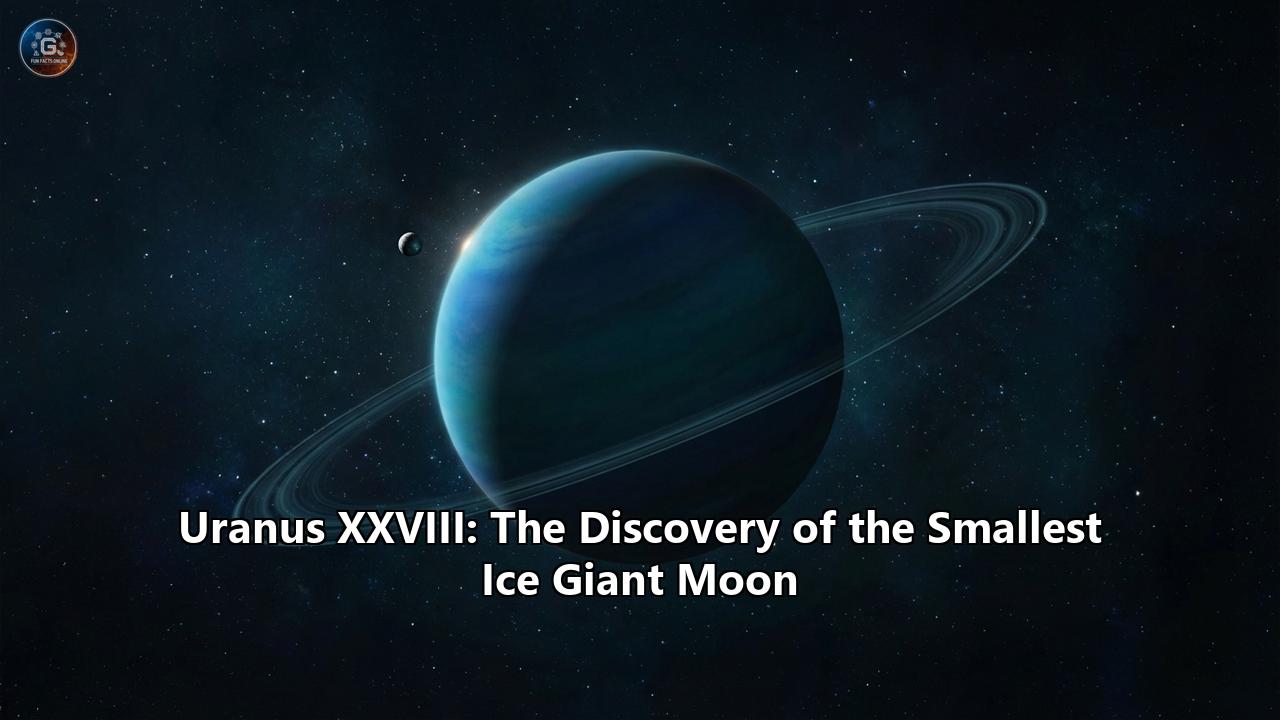
The darkness of the outer solar system is not empty; it is merely waiting. For decades, the ice giants Uranus and Neptune have guarded their secrets behind a veil of immense distance and faint reflected light. While Jupiter and Saturn, the gas giants closer to our own warmth, have boasted moon counts in the nearly hundreds, the Uranian system seemed, for a time, relatively quiet. But silence in astronomy is rarely an absence of things; it is usually an absence of seeing.
That silence was shattered—or rather, gently pierced—by a faint point of light that would come to be known as Uranus XXVIII.
The discovery of Uranus XXVIII, provisionally designated S/2023 U 1, marks a pivotal moment in planetary science. It is not a colossal world of geologic upheaval like Triton, nor a cracked icy wonder like Enceladus. It is a tiny, charcoal-dark rock, barely 8 kilometers (5 miles) across. Yet, its discovery represents a triumph of observational technology and perseverance, earning it the title of the smallest moon ever detected around an ice giant from a ground-based telescope. This article explores the journey of that discovery, the nature of this tiny world, and what its existence tells us about the chaotic, violent history of our solar system.
Part I: The Hunt for the Invisible
To understand the magnitude of discovering Uranus XXVIII, one must first grasp the sheer difficulty of the hunt. Uranus orbits the Sun at an average distance of 1.8 billion miles (2.9 billion kilometers). At this range, the sunlight is 400 times fainter than on Earth. Any object orbiting Uranus is illuminated by this meager light and must reflect it back across the same abyss to reach our telescopes.
For large moons like Titania or Oberon, this is manageable. They were discovered in the 18th century by William Herschel because they are hundreds of kilometers wide. But for a rock the size of a small city, the reflected light is so dim it borders on non-existent.
The "Shift-and-Add" RevolutionThe discovery of Uranus XXVIII was not a matter of simply pointing a telescope and snapping a picture. It required a technique known as "shift-and-add" image stacking, a method that has revolutionized our ability to map the outer solar system.
Dr. Scott S. Sheppard of the Carnegie Institution for Science, a legendary figure in the field of moon hunting, utilized the 6.5-meter Magellan telescopes at the Las Campanas Observatory in the high deserts of Chile. The process involves taking dozens of five-minute exposures over several hours. In a single exposure, a moon as faint as Uranus XXVIII is invisible, lost in the background noise of the universe.
However, Sheppard knew the moon would be moving. By shifting the digital images to match the predicted motion of a moon around Uranus and then stacking them on top of each other, the photons from the moon land on the same pixel in the final composite, while the background stars and galaxies streak into blurs. This amplifies the signal of the moon, coaxing it out of the darkness.
On November 4, 2023, the data revealed a candidate. A tiny speck of light, barely magnitude 26.7—millions of times fainter than what the human eye can see—was tracking with the planet.
The Waiting GameA single night’s observation is never enough. To confirm a moon, one must determine its orbit. Is it truly orbiting Uranus, or is it a passing asteroid? Is it background noise? Sheppard returned to the Magellan telescope in December 2023 for follow-up observations. Working with orbital dynamicists Marina Brozović and Bob Jacobson at NASA’s Jet Propulsion Laboratory (JPL), they managed to link the new detection to "precovery" images—archival data from 2021 taken by the Subaru Telescope and Magellan that contained the moon but had gone unnoticed.
On February 23, 2024, the Minor Planet Center officially announced the discovery. Uranus had its 28th moon.
Part II: The Nature of the Beast
Uranus XXVIII is a member of the "irregular" satellite population. To understand what this means, we must look at the architecture of the Uranian system.
Regular vs. IrregularThe moons of Uranus are divided into three distinct classes:
- The Major Moons: The five large, round worlds (Miranda, Ariel, Umbriel, Titania, Oberon) that formed with the planet, orbiting in the equatorial plane.
- The Inner Moons: The small, packed cluster of moons (like Cordelia, Ophelia, and Puck) that reside within the ring system.
- The Irregular Moons: The distant, chaotic swarm. These moons orbit far from the planet, often in highly elliptical and inclined paths. Many, including Uranus XXVIII, orbit in "retrograde"—meaning they move in the opposite direction of the planet's rotation.
Uranus XXVIII belongs to this third group. Its orbit takes approximately 680 Earth days to complete a single journey around the ice giant. It resides about 8 million kilometers from Uranus, in a region of space where the planet's gravity is weak enough that the sun constantly tugs at the moon, perturbing its path.
The Smallest of Them AllAt an estimated diameter of just 8 kilometers, Uranus XXVIII holds the record for the smallest known Uranian moon (pending precise measurements of the even more recently detected inner moon candidates by the James Webb Space Telescope in 2025). Before this, the smallest recognized moon was Cupid, at roughly 18 kilometers.
The small size of Uranus XXVIII is significant because it fills a "gap" in our understanding. We see populations of tiny irregular moons around Jupiter and Saturn, down to 1-2 kilometers in size. Their absence around Uranus and Neptune was not because they didn't exist, but because they were too faint to see. Uranus XXVIII proved that the ice giants also possess "collisional families"—swarms of debris left over from larger moons that were shattered by comets or asteroids billions of years ago.
The Caliban ConnectionOrbital analysis suggests that Uranus XXVIII is not a loner. Its orbital parameters (inclination and eccentricity) are strikingly similar to those of two other irregular moons: Caliban and Stephano. This suggests a common origin. It is likely that billions of years ago, a much larger object—perhaps 100 kilometers across—was captured by Uranus and subsequently smashed apart. Caliban is the largest remnant of this parent body, while Stephano and the tiny Uranus XXVIII are merely shrapnel from that ancient catastrophe.
Part III: The Violent History of the Ice Giants
The existence of Uranus XXVIII reinforces a dramatic theory about the early solar system: the Nice Model. This model posits that the giant planets (Jupiter, Saturn, Uranus, Neptune) did not form where they are today. Instead, they migrated.
As Uranus and Neptune moved outward into the Kuiper Belt (the ring of icy debris beyond Pluto), their gravity acted like a snowplow. They scattered comets everywhere, some toward the Sun and some into deep space. But they also captured objects.
The irregular moons of Uranus are essentially captured comets. They were free-floating bodies in the early solar system that got too close to the migrating ice giants and were ensnared. The fact that Uranus XXVIII is retrograde is a smoking gun for this capture scenario; a moon that forms with a planet will almost always orbit in the same direction as the planet spins. Only a captured object would approach from the "wrong" direction and be locked into a backward orbit.
The darkness of Uranus XXVIII also tells a story. Unlike the shiny, water-ice surfaces of the inner moons, the irregulars are often dark and reddish. This "ultra-red" material is thought to be organic compounds (tholins) baked by cosmic radiation over billions of years in the deep freeze of the Kuiper Belt before their capture. Uranus XXVIII is likely a piece of primordial solar system chemistry, preserved in deep freeze.
Part IV: A Shakespearean Legacy
One of the most charming aspects of Uranian astronomy is its naming convention. While the moons of Jupiter are named for the lovers and descendants of Zeus, and Saturn’s for the Titans, the moons of Uranus are named for characters from the works of William Shakespeare and Alexander Pope.
This tradition began with William Herschel’s son, John Herschel, in 1852. It has given us moons with names like Desdemona, Puck, Juliet, and Caliban.
When Uranus XXVIII was announced as S/2023 U 1, the speculation began immediately. As a retrograde irregular moon, it is generally given a name associated with a "darker" or more complex character, often from The Tempest or A Midsummer Night's Dream, though the convention has broadened.
In the years following its discovery, the proposed name Violenta (from All's Well That Ends Well) emerged as a favorite among the astronomical community, fitting the theme of the "Caliban group" which often draws from the more tragic or obscure corners of the Bard's folio. The process of naming is slow, overseen by the International Astronomical Union (IAU), but the identity of the moon as a character in the celestial play is part of its allure. It transforms a cold rock into a character in the grandest story of all.
Part V: The 2025 Confirmation and the Future
The story of Uranus XXVIII did not end with its discovery; it was merely the opening chapter of a new era of ice giant exploration.
Just over a year after the announcement of Uranus XXVIII, the James Webb Space Telescope (JWST) turned its golden honeycomb mirrors toward Uranus. In late 2025, it detected yet another candidate—provisionally S/2025 U 1—this time a tiny object embedded within the ring system itself.
While S/2025 U 1 challenged Uranus XXVIII for the title of "smallest," the significance of Uranus XXVIII remains unique. It was found from the ground. It proved that we do not necessarily need billion-dollar space telescopes to push the boundaries of the known solar system; we need large apertures, clever algorithms, and patience.
The Case for a OrbiterThe discovery of these "micro-moons" has added fuel to the fire for the planetary science Decadal Survey's top priority: the Uranus Orbiter and Probe (UOP).
We have only visited Uranus once, with the fleeting flyby of Voyager 2 in 1986. Voyager missed Uranus XXVIII completely—it was too small, too dark, and too far away. The fact that we are still finding moons 40 years later from Earth suggests that the Uranian system is far richer than we imagined.
A dedicated orbiter would not just count these moons; it would visit them. Imagine a spacecraft flying by Uranus XXVIII. What would it see?
- Is it a jagged shard of ice and rock?
- Is it a "rubble pile"—a loose collection of gravel held together by weak gravity, like the asteroid Bennu?
- Does it have craters?
- Does its surface composition match the reddish tholins of the Kuiper Belt objects?
Studying these small irregulars is akin to studying the fossil record of the solar system's formation. They are the unaltered building blocks of the planets, trapped in a gravitational museum.
Part VI: Conclusion
Uranus XXVIII is a speck in the void. To the casual observer, an 8-kilometer rock orbiting a planet 3 billion kilometers away might seem trivial. But in science, the extremes are where the truth hides.
The smallest moon tells us about the limits of our technology. The retrograde orbit tells us about the migration of the planets four billion years ago. Its grouping with Caliban tells us of ancient collisions that shattered worlds.
As we stand in 2026, looking back at the flurry of discoveries that began with S/2023 U 1, we realize that the Ice Giants are not sleeping. They are dynamic, complex systems teeming with debris, history, and mystery. Uranus XXVIII may be small, but its discovery cast a long shadow, reminding us that even in the darkest, coldest corners of the solar system, there is always something new to find if we only look long enough.
The 28th moon of Uranus is more than a number. It is a beacon, signaling that the age of discovery in our own solar system is far from over.
Appendix: The Technical Challenge of S/2023 U 1
To truly appreciate the discovery, one must delve into the specific parameters that made Uranus XXVIII such a difficult catch.
Magnitude and AlbedoAstronomers measure brightness in "magnitude." The lower the number, the brighter the object. The Sun is -27. The full moon is -13. The naked eye limit is +6. Pluto is about +14.
Uranus XXVIII shines at magnitude 26.7.
This is not just faint; it is on the very edge of what is physically detectable by 8-meter class telescopes on Earth. It is comparable to spotting a single candle flame on the surface of the Moon from Earth.
The moon is also incredibly dark. Its albedo (reflectivity) is estimated to be around 0.04 to 0.07. This means it reflects only 4% to 7% of the sunlight that hits it. It is darker than fresh asphalt. We are essentially looking for a piece of coal in a cellar, at night, from three billion kilometers away.
The Orbit- Semi-major axis: ~8,000,000 km
- Eccentricity: ~0.25 (highly elliptical)
- Inclination: ~144 degrees (retrograde)
- Period: ~680 days
The high inclination is the key. Because it orbits at such a steep angle relative to the plane of the solar system, it spends much of its time far above or below the glare of Uranus itself. This separation helps, but the distance also makes it faint.
The "Caliban Group" DeconstructedThe clustering of Uranus XXVIII with Caliban and Stephano is based on "proper elements"—orbital parameters that have been averaged over time to remove the oscillating effects of the Sun's gravity. When astronomers plotted the proper inclination and eccentricity of the new moon, it landed smack in the middle of the Caliban cluster.
This implies a "parent body" breakup.
- Scenario: A heliocentric projectile (a comet) struck the proto-Caliban moon.
- Result: The energy of the impact did not pulverize the moon entirely but spalled off large fragments. Caliban (72 km) remained as the core, while Stephano (32 km) and Uranus XXVIII (8 km) were ejected into similar orbits with slightly different velocities.
- Implication: There are likely hundreds more fragments in this group, smaller than 8km, waiting for the next generation of 30-meter telescopes (like the ELT or GMT) to discover them.
The Broader Context: Neptune's Twins
The announcement of Uranus XXVIII in February 2024 was accompanied by the announcement of two new moons of Neptune: S/2002 N 5 and S/2021 N 1.
The fact that these were found simultaneously is not a coincidence. It was the result of the same deep survey by Scott Sheppard.
Neptune is even further away than Uranus, making detection harder. Yet, the new Neptune moons showed a similar pattern: captured, irregular, and part of collisional families.
- S/2002 N 5 (about 23 km) orbits in resonance with Neptune.
- S/2021 N 1 (about 14 km) is tiny and faint.
The parallelism is striking. Both Ice Giants have similar moon systems, despite their differences. Uranus is tipped on its side; Neptune has the massive captured moon Triton which likely cleared out its original system. Yet, both have re-acquired a population of distant, irregular junk. This suggests that the process of capturing irregular moons is a fundamental mechanic of giant planet formation, robust enough to survive even the chaotic history of Triton's capture or Uranus's great tilt.
Looking Forward: The Decadal Hope
As we move deeper into the late 2020s, the planetary science community is rallying behind the Uranus Orbiter and Probe (UOP). This mission, envisioned to launch in the early 2030s, would arrive at Uranus in the 2040s.
For the first time, we would have a machine capable of tracking Uranus XXVIII up close. We could determine:
- Density: Is it solid rock or a porous fluff-ball?
- Shape: Is it spherical (unlikely) or an elongated sliver?
- Rotation: Does it tumble chaotically like Hyperion, or is it tidally locked?
Until then, Uranus XXVIII remains a point of light, a data point in a spreadsheet, and a reminder of the vast, unseen complexity of our cosmic neighborhood. It is the smallest moon, but it carries the heaviest weight of history, telling the story of a solar system that was once a shooting gallery, where giant planets moved like chess pieces and comets were the pawns caught in between.
Reference:
- https://aestheticsofsociety.wordpress.com/2018/12/21/natyashastra/
- https://subarutelescope.org/en/news/topics/2024/03/05/3373.html
- https://www.lco.cl/new-moons-of-uranus-and-neptune-announced/
- https://en.wikipedia.org/wiki/S/2023_U_1
- https://www.sci.news/astronomy/new-uranus-neptune-moons-12720.html
- https://sites.google.com/carnegiescience.edu/sheppard/home/newuranusneptunemoons
- https://sea.mashable.com/space/39153/webb-telescope-just-peeked-at-uranus-and-got-mooned-literally
- https://www.youtube.com/watch?v=MOXOQKvF03U
- https://www.space.com/new-moons-discovered-uranus-neptune
- https://www.theguardian.com/science/2024/nov/25/earth-mini-moon-to-disappear
- https://www.youtube.com/watch?v=0UdjvPuyJCU