
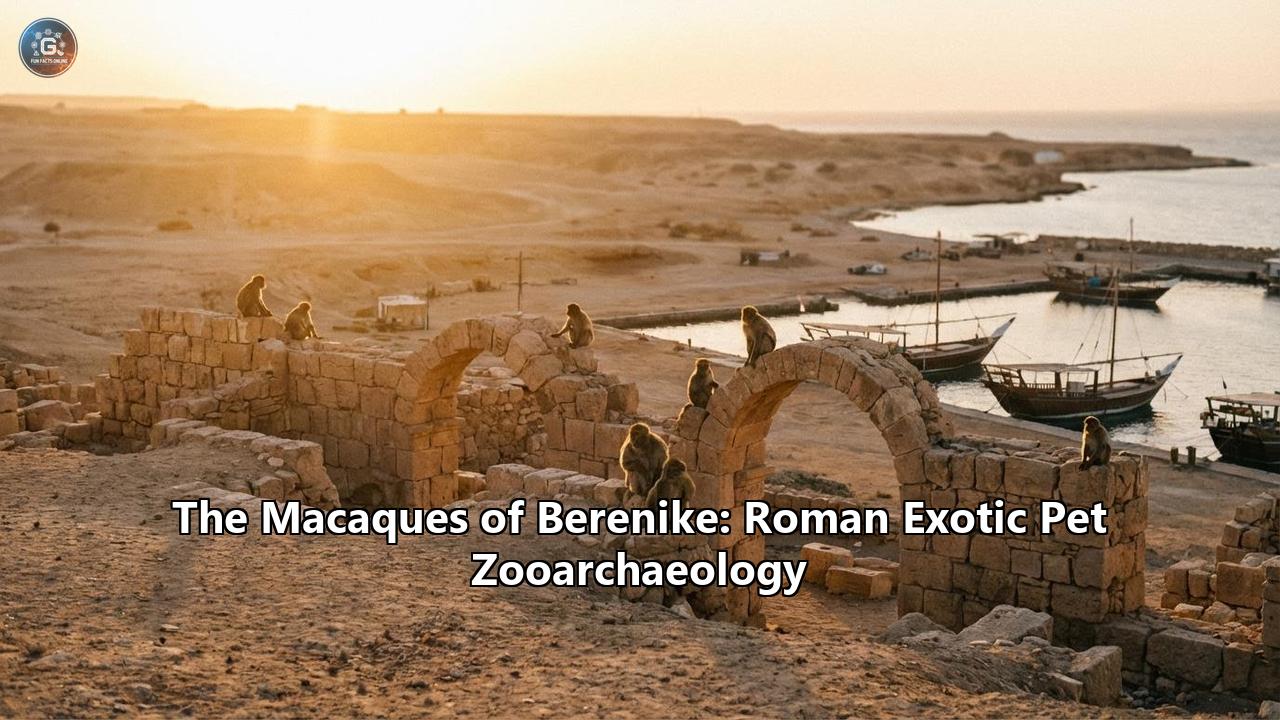
The sands of the Egyptian desert have long been famous for yielding the golden masks of pharaohs, monumental pyramids, and elaborate tombs filled with the riches of antiquity. Yet, on the desolate western shore of the Red Sea, an entirely different kind of treasure has been unearthed—one that speaks not of divine kingship or the afterlife of rulers, but of the tender, deeply emotional bond between humans and their animal companions. Here, in the ancient, cosmopolitan port city of Berenike (also known as Berenice Troglodytica), archaeologists have uncovered a sprawling 2,000-year-old pet cemetery. Among the remains of hundreds of beloved cats and dogs, researchers made a discovery that has reshaped our understanding of ancient global trade and social status: the carefully buried skeletons of exotic pet monkeys imported all the way from India.
The macaque burials of Berenike provide the first direct zooarchaeological evidence of a live animal trade spanning the treacherous waters of the Indian Ocean during the Roman Empire. More profoundly, the way these animals were treated in life and in death offers a poignant glimpse into the emotional landscape of the Roman elite stationed at the very edge of the known world.
The Port at the Edge of the World
To understand the significance of the Berenike macaques, one must first understand the city they were brought to. Founded in 275 BCE by the Hellenistic ruler Ptolemy II Philadelphus, Berenike was originally established as a logistical hub for importing African war elephants. However, by the time the Roman Empire annexed Egypt in 30 BCE, the port's purpose had shifted. During the first and second centuries CE, Berenike became a bustling, vital node in the transcontinental trade network connecting Rome with the Arabian Peninsula, India, and Sri Lanka.
Berenike was a harsh, unforgiving place to live. Located in the Eastern Desert, it was described by historians as being "way out on the edge of nowhere". The environment was arid, drinking water was scarce, and all agricultural staples had to be imported from the Nile Valley, hundreds of miles away. Yet, the city was incredibly wealthy, functioning as the primary gateway for the empire’s most coveted luxury goods: spices, frankincense, myrrh, textiles, pearls, and precious gems.
Securing this lucrative trade required a substantial Roman presence. The city was populated by a mix of wealthy merchants, sailors from across the globe, and elite Roman military personnel—legionaries and centurions—tasked with protecting the commercial routes. It was a transient, multicultural society where people lived far from home, surrounded by the harsh desert on one side and the vast ocean on the other. It is within this context of isolation and wealth that the residents of Berenike sought comfort in the companionship of animals.
A Cemetery Like No Other
The ancient Egyptians are well-known for their complex relationship with animals. Millions of animal mummies—ranging from cats and dogs to crocodiles and ibises—have been discovered in the Nile Valley. However, these animals were predominantly bred on an industrial scale to be sacrificed and mummified as religious offerings to the gods.
The animal burials at Berenike, discovered in 2011 beneath an early Roman rubbish dump by archaeozoologist Prof. Marta Osypińska of the Polish Academy of Sciences, are fundamentally different. Operating from the mid-1st to the mid-2nd century CE, the Berenike site is an actual pet cemetery—perhaps the oldest known dedicated cemetery for companion animals in the world.
Over several excavation seasons, directed by a joint American-Polish expedition under the auspices of the Polish Centre of Mediterranean Archaeology of the University of Warsaw (PCMA UW) and the University of Delaware, nearly 600 animal skeletons have been unearthed. The vast majority—over 90%—were domestic cats, alongside roughly 5% dogs, a handful of monkeys, and even a Barbary falcon and a Rüppell's fox.
What sets this site apart is the absolute absence of mummification and the clear evidence of profound human care. These animals were not killed for ritual purposes. In fact, many lived to old age or survived severe illnesses and injuries that would have been fatal without dedicated human intervention. For instance, researchers found the remains of a mastiff-like dog that had suffered from bone cancer; its stomach contents revealed it had been fed a final, comforting meal of goat and fish before being wrapped in a basket and carefully buried under pieces of pottery.
The burials were purposeful and tender. Animals were intentionally placed in sleep-like positions. Many were covered with textiles or fragments of amphorae that acted as makeshift sarcophagi. Cats and dogs were found wearing iron collars, some adorned with ostrich-shell beads or glass. This was a place of mourning, where the rough-hewn inhabitants of a desert frontier took the time and effort to honor the companions that made their harsh lives bearable.
The Exotic Monkeys of Berenike
While the sheer scale of the pet cemetery was astonishing, it was the discovery of the primate burials that propelled Berenike into global headlines. Dozens of monkey skeletons were found carefully interred alongside the cats and dogs.
Initially, due to the fragmented nature of the young bones and the geographical location of the site, researchers assumed the monkeys were African species. In other Roman sites across Europe, pet monkeys have exclusively been identified as Barbary macaques from North Africa, as their proximity made them relatively easy to procure. It was naturally hypothesized that the Berenike monkeys were local grivets (formerly classified as vervet monkeys), which had been kept as pets in the Nile Valley since antiquity.
However, Prof. Osypińska and her team decided to employ advanced 3D scanning technology to digitally reconstruct the fragile skulls and characteristic bones of the monkeys. When these 3D models were compared with reference collections from Delhi, the results were staggering: the monkeys were not African at all.
The remains belonged primarily to two distinct species native to the Indian subcontinent: the larger royal rhesus macaque (Macaca mulatta) and the smaller bonnet macaque (Macaca radiata). Rhesus macaques are native to the western and northern parts of the Indian subcontinent, while bonnet macaques inhabit the south-western regions. (A single skeleton of an African grivet was also later identified, adding to the site's diversity).
This breakthrough identification was a monumental scientific achievement. The Berenike monkeys represent the first and only direct zooarchaeological evidence of a live animal trade between India and the Roman Empire. Prior to this, the only hint of such commerce was a vague textual reference by the Roman author Pliny the Elder regarding monkeys in the mountainous districts of eastern India. The physical presence of these macaques in Egypt rewrote our understanding of the logistical capabilities of ancient maritime networks.
The Logistics of a Transoceanic Live Trade
The presence of Indian macaques in Berenike begs the question: how did they get there? The journey from the western coast of India to the Red Sea was incredibly arduous. Ships relied on the seasonal monsoon winds to cross the vast, open expanse of the Indian Ocean, a voyage that could take weeks or months.
Historical texts, such as the Periplus of the Erythraean Sea (a 1st-century Greek manual on navigation and trade opportunities), document the flow of inanimate luxury goods, but the transportation of live primates presents an entirely different logistical nightmare.
The monkeys found at Berenike were selected based on specific criteria. Osteological analysis suggests they were chosen for their sex and age, heavily favoring very young animals. A baby monkey is far more docile, easier to transport, and more malleable for taming as a pet than an aggressive adult. However, young primates require intensive care, constant feeding, and social interaction. Keeping them alive on a pitching wooden vessel, exposed to the elements, saltwater, and limited rations, required an unprecedented degree of organization and a highly specialized trade.
The fact that merchants undertook this immense challenge indicates that the demand for these animals—and the price they fetched—must have been extraordinary.
The Ultimate Status Symbol for the Roman Elite
In the socially stratified world of the Roman Empire, pets were more than just companions; they were expressions of wealth, power, and identity. For the Roman elites, military officers, and centurions stationed at Berenike, an imported Indian macaque was the ultimate status symbol.
A local dog or a cat might provide comfort, but a rhesus macaque on a leash broadcasted a very specific message. It conferred a sense of exotic prestige, signaling that its owner possessed extraordinary wealth, global connections, and access to the most distant, mysterious lands known to Rome.
The archaeological context of the monkey burials brilliantly underscores this elevated status. Around 40 percent of the monkey graves at Berenike contained deliberate grave goods, a stark contrast to the cats and dogs, which were rarely buried with such items. The monkeys were laid to rest wearing collars used for restraint. They were surrounded by visually striking, iridescent shells sourced from the Indian Ocean, suggesting a deliberate attempt to honor their oceanic origins.
One particularly poignant burial featured a macaque placed next to a woven basket, a pair of large sea shells, and a piece of folded cloth that strikingly resembled a rag doll—perhaps a beloved toy. Even more fascinating is the evidence that these exotic pets may have had pets of their own. In several instances, macaques were found buried alongside kittens, and in one case, a young piglet, placed gently under a pottery fragment. These companion animals were likely provided to the captive monkeys to ease their social isolation and fulfill their primate need for physical contact and grooming.
There is also touching evidence of attempted medical care. In one burial, researchers discovered traces of resin—likely myrrh, derived from Commiphora trees and highly prized for its healing and analgesic properties—coating the foot of a monkey. The owner had clearly tried to soothe the animal's pain before it succumbed.
The Tragic Reality of the Ancient Pet Trade
Despite the immense wealth of their owners, the high status they enjoyed, and the undeniable care they received in death, the story of the Berenike macaques is ultimately a tragic one. Almost all the monkeys buried in the cemetery died young or very young; few, if any, reached adulthood.
The root cause of this high mortality rate was not physical abuse. The skeletons show no signs of limb fractures, beatings, or the mutilations common in Egyptian ritual mummification. Instead, the bones tell a silent story of chronic malnutrition.
Detailed pathological examinations of the monkey skulls revealed severe instances of porotic hyperostosis—spongy, porous bone lesions that are a classic indicator of severe dietary deficiencies. The Roman owners, despite their best efforts and deep pockets, simply did not know how to feed a tropical forest primate.
The monkeys were fed a diet remarkably similar to that of the local human population: sorghum bread, dried figs, dates, and other imported carbohydrates. To supplement this, they were given raw fish. While this diet sustained the human legionaries and merchants, it was catastrophically inadequate for a growing macaque. The diet lacked essential vitamins, minerals, and the fresh foliage necessary for primate development. Furthermore, the raw fish was likely riddled with marine parasites and contaminated with seawater, leading to severe gastrointestinal distress.
Unable to provide the highly specific nutritional and behavioral conditions required for their survival, the owners inadvertently condemned their prized companions to early deaths. Those few that might have survived into adulthood were likely transported further up the Nile Valley to Alexandria or Rome itself, passing out of the archaeological record of the Berenike cemetery.
Redefining the Ancient Human-Animal Bond
The zooarchaeological discoveries at Berenike force us to re-evaluate our preconceived notions about antiquity. It is easy to view the ancient world through a lens of brutal utilitarianism, where animals were mere beasts of burden, sources of protein, or blood sacrifices to distant gods.
Yet, the Berenike pet cemetery reveals a startlingly modern emotional landscape. In an era defined by empire building, warfare, and harsh survival, the people of this remote desert port carved out a space specifically to mourn their non-human companions. They fashioned necklaces of ostrich shell for their cats, nursed dogs with bone cancer, and provided toys and companion kittens for their exotic, homesick monkeys.
Through the groundbreaking work of archaeozoologists like Prof. Marta Osypińska, the bones of Berenike have been given a voice. They speak of the incredible reach of Roman maritime trade, capable of transporting delicate live cargo thousands of miles across open oceans. They speak of the socio-cultural dynamics of Roman elites using exotic animals to project power and worldly sophistication.
But above all, they speak to a timeless, universal human need. Whether a 21st-century city dweller or a 1st-century Roman legionary stationed at the edge of the desert, humans have always sought the unconditional love and comfort of a pet. The macaques of Berenike may have died far from the lush forests of India, but the tender care of their burials ensures that the love of their ancient owners will not be forgotten by history.
Reference:
- https://archaeology.org/news/2016/12/02/161202-berenike-pet-cemetery/
- https://en.wikipedia.org/wiki/Berenice_pet_cemetery
- https://pcma.uw.edu.pl/en/2020/09/10/berenike-roman-port-indian-monkeys-and-3d-scanning/
- https://archaeology.org/news/2025/12/03/roman-pet-monkeys-evaluated/
- https://www.cambridge.org/core/journals/journal-of-roman-archaeology/article/abs/centurions-monkey-companion-animals-for-the-social-elite-in-an-egyptian-port-on-the-fringes-of-the-roman-empire-in-the-1st-and-2nd-c-ce/BC4AE30501792AF350762ADD326AE5B6
- https://archaeologymag.com/2025/12/roman-elites-kept-imported-monkeys-as-pets/
- https://www.berenike.pcma.uw.edu.pl/projects/non-humans-in%20berenike%20society.%20archaeozoological%20data%20for%20a%20discourse%20on%20ancient%20identity%20and%20value
- https://www.heritagedaily.com/2021/03/almost-600-cats-and-dogs-excavated-in-ancient-pet-cemetery/137451
- https://medium.com/the-academic/roman-soldiers-likely-kept-indian-macaques-as-pets-in-egypt-0f882c6175f9
- https://www.smithsonianmag.com/smart-news/archeologists-discover-ancient-pet-cemetery-egypt-180961292/
- https://berenike.animals.uwr.edu.pl/en/2023/12/12/berenike-miasto-ludzi-i-zwierzat-nowy-etap-badan-na-antycznym-cmentarzysku/