
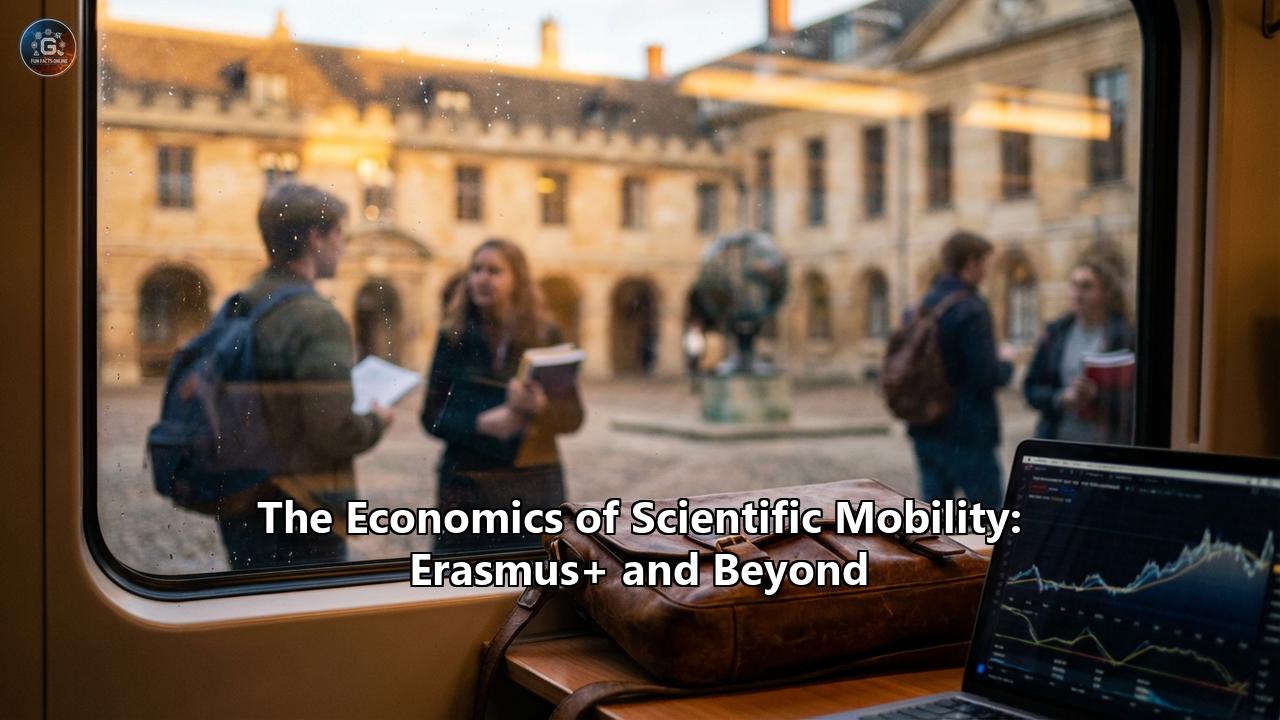
In the quiet corridors of a research institute in Heidelberg, a Portuguese bioengineer collaborates with a Korean data scientist on a project funded by Brussels, aiming to solve a protein folding problem that could revolutionize drug delivery. This is not merely an academic exercise; it is a microscopic transaction in a vast, global economy of intellect. It is the visible pulse of scientific mobility—a phenomenon that has transcended its origins as a scholarly rite of passage to become a cornerstone of modern economic strategy.
For centuries, the "wandering scholar" was a romantic figure, a solitary seeker of truth traveling from Bologna to Oxford. Today, that wanderer is a unit of human capital, a vector for innovation diffusion, and a line item in multi-billion-Euro budgets. The economics of scientific mobility—the movement of students, researchers, and academic staff across borders—has matured into a complex discipline involving labor market friction, agglomeration effects, and the delicate balance of payments between nations.
At the heart of this global circulatory system lies the European Union’s Erasmus+ programme, arguably the most successful experiment in mass intellectual migration in history. Yet, as we navigate the mid-2020s, the landscape is shifting. The simplistic narrative of "travel equals good" is being challenged by the hard realities of brain drain in the Global South, the geopolitical fragmentation exemplified by Brexit, the environmental costs of hyper-mobility, and the rise of a digital alternative. This article explores the intricate machinery of scientific mobility, dissecting its economic imperatives and forecasting its trajectory in a rapidly fracturing world.
Part I: The Erasmus+ Engine — Scaling the Intangible
To understand the macroeconomics of mobility, one must start with its most visible engine: Erasmus+. Originally conceived in 1987 as a student exchange program, it has mutated into a comprehensive framework for education, training, youth, and sport.
The Investment PortfolioThe financial commitment to Erasmus+ is a testament to the EU’s belief in the economic multiplier effect of mobility. The budget for the 2021-2027 cycle was set at over €26.2 billion—nearly double that of the previous seven-year period. This is not charity; it is venture capital. The European Commission estimates that for every euro invested in the program, the return in terms of employability, skills acquisition, and future earnings potential is significant.
The economic logic is rooted in Human Capital Theory. By exposing students and staff to different pedagogical systems, languages, and cultural problem-solving methods, the program increases the "stock" of competencies in the labor force. A 2019 impact study showed that Erasmus graduates had an unemployment rate 23% lower than their non-mobile peers five years after graduation. In an economy increasingly driven by "soft skills"—adaptability, cross-cultural communication, resilience—mobility acts as a high-intensity training ground that domestic education cannot replicate.
The Mechanics of AgglomerationBeyond individual employability, Erasmus+ facilitates agglomeration economies. In urban economics, agglomeration refers to the benefits that firms obtain by locating near each other. In science, this translates to "knowledge clusters." By funding the flow of personnel between universities, Erasmus+ creates artificial density. A physicist in a small university in rural France can plug into the high-energy physics cluster at CERN or the quantum computing hubs in the Netherlands. This reduces the "distance to the frontier" for peripheral institutions, theoretically allowing the entire Eurozone to converge toward higher productivity levels.
However, the 2021-2027 programme introduced a new economic variable: Inclusion. Previous iterations were criticized for being subsidies for the middle class—the "prosecco and Ryanair" generation. The current mandate includes top-ups for students from lower socio-economic backgrounds, recognizing that if mobility is an economic escalator, denying access to the poor exacerbates inequality. The economic argument here is one of allocative efficiency: talent is distributed randomly across the population, but opportunity is not. By lowering financial barriers, the program ensures that the most capable minds, not just the wealthiest, can participate in the knowledge economy.
Part II: The High-End Market — Marie Skłodowska-Curie and the Research Elite
While Erasmus+ handles the undergraduate mass market, the Marie Skłodowska-Curie Actions (MSCA) manage the luxury segment: PhD candidates and postdoctoral researchers. With a budget of €6.6 billion (2021-2027), MSCA is the gold standard for scientific mobility.
The Innovation Diffusion ModelEconomically, the movement of a post-doc is fundamentally different from that of an undergrad. An undergraduate moves to learn; a researcher moves to produce. When a top-tier researcher moves from a lab in MIT to a lab in Munich, they bring with them tacit knowledge—the "know-how" that cannot be written down in a patent or a journal article. This includes lab techniques, unspoken intuitions about experimental design, and networks of trust.
Economists call this knowledge spillovers. A study on the impact of the MSCA found that fellows tend to produce publications with higher citation impacts than their non-mobile peers. More importantly, the host institutions see a productivity bump. This confirms the Schumpeterian view of economic growth: innovation is the driver, and mobile scientists are the bees pollinating the industrial landscape.
Inter-Sectoral Mobility: The Corporate LinkA critical, often overlooked aspect of modern mobility schemes is the push for inter-sectoral mobility—moving researchers from academia to industry and back. The "ivory tower" isolation is an economic inefficiency. MSCA and similar national schemes (like the CIFRE fellowships in France) subsidize the placement of PhDs in companies.
The economic rationale is to reduce frictional unemployment among PhDs and to inject rigorous scientific methodology into corporate R&D. For a pharmaceutical giant or an automotive startup, hosting a mobile researcher is cheaper and less risky than acquiring a smaller company to get access to talent. It creates a fluid labor market where ideas can rapidly commercialize.
Part III: The Great Debate — Drain, Gain, and Circulation
The sunny narrative of "everyone benefits" collapses when we look at the directional flows of this human capital. The concept of Brain Drain has haunted policymakers for decades, but the 21st century has added nuance to the equation.
The Zero-Sum Game?Historically, the flow was unidirectional: from the periphery to the core. Scientists moved from Southern and Eastern Europe to the UK, Germany, and France; or from the Global South to the United States. For the sending country, this represents a fiscal loss: the state pays for the education of a doctor or engineer, only for the tax revenues on their high future earnings to be collected by another government.
Recent data from the Open Society Foundations (2024) suggests that for the Global South, "Brain Drain" is still the dominant reality. Despite the rhetoric of "Brain Circulation," the net flow of the highest-performing scientists remains toward the Global North. The "circulation" often happens only among the elite nations (e.g., a German scientist moving to the US), leaving developing nations in a permanent state of human capital deficit.
The Circulation Counter-ArgumentHowever, proponents of Brain Circulation argue that the diaspora is an economic asset. The "network externalities" created by expatriate scientists can lead to:
- Remittances: Not just money, but "knowledge remittances."
- Bridge-Building: An Indian scientist in Silicon Valley is more likely to outsource R&D to Bangalore or invest in Indian startups.
- Return Migration: The "boomerang effect" where scientists return mid-career with better skills and networks.
Countries like China and India have aggressively pivoted to Brain Retention and Re-attraction strategies. China’s "Thousand Talents Plan" effectively engaged in a bidding war for its own diaspora, offering salaries and lab funding that matched or exceeded Western standards. This suggests that mobility is eventually self-correcting if the sending economy grows enough to compete. The economic lesson is that you cannot legislate against brain drain; you can only out-invest it.
Part IV: The Brexit Shock — A Natural Experiment in De-Integration
No discussion on the economics of mobility is complete without addressing the seismic shift of Brexit. The UK’s withdrawal from the EU provided a grim "natural experiment" on what happens when you erect barriers in a frictionless market.
The Cost of DivergencePrior to 2020, the UK was a net importer of European scientific talent, a status that underpinned its heavy weight in global university rankings. The end of freedom of movement introduced transaction costs (visas, healthcare surcharges, bureaucratic uncertainty) into the labor market.
The immediate economic impact was a "softness" in recruitment. EU student numbers in the UK plummeted—a direct hit to the "export" revenue of UK universities (education is a major UK service export). More critically, the uncertainty over Horizon Europe association (the EU's key funding programme) led to a hiatus where UK-based scientists were excluded from leading pan-European consortia.
Although the UK re-associated with Horizon Europe in 2024, the "lost years" demonstrated the path dependence of scientific networks. Once a network is broken (e.g., a German lab stops calling their British partner because the funding is uncertain), it is expensive to rebuild. The Brexit case study proves that scientific mobility is not just about individuals wanting to move; it is about the institutional and legal infrastructure that makes movement risk-free. When that infrastructure cracks, the market fails.
Part V: The Green Dilemma — The Environmental Externalities of the Mind
We have arrived at a paradox. We believe scientific mobility is good for the economy, but we know physical mobility is bad for the planet. The carbon footprint of international conferences, student exchanges, and field research is massive.
The "Green Erasmus" LedgerThe 2021-2027 Erasmus+ programme introduced "Green Travel" top-ups, incentivizing students to take trains instead of planes. However, this is a micro-solution to a macro-problem. The real economic tension is between productivity and sustainability.
A Zoom call has near-zero marginal cost and zero carbon footprint, but does it generate the same economic value as a physical meeting? Most research suggests no. The "water cooler effect"—spontaneous idea generation—requires physical proximity. Trust, the currency of collaboration, is harder to mint virtually.
Therefore, the economics of scientific mobility is shifting toward a hybrid model. The "low-value" mobility (short administrative meetings, introductory lectures) is moving online, driven by cost and climate. The "high-value" mobility (long-term research stays, intense workshops) remains physical but is becoming more expensive and elite. We risk creating a two-tier system: a wealthy elite that continues to fly and network, and a "virtual class" that participates only through screens, missing out on the serendipity that drives careers.
Part VI: The Geopolitics of Science — 2030 and Beyond
As we look toward 2030, the map of scientific mobility is being redrawn by tectonic geopolitical shifts. The era of a unipolar scientific world (dominated by the US, with Europe as a second hub) is over.
The Rise of the Asian HubsThe "Asian Century" in higher education is no longer a prediction; it is a statistic. Intra-Asian mobility is exploding. Students who once would have gone to the US or UK are now choosing Japan, South Korea, China, or Singapore. These nations are creating their own "Erasmus-style" frameworks, reducing their reliance on the West.
Economically, this fragments the global market for talent. We are moving toward regional trading blocs of intelligence: a North American bloc, a European bloc, and an East Asian bloc, with varying degrees of permeability.
The Weaponization of MobilityScience is increasingly viewed through the lens of national security. The US and EU are tightening scrutiny on researchers from "strategic rivals" (primarily China) in sensitive fields like AI, quantum computing, and biotech. This introduces protectionism into the scientific labor market.
While protectionism might serve national security goals, standard economic theory predicts it will lower global innovation rates. If the best AI researcher in the world is Chinese but cannot work in Silicon Valley or London due to visa restrictions, the global pace of AI development slows. The cost of this "scientific decoupling" will be measured in trillions of dollars of unrealized GDP over the next decade.
Conclusion: The Imperative of Openness
The economics of scientific mobility is ultimately a story about the tension between flow and friction. Erasmus+, MSCA, and their global counterparts are massive investments designed to reduce friction, based on the belief that the free flow of minds creates wealth just as the free flow of goods does.
The data overwhelmingly supports this. Mobile scientists are more productive; mobile students are more employable; mobile ideas solve problems faster. The Return on Investment (ROI) of mobility is positive.
However, the challenges of the next decade—inequality, climate change, and geopolitical rivalry—threaten to clog these arteries. The task for policymakers is not just to fund travel, but to design smart mobility systems:
- Systems that mitigate brain drain through "circulation" incentives.
- Systems that balance carbon costs with the necessity of face-to-face interaction.
- Systems that maintain scientific openness even in a world of closing borders.
In a knowledge economy, stillness is stagnation. The cost of mobility may be high, but the cost of immobility—of a world where ideas stop crossing borders—is a price no modern economy can afford to pay.
Reference:
- https://www.ecb.europa.eu/press/economic-bulletin/articles/2023/html/ecb.ebart202303_01~3af23c5f5a.en.html
- https://www.newswire.ca/news-releases/mobility-in-2030-explore-the-top-transformative-trends-reshaping-the-industry-880082229.html
- https://www.lgt.com/de-en/market-assessments/insights/investment-strategies/investing-to-keep-the-world-moving-227064
- https://pmc.ncbi.nlm.nih.gov/articles/PMC3615651/
- https://pmc.ncbi.nlm.nih.gov/articles/PMC10240190/
- https://www.cer.eu/publications/archive/policy-brief/2022/uk-science-and-technology-after-brexit
- https://www.researchgate.net/publication/347921249_FROM_BRAIN_DRAIN_TO_BRAIN_CIRCULATION_BRAIN_POWER_IN_REGIONAL_DEVELOPMENT