
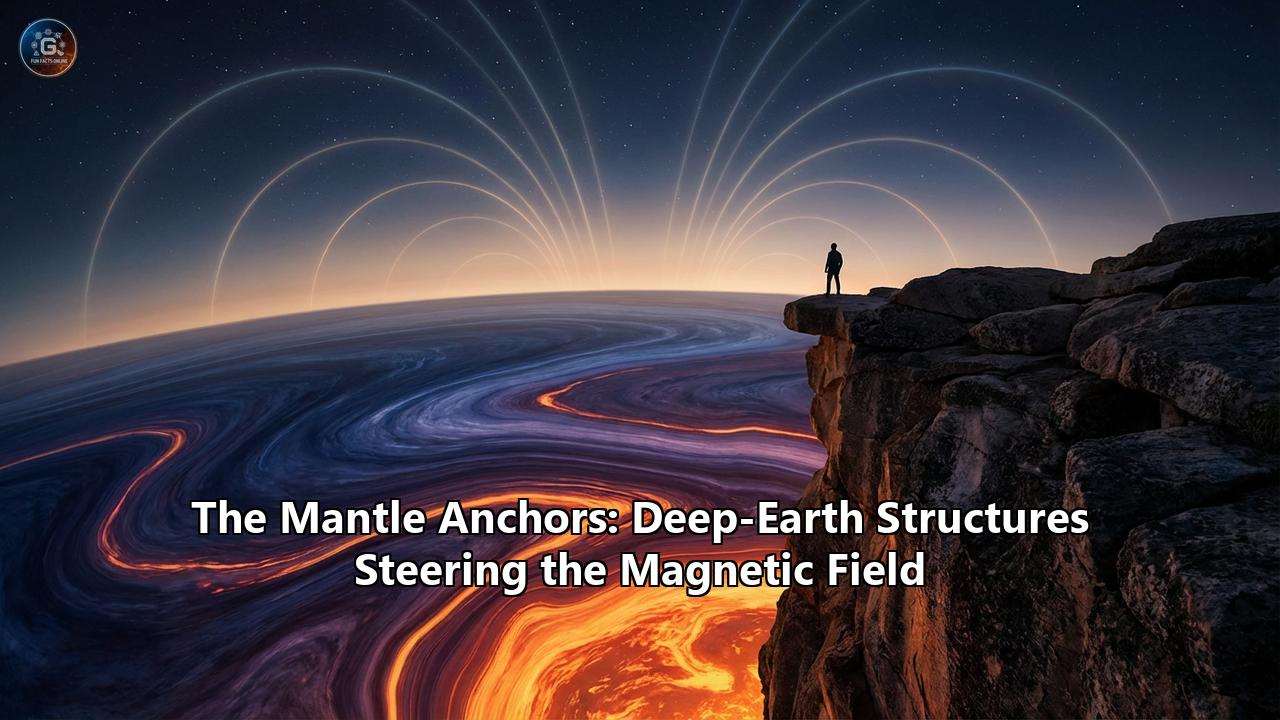
For centuries, navigators have trusted the compass to point north. It is the ultimate constant, the reliable invisible force that guides ships across trackless oceans and hikers through dense wilderness. We tend to think of the Earth’s magnetic field as a permanent, static geometric cage protecting us from the solar wind—a simple bar magnet buried deep within the planet. But this comforting image is an illusion.
In reality, the magnetic field is a chaotic, writhing beast. It wanders, it weakens, and occasionally, it collapses and flips entirely. And right now, something strange is happening. A massive "dent" in the magnetic shield, known as the South Atlantic Anomaly (SAA), is growing over Brazil and the southern Atlantic Ocean. Here, radiation from space dips dangerously close to the surface, frying the electronics of satellites and forcing the Hubble Space Telescope to shut down its sensors when it passes overhead. The anomaly is expanding westward and splitting in two, behaving like a hole in a dike that is slowly widening.
For decades, this behavior was a puzzle. Was it just a random fluctuation of the liquid iron swirling in the outer core? Or was something else—something deeper and more solid—pulling the strings?
Recent advances in seismic tomography and paleomagnetism have revealed that the chaos of the magnetic field is not random. It is being steered, steered by colossal structures located 2,900 kilometers beneath our feet. These are the "Mantle Anchors"—two continent-sized blobs of hot, dense rock that sit at the bottom of the mantle, pressing against the liquid core like clamps on a spinning hose.
These structures, formally known as Large Low-Shear-Velocity Provinces (LLSVPs), are the puppeteers of our planet’s magnetic history. They dictate where the magnetic poles can travel during a reversal, they govern the frequency of these cataclysmic flips, and they may even determine where diamonds erupt onto the surface. This is the story of the deep-earth architecture that protects—and occasionally threatens—life on the surface.
Part I: The Architecture of the AbyssTo understand the Mantle Anchors, we must first visualize the Earth not as a solid rock, but as a dynamic engine. The planet is layered like an onion: the thin, brittle crust we live on; the massive, slowly flowing solid mantle; the liquid iron outer core; and the solid iron inner core.
The magnetic field is generated in the outer core, where molten iron, nickel, and lighter elements churn in a violently turbulent convection. This motion, driven by the heat escaping from the inner core and the rotation of the Earth, creates the "geodynamo." It is a self-sustaining electromagnet, powered by the kinetic energy of the fluid.
But this fluid does not flow in a vacuum. It flows inside a container. The "roof" of this container is the Core-Mantle Boundary (CMB), a jagged, alien landscape where the liquid iron meets the solid silicate rock of the mantle. For a long time, geologists assumed this boundary was relatively uniform. They were wrong.
The Discovery of the BlobsIn the 1980s, seismologists began using earthquake waves to scan the interior of the Earth, much like a doctor uses X-rays to see inside a human body. They noticed that in two specific regions—one beneath the Pacific Ocean and one beneath Africa—the shear waves slowed down dramatically.
These regions were not small. They are enormous. The African LLSVP stretches from the Atlantic Ocean across Africa to the Indian Ocean. The Pacific LLSVP covers a vast swath of the underside of the Pacific plate. Together, they cover roughly 30% of the core-mantle boundary and extend nearly 1,000 kilometers upwards into the mantle. They are 100 times taller than Mount Everest. If they were on the surface, the International Space Station would have to adjust its orbit to avoid hitting them.
Scientists colloquially call them "The Blobs."
Thermochemical Piles vs. Thermal PlumesA fierce scientific debate rages about what these blobs actually are.
- The Thermal View: Some researchers believe they are simply "superplumes"—massive upwellings of hot mantle rock, like the wax rising in a lava lamp. In this view, they are lighter than the surrounding rock and are actively rising, albeit slowly.
- The Thermochemical View: The prevailing theory, however, suggests they are "thermochemical piles." They are composed of material that is chemically distinct from the rest of the mantle—richer in iron and silica, perhaps the graveyard of ancient subducted tectonic plates that sank to the bottom of the mantle billions of years ago. Because they are denser than the surrounding mantle, they are gravitationally stable. They sit at the bottom, resisting the flow of the rest of the mantle, like heavy sludge at the bottom of a gas tank.
This density is crucial. If they are heavy, stable piles, they act as "anchors." They have likely been in their current positions for hundreds of millions of years, perhaps even since the formation of the Moon. This long-term stability means they have been a constant boundary condition for the swirling core underneath them. They are the static landscape against which the dynamic core washes.
The Edge EffectThe most interesting action happens not in the center of the blobs, but at their edges. The borders of the LLSVPs are sharp, not gradual. Seismic data suggests near-vertical cliffs of hot rock rising from the core. These boundaries represent extreme contrasts in temperature and viscosity. The blobs are hotter than the surrounding mantle, insulating the core beneath them. The "normal" mantle outside the blobs is colder, allowing heat to escape from the core more efficiently.
This thermal difference creates a "thermal wind" in the outer core. Just as temperature differences in the atmosphere drive the trade winds, temperature differences at the Core-Mantle Boundary drive flows of liquid iron. The fluid iron rushes from the hot regions (under the blobs) toward the cold regions (the "graveyards" of slabs), creating vast sub-surface cyclones.
It is this interaction—the core fluid scrubbing against the sharp, hot edges of the Mantle Anchors—that steers the magnetic field.
Part II: The Engine Room and Flux ExpulsionTo understand how the anchors steer the field, we have to look at "magnetic flux." Think of magnetic flux lines as elastic bands that are frozen into the liquid iron. As the iron moves, it drags the magnetic field lines with it.
Under normal conditions, the geodynamo creates a nice, orderly dipole (two poles, North and South). But the thermal interference from the African and Pacific blobs disrupts this order.
The Mechanism of Flux ExpulsionResearch by geophysicists has identified a phenomenon called "flux expulsion" occurring specifically at the edges of the African LLSVP. Because the mantle above the blob is hot and conducts heat poorly, the core beneath it gets stifled. It can't lose heat upwards, so convection slows down or becomes chaotic.
At the steep edges of the blob, however, there is a sudden change. The cold mantle next door sucks heat out of the core avidly. This creates a vigorous downwelling of liquid iron. As the iron plunges downwards, it drags the magnetic field lines with it.
This process concentrates the magnetic field into intense bundles. But sometimes, it does something even stranger: it twists the field lines into "reverse flux patches." These are regions where the magnetic field points in the opposite direction to the rest of the planet. If the global field points North, a reverse flux patch points South.
The South Atlantic Anomaly: A Case StudyThis is exactly what creates the South Atlantic Anomaly. Beneath the South Atlantic, right at the southwestern edge of the African LLSVP, there is a massive patch of reversed magnetic flux on the surface of the core.
This reversed patch cancels out the normal field. It’s like subtraction: Global Field (+10) + Reversed Patch (-5) = Weakened Field (+5). The result is the "dent" in the shield we see today.
The SAA is not just a surface feature; it is a direct window into the turmoil at the Core-Mantle Boundary. The fact that the SAA is growing and drifting westward is evidence that the "weather" in the core is changing, but it is changing along a track dictated by the African Blob. The blob provides the stage; the core provides the actors.
Part III: The Highway of the PolesThe most dramatic evidence for the influence of Mantle Anchors comes from the ancient past, during times when the magnetic field has flipped.
A magnetic reversal is a chaotic event. The dipole collapses, the field strength drops to 10% or less, and multiple poles pop up all over the planet like a measles outbreak. Eventually, the field re-organizes itself in the opposite direction. But for decades, scientists wondered: is the path of the reversal random? Does the North Pole just wander drunkenly across the globe until it finds the South?
The Preferred PathsIn the early 1990s, paleomagnetists began compiling data from lava flows that froze during past reversals, such as the Matuyama-Brunhes reversal (780,000 years ago) and the Upper Olduvai reversal (1.7 million years ago). By measuring the magnetism trapped in these rocks, they could reconstruct the path the pole took as it flipped.
They found something successful and startling. The poles did not wander randomly. They followed specific "highways."
There are two main longitudinal bands that the poles prefer to travel along during a reversal:
- The American Band: Running roughly through North and South America.
- The East Asian/Australian Band: Running through Eastern Asia and Australia.
When you overlay these bands on a map of the deep earth, the coincidence is chilling. These bands correspond exactly to the gaps between the two LLSVPs. They are the "cold rings" of the mantle.
Hugging the RimsThe Virtual Geomagnetic Poles (VGPs) essentially "hug" the rims of the blobs. They seem unable to cross the center of the African or Pacific LLSVPs. Why?
The theory is that the LLSVPs stabilize the main magnetic flux lobes. The core fluid flow is organized into large gyres around these blobs. During a reversal, the main dipole field (which is usually aligned with the rotation axis) weakens. As it collapses, the non-dipole components of the field—the messy, complex parts—take over.
These non-dipole components are dominated by the heat flow pattern set by the blobs. The "flux expulsion" patches at the edges of the blobs become the dominant magnetic features. The magnetic pole effectively "hops" from one patch to another along the rim of the blob, avoiding the dead center where the convection is stifled.
The LLSVPs act as "exclusion zones" for the reversing pole. They steer the collapse and rebirth of the field along the cold corridors where the mantle creates the most vigorous core convection.
The Laschamp ExcursionA more recent event, the Laschamp Excursion (41,000 years ago), provides even clearer detail. This was a "failed reversal"—the pole traveled down to the equator, the field weakened, but then it snapped back to North instead of flipping all the way to South.
Reconstructions of the Laschamp event show the pole diving down through the Americas—again, following the edge of the Pacific and African blobs. It circled the drain, so to speak, following the flow patterns dictated by the Mantle Anchors, before returning to the pole. This confirms that even in short-term excursions, the deep mantle structure is the guardrail.
Part IV: Surface Scars and the Breathing of the EarthThe influence of the Mantle Anchors is not limited to the core below. It extends upwards to the surface, linking the magnetic field to geological cataclysms.
If the LLSVPs are hot, chemically distinct piles, they are also the breeding grounds for mantle plumes. These are narrow conduits of hot rock that rise from the CMB all the way to the crust, creating "hotspot" volcanoes like Hawaii, Iceland, and Reunion.
The LIP ConnectionGeologists have found a remarkable spatial correlation: the eruption sites of almost all Large Igneous Provinces (LIPs) in the last 300 million years lie directly above the margins of the LLSVPs.
LIPs are massive flood basalt events—volcanic apocalypses that cover continents in lava and are often associated with mass extinctions (like the Siberian Traps and the Great Dying). The fact that they originate at the edges of the blobs reinforces the idea that these edges are the most dynamic places in the deep Earth. They are the zones of maximum instability, where the interaction between the hot blob and cold mantle generates both magnetic flux expulsion (downwards) and mantle plumes (upwards).
Diamond ElevatorsEven more fascinating is the connection to kimberlites. Kimberlites are the rare, supersonic volcanic eruptions that bring diamonds from the deep mantle to the surface. When researchers back-tracked the tectonic plate positions of kimberlite eruptions over the last billion years, they found that they, too, preferentially erupted above the margins of the African LLSVP.
This creates a unified theory of the Earth’s engine:
- The Anchor: The LLSVP sits at the bottom, stable and hot.
- The Edge: The steep thermal gradient at the edge creates turbulence.
- Downwards: This turbulence drives "flux expulsion" in the core, steering the magnetic field and creating anomalies like the SAA.
- Upwards: The same turbulence triggers mantle plumes and kimberlites, sending heat and diamonds to the surface.
The "Mantle Anchors" are effectively the heart of the planet's circulatory system, pumping magnetic energy down and thermal energy up.
Part V: The Electromagnetic WebThere is another, subtler layer to this interaction: electricity.
For a long time, the mantle was thought to be an electrical insulator. But at the extreme pressures and temperatures of the deep Earth, minerals behave differently. We now know that the lower mantle—and specifically the LLSVPs and the ultra-low velocity zones (ULVZs) at their base—are semiconductors. They conduct electricity, albeit poorly compared to the iron core.
This creates "electromagnetic coupling." The changing magnetic field of the core induces electrical currents in the conducting piles of the mantle. These currents create their own magnetic fields, which then push back against the core.
The Length of DayThis electromagnetic grip is so strong that it can alter the rotation of the Earth. When the magnetic field undergoes a "jerk"—a sudden, sharp change in its acceleration, which happens every few years—it is often followed by a tiny but measurable change in the Length of Day (LOD).
The mechanism is likely the electromagnetic coupling at the LLSVPs. A sudden shift in core flow tugs on the magnetic field lines. These lines get snagged on the conducting Mantle Anchors. The transfer of angular momentum speeds up or slows down the mantle (and thus the crust we live on) by milliseconds.
This proves that the LLSVPs are not just passive thermal blankets; they are electrically active components of the dynamo. They provide the friction against which the core pushes.
Part VI: The Future—Are We Flipping?This brings us to the ultimate question: What does this mean for us today?
The Earth’s magnetic dipole strength has been decaying for the last 3,000 years. It has dropped by about 10-15% in the last 150 years alone. The South Atlantic Anomaly is growing, splitting, and deepening. The North Magnetic Pole is sprinting across the Arctic toward Siberia at 50 kilometers per year.
Many headlines suggest a reversal is imminent. The role of the Mantle Anchors adds nuance to this prediction.
The Trigger from BelowIf the SAA is caused by a reverse flux patch generated by the African LLSVP, its growth suggests that the "flux expulsion" mechanism is currently in overdrive. The "weather" at the edge of the African blob is stormy.
However, a reversal requires more than just one anomaly. It usually requires the growth of reverse flux patches at both poles and the equator. Currently, while the SAA is dramatic, the field strength in other areas (like the Pacific) is still quite high.
The stabilizing effect of the LLSVPs might actually prevent a full reversal. The "anchors" tend to keep the system in a dipole state for long periods. It takes a massive disruption to overcome the thermal inertia imposed by these structures.
Some models suggest we are entering a period of an "excursion" rather than a full reversal. An excursion is a short-term collapse (lasting a few thousand years) where the poles might wander into the tropics (following the LLSVP edges again) before snapping back.
The Danger ZoneIf an excursion or reversal does happen, the LLSVP edges give us a map of the danger zones. As the dipole collapses, the quadrupole and octupole fields take over. These multipole fields will likely be anchored to the LLSVPs.
This means we could see multiple magnetic poles clustered around the edges of Africa and the Pacific. The SAA could expand to cover the entire southern hemisphere. This would result in a massive increase in cosmic radiation reaching the surface in these regions, impacting power grids, satellite communications, and potentially even atmospheric chemistry (ozone depletion).
Conclusion: The Clockwork EarthThe discovery of the Mantle Anchors has revolutionized our understanding of the Earth. We used to view the magnetic field, plate tectonics, and volcanism as separate systems. Now, we see them as an integrated clockwork mechanism.
The LLSVPs are the heavy gears at the center of the clock. They have likely been there for billions of years, surviving the breakup of supercontinents and the bombardment of asteroids. They are the silent, dark conductors of the planetary symphony.
- They steer the flow of liquid iron, generating the shield that protects our atmosphere.
- They guide the magnetic poles during their rare and chaotic flips.
- They puncture the surface with massive volcanoes and diamond pipes.
- They even tug on the rotation of the planet itself.
As we watch the South Atlantic Anomaly grow and the North Pole race toward Russia, we are watching the gears turn. The Mantle Anchors are shifting the flow, breathing new magnetic weather into the system. We are not just passengers on a rock; we are riders on a complex, living magnetic engine, steered by the deep, hot shadows of the abyss.