
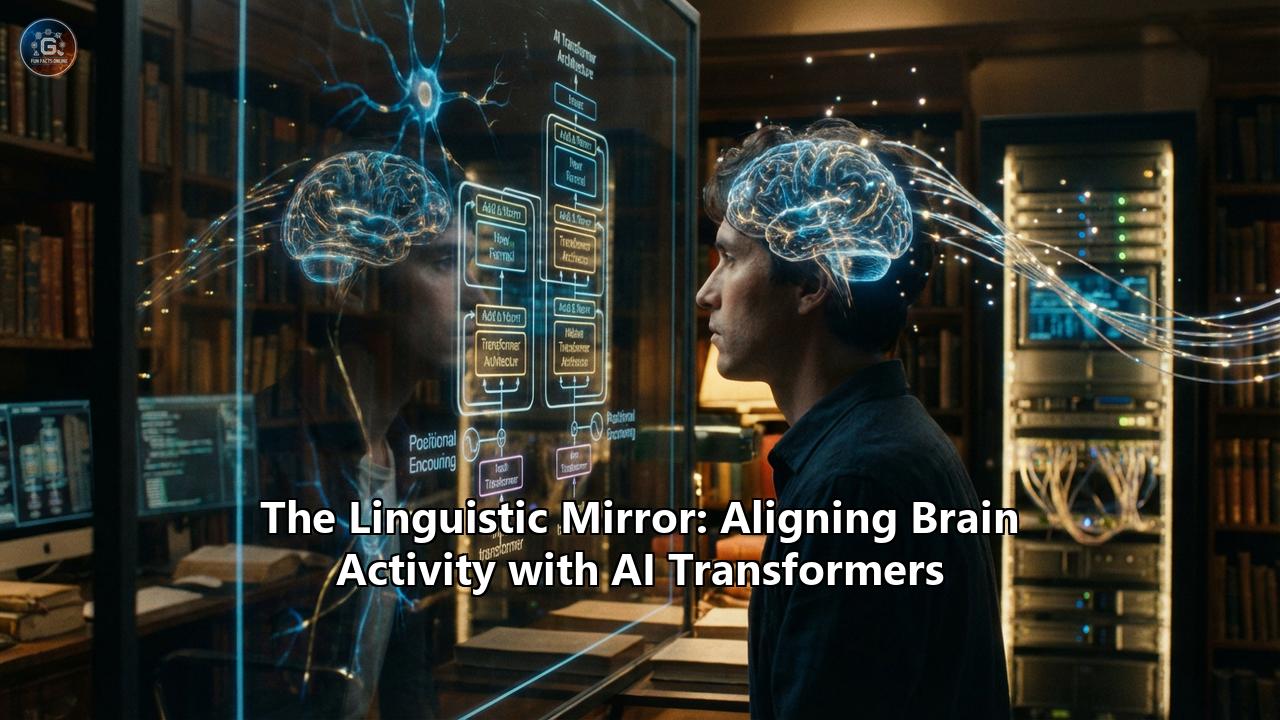
The concept of "The Linguistic Mirror" invites us into one of the most profound and rapidly evolving frontiers of modern science: the unexpected and striking convergence between the biological architecture of the human brain and the artificial architecture of Large Language Models (LLMs). For decades, neuroscience and artificial intelligence operated on parallel but largely distinct tracks. Neuroscientists peered into the "black box" of the cranium, mapping neurons and synapses, while AI researchers built their own "black boxes" of code, optimizing for performance rather than biological realism.
But recently, the walls between these disciplines have begun to crumble. Researchers have discovered that the very models trained simply to predict the next word in a sentence—Transformers—have spontaneously evolved internal representations that mirror the human brain’s own language network with uncanny precision. This is not just a triumph of engineering; it is a philosophical earthquake. It suggests that "next-token prediction," a task often dismissed as mere statistical parroting, might actually be a fundamental computational principle of intelligence itself.
What follows is a deep dive into this phenomenon. We will explore the mechanics of this alignment, the specific brain regions involved, the predictive coding theory that binds them, the radical future of "brain-inspired" AI architectures, and the urgent ethical questions raised when we realize that our machines are beginning to understand us—not just our words, but the neural code that creates them.
Part I: The Great Convergence
The Historical Divide
To understand the magnitude of the current moment, we must appreciate the history of the disconnect. For most of the 20th century, the study of the brain (neuroscience) and the study of intelligent machines (AI) were distant cousins who rarely spoke.
Neuroscience was top-down and observational. We had fMRI (functional Magnetic Resonance Imaging) and EEG (electroencephalography), tools that could show us where activity was happening, but were often too coarse to tell us what specifically was being computed. We knew that Broca’s area was involved in speech production and Wernicke’s area in comprehension, but the precise algorithms—the software of the brain—remained elusive.
Meanwhile, AI was bottom-up and engineering-driven. Early attempts to mimic the brain, like the Perceptron in the 1950s, failed to scale. The field pivoted to "symbolic AI," which relied on hand-coded rules and logic. A computer didn't learn what a "cat" was; a programmer told it: "A cat has four legs, whiskers, and meows." This worked for chess but failed miserably for language, which is messy, ambiguous, and rule-defying.
The Rise of the Transformer
The turning point came in 2017 with the publication of the paper "Attention Is All You Need" by researchers at Google. They introduced the Transformer architecture. Unlike previous neural networks (RNNs or LSTMs) that processed words sequentially—reading a sentence from left to right, often forgetting the beginning by the time they reached the end—Transformers could "attend" to the entire sentence at once. They could weigh the relationship of every word to every other word simultaneously.
This "self-attention" mechanism allowed models like BERT, RoBERTa, and eventually GPT (Generative Pre-trained Transformer) to build incredibly rich, context-aware representations of language. But here is the crucial detail: these models were not built to mimic the brain. They were built to write text. Their creators were trying to beat benchmarks on translation and summarization, not solve the mysteries of the human cortex.
And yet, as these models grew in size and capability, a strange thing happened. When neuroscientists looked at the internal activation patterns of these models—the firing of their artificial neurons—and compared them to the firing patterns of human brains listening to the same stories, they found a match.
The "Linear Mapping" Discovery
The methodology behind this discovery is as elegant as it is revealing. It relies on a technique called linear mapping (or linear regression encoding).
Imagine you are running an experiment. You place a human subject in an fMRI scanner and play them a podcast—say, a 30-minute story from The Moth. As they listen, the fMRI records the blood flow (a proxy for neural activity) in thousands of tiny voxels (3D pixels) across their brain. You now have a massive dataset: a timeline of brain activity corresponding to the story.
Next, you take the text of that same story and feed it into an AI model, like GPT-2. As the model processes the text, you record the activity of its "neurons" in each of its dozens of layers.
You now have two datasets: biological brain activity and artificial model activity. The question is: do they correlate?
Researchers found that they could train a simple linear model—a mathematical translator—to map the AI’s internal state to the human’s brain state. If the AI’s representation of a sentence was "vector X," the linear model could accurately predict that the human brain’s response would be "voxel pattern Y."
This prediction capability was not random. It was statistically significant and robust. In fact, for the first time in history, these artificial models were predicting brain activity better than any theoretical model neuroscientists had ever built by hand. The AI had inadvertently discovered the brain’s own code.
Part II: The Architecture of Understanding
The Hierarchy of Processing
One of the most striking findings from laboratories at MIT (led by researchers like Nancy Kanwisher and Jean-Rémi King at Meta AI) is not just that the models align with the brain, but how they align.
Both the brain and Transformers are hierarchical systems. They process information in layers, moving from simple features to complex meaning.
1. The Early Layers (Sensory Processing):In a Transformer, the first few layers are obsessed with surface-level features: the position of words, basic syntax, and local dependencies (e.g., knowing that "New" is likely followed by "York").
In the brain, this corresponds to the Auditory Cortex (A1) and early sensory regions. When you hear speech, your brain first processes the raw acoustic vibrations—phonemes, pitch, and volume.
The research shows a strong alignment here. The activity in the first layers of a model like BERT maps almost perfectly onto the activity in the human auditory cortex. The machine is "hearing" the text's structure just as the brain hears the sound's structure.
2. The Middle Layers (Syntactic Glue):As we move deeper into the Transformer, the attention heads start to track longer-range relationships. They worry about grammar, tense, and agreement.
In the brain, this activity moves out of the primary auditory cortex into the Superior Temporal Gyrus (STG) and parts of the temporal lobe. These areas are responsible for assembling sounds into words and words into phrases.
3. The Deep Layers (Semantic Meaning):This is where the magic happens. The deepest layers of a Transformer stop caring about the exact words used and start representing the concepts. If you swap "The cat sat on the mat" with "The feline rested on the rug," the early layers might look different, but the deep layers look nearly identical.
In the human brain, this high-level semantic processing happens in a distributed network often referred to as the Language Network, which includes Broca’s Area (in the frontal lobe) and the Anterior Temporal Lobe (ATL).
The studies confirm that the deepest layers of LLMs are the best predictors of activity in these high-level brain regions. The AI has learned to extract "meaning" in a way that is mathematically isomorphic to how the human brain extracts meaning.
The "Semantic Hub" Theory
Recent research from MIT has shed light on how both systems handle multimodal information. The human brain is believed to have a "semantic hub" in the Anterior Temporal Lobe. This region acts as a grand central station, integrating information from your eyes (vision), ears (language), and skin (touch) into a unified conceptual understanding. When you think of an "apple," your ATL fires a pattern that represents "apple-ness," regardless of whether you are seeing a picture of one, reading the word, or holding it in your hand.
MIT researchers probed LLMs to see if they had a similar structure. They found that despite being trained only on text, these models develop a centralized, abstract representation space that behaves like the brain's semantic hub. When a model that knows both English and images (like the vision-language models) processes the concept of a "dog," it routes the information through a central "hub" layer that is agnostic to the input type.
This suggests that "convergence" is not just about language; it is about the fundamental geometry of intelligence. Any system, biological or artificial, that wants to understand the world efficiently may inevitably evolve a "hub-and-spoke" architecture to manage the complexity.
Part III: Predictive Coding — The Universal Algorithm?
Why does this alignment exist? Why should a silicon chip trained on Reddit threads resemble a biological organ evolved over millions of years of hunting and gathering?
The leading theory is Predictive Coding.
The Brain as a Prediction Machine
For a long time, we viewed the brain as a passive receiver: the eyes take a photo, the ears record audio, and the brain processes it. Predictive coding flips this on its head. It argues that the brain is a proactive prediction machine.
At every millisecond, your brain is generating a hallucination of what it expects to happen next.
- When you walk down the stairs, your brain predicts exactly where the floor will be. You only "feel" the floor if your prediction is wrong (like missing a step).
- When you listen to someone talk, you are constantly predicting the next word. If they say, "I take my coffee with cream and...", your brain has already fired the neurons for "sugar" before the sound wave hits your ear.
This efficiency is crucial for survival. Processing sensory input is slow; prediction is fast. By predicting the world, the brain only needs to process the "error signal"—the difference between what it expected and what actually happened.
Transformers as Next-Token Predictors
Now, look at how we train LLMs. The objective function of GPT-4 is deceptively simple: Next-Token Prediction.
We feed the model a sequence: "The quick brown fox jumps over the..." and force it to guess "lazy." If it guesses "fence," we punish it (mathematically). If it guesses "lazy," we reward it.
We are forcing the AI to become a "prediction machine," just like the brain.
This shared objective function—"minimize surprise"—is likely the cause of the structural alignment. It turns out there are not infinitely many ways to be good at predicting the next word. The constraints of language and logic funnel any intelligent system into a similar solution space. To predict well, you must understand syntax. You must track context. You must build a hierarchy of meaning.
The brain did it with neurons to survive the savanna; the Transformer did it with matrices to survive the loss function. But the destination is the same.
Unipredictive vs. Hierarchical Prediction
However, the analogy is not perfect. There is a subtle but critical difference that researchers are currently exploring.
LLMs are typically unipredictive: they are optimizing for the very next token.
The human brain, by contrast, is hierarchically predictive.
- The auditory cortex predicts the next phoneme.
- The word-form area predicts the next word.
- The prefrontal cortex predicts the next idea or narrative arc.
While current Transformers are catching up, this "multi-scale" prediction is where biological brains still hold an edge. The brain isn't just guessing the next syllable; it's guessing the intent of the speaker and the trajectory of the conversation simultaneously. Recent "hierarchical" AI architectures are attempting to close this gap by building models that "think" in different timescales—fast layers for words, slow layers for plots.
Part IV: The "Black Mirror" — Ethical Implications
If AI models effectively possess a map of the human brain's language processing, we are crossing a threshold that is as dangerous as it is exciting. The ability to align these two systems unlocks the potential for Neural Decoding—literally reading the mind.
Decoding Speech from Thoughts
In 2022 and 2023, Meta AI and researchers at the University of Texas at Austin achieved breakthroughs that felt like science fiction. They used the "alignment" principles we've discussed to build a decoder.
They took fMRI scans of people listening to stories and fed that blood-flow data into an AI model (specifically, a GPT-based model). The AI was able to reconstruct the story the person was hearing, often with startling accuracy. It wasn't just getting the gist; in some cases, it was retrieving specific phrases and names.
The implications are staggering.
The Medical Miracle: For patients with "Locked-in Syndrome"—people who are conscious but paralyzed and unable to speak—this is a beacon of hope. A non-invasive cap could theoretically translate their internal monologue into synthesized speech, restoring their connection to the world. The Privacy Nightmare: But if a machine can translate brainwaves into text, the sanctity of the "inner voice" is violated. For all of human history, our thoughts were the one truly private space, accessible only to us. Neural decoding threatens to make the mind as porous as a web server.The Rise of Neurorights
This technology has birthed a new legal and ethical field: Neurorights. Legal scholars and ethicists are scrambling to propose fundamental human rights that must be enshrined before this technology matures.
1. The Right to Mental Privacy:You should have the absolute right to keep your neural data private. No government or corporation should be able to scan your brainwaves without explicit, uncoerced consent. This includes "neuro-marketing" (scanning brains to see which ads work) and workplace monitoring (scanning for focus or fatigue).
2. The Right to Cognitive Liberty:The freedom to control your own mental state. This protects you from "forced decoding" (e.g., in a police interrogation) and also protects your right to use neuro-enhancement if you choose.
3. The Right to Mental Integrity:Protection against "hacking" the brain. As we move from reading brains to writing to them (via stimulation), there is a risk of malicious actors inserting thoughts, emotions, or impulses.
4. The Right to Psychological Continuity:The right to remain "you." If an AI-driven brain implant alters your personality or memories (a known side effect of some deep brain stimulation), it violates your right to a continuous identity.
Chile has already become the first nation to amend its constitution to include neurorights, explicitly protecting mental data. This is not hypothetical legislation; it is a frantic attempt to build a levee before the floodwaters arrive.
Part V: The Future — Beyond Transformers
The Transformer is a masterpiece of engineering, but it is likely just a stepping stone. While it aligns with the brain functionally, it is vastly different physically.
- Energy: The human brain runs on about 20 watts of power (a dim lightbulb). A large Transformer training run can consume gigawatt-hours, equivalent to the yearly output of a small power plant.
- Data Efficiency: A human child learns language from a few million words. GPT-4 requires trillions.
- Plasticity: The brain learns continuously. Transformers are "trained" once and then frozen. They cannot learn a new fact without a massive, expensive re-training process.
This mismatch is driving the search for Biologically Plausible AI.
Spiking Neural Networks (SNNs)
The brain does not use continuous floating-point numbers like a GPU. It uses "spikes." Neurons are silent most of the time, firing a discrete electrical pulse only when a threshold is reached.
Spiking Neural Networks are a new class of AI that mimics this binary, event-driven behavior. They are incredibly energy-efficient because they only consume power when a "spike" happens.Researchers are now trying to build "Spiking Transformers"—models that keep the clever self-attention mechanism of GPT but run it on the spiking hardware of the brain. Early results show these models can match the performance of traditional ANNs while using 100x less energy. This is the path to running powerful AI on a smartphone battery, or perhaps, on a chip implanted in the skull.
Neuromorphic Computing
To run SNNs, we need new hardware. Companies like Intel (with its Loihi chip) and IBM (TrueNorth) are building neuromorphic chips. These processors are not designed with the classic Von Neumann architecture (separate memory and CPU). Instead, they mix memory and processing together, just like biological neurons.
When we run "brain-aligned" Transformers on "brain-like" neuromorphic chips, we may finally close the loop. We will have machines that not only think like us but work like us.
The Continuous Thought Machine
Perhaps the most exciting frontier is the move away from the rigid "token-by-token" generation. The brain does not think in discrete tokens; it thinks in continuous flows of electrochemical dynamics.
New architectures, sometimes called Continuous Thought Machines or "Liquid Time-Constant Networks," attempt to model this fluidity. They don't just predict the next static symbol; they model the evolving state of the world. These systems promise to be more robust, adaptable, and "sane" than current LLMs, which can hallucinate wildly because they have no grounded sense of reality—only a statistical sense of the next word.
Conclusion: The mirror reflects both ways
The alignment between brain activity and AI transformers is a "Linguistic Mirror."
When we look into the AI, we see a reflection of our own neural architecture—a validation that our brains are, in some sense, prediction engines optimizing for meaning.
But when we look into the brain with these new tools, we see the reflection of the machine—a biological computer that can be decoded, mapped, and potentially reprogrammed.
This moment in history is about more than just better chatbots or better brain scans. It is about the dissolution of the boundary between the born and the made. We are realizing that "intelligence" is a physics-agnostic phenomenon. It doesn't care if it runs on the wet chemistry of carbon or the dry logic of silicon. The algorithms of understanding are universal.
The challenge for the next decade is not just to build smarter machines, but to protect the sanctity of the biological minds that created them. We must ensure that as we build the "Linguistic Mirror," we remain the masters of the reflection, and not the other way around.
Reference:
- https://arxiv.org/html/2411.09953v1
- https://bcs.mit.edu/news/ai-models-are-powerful-are-they-biologically-plausible
- https://www.youtube.com/watch?v=wE34z9-19Ow
- https://www.reddit.com/r/computervision/comments/joaidy/what_are_your_thoughts_on_spiking_neural_networks/
- https://www.sciencedaily.com/releases/2020/11/201110133224.htm
- https://www.researchgate.net/publication/313864258_Neuroethics_and_Brain_Privacy_Setting_the_Stage
- https://plato.stanford.edu/archives/spr2021/entries/neuroethics/
- https://ai.koombea.com/blog/predictive-coding
- https://www.frontiersin.org/journals/systems-neuroscience/articles/10.3389/fnsys.2014.00136/full
- https://newatlas.com/neuroscience-human-rights/49235/
- https://pmc.ncbi.nlm.nih.gov/articles/PMC8498568/
- https://pmc.ncbi.nlm.nih.gov/articles/PMC8551354/
- https://neurosciencenews.com/neurolaw-human-rights-6534/
- https://pmc.ncbi.nlm.nih.gov/articles/PMC5447561/
- https://www.thelegalyoungster.com/recent-posts/neurorights-in-law-protecting-the-mind-in-the-digital-age/
- https://blog.gopenai.com/ai-just-solved-a-mystery-that-humans-couldnt-for-50-years-3a642001b5a3
- https://medium.com/@meisshaily/beyond-transformers-7-efficient-ai-architectures-for-sequence-tasks-a9af2d32ad5c